Why Relapse Risk Peaks in Your First 90 Days After Rehab
September 23, 2026

What You Need to Know
- More than two-thirds of people who enter treatment relapse within weeks to months, and over 85% relapse within a year.
- Fewer than 35% of alcohol- or opioid-dependent patients stay abstinent a full year after discharge.
- The earliest relapses can hit within hours or days of leaving rehab, well before any weekly check-in comes around.
- During early abstinence the HPA axis stays hyper-reactive, keeping cortisol and craving responses high while the brain's impulse-control regions are still stabilizing.
- Lowered tolerance during treatment makes an early slip in the first 72 hours far more dangerous, raising overdose risk.
Quick Summary
The first 90 days after rehab are the highest-risk stretch of recovery. Two-thirds of people who enter treatment relapse within weeks to months, and the first three months are the sharpest part of that curve, when the brain's stress-response system is still dysregulated and craving is at its peak. What most aftercare plans miss is the speed. The earliest relapses can happen within hours or days of leaving treatment, long before a weekly check-in arrives.
And that speed is where the plan breaks. The fastest relapses are measured in hours, while standard after-rehab support is measured in weekly phone calls and twice-a-week meetings. The one element that covers the hours-to-days gap is continuous in-home sober companionship, and it's the piece almost nobody builds in.
What the First 90 Days Actually Look Like
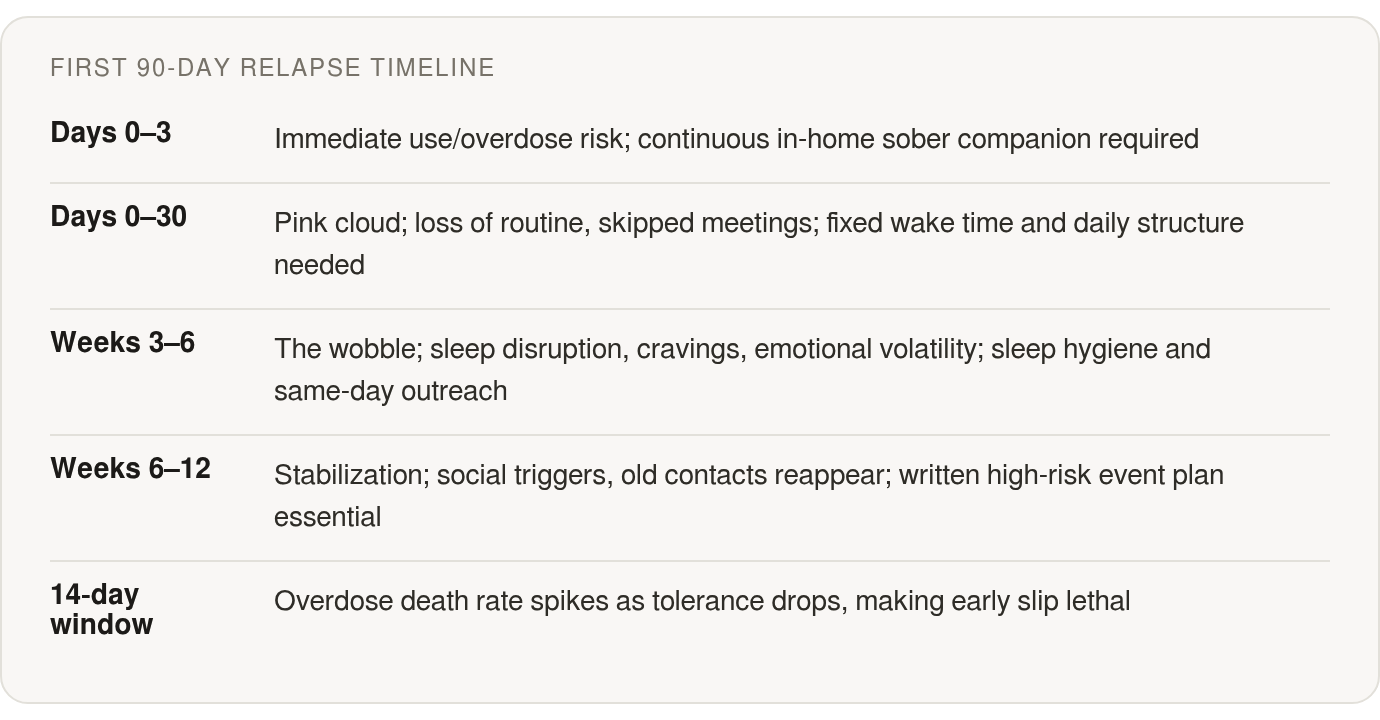
The window moves through predictable phases, each with its own dominant risk and its own required response. Here's the at-a-glance version.
| Phase (approx.) | Dominant risk marker | Why it happens | Core support action | Who delivers it |
|---|---|---|---|---|
| Days 0–3 | Immediate use / overdose | Lowered tolerance meets zero supervision; the HPA axis stays hyper-reactive right after detox, fueling craving | Continuous presence; no gaps in the first 72 hours | In-home sober companion (non-medical); medical team for any detox/medication needs |
| Days 0–30 (pink cloud) | Loss of routine, skipped meetings | Feeling "cured" leads to dropping structure while motivation is still high | Fixed wake time, daily structure, accountability check-ins | Sober coach (non-medical) |
| Weeks 3–6 (the wobble) | Sleep disruption, cravings, emotional volatility | Brain chemistry destabilizes; depressive symptoms and drug-cue reactivity peak during early abstinence | Sleep hygiene, HALT checks, same-day outreach on drift | Coach for routine and monitoring; clinician for persistent insomnia or MAT |
| Weeks 6–12 (stabilization) | Social triggers, renewed old contacts | Stress-induced craving predicts real-world relapse; ambush events surface | Written plan for weddings, travel, anniversaries; peer accountability | Coach and peer network (non-medical) |
The three interventions with the strongest track record are simple: a daily structure you don't have to negotiate with yourself, one accountability person you actually check in with, and a written plan for high-risk events. What the research keeps adding is that staying engaged with structured support matters more than the specific format. Duration and continuity carry the weight.
One caveat on who does what. Coaching, companionship, and routine-building are non-medical work. Detox, medication decisions, and diagnosis belong with clinicians. Don't blur that line.
Two things to carry into the rest of this guide:
- The relapse timeline is front-loaded and biological, not a character test. Most people relapse after treatment, so the goal is coverage during the risky hours, not willpower.
- Intermittent aftercare leaves the deadliest hours unsupervised. The sections ahead break down each risk marker and where continuous in-home support fits the gaps a weekly call can't reach.
Finishing the Program Buys a Head Start, Not Immunity
Here's a number that reframes aftercare planning: more than two-thirds of people relapse within weeks to months of leaving treatment, and over 85% relapse within a year. Completing the program does not buy protection. It buys a head start that erodes fast if nothing replaces the structure the facility provided.
So after-rehab support deserves its own plan, built separately from the treatment that came before. The stakes go past a return to use. Tolerance drops during treatment, which means the same progress that helped someone get clean can make an early slip more dangerous. The first 90 days are the most exposed stretch, when the stress-response system is still dysregulated and craving is at its peak.
Why Doesn't Finishing Treatment Protect You?
Because early abstinence is a poor predictor of long-term success. Research on relapse vulnerability shows fewer than 35% of alcohol- or opioid-dependent patients stay abstinent a year after discharge. Time inside a program helps, but it can't do everything.
The discharge transition is its own distinct problem. During early abstinence the HPA axis stays hyper-reactive, cortisol and craving responses run high, and the frontal regions that govern impulse control are still stabilizing. Read together, these findings say something uncomfortable: more treatment can improve your odds, but it can't cover the transition itself. The days right after you walk out are their own challenge, and no amount of time inside fully solves them.
Doesn't Structured Aftercare Already Solve This?
Not on its own. This is the part most discharge plans get wrong. Standard aftercare helps, but the way it's delivered often leaves gaps exactly where risk concentrates.
We read that as a dosing problem, not proof that aftercare fails. Outreach, weekly visits, and scheduled check-ins all leave long unsupervised stretches between contacts. That's the window relapse lives in. In our experience, this is where continuous in-home sober companionship earns its place. Someone present through the ordinary evenings, the bad nights, and the first cravings covers the hours a phone call can't reach. It can pull a person back before drift becomes a slip.
Who Actually Needs to Understand This Window?
Three groups, each for a different reason.
The person in recovery needs to know that feeling stable is not the same as being safe. Overconfidence is itself a warning sign, not proof the hard part is over, especially while post-acute withdrawal keeps mood and sleep unsettled for months.
Families need to read the early signals rather than wait for a crisis. Our guide on spotting early relapse warning signs walks through what to watch for.
And aftercare providers need to build for the transition, not just the discharge date. Getting someone through 90 days takes coverage where the risk actually concentrates.
Neurobiology of Early Recovery
Here's the cruel irony of early sobriety: cravings can feel sharper at week six than they did the day you walked out of detox, even while overall use is dropping. That's not weakness. It's chemistry, and it explains why after-rehab life gets more volatile before it gets calmer.
When alcohol or opioids stop, the dopamine system that reorganized itself around them does not snap back on schedule. The brain set its reward baseline around a substance. Remove it, and ordinary pleasures register as flat while drug cues light up hard. Yale-based relapse research maps the structural side: atrophy in medial frontal regions and hyper-reactivity of the anterior cingulate during withdrawal both track with relapse risk. The accelerator gets more sensitive while the brakes go quiet.
Why Do Cravings Peak While Use Drops?
That imbalance between the reward circuit and the regions that weigh consequences is the core of it. The reward circuit screams for relief, and the frontal regions that would normally check it are running at reduced capacity. So a craving a settled brain would file and dismiss instead feels like an emergency.
It's also why early abstinence is a lousy predictor of long-term success. Cue reactivity in the reward circuit doesn't fade on a fixed timeline, and a person's response to drug-linked triggers often stays elevated for months after the last dose. A quiet first few weeks can mask a brain still primed to fire hard at the wrong moment. Staying clean at discharge tells you almost nothing about week eight.
What Happens to the Stress Axis?
The stress system is the other half, and the evidence here is striking. One finding shows a high cortisol/ACTH ratio more than doubles relapse risk. Another marker from the same review: elevated serum BDNF is linked to faster relapse and greater drug use during follow-up.
After detox, the HPA axis stays stuck in the on position. Cortisol and ACTH responses to everyday stress remain exaggerated, and stress-induced craving is one of the strongest predictors of real-world relapse. It all points the same direction: the machinery that should help you ride out a bad day isn't working yet.
How Fast Does Impulse Control Return?
Slower than anyone wants. The prefrontal repair that restores judgment and impulse control is still underway well past the 30-day mark, and post-acute withdrawal symptoms can linger from six months to two years. Foggy thinking, mood swings, and disrupted sleep are neurology healing, not proof that sobriety failed.
That last symptom matters more than it looks. Sleep is the one piece of this biology you can watch without a blood draw. Disrupted sleep tracks the same stress dysregulation the cortisol and BDNF markers capture, which means someone present in the home can read a daily proxy for relapse risk a monthly phone call never sees.
This is the gap continuous companionship is built to close. The brain spends these 90 days lying to its owner about how stable things are. An outside set of eyes on sleep, mood, and routine catches the drift the person themselves will deny, often the same behavioral shifts that show up as early relapse warning signs weeks before any first drink.
The Pink-Cloud Phenomenon and Its Dissipation
Most people leave treatment feeling better than they have in years. Sleep starts repairing, the fog lifts, and the world looks manageable again. This is the pink cloud, and in the first weeks after rehab it does something genuinely useful. It hands you energy and optimism right when you need to build a new routine.
The trap is mistaking that feeling for the finish line. The pink cloud is a chemistry effect, not a character change, as the team behind this survival guide puts it. Your brain is enjoying the absence of acute withdrawal and the novelty of clarity. That's why after-rehab planning has to account for the mood, not just ride it.
Why Does Mood Lift So Sharply After Detox?
The lift is real relief. The daily pressure of using is gone, the body starts to settle, and clarity returns fast enough to feel like proof the hard part is over.
We see clients read this as a signal to ease off. They skip the meetings they promised to attend and let the new routine slide because they feel fine. And feeling good at week two says almost nothing about where you'll be at week eight.
When Does the Pink Cloud Break?
For most people it fades sometime in the first months after rehab. Energy drops, sleep gets worse again, old contacts start texting, and the optimism that carried the early weeks quietly drains out.
None of that is failure. It's the predictable dip that follows the initial relief, and it lands at almost the exact moment the earlier structure has been abandoned. Depressive symptoms and craving both climb during this stretch, and both are known to shorten time to relapse. The emotional low isn't just uncomfortable. It's a documented risk window.
Is the Fade a Relapse Warning Sign?
The fade itself isn't the danger. The danger is what the pink cloud hid while it lasted.
Relapse rarely starts with a drink. It starts with emotional and behavioral drift weeks earlier, which the five rules of recovery frame as the earliest stage of the process. The person feeling great is often the one already skipping meetings, isolating, and building nothing. The meetings quietly dropped in the first month are exactly the kind of drift that precedes a return to use.
Someone gliding on the pink cloud will tell you they're fine, and they'll believe it. The behavioral signs show up in daily life long before they surface in a weekly check-in. This is where continuous in-home companionship earns its place. An outside presence sees the routine slipping in real time, gently reintroduces structure before the low hits, and catches the drift the person can't yet see in themselves. If you want the specific behaviors to watch for, we've mapped them in our guide to early relapse warning signs.
Tolerance Drop and Overdose Risk in Early Sobriety
Here's the fact that changes how we plan those first days: a systematic review of residential OUD treatment documented a sharp overdose risk in the 14-day window right after discharge. That rate lands hardest at the exact moment most after-rehab plans are quietest.
The mechanism is simple and brutal. Time away from the substance lowers physiological tolerance. The dose that felt routine before treatment can be lethal now. In the current fentanyl-dominated supply, that gap turns recovery progress into a risk factor. The review is blunt about it: the low tolerance treatment builds is exactly what makes an early slip fatal.
Why Does Tolerance Reset Make a Single Use So Risky?
People tend to think of a lapse as one bad night, recoverable by morning. Physiologically it doesn't work that way. The body that adapted to daily heavy use has, over weeks of abstinence, stepped its tolerance back down. A "just testing it" dose calibrated to old tolerance meets a system that can no longer handle it.
The same review recorded that 2.5% overdosed and 15.4% had opioid-related ED visits after discharge. In three patient vignettes from that body of research, one person had a non-fatal opioid overdose and two returned to use. These aren't people who wanted to die. They misjudged a dose against a tolerance that had quietly dropped.
What Harm-Reduction Steps Lower the Danger?
We're a non-medical support team, so this is coaching, not clinical advice. The steps harm-reduction guidance keeps returning to are practical, and worth rehearsing before anyone re-enters a setting where use is possible.
- Never use alone. Most overdose deaths involve someone using with no one present to respond.
- If a lapse happens, a small test amount is safer than a full old-tolerance dose.
- Keep naloxone accessible and make sure someone nearby knows how to use it.
- Name the high-risk settings ahead of time. Weddings, work travel, and old neighborhoods are predictable ambush points.
These reduce lethality. They don't remove the underlying risk, and none of them help if the person is alone when a craving hits at 2am.
Who Covers the Deadliest Hours After Rehab?
This is where intermittent aftercare falls short. Even a structured, evidence-based program leaves gaps. A randomized trial of assertive outreach still saw relapse on opioids in the intervention arm. Better than treatment-as-usual, but far from safe.
Weekly calls and twice-weekly meetings can't reach the hours when tolerance is lowest and impulse is highest. The deadliest stretch is measured in hours; standard support is measured in weeks. Continuous in-home companionship puts a sober, trained person in the room during those hours, so a moment of craving doesn't become a solo overdose.
If you want to catch trouble before it reaches that point, our guide on early relapse warning signs pairs well with this.
Lifestyle Gaps: Routine, Triggers, and Social Pressure
Inside treatment, the day runs itself. Wake time, meals, groups, no substances in reach. The moment you leave, every one of those decisions lands back on you at once, and that sudden vacuum is where the trouble starts. The survival guide from one residential program names three things that actually move the needle: a daily structure you don't negotiate with yourself, one accountability person you check in with, and a written plan for the ambushes you can see coming.
The catch is that most after-rehab support runs on intermittent contact. A weekly call, two meetings, a check-in every few days. Triggers don't keep that schedule. The first drive past the old corner store, the first sleepless 2am, the first "just one" at a cousin's wedding all happen in the gaps between check-ins. This is the window continuous in-home presence is built to cover, and it's the piece nearly every discharge plan leaves out.
What Are the Biggest Routine Stressors After Rehab?
Sleep quietly decides a lot of outcomes. Melemis's relapse-prevention framework treats sleep disruption as a sign of neurological adjustment, not a passing inconvenience, and a nervous system under stress raises relapse risk. When wake times drift and nights fall apart, the scaffolding of recovery goes with them.
Then there's craving that refuses to fade on schedule. An Egyptian addiction program study found cravings still active six weeks after detox predicted relapse. Six weeks out is usually when the calls have thinned and the routine has slipped. A simple anchor habit helps. A fixed morning walk, same time daily, gives the brain one non-negotiable structure to build the rest of the day around.
Which Triggers Surface First, and Why?
People, places, and old activities do the early damage. The Ashley Treatment team notes that many people finish a 30-day program and return straight to the environments and relationships that surrounded their use, losing the separation from triggers that treatment provided. What changes at discharge is the level of structure, not the level of need.
That's why the people, places, things audit matters in week one, while conviction is still high. Which numbers get deleted, which roads you stop driving, which "friends" go on mute. Someone living in the home sees the trigger land in real time, not three days later on a phone call.
How Do Family Dynamics Shift in Early Sobriety?
Family is both the strongest support and a source of old friction. Old roles, resentments, and enabling patterns don't reset because someone came home clean. A Norwegian cohort study found 37% of patients relapsed by three months, with completing treatment cutting the odds by about half. Families want to help but rarely know what early-stage relapse looks like.
Our first 30 days home guide covers this from the family's side. The skipped meeting in month two is often the relapse in month three, and an outside set of eyes in the home can flag the drift before anyone at the kitchen table names it.
The Role of After-Care Coaching & Support (Including MADE Recovery)
Every earlier section pointed at the same gap, and this is where we close it. Structured after-rehab support does lower relapse odds, but the form matters less than how often it actually reaches you. Sustained support with frequent, ongoing contact tends to outperform the standard "call us if you need anything" discharge model, because early recognition of warning signs works best when someone checks in consistently rather than waiting for a crisis to surface. Duration and contact density are the active ingredients, not the label on the program.
The problem is that most after-rehab support runs on intermittent contact. A weekly call. Two meetings. A check-in every few days. Even strong programs strain against this window: structured outreach clearly reduces relapse, but contact spaced across days still leaves many people exposed. It helped. It just couldn't reach into the hours where relapse actually begins.
The Continuous Presence Intermittent Support Can't Reach
So which is it? Does aftercare work, or does it fail most people? Both findings are real, and they reconcile cleanly once you stop treating "has a program" as the variable. Intermittent outreach reduces relapse but still leaves the majority exposed, because contact spaced across weeks can't cover a craving that spikes at 2am on a Tuesday. The mismatch isn't quality. It's coverage.
That's the case for continuous in-home sober companionship. It occupies the hours-to-days gap the phone call misses. When someone is physically present through the first sleepless night or the first drive past an old trigger, the improvised response that usually fails gets replaced by a rehearsed one, in the moment it's needed.
Coaching Fills the Structure Gap, Not the Need Gap
Treatment builds the tools. Discharge removes the scaffolding that made using them automatic. What changes on the outside is the level of structure, not the level of need.
Non-medical coaching rebuilds that scaffolding. In our experience, the three things that move the needle are a daily structure you don't renegotiate every morning, one accountability person you actually call, and a written plan for the ambushes you can see coming. Coaches keep those live between meetings. Skipped sessions and quiet withdrawal from support usually show up well before a return to use, which is why consistent contact matters.
How Our Model Covers the First 90 Days
At MADE Recovery we work as a non-medical team. We're not doctors, we don't run detox or manage medication, and coaching isn't a substitute for clinical care. What we can do is hold the structure steady through the highest-risk stretch.
Our support scales to the situation: personalized sober coaching for accountability and routine, in-home sober companionship for the hours intermittent care can't reach, and sober-living options when the home environment itself is a trigger. If you're mapping out the first month, it starts with a conversation to assess your needs and coordinate the handover from treatment. The goal is simple: keep someone covered until the tools hold on their own.
Building a Week-by-Week 90-Day Action Plan
A 90-day plan works best when it maps to how the risk actually moves, not to a generic calendar. Relapse tends to unfold in stages, emotional and mental shifts before any physical slip, so the pressures you face early differ from the ones that surface as you rebuild independence. Your plan should change with them.
Here's the mismatch we keep running into. Most after-rehab schedules front-load nothing and back-load contact. Standard follow-up protocols often start light and space visits further apart over time. That looks structured on paper. It still leaves the highest-density relapse hours uncovered, which is the gap continuous in-home companionship is built to close. Below is how we phase a plan around that reality.
What Should Days 1-14 Focus On?
Stabilization, not ambition. The first fortnight is about installing structure while the pink cloud still hands you energy to do it. Lock a fixed wake time, name one person you'll actually call, and write down the high-risk places, people, and feelings you already know are coming.
Sleep is your early-warning gauge here. Disturbed sleep is a documented PAWS symptom and one of the early signs of emotional relapse, as Melemis lays out. Track it daily. Broken sleep in week one is a signal, not a footnote.
This is also the window where continuous presence matters most. A weekly check-in can't catch the 2am you can't sleep or the first drive past the old corner store. Someone in the home can.
How Do You Solidify Routine in Days 31-60?
This phase is where the plan gets tested, because the pink cloud has usually broken and cravings sharpen. Cravings are a core sign of the mental relapse stage, so month two is not the time to loosen contact. It's the time to hold it.
Relapse is a gradual process with emotional and mental stages that show up well before any physical slip, as Melemis lays out. Isolating, skipping meetings, bottling things up: these are the early tells worth catching before they escalate. Build an ambush plan for each foreseeable event. A birthday party gets a written exit strategy. A stressful work week gets a scheduled call and a coping step you've rehearsed, not improvised.
One caution worth stating plainly: don't assume lighter contact alone is enough here. Reducing support too soon leaves the emotional and mental warning signs harder to catch. Lighter support is not automatically safer support.
What Does Independence Look Like by Days 61-90?
The final month is a deliberate taper, not a cliff. You widen the gaps between touchpoints as self-management holds, while keeping the accountability relationship live. Post-acute withdrawal can run mood swings and irritability for up to two years, so 90 days is a milestone, not a graduation.
We taper support intentionally as clients gain independence. As self-management holds steady, we step contact down; if things wobble, we step it back up. The point of the whole plan is that support responds to how the client is actually doing, which is what our first 30 days home guidance is built around too.
Extending Support Beyond 90 Days: The Continuum of Care
Day 90 is a checkpoint, not a finish line. The recovery timeline runs well past it. The abstinence stage alone lasts one to two years, followed by a repair stage of two to three years and a growth stage of three to five, according to the five rules of recovery framework. Post-acute withdrawal, with its mood swings and disturbed sleep, can linger up to two years. So after-rehab support that quits at day 91 stops right as the longest stretch begins.
That's the case for a continuum, not a cutoff. Continuous in-home companionship carries the highest-density risk hours early. What follows is a deliberate step-down, where intensity tapers on a schedule that follows the risk, not the calendar.
How Do You Taper Coaching Without Losing Accountability?
The mistake we see is treating "less support" as "no support." Daily companionship in the first weeks earns its place because relapse is a gradual process with distinct stages, moving from emotional to mental to physical long before any use. An observer who sees daily behavior catches the emotional stage. A monthly phone call catches the aftermath.
So we taper the hours, not the accountability. Continuous presence gives way to scheduled visits, then to regular check-ins, while one constant stays fixed: someone who knows your baseline and notices when it shifts. The five-rule habits, honesty, self-care, asking for help, get handed off gradually to the person, not dropped in one move.
Watch sleep as you step down. Disturbed sleep is a core post-acute withdrawal symptom, and it's the one early-relapse signal you can track at home without a lab. If it slides, that's a cue to hold intensity steady rather than taper further. Our guide to spotting early warning signs breaks down what else to watch for.
Which Community Resources Carry the Load After 90 Days?
This is where peer support does its real work. Joining a self-help group significantly increases the chances of long-term recovery, in large part because it helps people overcome guilt and shame by seeing they aren't alone. Peer meetings, sponsors, home groups, and sober social circles replace paid structure with earned belonging.
As coaching hours drop, these community supports can carry more of the daily rhythm, the honest conversations, and the weekends that used to feel risky. Our tapering is built to encourage exactly that shift toward independence. The goal is a web of accountability that doesn't depend on us.
What Extended Care Actually Buys You
Here's a tension worth naming. Time in treatment lowers overall relapse odds, but the moment of discharge opens a transition window the treatment stay itself can't fully cover. The abstinence stage runs one to two years, and post-acute withdrawal can stretch nearly as long. The risk doesn't end when the program does.
Duration of inpatient care can't cover the handoff home. A different kind of support has to. Extended, step-down coaching isn't a luxury add-on. It's the piece that can help guard the months where the risk quietly outlasts the program.
References
[1] New Findings on Biological Factors Predicting Addiction Relapse ... - PMC - https://pmc.ncbi.nlm.nih.gov/articles/PMC3674771/
[2] Relapse Prevention and the Five Rules of Recovery - PMC - NIH - https://pmc.ncbi.nlm.nih.gov/articles/PMC4553654/
[3] Sobriety Relapse in Early Recovery | Ashley Addiction Treatment - https://www.ashleytreatment.org/rehab-blog/why-some-people-relapse-after-30-days-of-sobriety/
[4] The First 90 Days After Rehab: A Survival Guide - https://onesteprehab.com/blog/first-90-days-after-rehab/
[5] The Bad News About How Quickly Patients Relapse After Treatment - https://vista-research-group.com/bad-news-relapse-post-treatment
[6] Risk of Relapse Following Discharge from Non-Hospital Residential ... - https://pmc.ncbi.nlm.nih.gov/articles/PMC12035408/
[7] Relapse after inpatient substance use treatment: A prospective ... - PubMed - https://pubmed.ncbi.nlm.nih.gov/30447514/
[8] Assessment of addiction management program and predictors of relapse ... - https://pmc.ncbi.nlm.nih.gov/articles/PMC9579533/
Frequently Asked Questions
How long does the elevated relapse risk actually last after the first 90 days?
Risk stays elevated well past 90 days. Post-acute withdrawal symptoms like foggy thinking, mood swings, and disrupted sleep can linger from six months to two years while the prefrontal regions governing impulse control finish repairing. The first 90 days are the peak, but stabilization is gradual, not a hard cutoff.
What's the difference between a sober companion and a therapist or medical provider?
A sober companion delivers nonmedical support: daily structure, accountability, and continuous presence in the home. Detox, medication decisions, diagnosis, and therapy belong with clinicians. MADE Recovery provides coaching, companionship, sober living, and intervention support, not medical treatment. The two roles work alongside each other and shouldn't be blurred.
If I completed a full detox, do I still need naloxone around?
Keeping naloxone accessible matters most right after treatment, because detox lowers your physiological tolerance. A dose that felt routine before can be lethal now, especially with fentanyl in the supply. Completing detox increases that danger rather than removing it. Make sure someone nearby knows how to use it.
Does a relapse mean the treatment failed?
A relapse reflects front-loaded biology, not failed treatment or weak character. The brain's stress-response system stays dysregulated and craving peaks during early abstinence. Completing a program still helps, one Norwegian cohort found it cut three-month relapse odds by roughly half, but no amount of time inside fully covers the discharge transition itself.
Should someone in early recovery return to their normal social life and old friends right away?
Returning straight to old environments and relationships is one of the earliest relapse triggers, because it erases the separation from cues that treatment provided. Run a "people, places, things" audit in week one while conviction is high: which numbers to delete, which roads to avoid, which contacts to mute.
What can families watch for if they're worried someone is drifting toward relapse?
Watch behavior, not just the drink. Relapse usually starts weeks earlier with emotional and behavioral drift: skipped meetings, isolating, sleep falling apart, building nothing new. The meeting quietly dropped in month one often precedes the relapse in month three. An outside presence in the home catches this drift before anyone at the kitchen table names it.
Why can cravings feel worse weeks into sobriety than on day one?
Cravings often sharpen around week six even as use drops because the reward circuit stays hyper-reactive to drug cues while the frontal brakes run at reduced capacity. Cue reactivity doesn't fade on a fixed schedule.
How is continuous in-home support different from attending meetings and weekly check-ins?
Meetings and weekly calls run on intermittent contact, leaving long unsupervised stretches between them. Cravings and triggers don't follow that schedule, they surface at 2am or during an unplanned event. Continuous in-home presence covers those hours directly, reading real-time signals like sleep and mood that a scheduled check-in never sees.