Spot Early Relapse Warning Signs Before They Escalate
August 31, 2026

Key Takeaways
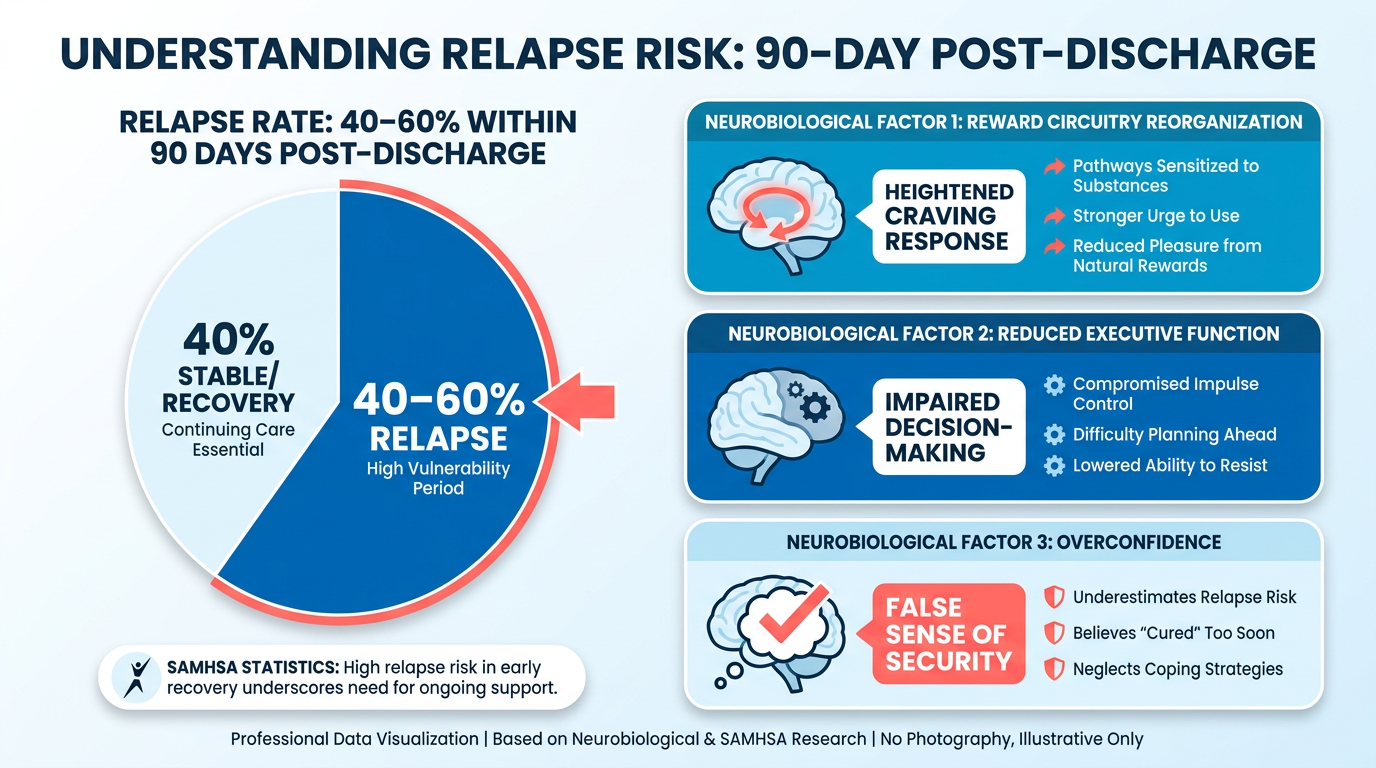
- Relapse rates hit 40–60% within the first 90 days after residential care.
- The CDC estimates relapse-related emergency care and rehospitalizations exceed $3.4 billion annually.
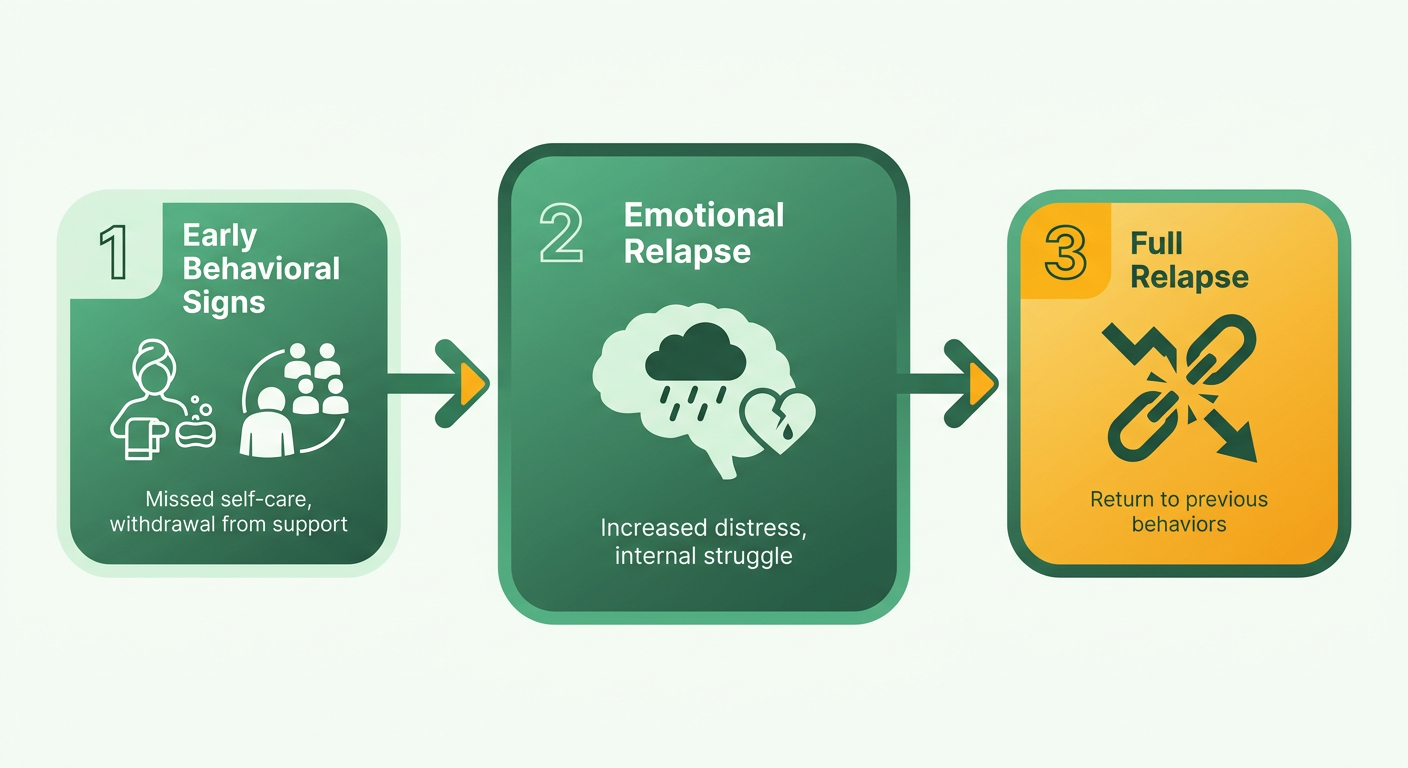
- Emotional relapse carries no craving signal. It starts with poor self-care, withdrawal, and denial.
- Executive function stays compromised for two to four weeks post-detox, even with confidence.
- Post-acute withdrawal syndrome can extend neurological vulnerability for up to two years.
- Standard self-check tools often miss the emotional relapse stage.
- Early confidence can hide warning signs when neurological risk is highest.
The First 90 Days After Rehab Are the Highest-Risk Window
The transition back to everyday life rarely announces its dangers. That is what makes it dangerous. The brain's reward circuitry is still reorganizing. Cognitive control is still stabilizing in a less structured setting. And the person often feels better than they have in years.
None of that is bad. But it creates a window where vulnerability and confidence coexist. Behavioral drift can go unnoticed until it has already gained momentum.
The costs of missed early signs are real. The CDC puts relapse-related emergency care and rehospitalizations above $3.4 billion annually. Families and employers absorb the rest: lost income, strained relationships, and the setback of rebuilding after a relapse earlier attention might have stopped.
Why the Brain Is Still Vulnerable After You Leave Treatment
Completing detox does not close the risk window. Research on post-acute withdrawal identifies PAWS as extending neurological vulnerability long past physical detox. That often goes beyond the point where most aftercare programs stay actively engaged. During this phase, the brain is highly sensitive to environmental cues while self-regulation is still finding its footing.
A longitudinal study of 247 inpatients found 40.5% had relapsed by the three-month mark; by twelve months, that figure reached 74.6%. Risk does not plateau. It nearly doubles across the first year. That trajectory is why long-term engagement matters. It is also why building consistent daily structure during this period offers measurable protection while the brain's regulatory systems continue to heal.
Three things make this phase structurally different from what came before:
- Self-assessment is less reliable here — not because people are dishonest, but because reduced executive function affects insight itself. External observation fills the gap.
- PAWS extends the risk window past what most aftercare plans address. The monitoring timeline needs to match that reality.
- Post-treatment confidence is appropriate and expected — and it can cause subtle behavioral drift to be rationalized instead of flagged.
Why Self-Assessment Alone Isn't Enough
A randomized trial of early warning signs training enrolled participants with a median history of five prior relapses. Structured external monitoring produced clinically meaningful reductions in heavy drinking, even without continuous abstinence. The mechanism is straightforward: a coach or coordinated team maintaining regular contact across multiple touchpoints can track behavioral drift long before it shows up on a self-report form.
Research on craving variability confirms that fluctuation across multiple sessions predicts relapse better than peak intensity at a single moment. Weekly self-report captures a snapshot. Consistent, multi-touchpoint monitoring shows the pattern in real time.
What standard self-check tools miss:
- Withdrawal from sponsors or support contacts — One of the earliest measurable behavioral signals in clinical observation, often appearing weeks before any conscious thought of using. A coaching team can see it before it appears in self-report.
- Skipping meetings, therapy, or scheduled check-ins — Attendance is objective data. Our team tracks this directly, which gives us a cleaner signal than self-assessment.
- Shifts in sleep, mood, or daily self-care — These mark emotional relapse, the first stage of the three-stage process, and appear before cravings would register on a standard assessment.
- Renewed contact with former using networks — This consistently precedes mental relapse when a team pays close attention across regular contact.
The Behavioral Drift Nobody Notices Until It's Already Moving
The weeks after residential care require close attention because behavioral changes happen below conscious awareness. The NIH relapse prevention framework makes this clear: the initial phase involves subtle lifestyle shifts, not urges. No craving signal. Just a slow move away from the habits that kept someone stable.
Tracking daily behavioral patterns gives an objective measure of that stability. In post-treatment transitions, missed sessions are rarely simple scheduling conflicts. Pulling back from structured support is usually the first sign that something has shifted. It is visible long before mood or sleep disruption becomes obvious.
When Recovery Practices Start Disappearing
A decline in active recovery engagement is an early warning sign, not a minor inconvenience.
- Missed coaching or support-group sessions — Two or more consecutive misses trigger outreach. Our coaches treat this as an active signal, not a scheduling gap. Accountability is built into how we work with every client.
- Going off medication-assisted treatment without a clinical decision — This is not a personal choice to respect. We treat it as urgent.
- Abandoning journaling or daily check-ins — Gratitude logs and recovery notes are often the first things to disappear when someone starts mentally distancing from recovery.
- Pulling back from sponsor contact — Relapse warning sign research consistently identifies decreasing communication with recovery mentors as a reliable predictor of a return to active use.
What Your Body Is Telling You: Sleep, Nutrition, and HALT
Physical self-care often degrades quietly during post-treatment transitions. According to Melemis's PMC relapse research, sleep disruptions should be read as signs of neurological adjustment, not temporary inconveniences. A significant shift in sleep patterns is a clinical signal that the nervous system is under stress.
- Sleep schedule shift greater than 2 hours — Either direction: sleeping far later, waking far earlier.
- Sustained wakefulness beyond 8 hours overnight — A mind that will not settle is worth documenting.
- Increased sugar or processed-food cravings — Dopamine-seeking behavior can shift across categories. Sweet binges often precede the mental relapse stage.
- Consistently skipping meals — Poor nutrition compounds cognitive vulnerability in early recovery.
The HALT check (Hungry, Angry, Lonely, Tired) from Melemis's framework is a practical daily reset. Any one of those states left unaddressed raises risk. Two or more together warrants a same-day coaching conversation.
Avoidance Doesn't Always Look Like Avoidance
Screen time and binge-watching are common places where avoidance hides. We do not flag ordinary TV. We flag a pattern shift: someone who was asleep by 11 pm now scrolls until 3 am.
- Distraction apps displacing recovery tasks — When scrolling replaces journaling or peer contact, that substitution is the signal.
- Binge-watching as a sleep replacement — Avoidance of quiet rest is a behavioral pattern our coaches track in weekly check-ins.
- Withdrawal from sober social connections — Relapse vulnerability research consistently ties self-imposed isolation to a downward trajectory.
Daily self-check: Four questions each morning. Did I sleep within 2 hours of my normal time? Did I complete my recovery tasks yesterday? Am I connecting with someone in my support network today? Is HALT clear right now? Two "no" answers mean a conversation with your coach that day, not next week. Building a structured daily sober routine turns this self-check into a habit rather than an afterthought.
The People and Places That Still Have Power
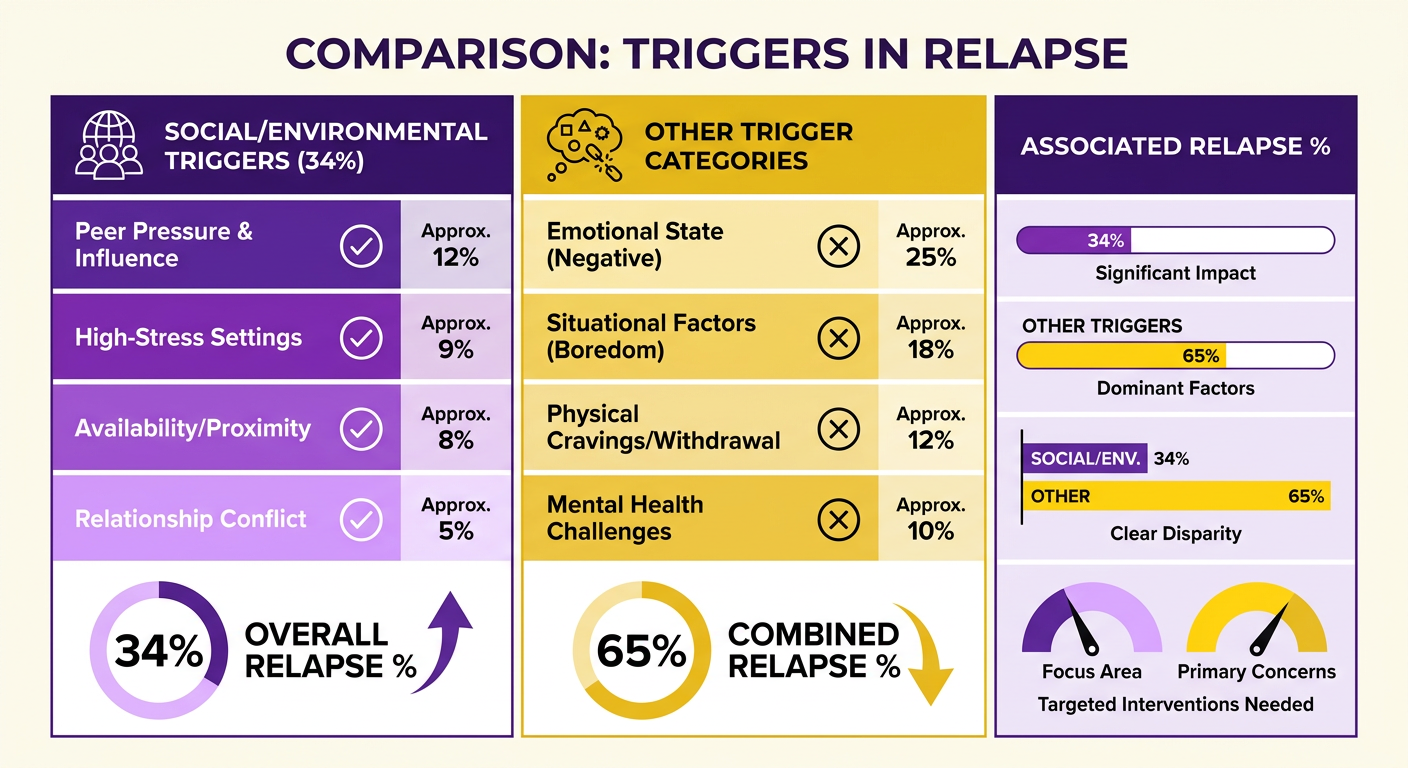
Coming back to everyday life after treatment means returning to environments that were, for many people, woven into substance use. The routes home. The familiar rooms. The old faces. These carry associations the brain encoded during active use, and social exposure drives 34% of relapses within the first month post-discharge (Addiction Science & Clinical Practice, 2022). Not background risk. The primary risk, in a tight window, with identifiable causes.
Tracking external circumstances from intake through ongoing check-ins helps identify risks that may be invisible from the inside. Returning to a household with active users might not register as an immediate threat to the person living there. An outside observer can flag it before it becomes a crisis.
Social Exposure: Who You're Around and Where You're Going
Social cues reactivate use-related pathways faster than most people expect. Our coaches look for changes in contact first, because those are easier to rationalize and harder to self-detect.
- Renewed contact with former using peers — Casual contact still counts. "Just coffee" still matters. The association carries the risk, not the intent.
- Revisiting locations tied to past substance use — Specific bars, neighborhoods, familiar routes. Context alone can trigger craving before any conscious decision is made.
- A shrinking social circle — Fewer contacts week over week, skipping family events, declining invitations. Self-imposed isolation compounds quickly.
- Reduced contact with a sponsor or sober support network — Ashley's relapse warning sign analysis notes that declining engagement with recovery peers is an objective indicator of drift, detectable by others before the individual acknowledges a change.
When Life Stacks Up in the First Months
High-stress events do not cause relapse on their own. They narrow the gap between a coping strategy and a using decision. And they tend to cluster in the first few months more than people expect.
- Major work events — A layoff, a high-pressure promotion, returning to a demanding job. Occupational stress is a documented relapse accelerant, not minor background noise.
- Relationship ruptures — Separation, divorce, or family conflict surfacing after treatment, including conflict triggered by disclosure of past use.
- Living situation changes — Moving back with family members who use substances, or returning to a household that functioned as an active using environment. Familiar settings are consistently underestimated as risk factors.
- Compounding financial pressure — Legal fees, lost income, or debt connected to prior use. Stress load matters in aggregate, not just in isolation.
The Reason You Don't Always See It Coming
Environmental triggers are difficult because the first response to stress is often pulling away from the same support systems meant to help. Research on post-treatment relapse timelines places the median relapse point around 54 days post-discharge. This period overlaps with the most active behavioral drift: isolation, neglected routines, no conscious desire to use. Asked how they're doing, the person may genuinely answer "fine." And mean it.
Consistent external monitoring bridges that gap. When a coach notes reduced engagement, a changed living situation, or renewed contact with old networks, those observations prompt direct, supportive conversations. Pulling back is treated as an active signal, not a passive detail to address later.
How to Catch It Before It Catches You
Early vulnerability shows up in behavioral patterns, not cravings. Tracking daily habits, communication consistency, sleep regularity, and community engagement gives the most reliable path to early intervention.
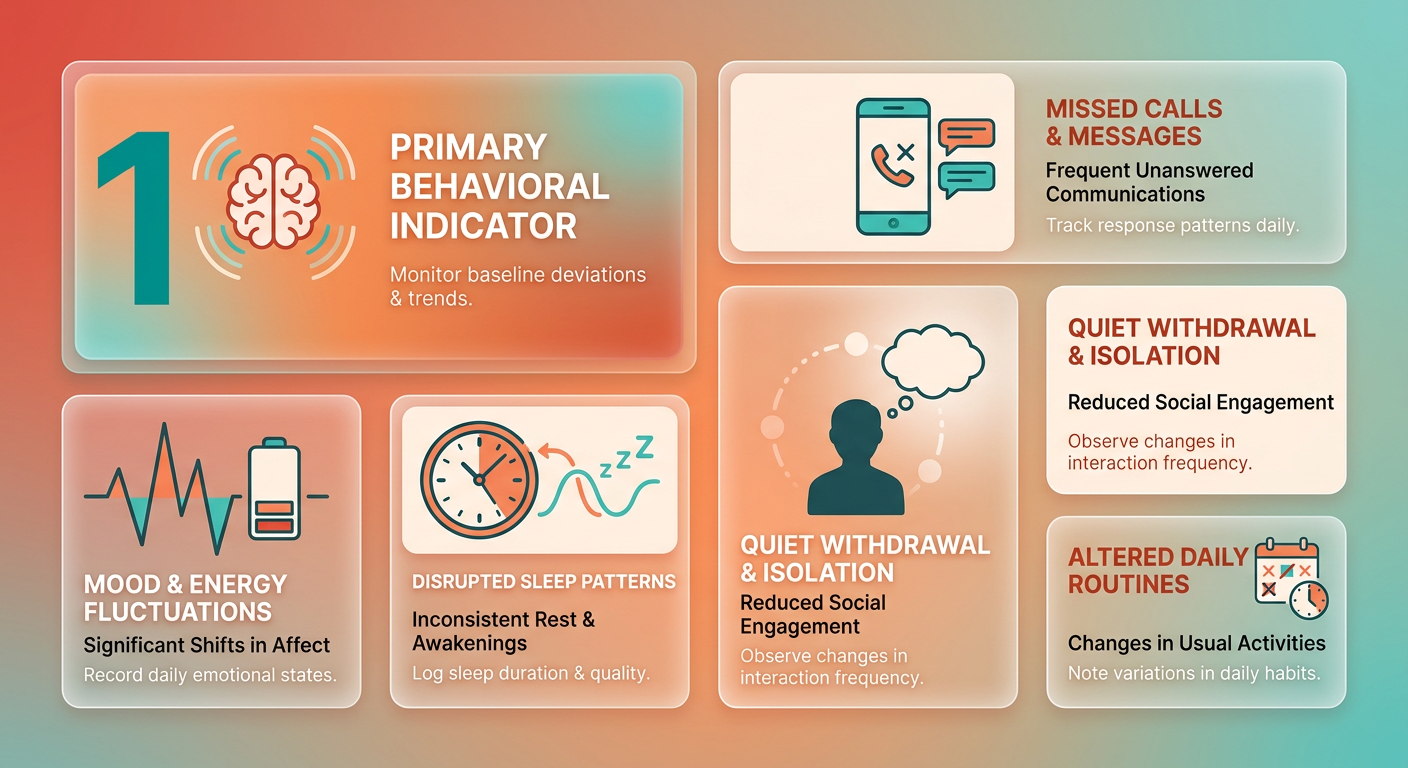
Behavioral signals often appear one to three weeks before active cravings. That is the window. Using it means tracking these early indicators and scaling support to match the level of risk.
The Daily 5-Minute Self-Audit
Run this every morning. Five categories, less than five minutes. Two or more red items mean same-day contact with your coach. Do not wait to see if it resolves.
Mood
- Mood stable or improved from yesterday
- No persistent irritability, anxiety, or emotional flatness over 24 hours
Sleep
- Sleeping 6+ hours without major disruption
- Not using anything, including alcohol, to fall asleep
Cravings
- No active craving in the last 24 hours
- Not mentally replaying or romanticizing past use (this is a documented mental-relapse indicator)
Social Contact
- Spoke with at least one sober support today
- No deliberate withdrawal from recovery network
Recovery Tasks
- Attended or scheduled required sessions or meetings
- Completed at least one healthy routine item
2+ unchecked = same-day contact with your coach. No exceptions.
Warning Signs Reference Table
Color key: 🟢 Monitor | 🟡 Flag | 🔴 Act now.
| Warning Sign | Typical Onset (days) | Severity (1–5) | Self-Check Action | Coaching Response |
|---|---|---|---|---|
| Social withdrawal | 1–14 | 🟡 2 | Flag in audit; note trend | Increase check-in frequency |
| Skipping recovery tasks | 7–21 | 🟡 3 | Reach out to coach if persistent | Same-day contact; review barriers |
| Sleep disruption | 1–30 | 🟡 2 | Log nightly hours | Discuss sleep hygiene; consider referral |
| Romanticizing past use | 21–45 | 🔴 4 | Contact coach immediately | Same-day call; reframing session |
| Active craving | 30–60 | 🔴 5 | Call coach or SAMHSA helpline now | Intensified support. Virtual or in-person |
When to Call and What Happens Next
Clinical evidence supports structured, calibrated responses over reactive crisis management for long-term stability. A clear protocol keeps minor deviations from escalating.
Working with a sober coach gives you a concrete escalation path instead of a judgment call made alone:
Daily check-in: The 5-minute audit above, self-administered and shared with your coach at the next scheduled contact.
Same-day contact (2+ flagged items): Do not wait for the next session. Reach out by phone or message to assess where things stand, confirm safety, and decide the next step together.
Intensified support: If that conversation reveals an escalating pattern, support can shift to more frequent sessions, virtually or in person, to stabilize and rebuild structure.
Crisis resources: SAMHSA National Helpline (1-800-662-4357), local ER if physical safety is at risk, and a pre-identified trusted contact. Write these down before you need them. Do not leave them only in a phone.
The discipline of running the five-minute daily audit is the intervention itself. Consistent accountability builds the daily structure and healthy habits that hold firm when willpower starts to thin out.
Download the printable checklist or scan the QR code for mobile access.
A Note for Families
Support and enabling can look almost identical from the inside. A few lines to hold:
- Ask once whether the person completed their daily audit. Do not complete it for them or ask twice.
- If 2+ red flags appear, encourage them to contact their coach rather than managing it yourself.
- Know the SAMHSA number and the designated crisis contact name. Have it ready without making it feel like surveillance.
- Do not soften the trigger threshold. "It's probably nothing" is the phrase that precedes most missed interventions we've seen.
References
[1] 6 Relapse Warning Signs To Know | Ashley Addiction Treatment - https://www.ashleytreatment.org/rehab-blog/early-relapse-warning-signs/
[2] Warning Signs of Relapse: Depression, Stress, and Other ... - https://americanaddictioncenters.org/adult-addiction-treatment-programs/signs-of-relapse
[3] 5 Warning Signs of Relapse Vulnerability - Recovery - Valley Hope - https://valleyhope.org/blog/recovery/education-recovery/5-warning-signs-of-relapse-vulnerability/
[4] Relapse Prevention and the Five Rules of Recovery - PMC - NIH - https://pmc.ncbi.nlm.nih.gov/articles/PMC4553654/
[5] 10 Signs of Relapse to Look Out for - Footprints to Recovery - https://footprintstorecovery.com/blog/signs-of-relapse/
[6] The Signs of Relapse and How to Prevent It - https://rhmsevier.com/signs-of-relapse-and-how-to-prevent-it/
[7] 15 Relapse Warning Signs - https://futuresrecoveryhealthcare.com/blog/relapse-warning-signs/
[8] A randomised trial of early warning signs relapse ... - https://pubmed.ncbi.nlm.nih.gov/15925121/
[9] Rapid relapse generally follows treatment for substance ... - https://www.researchgate.net/publication/10911557_Rapid_relapse_generally_follows_treatment_for_substance_use_disorders_among_adolescent's
[10] Predictors of Relapse to Alcohol and Substance Use - https://pubmed.ncbi.nlm.nih.gov/34553671/
[11] Predicting Relapse in Substance Use: Prospective Modeling ... - https://pmc.ncbi.nlm.nih.gov/articles/PMC9319974/
[12] Psychological factors predicting patients' risk of relapse ... - https://pubmed.ncbi.nlm.nih.gov/38556252/
Frequently Asked Questions
1. Does feeling confident and stable after completing treatment mean my relapse risk is lower?
Feeling positive about recovery is encouraging, but early confidence can mask subtle behavioral changes. During the first weeks after treatment, cognitive control is still stabilizing. That makes objective self-assessment difficult. Minor routine changes can be easy to miss. External accountability still matters.
2. What is the difference between emotional relapse and mental relapse?
The difference is conscious awareness and intent. Emotional relapse starts with neglected routines, isolation, and unmanaged stress. There is no active desire to use yet. Mental relapse follows, with bargaining, romanticizing use, and direct cravings.
3. Does neurological vulnerability actually end when formal aftercare ends?
Neurological healing is a long process that often outlasts standard transitional programs. Cognitive clarity improves after detox, but the nervous system stays sensitive to stress and environmental cues. Because formal support often scales back after a few months, long-term monitoring remains important.
4. Can relapse warning signs appear even when someone has no desire to use?
Yes. The earliest indicators are behavioral and lifestyle-based, not psychological. Sleep changes, reduced recovery participation, and small drops in daily discipline can appear weeks before any urge to use. Catching these signs early allows course correction.
5. What does the HALT check measure, and when does it require same-day action?
This check looks at nutritional neglect, emotional agitation, social isolation, and physical exhaustion. Each one weakens cognitive resilience. When multiple factors happen together, risk rises sharply. That is when same-day action is needed.
6. Does intent matter when someone reconnects with former using peers — is casual contact still a risk?
Even with good intentions, returning to old social circles carries significant risk. The brain keeps strong associations between certain people and past habits. Those associations can trigger automatic responses below conscious awareness. For that reason, contact with former networks is monitored closely, regardless of how safe it feels.