5 Relapse Traps After Rehab, From Payday to Funerals, a Sober Coach Defuses
September 29, 2026

Why the first 90 days after rehab break so many people
The stretch right after rehab is the most dangerous part of early recovery. The numbers make that clear. Between 40 and 60 percent of people treated for substance use disorders relapse at least once, according to NIDA figures cited by Ethos. The timing matters most. That window is exactly where sober coaching after rehab earns its keep.
What we see in our work is simple. Relapse rarely starts with a drink or a drug. It starts weeks earlier, in what clinicians call emotional relapse. The person isn't thinking about using yet. They're skipping meetings, sleeping badly, and bottling things up. Steven Melemis's clinical paper lays out this stage plainly. The groundwork gets set before anyone notices. Daily contact with a coach in those first weeks catches the signals while they're still small.
Why is the re-entry period so high-risk?
Re-entry risk is the spike in relapse vulnerability after leaving a structured setting. The clinical picture is less about one dramatic decision and more about a fast loss of scaffolding. Meals, meetings, peer accountability, transportation, and sleep all land back on the client at once.
That's the case for front-loading support. The specific traps this article walks through, payday, funerals, social pressure, boredom, and isolation, tend to hit hardest in these opening weeks when coping skills are still new and shaky.
What triggers relapse most often in early recovery?
The most-cited triggers are stress, grief, social pressure, boredom, and isolation. Payday and funerals are classic examples of what the research calls bargaining, where a person quietly gives themselves permission to use for a special occasion. Melemis names holidays and trips as exactly these moments.
Grief compounds the danger. American Addiction Centers notes conflict is present in more than 50 percent of relapses, and a funeral stacks loss and family tension in one room. Good days matter too. Recovered.org points out celebrations can trigger cravings, not just hard days. A payday windfall is a celebration.
Isolation deserves its own line. Valley Hope calls human connection "the engine" of recovery, and it's one of the strongest predictors of whether someone stays sober.
Where does coaching fit between rehab and real life?
Coaching bridges the gap between the structure of treatment and the messiness of daily life. Formal therapy has diminishing returns past a point. The Recovery Research Institute notes brief interventions can match longer ones. The added value lives between sessions, in the daily check-ins that keep a person honest.
- Treat the period right after discharge as needing extra structure, not a casual "wait and see."
- Map your payday, funeral, and social-pressure moments in advance, because that's where the internal permission-granting narrative starts.
- Build daily contact with a coach or accountability partner before a crisis, not during one.
To be clear, we're a nonmedical recovery support team, not a treatment facility. We can't guarantee anyone stays sober. What we can do is walk beside you through the weeks where the ground is least steady. A practical starting point is establishing daily routines that reduce stress and restore balance, which is one of the core areas our coaches help clients build.
Key Takeaways
- Early recovery calls for proactive support, especially right after leaving a structured setting.
- Relapse prevention isn't only about refusing substances. It's about catching the earlier drift in sleep, meetings, honesty, and connection.
- Payday, funerals, parties, boredom, and isolation each build a different kind of permission structure around using.
- Coaching is strongest in the spaces between formal sessions: the parking lot before an event, the quiet evening alone, the morning after a hard family call.
- The goal isn't permanent dependence on a coach. It's enough structure, support, and self-awareness that the client can carry recovery on their own.

Financial & Emotional Triggers (Payday Pressure & Funerals)
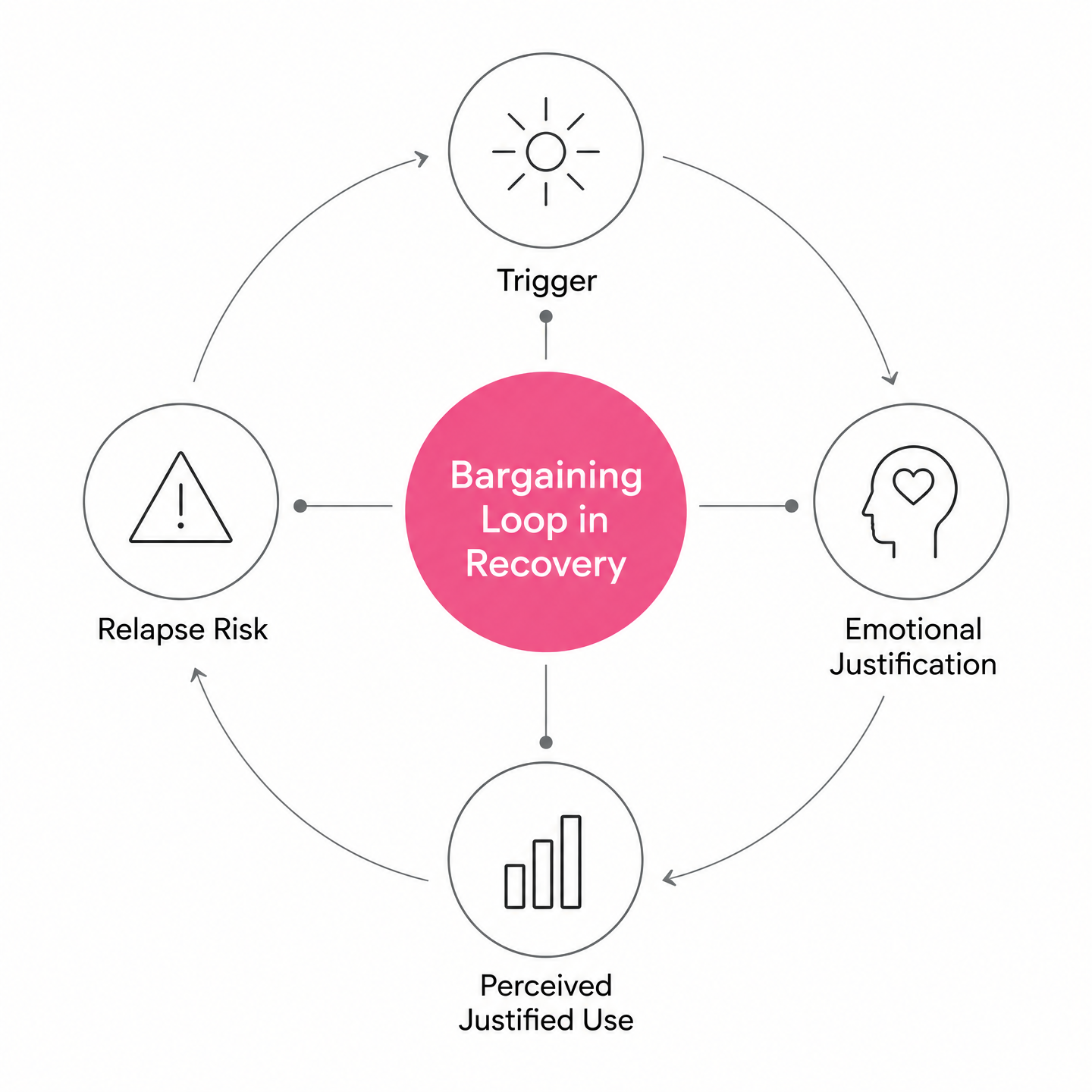
Money and grief share a strange feature. Both can hand you a reason to use that feels completely justified in the moment. A paycheck lands, and suddenly there's cash for the first time in months. A relative dies, and nobody would blame you for one drink at the wake. That's the trap, and it's why sober coaching after rehab pays such close attention to the first payday and the first funeral.
The mechanism has a name. Clinicians call it bargaining, and the Yale relapse-prevention work documents how people give themselves permission to use during trips, holidays, and special occasions. Payday and a memorial are the everyday versions. Our job as coaches is to catch that internal permission slip before it moves from a thought into a plan.
Why does payday hit so hard in early recovery?
A windfall is a trigger, not a reward. Recovered.org lists financial issues as an environmental trigger and, just as important, notes that positive events like celebrations stir cravings too. Cash in the account reads as both stress relief and celebration at once.
- Set up a budget check-in for the day the deposit lands, not the day after. We help clients pre-assign the money to rent, bills, and savings so there's no ambiguous "extra" sitting there.
- Route the first few paychecks through a trusted person or automatic transfers. Removing easy access to a lump sum takes the decision out of a vulnerable moment.
- Name the HALT state before shopping or socializing. The self-check is simple: hungry, angry, lonely, tired. Any of them stacks the odds toward a bad call on payday.
- Plan one sober thing to do with the money. A coach can help swap the old ritual for a new one, so the paycheck marks progress instead of triggering the old script.
How can a coach help you through a funeral sober?
Grief is the harder one, because you can't budget your way around it. Loss brings sadness, loneliness, and anger, all named emotional triggers, and a wake often puts alcohol front and center while family tension runs high.
- Schedule a grief-support call before and after the service. Talking it through beats white-knuckling it, and staying connected between formal sessions is where the added protection lives, as Valley Hope notes.
- Bring an exit plan and a sober ally. Knowing you can leave, and having someone to text, keeps the "war going on inside people's minds" that the Yale authors describe from tipping toward use.
- Practice urge surfing for the moment a drink gets offered. The Recovery Research Institute describes this as riding a craving out without acting on it, and it's worth rehearsing before the day.
- Lean on ritual and community, not the bar. Non-clinical grief processing, a support meeting, a walk, a shared meal give the feeling somewhere to go.
There's a scope limit worth stating plainly: we don't diagnose grief or treat depression. If loss is pulling you into something deeper, that's a referral to a licensed professional, not a coaching call. What daily companionship does well is keep the payday and the funeral from becoming the quiet start of a relapse nobody saw coming. For more on building steady structure, our team walks through it in this guide on post-rehab routines.
Social & Peer‑Pressure Situations (Parties, Bars, Gatherings)
The first wedding. The first backyard barbecue. The first payday round with old coworkers. These land fast in early recovery, often before the person has tested their skills outside treatment. Sober coaching after rehab exists partly to get a client through that first alcohol-soaked gathering without white-knuckling it or bailing entirely.
Social exposure is one of the most direct triggers there is. Recovered.org lists parties and bars as classic environmental triggers. The problem isn't only the alcohol in the room. It's the speed of the old social script. Someone arrives, someone offers, someone laughs, and suddenly the client is responding from habit instead of intention.
The "just one drink" line needs a rehearsed counter
Peer pressure rarely sounds like pressure. It sounds like "come on, one won't hurt" from someone who means well. The Recovery Research Institute describes a specific skill for this, assertive drink and drug refusal. Learning to say no, comfortably and without a speech, is trainable, not a personality trait.
That same relapse-prevention model leans hard on role playing. A coach and client act out the real scene before it happens, so the refusal is muscle memory by the time it counts. The aim isn't a perfect speech. It's a short answer that doesn't invite debate.
- Rehearse two or three refusal lines out loud with your coach before the event, so the "no" comes automatically instead of getting negotiated in the moment.
- Decide in advance which questions you'll answer and which you won't. Privacy is allowed.
- Build the self-efficacy the RP model targets by starting with a lower-stakes gathering before the big wedding.
Skipping the party isn't weakness in week two
There's a tension worth naming. The Yale author observed that clients often see avoiding high-risk situations as a sign of weakness, and clinicians treat that belief itself as a red flag. Yet Valley Hope's guidance pushes people to stay socially engaged. Both are right, at different times. In the earliest stage, dodging an unnecessary bar night is smart triage, not cowardice. Building your support network for the unavoidable events runs right alongside it.
Watch the basics too. If you're depleted before you walk in, the room gets harder to manage. A coach's pre-event call is often less dramatic than people expect: eat something, confirm the ride, rehearse the refusal, decide when to leave.
- Check your body and mood before you go. Don't arrive already drained.
- Set a timed exit and line up a ride, so leaving early takes no debate with yourself.
Where a sober companion earns its place at the event
Some risk is situational. A client may be steady on an ordinary Tuesday and still need support at a reception, company dinner, or family gathering where old patterns are waiting. That's the argument for booking companionship, in person or virtual, for a specific high-risk event. We can be on the phone in the parking lot or standing beside you at the reception. Pairing that with a steady weekly routine keeps the plan from living only in your head.
- Book a sober companion for known high-risk events rather than improvising the night of.
- Agree on a check-in signal or call time mid-event, so support is one text away when the room gets loud.
Boredom, Unstructured Time & Routine Gaps
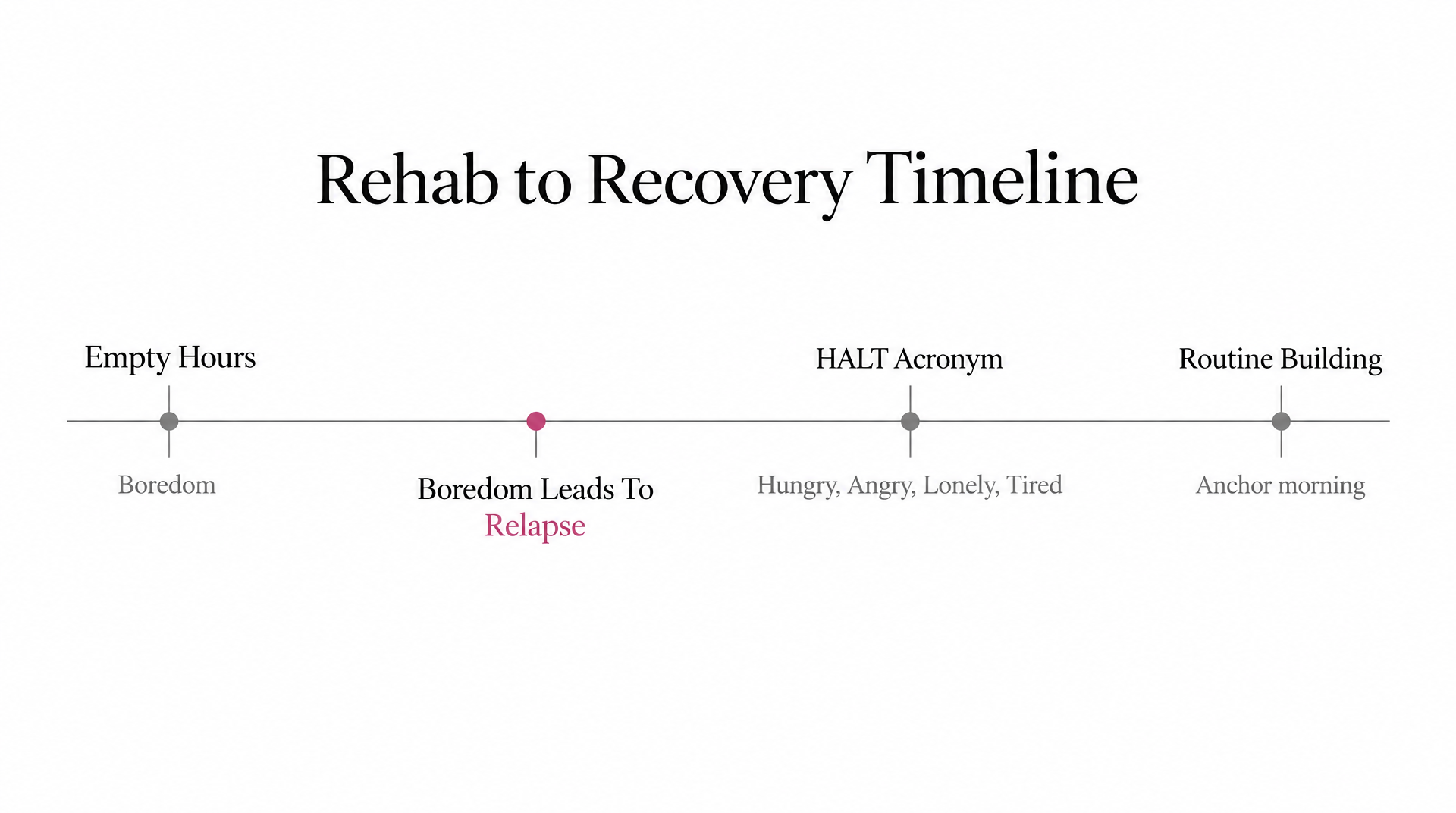
Empty hours aren't neutral in early recovery. Recovered.org lists persistent boredom from too much free time as a behavioral trigger, right alongside skipping meetings and the old after-work habit of hitting the pub. This is the trap nobody warns you about when you leave treatment. Your calendar clears, the structure of rehab disappears, and the day suddenly has holes in it. Sober coaching after rehab spends a lot of its energy on those holes.
That drift is worth catching early. Boredom rarely stays boredom. It can slide into the emotional relapse stage the Yale paper describes, where a person isn't thinking about using yet but poor self-care is already stacking up. A coach checking in during the moments that matter can spot the drift before it turns into a craving with a plan attached.
Why does empty time set off cravings?
The mechanism is quieter than most people expect. When the day has no shape, self-care is the first thing to go. Meals get skipped, sleep slides, isolation creeps in.
The Yale paper points back to that HALT self-check. In this section the practical value is pattern recognition: if an empty afternoon reliably turns into agitation by evening, the schedule needs support before the craving shows up. A coach paying attention to your day is really asking which needs have gone ignored since morning.
How do we build a routine after rehab?
Routine building is one of the fundamentals our coaching rests on. We help clients establish healthy routines that reduce stress, restore balance, and build resilience. The goal isn't a packed schedule. It's removing the empty stretches where old habits used to live. We work through it together, and support tapers as you find your own rhythm.
- Anchor the morning with a fixed wake time and a meal, so the day starts with structure instead of drift.
- Block out activity time. A walk, the gym, any movement. Recovered.org names physical exercise as a direct way to manage triggering emotions.
- Protect meals and sleep as non-negotiable. The Recovery Research Institute flags eating and sleeping as lifestyle factors that change how often triggers show up.
- Schedule one purposeful block daily: work, study, a meeting, or a commitment to another person.
- Keep a standing coach check-in, so a bad afternoon gets flagged the same day, not next week.
What micro-habits keep the mind occupied?
Big routines hold the week together. Small habits hold the hour together, and those are what we help you build between sessions.
- Run a midday pause to notice whether your mood, energy, or basic needs are sliding.
- Do a short thought journal. The RP model uses journaling to surface the automatic thoughts that push toward using.
- Use a brief grounding practice when intensity rises, especially if leaving the situation isn't immediately possible.
- Tie a hydration or healthy-eating habit to something you already do each day, so it actually sticks.
A scope note: if you already have a full work schedule and a strong meeting habit, you may not need a coach rebuilding your calendar. Where daily companionship earns its place is the client staring down a wide-open month with nothing on it yet.
Isolation & Support Gaps (Using Coaching & Community)
Leaving a residential program means losing the thing that made it work: people around you, all day, every day. That structure vanishes the moment you walk out the door. What replaces it early on often decides whether the warning signs get caught or missed. This is the gap sober coaching after rehab is built to fill.
The isolation risk isn't abstract. Conflict with others and returning to a home where family or friends still use are well-documented pressures on early recovery. Read those together and a hard truth surfaces: for many people, home isn't a neutral place. The network you return to can be the exact network that pulls you back.
Isolation is a relapse trigger, not just a bad feeling
Loneliness sits on nearly every clinical list of triggers, including Recovered.org's breakdown of emotional triggers. But the danger runs deeper than mood. One of the five rules in Melemis's framework is simply "ask for help," and the same paper notes clients often treat needing support as weakness. That belief is itself a warning sign.
So the early weeks pull in two directions. You need to skip the payday bar and the using friends, and you need to build a support bench strong enough to hold you at the first funeral. Avoiding triggers and staying connected aren't opposites. A coach helps you do both at once.
How virtual coaching after rehab closes the distance
Geography, work schedules, and stigma keep people from showing up to in-person support. Daily contact solves the schedule problem without requiring anyone to be in the same room. We run check-ins by video and message, coordinate with family so they know what to watch for, and connect clients to sober-living options when the home environment is the risk itself.
None of this replaces medical care or licensed therapy. What it does is keep a client from spending a high-risk Tuesday alone with their own thinking. Peer communities like 12-step and SMART Recovery meetings, both named in the relapse-prevention literature, stack on top of coaching rather than competing with it.
A support-gap checklist you can actually use
Map your isolation risks before a crisis hits. Fill this in during your first week home:
| Trigger | Warning Signs | Immediate Action | Coach Support | Frequency |
|---|---|---|---|---|
| Empty evenings alone | Skipping meals, scrolling for hours | Text your coach, join a meeting | Scheduled check-in | Daily |
| Using friends reaching out | Rationalizing "just this once" | Leave the thread, call support | Rehearsed exit script | As needed |
| Family conflict at home | Withdrawing, bottling anger | Name it out loud to someone | Family coordination | Weekly |
Then lock in these habits:
- Schedule daily contact for the first month. Isolation does its damage quietly, so a set check-in beats waiting until you feel bad enough to reach out.
- Name three people who can hold you at a crisis moment. Melemis's "ask for help" rule only works if the list exists before the funeral or the payday.
- Get a sober-living plan if home includes active use. When your household is the strongest predictor of relapse, distance is a strategy, not a retreat.
If your recovery already has a stable home and a strong network, you may not need daily coaching. Be honest about which situation you're in.
References
[1] Relapse Prevention and the Five Rules of Recovery - PMC - NIH - https://pmc.ncbi.nlm.nih.gov/articles/PMC4553654/
[2] Why Do People Relapse After Addiction Treatment? | Ethos - https://www.ethostreatment.com/why-do-people-relapse/
[3] Relapse Prevention Strategies for Lasting Recovery Success - https://powerofrecovery.org/blog/relapse-prevention-strategies/
[4] Relapse Prevention: 10 Strategies to Protect Your Sobriety - Valley Hope - https://valleyhope.org/blog/recovery/education-recovery/10-strategies-to-protect-your-sobriety/
[5] Relapse Prevention (RP) (MBRP) - Recovery Research Institute - https://www.recoveryanswers.org/resource/relapse-prevention-rp/
[6] Addiction Relapse: Risk Factors, Coping & Treatment Options - https://americanaddictioncenters.org/treat-drug-relapse
[7] Managing Relapse Triggers: Key Strategies for Recovery - https://recovered.org/relapse/triggers
Still Wondering?
What's the difference between a sober coach and a therapist?
A sober coach works on practical recovery support: accountability, routine, event planning, transportation decisions, communication with family, and sober companionship when a situation is risky. A therapist provides licensed clinical care. MADE Recovery coaches stay in the support lane and refer out when a client needs diagnosis, mental health treatment, or deeper clinical work.
Is keeping alcohol out of the house enough to prevent relapse?
It helps, but it is not a complete plan. A dry home removes an obvious cue, while leaving money stress, grief, loneliness, social pressure, and unstructured time untouched. The stronger approach is to pair environmental cleanup with a daily plan for connection, schedule, and accountability.
How do I know I'm sliding toward relapse before cravings even start?
Look for changes in behavior before looking for cravings. Are you cancelling support, hiding how you feel, drifting from meals or sleep, replaying old resentments, or becoming harder to reach? Those shifts matter because they show recovery routines weakening before the urge to use becomes obvious.
What is urge surfing and how do I actually do it?
Urge surfing is a craving-management skill that asks you to observe the urge instead of obeying it. You notice where it sits in the body, breathe through the rise, and let the intensity crest and fall. It works best when practiced ahead of time, not invented in the middle of a high-risk event.
Do I really need daily coaching if I already have a steady job and network?
Maybe not. Coaching should match the actual risk level. Someone with work, meetings, supportive housing, and reliable sober contacts may only need lighter accountability. Daily support makes more sense when the calendar is empty, the home environment is unstable, or high-risk events are coming quickly after discharge.
What if grief after a funeral feels heavier than normal sadness?
Use the coach for immediate recovery protection: planning the service, arranging rides, checking in afterward, and staying connected. If the grief becomes overwhelming, persistent, or unsafe, the next step is licensed clinical support. Coaching can sit alongside that care, but it should not replace it.