Sober Coach Defined: The Daily Accountability Partner After You Leave Rehab
September 29, 2026

What the First Weeks After Rehab Actually Test
Most people leave rehab with a solid plan and lose it within weeks. It isn't weak willpower. The structure that held the plan together disappears the moment you walk out the door, and real life starts pushing back. Sober coaching after rehab fills that gap. It's the gap we work in every day.
The risk is easy to underestimate. Even with a strong aftercare plan, the stretch right after treatment is when triggers hit hardest, and daily structure is toughest to hold. Sober coaching puts a daily accountability partner in that window, so the plan you built in treatment gets used when a trigger shows up in the wild. This guide covers what a coach does, when support is worth paying for, and one setting almost every provider ignores: travel.
That last piece is our focus. Frequent flyers, event attendees, and people with travel-heavy careers hit their highest-risk moments in airports, hotels, and conference bars. That is exactly where routine and support networks fall apart. We built our sober travel companion service around that blind spot.
What You'll Walk Away With
You'll leave knowing how to tell coaching apart from therapy and sponsorship, how to vet a coach, and how to scope support to your actual risk instead of paying for a permanent presence you don't need. We're also honest about limits. Coaching isn't for everyone, and this guide helps you gauge whether it fits your situation.
One point is worth sitting with: coaching isn't therapy, and it isn't a substitute for clinical care. It focuses on implementation, turning a plan into action. Peer and coaching support tends to help most with follow-through and staying engaged. The harder work of lasting recovery usually comes from layered support with clear boundaries, so each person stays in their lane. More contact does not automatically mean better outcomes. The point is matching support to actual risk.
Read that as a scoping instruction, not a reason to skip support. Coaching earns its keep by adding structure in the most vulnerable windows: evenings, weekends, and travel days. It also helps in real-world settings where triggers show up. A sober travel companion is that same low-barrier accountability, relocated to the settings where you're most exposed. Time-boxed to the trip, not indefinite.
Who This Guide Is For
| Detail | What to expect |
|---|---|
| Best fit | People leaving detox, residential, PHP, or IOP; frequent travelers and event attendees |
| Also useful for | Families weighing recovery support options |
| Reading time | About 10 minutes |
| Difficulty | Beginner friendly, no clinical background needed |
| What we cover | What a coach does, coaching vs therapy vs sponsor, vetting questions, costs, and event-based travel support |
One note on scope. We provide nonmedical recovery support: coaching, companionship, sober living, and intervention help. We're not doctors, and we don't replace clinical care. If you're weighing coaching against group meetings for month one, that comparison is a fair place to start before you read further.
Key Takeaways
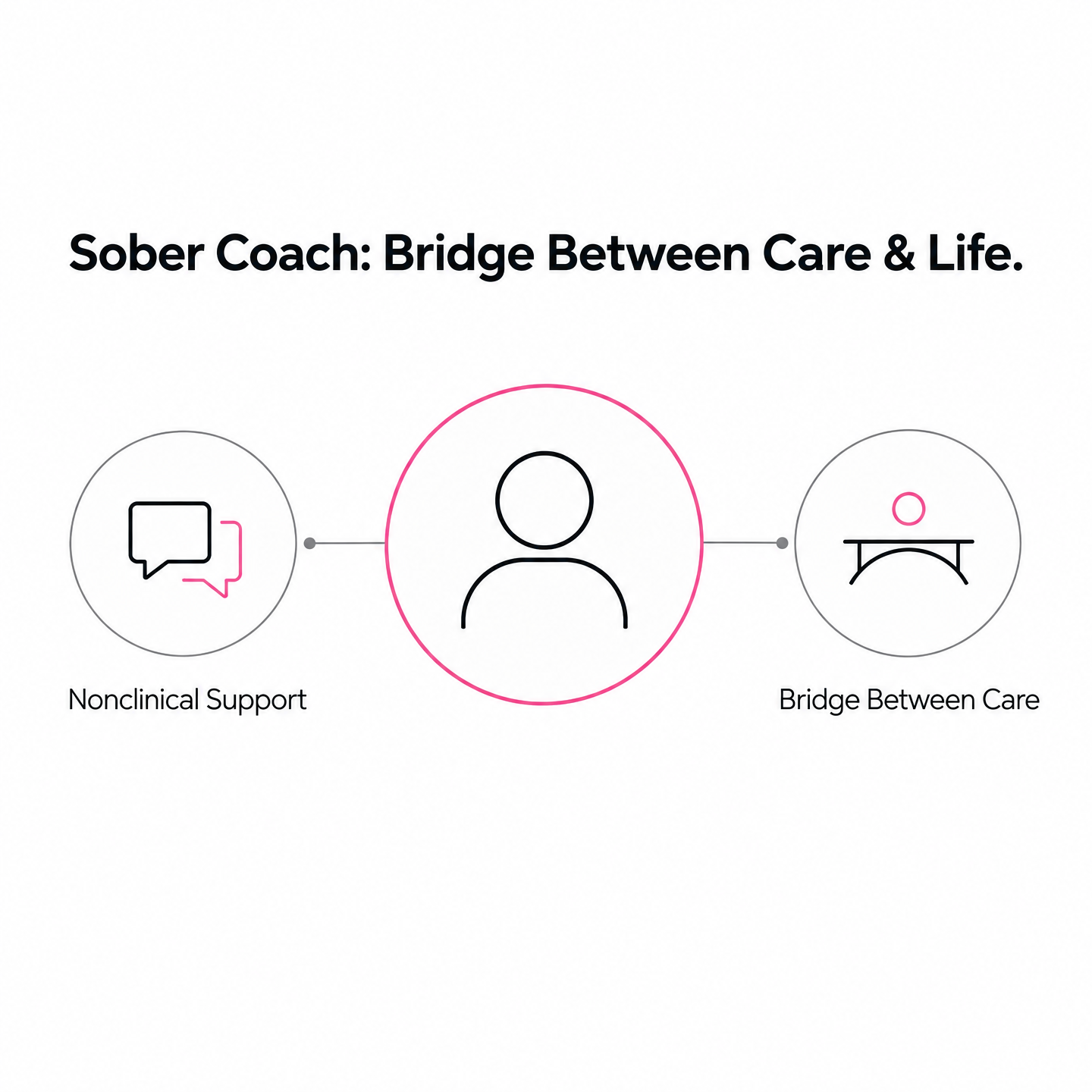
- A sober coach is best understood as a bridge between treatment planning and ordinary life.
- The role is practical: scheduling, accountability, communication, routine-building, and support during high-risk moments.
- Good coaching has boundaries, especially around clinical care, family dynamics, privacy, and crisis escalation.
- The right level of help depends on the calendar in front of you, not on a generic package.
- Research on peer recovery support is strongest around engagement with care, which is useful but not the same as a sobriety guarantee.
- Travel creates a distinct planning problem because the risk environment changes quickly and often away from familiar support.
- A sober travel companion is most useful when the exposure is clear, temporary, and hard to manage alone.
What a Sober Coach Actually Does
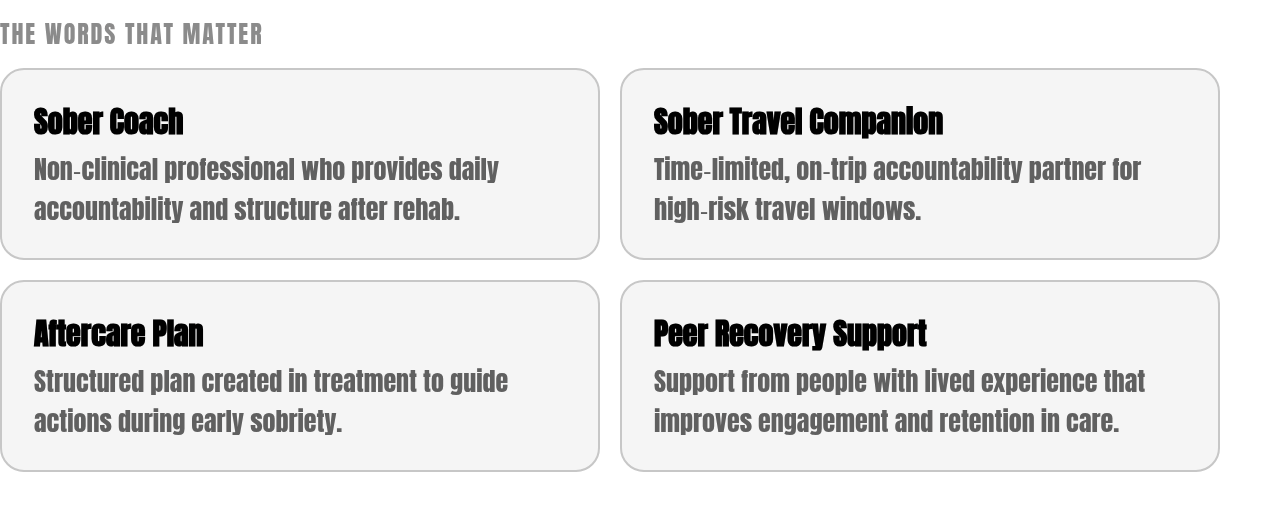
A sober coach is a nonclinical recovery support professional who works one-on-one with you in early sobriety or during a major transition, like stepping down from residential care, PHP, or IOP. The job is practical, not medical. We don't diagnose, prescribe, or run therapy. We help you take the plan you built in treatment and actually run it when life gets loud.
That distinction matters, because sober coaching after rehab lives in the space between clinical care and going it alone. A therapist treats mental health and trauma. A sponsor guides you through a recovery pathway. A coach handles real-world structure and accountability in daily life, as Futures Recovery Healthcare lays out. The best outcomes come from layering these roles, with clear boundaries so nobody drifts out of their lane.
Two Parts Hold Coaching Together: Check-Ins and Access
Strip coaching down, and two parts hold it together: regular check-ins and on-call access. Unlike a live-in companion, a coach meets with you throughout the week and stays reachable when a crisis lands, per Caron's breakdown of how it works. You still own your sobriety. We keep the plan honest and moving.
The evidence for this model is real but uneven. Research on peer recovery support points to gains in how consistently people stay engaged with treatment and aftercare. That is often the first thing to slip once structure fades. What that engagement translates to over the longer term is where the picture gets more complicated.
Engagement Is Not the Same as Sobriety
Here's where honesty matters. More contact can surface more crises, and showing up more often does not automatically mean using less. Engagement is a leading indicator, not a guarantee.
So the encouraging findings and the mixed ones aren't really in conflict. Coaching consistently gets people to show up. Whether that translates to reduced use depends on pairing quality, what the comparison group receives, and which outcome you track. Skip coaching if your only gap is knowledge. It earns its cost when follow-through and routine are the problem, not information.
Why We Build for Travel
The value of coaching shows up outside controlled environments, where relapse prevention stops being theoretical and gets immediate. The question isn't whether someone understands their plan. The question is whether the plan survives the moments that pull them off rhythm.
A sober travel companion applies coaching to that problem directly. The support attaches to a specific itinerary, a specific event, or a specific stretch of exposure, rather than becoming a vague ongoing arrangement. For frequent travelers and event attendees leaving treatment, that's the gap most providers never staff.
How Coaching Works in the Settings That Matter
The most useful thing sober coaching after rehab does is lower the barrier to being present when you need support. Coaching works best when it meets people where they actually live, in homes, cafés, parks, or by phone. Peer and coaching support strengthens engagement and retention most reliably when it's added to your existing care and coordinated with your treatment team, not stacked on top as a separate silo.
That low-barrier, in-context presence is the feature we build everything else around. Coaching works because the accountability shows up where the trigger lives, not in a room you visit twice a week. A coach checks in regularly through the week, tracks how the plan is holding, and adjusts fast when life shifts. That's different from a live-in arrangement. A sober companion stays with you day to day, while a coach meets and checks in on a regular cadence throughout the week.
A Travel Companion Is That Accountability, Packed for the Trip
Travel support turns a recovery plan into something portable. Before the trip, the work is concrete: identify the events that carry risk, decide how exits will work, set communication expectations, and agree on what happens if the plan starts to wobble. During the trip, the companion helps you keep decisions small before they become urgent.
For frequent travelers and event attendees, the issue is rarely one single trigger. It's the pileup: unfamiliar rooms, disrupted sleep, business meals, long gaps between obligations, and the quiet pressure to blend in. Travel days function as concentrated high-risk windows, which is exactly when in-person accountability earns its cost.
Scope It to the Risk, Not to Forever
So we scope travel support as event-triggered and time-boxed. You bring us in for the trip, the conference, the family event, then step back down. Acute exposure can justify extra help. That doesn't mean help should become permanent by default.
The goal is a support plan that strengthens your own recovery system rather than replacing it. As Futures Recovery Healthcare frames it, a coach should help you build independence over time. In practice, that means deciding in advance where support starts, where it ends, and what has to be true before you taper.
What Setup Actually Looks Like
Getting started is simpler than people expect. We map your trip against your known triggers, agree on check-in cadence and boundaries, and confirm what's in scope and what isn't. That includes basic privacy expectations, who can be contacted in an emergency, whether family members are involved, and how the companion should handle social settings where discretion matters.
Help starts with a conversation about your situation and what you need next. From there, the plan should be specific enough to use under pressure but flexible enough to adjust when the real day doesn't match the itinerary.
Setting Coaching Up So It Actually Holds
The most reliable practice in the research is also the simplest: lower the barriers to being present. Peer recovery support has produced positive results across a wide variety of settings, not only inside a clinic. That principle should shape how you set up sober coaching after rehab, because accountability only works when it shows up where the risk lives.
Travel is where the principle gets tested hardest. A coach who's helpful during an ordinary week may still need a different plan for a business trip, a wedding weekend, or a family gathering with old patterns built into it. Design the support around the situation before the situation starts making decisions for you.
When is a sober travel companion the right call?
A sober travel companion is the right call when the exposure is predictable enough to plan for and intense enough that ordinary check-ins may not hold. The question isn't whether travel is automatically dangerous. It's whether this specific trip includes people, places, timing, or pressure that has beaten your plan before.
The evidence supports caution and precision. A systematic review of peer support services found coaching reliably boosts treatment engagement and retention, though the direct effect on substance use itself is more mixed. Engagement is a leading indicator, not a guarantee.
So the decision should be practical, not fear-based. If the problem is an open-ended need for monitoring, you may need a broader care plan. If the problem is a defined event with a known pattern of risk, a companion can be matched to that window and removed when the window closes.
How do you get the pairing right?
Pairing quality matters more than most people expect, and this is where the outcomes split.
One of the clearest advantages a peer coach brings is lived experience. That lived experience helps people navigate treatment systems that can be complicated and sometimes fraught. That kind of trust is hard to replicate, and it's a big part of why the pairing matters.
But the same body of research is honest about the flip side. The evidence for coaching's direct effect on substance use remains mixed and inconclusive, and its most consistent benefit shows up in keeping people engaged and retained in care. Not every pairing lands the same way.
Read those findings together and the practice is clear. Coaching shines when the pairing fits and it's added to whatever support is already in place. Its direct effect on staying sober is less certain and depends on match quality. Ask for a trial call before a trip. If the fit feels off, switch. And if you're carrying acute mental health needs, keep a clinician in the loop, because a companion works inside a broader network, not instead of one.
What to Hold Onto
- Tie extra support to the event that actually changes your risk.
- Prioritize lived-experience fit over credentials on paper.
- Keep coaching coordinated with your clinical team, not siloed.
- Treat engagement as progress, not proof, and watch the actual behavior on the ground.
Coaching vs Therapy, a Sponsor, and a Live-In Companion
The clearest way to understand sober coaching after rehab is to line it up against the three things people usually reach for instead: a therapist, a sponsor, or a live-in sober companion. Each does something real. None of them does the specific job a coach does, and the gaps show up fastest when you leave home.
A therapist works on what's underneath. A sponsor walks you through a program. A live-in companion moves into your space for round-the-clock coverage. Coaching sits in a different spot: regular check-ins, real-world accountability, and fast adjustments when your week changes, without someone living in your guest room. That's why our coaching flexes with your schedule and can shift from a single coach to a coordinated team as your needs change.
The Live-In Companion Costs More Than Most People Need
A live-in sober companion is the heaviest option. It's built for the first fragile days when someone needs eyes on them constantly. That level of coverage carries a price and an intensity most people don't need past the earliest stretch.
Coaching is lighter on purpose. You keep your independence. You get accountability that flexes to your schedule instead of occupying your home. For most people stepping down from residential care or an IOP, that fit is better and more sustainable.
Where Travel Breaks Every Other Option
Travel exposes the limits of support that only works from a distance. A therapist may be available at an appointment time, but not beside you at a reception. A sponsor can be essential, but may not be reachable when your schedule shifts across time zones. A meeting can anchor a day, but it can't restructure the social pressure around you in the moment.
This is exactly where a sober travel companion earns its place. We can travel to meet you within the United States or internationally and accompany you to the airport, the wedding, the sales trip. The accountability shows up in the room where the trigger lives, then goes home when you do. That's the piece the rest of the field keeps missing.
When the Plan Hits Friction
Even good sober coaching after rehab hits friction. The plan looks airtight on paper, then the first weekend trip or work conference blows a hole in it. Most of the problems we see aren't dramatic relapses. They're small breakdowns in structure that snowball when nobody catches them early.
Here's what tends to go wrong, and how we fix it before it costs you.
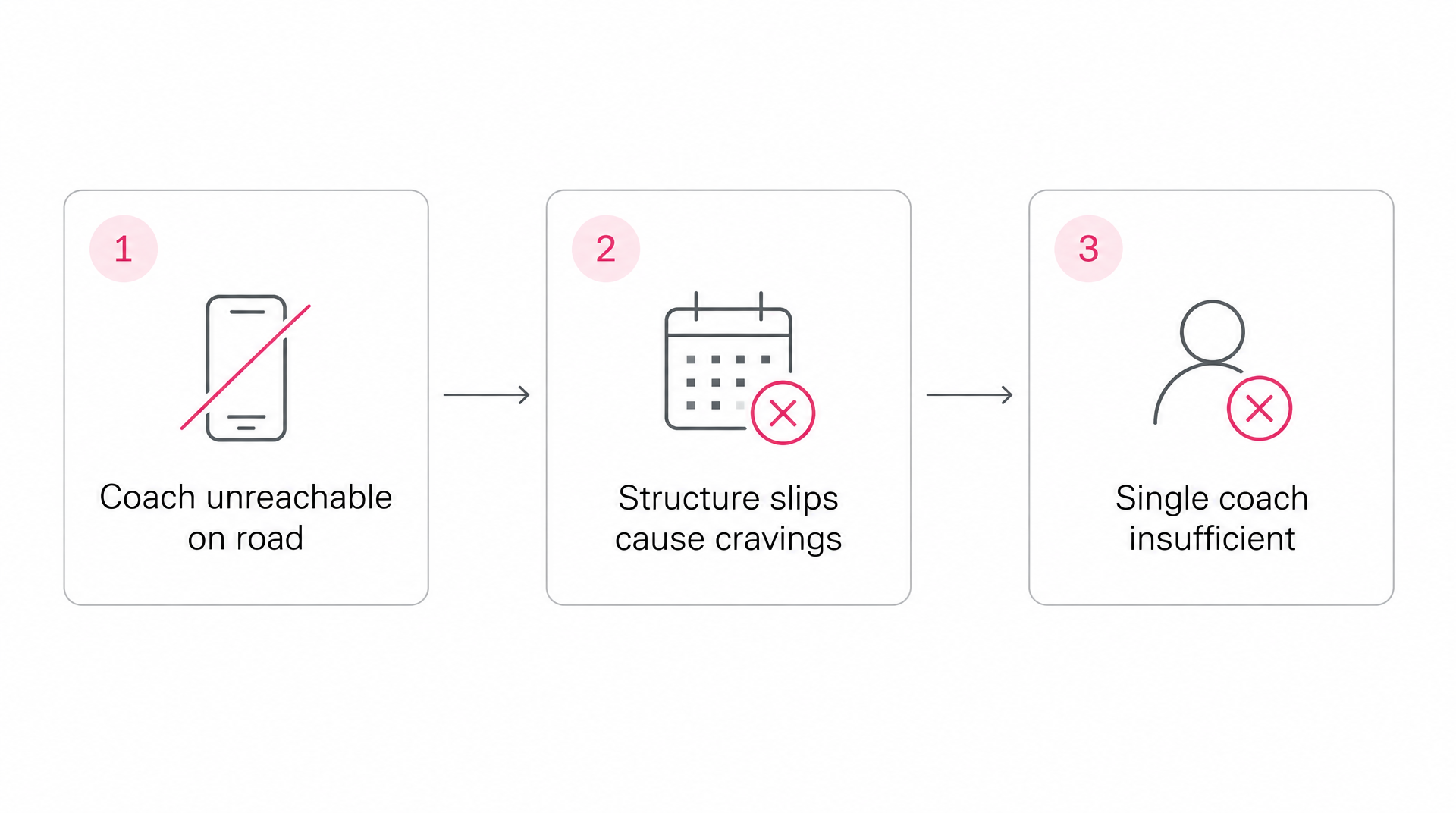
The most common issue is a coach who's easy to reach at home and invisible on the road. You build a rhythm, then you fly out and the calendar changes faster than the support plan. Our fix is to map the trip before you leave: flight times, hotel, events, and the moments you already know will be hard. The companion plan gets built around those pressure points, not around your normal week.
Structure Slips First, Cravings Follow
When a client tells us the cravings came out of nowhere, we usually find the structure went first. Skipped check-ins, no morning plan, a schedule with open blocks nobody accounted for. The craving didn't appear from nothing. The scaffolding just quietly came down.
We debug this by looking at the routine, not the willpower. What time did check-ins stop? Where did the empty pockets appear? A daily check-in and relapse plan exists so you're not improvising in a lobby, hallway, or rideshare when stress spikes.
One Coach Isn't Always Enough
The other frequent snag: the support doesn't scale to the situation. A single coach works for a normal week. A multi-day event with travel, family, and late nights can outrun one person's bandwidth.
That's when we shift from a single coach to a coordinated team, or add a travel companion for the high-risk stretch. If the same problem keeps recurring, that's the signal to change the structure, not to try harder inside a setup that already isn't holding.
Tools That Keep the Plan Portable
The right tools turn sober coaching after rehab from a good idea into a system you actually use. None of these replace a coach or your treatment team. They make the daily work lighter, and they keep your plan visible when your routine gets disrupted.
Travel is one of the settings where that visibility matters most, and it's one MADE Recovery covers directly through sober travel companionship.
A Travel Kit That Keeps Structure Portable
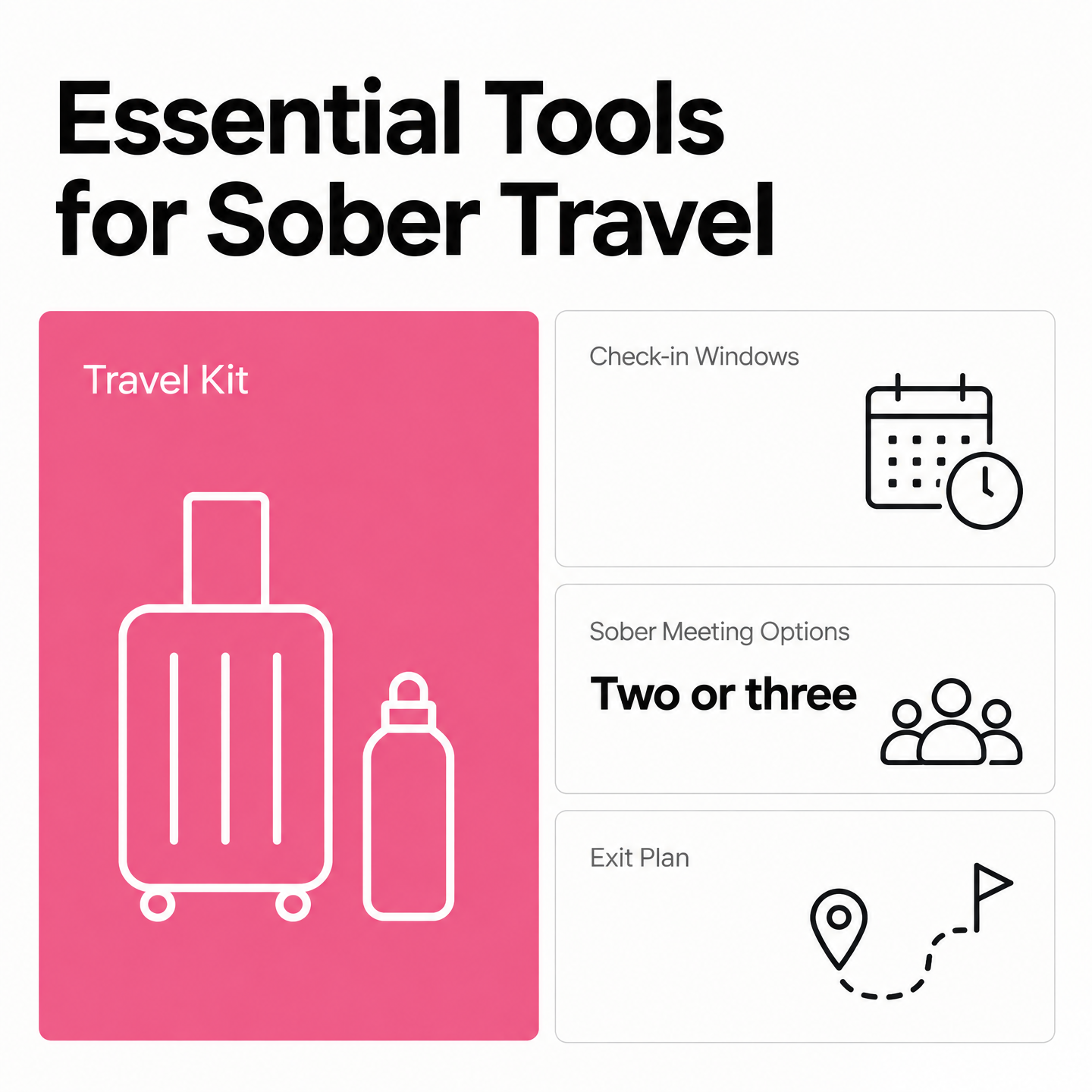
Sober coaching after rehab falls apart most often when the environment changes faster than the support does. A small kit fixes that. Before any trip, write out a simple plan you can pull up on your phone:
- A trigger map for the trip: flight times, layovers, the open bar at the reception, the client dinner
- Check-in windows set to your destination time zone, not the one you left
- Two or three sober meeting options near your hotel, located before you land, not at 9 p.m. when you need one
- A short list of exits: how you leave an event early without a speech, and who you text first
Pair that with a recovery app that logs mood and check-ins, plus the free national helplines you can reach from anywhere. The point is redundancy. When one layer slips, another catches you.
Reading That Sharpens the Decision
If you're still weighing whether coaching is worth it, a few honest breakdowns help more than another motivational post. Compare where a coach is strong, where meetings are strong, and where either option leaves you exposed in the first month home. MADE Recovery can talk you through both during an initial consultation, then help you build a plan around the level of support you actually need.
One caveat worth stating plainly: skip the app-only approach if travel is your main risk. A tracker on your phone does not walk you out of a hotel bar. That's the exact moment a real person on the other end of the line matters more than any tool.
Build the kit, then build the human backup behind it. The tools carry the routine. A coach carries you through the parts a checklist can't reach.
The Bottom Line on Sober Coaching After Rehab
Here's what we keep coming back to: the plan you built in treatment is only as good as your ability to run it when the room changes. Sober coaching after rehab exists to protect that plan in the messy stretch right after you leave, when structure is thin and triggers are easy to underestimate.
Most providers cover the home version of that job well. Where the support usually breaks is the road. A frequent traveler or an event attendee steps onto a plane, and the daily rhythm quietly disappears, right when the itinerary gets more demanding. That's why we treat sober travel companionship as part of coaching, not a separate add-on.
What Should Your Next Step Be?
Start by being honest about your calendar. If your next ninety days include a wedding, a work conference, or regular business travel, plan the support around those dates now. Don't wait for the trip to expose the weak spot.
Map the trip before you book the coach. Know your flight times, your high-risk windows, and who you check in with when the time zones shift. A coach who's easy to reach at home and silent on the road isn't enough for a traveler.
Then decide what level of support fits. Some people need one coach and steady check-ins. Others want a companion physically present for a specific high-stakes event. Our model flexes between the two as your needs change, so you're not locked into more or less than the moment calls for.
Where To Learn More
If you're still weighing your options, the best next step is a conversation. Call us to talk through your situation, and we'll help you build the right sober coaching program for you or your loved one, whether that starts with everyday companionship at home or travel support for the trips ahead. Coaching works because accountability has to match the setting, the timing, and the real pressure points. For travelers and event-goers, that means building support into the trip before the trip starts testing the plan.
References
[1] What Is a Sober Coach? | Benefits, Costs, and How to Choose One - https://futuresrecoveryhealthcare.com/alcoholism/what-is-a-sober-coach/
[2] Sober Coaching: How It Works, Key Benefits,… - Caron Treatment Centers - https://www.caron.org/addiction-101/treatment-advice/sober-coaching
[3] Peer Recovery Support Services and Recovery Coaching for Substance ... - https://pmc.ncbi.nlm.nih.gov/articles/PMC12811009/
[4] Effect of Peer Recovery Coaching on Relapse Prevention in Post-Re - https://www.longdom.org/open-access/effect-of-peer-recovery-coaching-on-relapse-prevention-in-postrehabilitation-patients-1103383.html
[5] A Pilot Randomized Controlled Trial Evaluating Peer Recovery Coaches ... - https://pmc.ncbi.nlm.nih.gov/articles/PMC12353338/
Questions People Ask
1. Can a sober coach diagnose conditions or manage my medications?
No. Medication decisions, diagnosis, and treatment planning belong with licensed clinical professionals. MADE Recovery provides coaching and companionship that stays in the recovery-support lane, which means we help with structure, accountability, communication, and practical follow-through while your treatment team handles clinical care.
2. How do I tell whether a coach is actually a good fit for me?
Pay attention to the first conversation. You should feel respected, not managed; challenged, not shamed; and clear about how the coach will communicate when pressure rises. Before committing to a trip or ongoing work, ask how they handle boundaries, family contact, privacy, emergencies, and coordination with existing providers.
3. I only travel a few times a year. Do I still need a full-time coach?
Probably not if travel is the main risk. Build support around the trips that matter rather than buying more coverage than your life requires. For some people, that means planning ahead for a conference, wedding, sales trip, or family visit and then returning to a lighter support rhythm afterward.
4. If I'm checking in daily, doesn't that mean I'm staying sober?
Daily contact is useful, but it is only one signal. The better question is whether your actual behavior is lining up with the plan: sleep, meetings, honest communication, avoided triggers, and quick repair when something slips. A check-in is most valuable when it leads to a concrete adjustment before the day gets away from you.
5. What's the practical difference between a sober coach and a live-in companion?
A live-in companion provides continuous presence in your environment, which can make sense when someone needs close support early on. A coach is less intensive and usually works through scheduled contact, planning, and availability when a problem comes up. The right choice depends on how much structure you need and where the risk is showing up.
6. Is a recovery app enough to keep me on track when I travel?
An app can help you notice patterns, log check-ins, and keep a plan visible. It should not be the whole safety net if travel is where you struggle. Use digital tools as one layer, then add human support for the moments when a reminder, mood log, or checklist cannot interrupt the decision in front of you.
7. What should I do if I'm carrying serious mental health needs alongside recovery?
Keep your clinician involved and make sure everyone understands their role. A coach can support routines, communication, and follow-through, but serious mental health needs require appropriate clinical care. The safest setup is coordinated support, with coaching reinforcing the plan rather than operating separately from it.