Your Recovery Coach and Counselor Do Different Jobs: Split Them Right
September 28, 2026

Before we get into it, the short version:
- A recovery coach gives you peer accountability and daily structure. A counselor handles clinical assessment, diagnosis, and substance use treatment.
- Coaches usually hold CPRS or NCPRSS credentials and lived recovery experience. Counselors carry state licenses, and personal recovery history is not required.
- Peer support research is encouraging but unsettled. Substance-use findings are often modest and limited by study design.
- Recovery moves through four post-treatment stages: assessment, stabilization, integration, and independence. Coaching helps most in the later two.
Coach or counselor? Get this wrong and your trip pays for it
Pick the wrong kind of support for a long trip, and the mismatch shows up fast. Hire someone for accountability and expect counselor work, or use a counselor when you need a peer beside you on the road. Neither choice works well. Travel is where this gets tested, because a sober travel companion is the clearest real-world version of the split.
One distinction should drive the decision. A counselor assesses, diagnoses, and treats a substance use disorder. A coach draws on their own recovery to keep you moving day to day. Sober coaching after rehab lives in that second category. Your travel companion is a coach, not a counselor, and blurring the two puts both the trip and your recovery at risk.
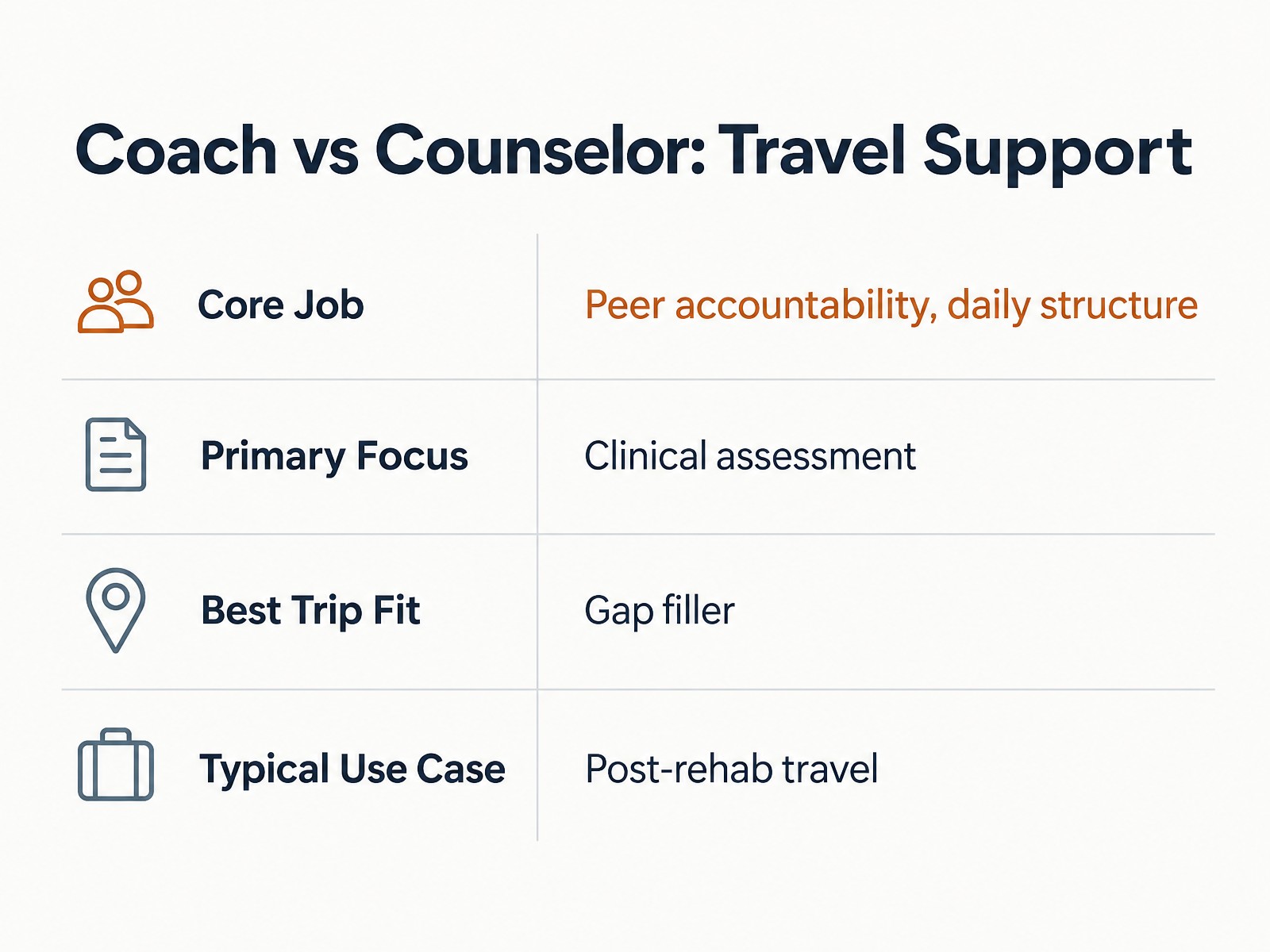
A travel companion is a coach, not a counselor
A sober travel companion is a peer who provides real-time accountability and course correction on the road. Not clinical assessment. Not trauma work. That maps directly onto the recovery coach role, which is practical, motivational, and non-clinical by design.
You do not bring your counselor on a trip, and you should not try to recreate one. As Hazelden Betty Ford explains, peer specialists do not provide counseling at all. Their job is to be living proof that recovery works and to help you advocate for yourself. On a trip, that means noticing a rough moment and helping you adjust, not diagnosing why it happened.
| Factor | Sober travel companion (coach) | Addiction counselor |
|---|---|---|
| Credential | CPRS / NCPRSS, personal recovery required | State license/certification, recovery not required |
| Core job | Peer accountability, daily structure | Assessment, diagnosis, treatment |
| Availability | Between sessions, on the road | Scheduled sessions |
| Best trip fit | Yes, travels with you | No, stays in clinical setting |
The timing that makes coaching worth it
Long trips tend to land in the exact window where coaching pays off most. Our sober coaching is built for the stretch after detox or residential treatment, when structure fades and real-world challenges return, but formal counseling has already tapered off. That transition is where relapse risk stays real and daily accountability matters most.
If your trip falls in that stretch, a companion fills the gap counseling leaves. That's the strongest case for the role. We help clients map a trip against their recovery plan before they book.
Where the evidence is genuinely thin
The research on peer support is promising, but it is not settled. Broader reviews of peer providers in behavioral health call the evidence encouraging and still developing, with substance-use findings that are often modest and limited by study design. There is real signal here. The clinical proof is not complete yet.
Which is exactly why a companion should complement a counselor, never replace one. Our coaching, companionship, and travel support are nonmedical by design. If a trip surfaces something clinical, a good coach helps get you to a licensed professional that day.
Match the support to your recovery stage
The cleanest way to pick support for a trip is to know where you are in recovery, then match the role to the phase. Most people move through four rough stages after detox or residential care: assessment, stabilization, integration, and independence. Each leans on a different kind of help, and a long trip almost never lands in the first two.
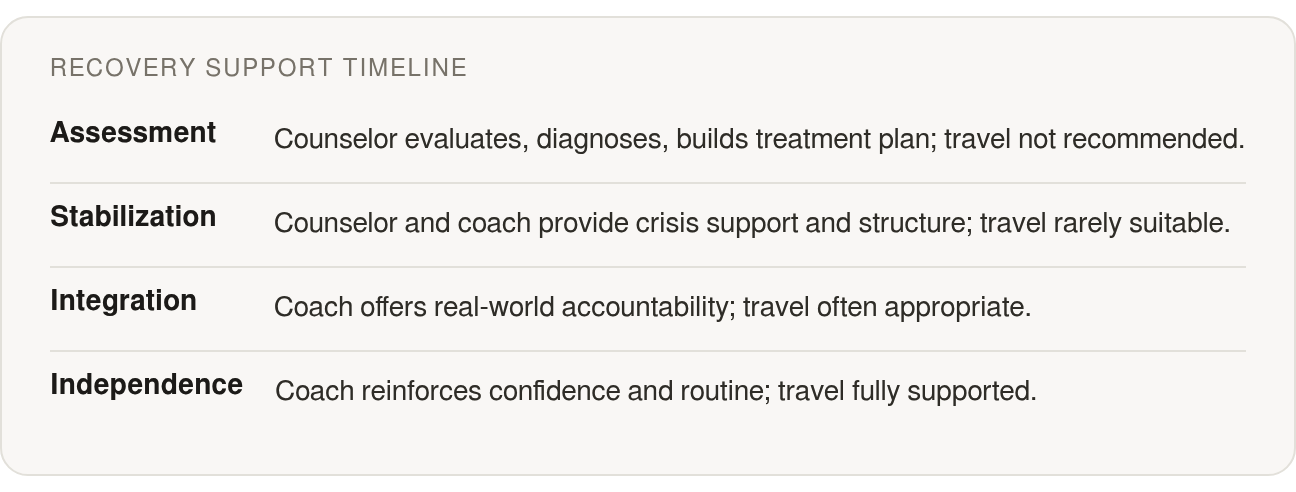
Sober coaching after rehab does its best work later in that arc. A counselor is most intense early, when you need an assessment and a treatment plan. Coaching climbs in value once the clinical scaffolding comes down and you're trying to live the plan in the real world.
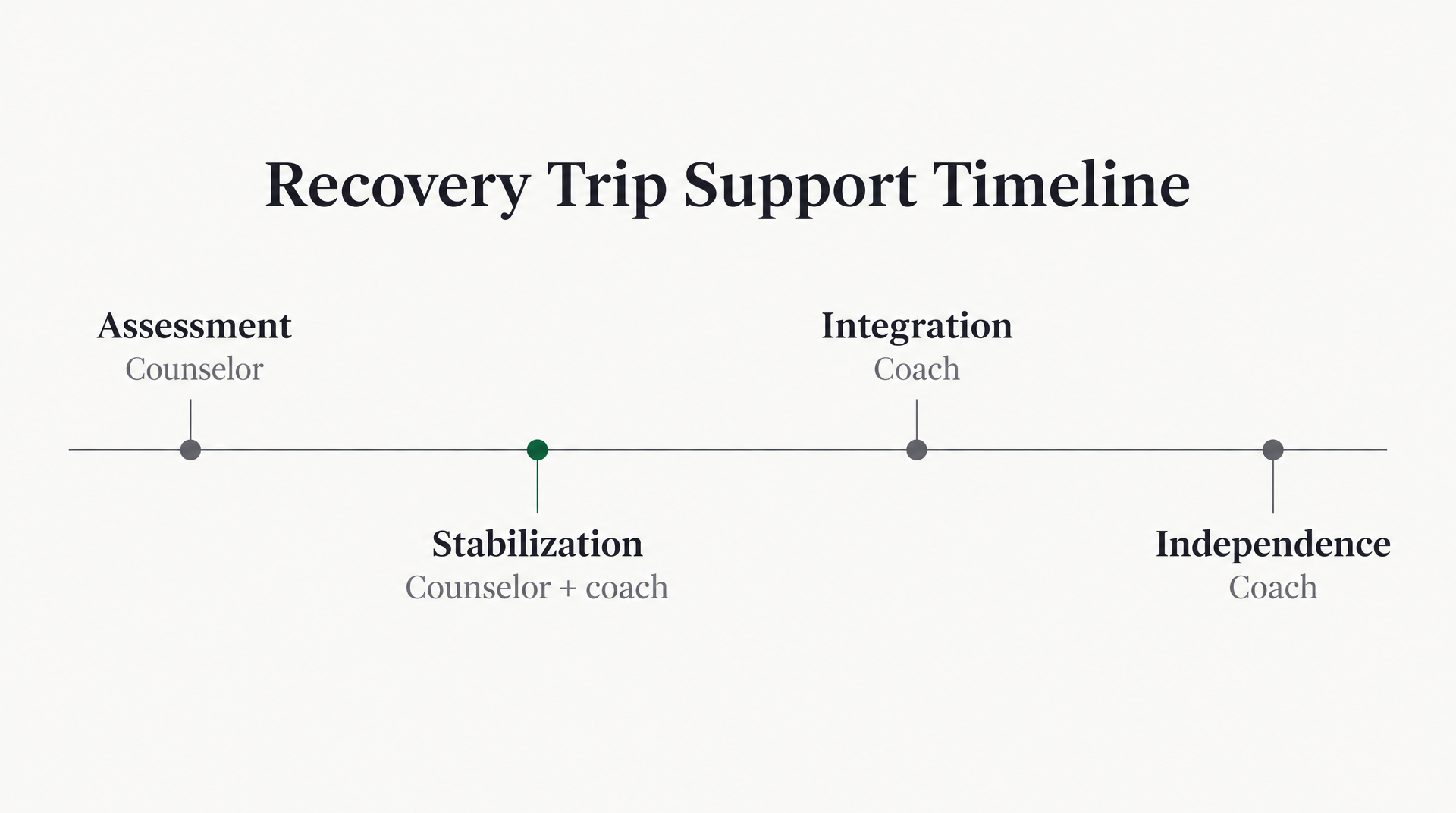
Which stage calls for a counselor, and which calls for a coach?
Assessment and stabilization are clinical territory. This is where a licensed counselor runs an evaluation, arrives at a diagnosis, and builds a treatment plan, as Accountable's role comparison lays out. If you're still in this window, a trip is usually the wrong call, and a travel companion can't fill the gap.
Integration and independence are where a coach earns their keep. Early on, the coach focuses on daily structure and crisis support, then shifts toward confidence and a routine you can sustain, per Power of Recovery's coaching guide. That later focus is exactly what travel tests.
| Recovery stage | Primary need | Who leads | Trip-ready? |
|---|---|---|---|
| Assessment | Evaluation, diagnosis | Counselor | No |
| Stabilization | Crisis support, structure | Counselor + coach | Rarely |
| Integration | Real-world accountability | Coach | Often |
| Independence | Confidence, routine | Coach | Yes |
Here's where the decision turns practical. If your counselor is still building the treatment plan, travel adds complexity before your foundation is ready. If you're already practicing that plan at home, a MADE Recovery companion can help carry the same structure into airports, hotels, family visits, work events, and unfamiliar routines.
When the red flags mean clinical care, not a companion
Some signs mean stop planning the trip and call a clinician. Untreated co-occurring conditions, active suicidal thinking, or a body still working through withdrawal are clinical problems. A coach's job in that moment is to get you to a clinician that day, and to 988 if there's danger. Not to treat it.
Travel can make hidden strain easier to see. Sleep disruption, isolation, family pressure, or easy access to alcohol may expose problems that felt manageable at home. If those problems are clinical, the right move is escalation, not a heavier coaching plan.
Our position is direct. Bring the coach on the road. Don't try to recreate your counselor there. Before you go, it helps to have the clinical side settled with your counselor, so your companion can focus on real-world support and accountability throughout the trip.
Counselor, coach, and MADE Recovery, side by side
Line up the three kinds of support and the differences that matter for a trip jump out fast. A licensed counselor treats the disorder. An independent coach keeps you moving day to day. Our work at MADE Recovery sits squarely in that second lane, and sober coaching after rehab is the kind of support a traveler needs once the clinical scaffolding comes down.
Most guides muddy the decision by treating every support role as interchangeable. On the road, the question is narrower: who can be physically present, reinforce the plan, coordinate with family, and respond without crossing into therapy? That's the lane where a travel companion makes sense.
The comparison that actually matters on the road
| Option | Credentials | Primary Focus | Typical Settings | Cost / Payment | Best Fit |
|---|---|---|---|---|---|
| Licensed counselor | State licensed or certified (CASAC, LCADC, LCSW) per this credentials guide | Assessment, diagnosis, treatment | Clinic, IOP, private practice | Often insurance-billable | Assessment and stabilization |
| Independent sober coach | Certified peer (CPRS, NCPRSS), in recovery | Accountability, daily structure | Phone, video, in person | Private-pay | Solo accountability |
| MADE Recovery | Nonmedical sober coaches | Coaching, companionship, routine, family coordination | Virtual or in person, including travel | Nonmedical, tailored programs | On-the-road support for a long trip |
Why a team beats a single freelance coach
A freelance coach gives you one person. When they are asleep, on a plane, or off the clock, your coverage is gone. Our team-based approach keeps continuity running, which matters most on a trip that crosses time zones or stretches past a single coach's day.
We build the trip around routine, family coordination, and a companion who travels with you instead of a voice on a weekly call. The team-based model means coordinated, nonmedical support that holds steady even as one coach steps back. Guidance, accountability, and human connection, not clinical treatment. The line stays clear: counselors handle assessment and clinical care, and our coaches handle day-to-day execution, the routines and accountability of real life.
The limit still holds. Stronger support logistics do not turn coaching into healthcare. If the issue belongs in therapy, psychiatry, detox, or emergency care, the travel plan has to route the client there rather than manage it inside the companion relationship.
The mix-ups that trip people up
- A coach can diagnose or adjust meds. They can't. That's clinical work, reserved for a counselor.
- Accountability means punishment. It doesn't. Power of Recovery frames it as noticing when you slip and course-correcting.
- Your companion is a stand-in therapist. Wrong role. Keep clinical questions with your counselor and let the re-entry plan cover the rest.
If you need structured, day-to-day accountability on a long trip after treatment, a coach-based travel companion is the right call, and our team is built for exactly that job.
Building a dual-support plan that holds up
A dual-support plan sounds complicated until you strip it to one question: who owns what? Your counselor owns the clinical work. Your coach owns day-to-day accountability. On a long trip, that split gets tested in real time, because your travel companion functions as the coach in the pairing, not a stand-in for the person treating your disorder.
Sober coaching after rehab does its best work when it feeds back into the clinical picture instead of running in a separate lane. The connective tissue is consent. With your written permission, a coach can coordinate with your counselor and your family, relaying what they see on the road so nobody is guessing. That coordination, done with the member's sign-off, is a normal part of how the two roles work together.
The split that keeps both roles honest
Before you book anything, map the tasks. A clear division isn't bureaucratic. Research on peer integration found that clearer role delineation improves collaboration and cuts confusion between clinical and non-clinical providers.
| Task | Counselor | Travel companion (coach) | Shared, with consent |
|---|---|---|---|
| Assessment and diagnosis | Yes | No | . |
| Treatment plan and homework | Writes it | Reinforces it | Progress updates |
| Real-time accountability on the trip | No | Yes | . |
| Objective check-ins (breathalyzer, screening) | Reviews results | Runs them | Positive result relayed |
| Crisis escalation | Treats | Gets you to a clinician, or 988 | Alerts both |
The row that matters most for travel is real-time accountability. That's peer work, and it lands squarely in the coach's job.
How coaching reinforces the plan on the road
A good companion does not invent their own program on the road. They carry your counselor's homework forward. If your clinician assigned trigger mapping before you left, the coach checks in on it at the airport bar or the hotel minibar moment, then reports back.
This is where two philosophies of accountability collide. One view treats it as gentle course correction, noticing when you slip rather than policing. The other layers in objective monitoring the member can't opt out of. My read: the right dial depends on trip risk. A high-stakes destination justifies more objective data than a coach's default supportive stance. A counselor works from what you report during a session. A coach beside you can observe what happens in real life and relay it back with your consent.
The boundary is what keeps the plan safe. Peer support is not a substitute for clinical care, so the coach should reinforce the treatment plan without rewriting it. If new clinical concerns appear, the answer is not more coaching intensity. It's a handoff back to licensed care.
Taper the coaching as your independence grows
The plan should shrink over time. Coaching delivers its peak value in the months after treatment ends, when clinical contact has tapered but relapse risk stays high. As you string together stable trips, dial back the check-ins.
Start a trip with daily touchpoints, move to a morning-and-night rhythm, then to a single anchor call once you've proven you can handle triggers solo. We build these plans with families too, and our approach to a family re-entry plan uses the same taper logic. The goal is a companion you eventually do not need packed for every trip.
References
[1] Recovery Coach vs. Addiction Counselor: Credentials, Scope, and ... - https://www.youareaccountable.com/guides/recovery-coach-vs-addiction-counselor
[2] What Does a Recovery Coach Do? - Role, Benefits & Support Guide - https://powerofrecovery.org/blog/what-does-a-recovery-coach-do/
[3] Peer Recovery Specialist vs. Addiction Counselor - https://www.hazeldenbettyford.org/graduate-school-addiction-studies/recovery-specialist-vs-addiction-counselor
[4] [PDF] Peer Integration and the Stages of Change ToolKit - https://mopeerspecialist.com/wp-content/uploads/2018/09/PeerIntegrationToolKit-DigitalFinal.pdf
[5] Overcoming Barriers to Integrating Peer Support in Mental Healthcare ... - https://behavioralhealthnews.org/overcoming-barriers-to-integrating-peer-support-in-mental-healthcare-systems/
[6] A Systematic Review of the Roles and Contributions of Peer Providers in ... - https://www.sciencedirect.com/science/article/abs/pii/S0749379721002671
[7] Chapter 2—Roles of the Peer Worker - NCBI - https://www.ncbi.nlm.nih.gov/books/NBK596269/
FAQ
Can my recovery coach talk to my counselor while I'm traveling?
Yes, but permission comes first. The cleanest version is agreed on before departure: what can be shared, with whom, and under what circumstances.
What credentials should I look for when hiring a sober travel companion?
Ask whether the person is trained for peer support rather than therapy. The credential matters, but so does whether they understand scope, travel logistics, relapse prevention planning, and when to escalate to licensed care.
Is peer coaching proven to work as well as clinical treatment?
No. Coaching belongs beside clinical care, not in place of it. Use it for structure, accountability, and recovery support in daily life, while keeping diagnosis and treatment with licensed professionals.
I'm only a few weeks out of detox and want to take a trip. Is that safe?
Treat that as a clinical question first. Before committing to travel, ask your treatment team whether the timing, destination, schedule, and support plan fit your current stability.
What happens if a mental health crisis comes up mid-trip?
The companion shifts from routine support to escalation. That means helping you access appropriate care immediately and keeping the agreed emergency contacts informed according to the plan.
How is MADE Recovery's model different from hiring a freelance coach?
MADE Recovery is built around coordinated support rather than a single-person arrangement. That matters when travel creates long days, changing schedules, family involvement, and the need for continuity.
Does having a coach mean someone is policing my every move?
No. The job is to help you stay aligned with the plan you already chose. The level of structure should match the risk of the trip and be discussed in advance.
How long should I keep a coach for my trips?
Keep support as long as it is helping you build capacity, not dependency. A good plan gives you enough structure for the next trip while also creating a path toward traveling with less support over time.