What a Sober Coach Actually Costs, and When the Spend Pays Off
September 28, 2026

Key Takeaways
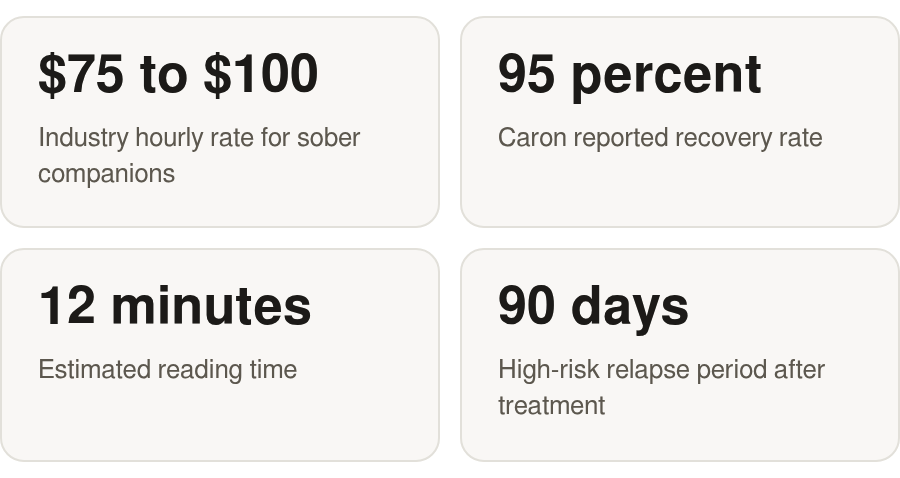
- Between 65 and 70 percent of people relapse within the first 90 days after leaving treatment, the stretch where structured support matters most.
- Most insurance plans treat sober coaching as an out-of-pocket expense, which puts the cost of relapse prevention on families directly.
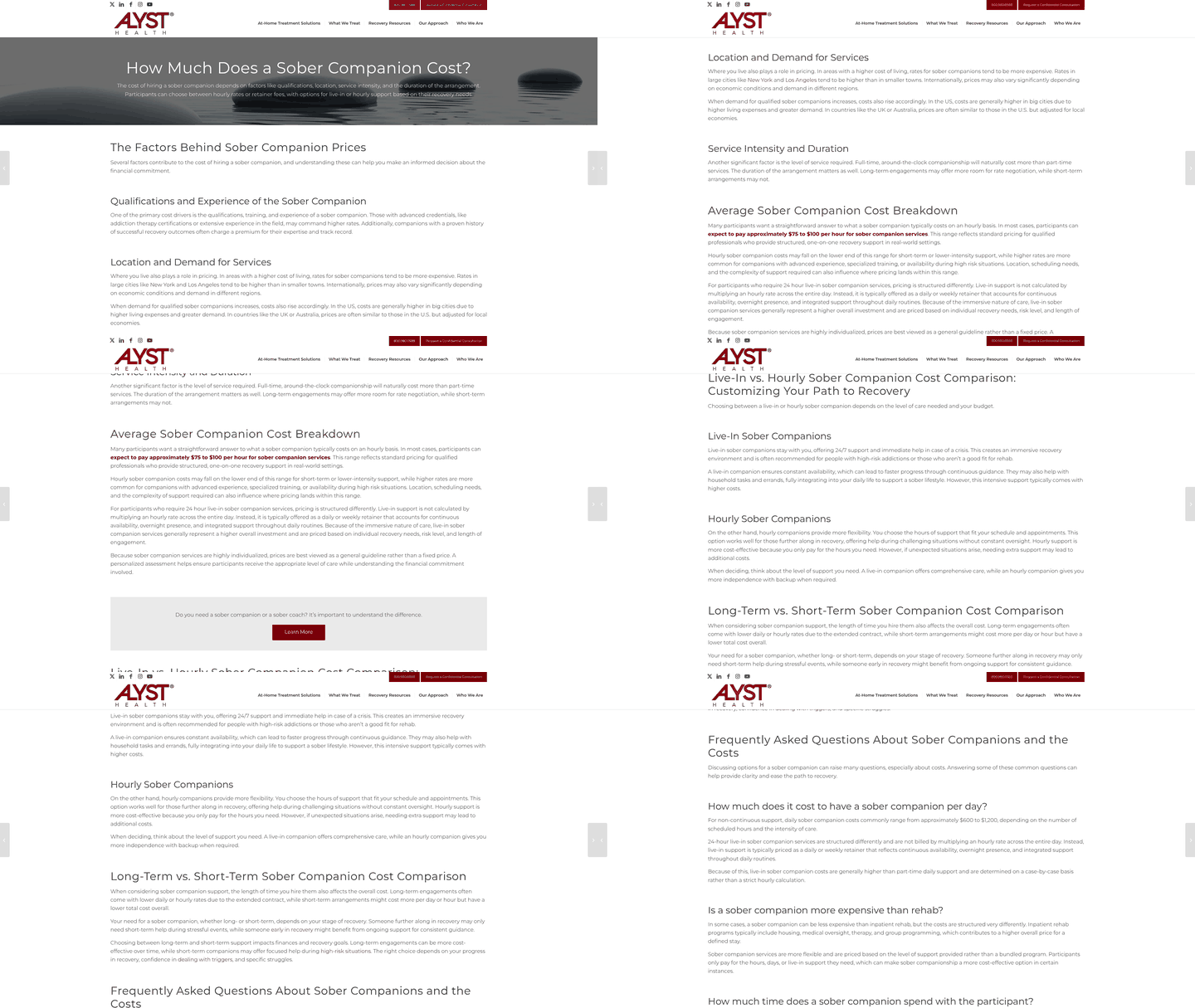
- Hourly rates for sober companions vary widely, offering a budgeting benchmark.
- Dozens of coaching hours can cost less than a single relapse-driven readmission, according to the break-even math in this guide.
- Caron reports a 95 percent recovery rate, a figure this article ties to how coaching is structured rather than the hourly price alone.
The Number Most Cost Guides Leave Out
Most guides on sober coaching after rehab give you a price range and stop there. We wrote this one because the number families actually need rarely shows up in those articles: what a relapse costs when no coaching is in place. That absence is the reason this guide exists.
The hard part usually reveals itself after discharge. The highest-risk stretch is also the one where practical, structured support gets treated as something families have to arrange and pay for on their own. So this guide looks past the sticker and asks a different question: can the spend head off a much larger one?
What you'll actually get here
This guide breaks down the economics of hiring a sober coach after treatment, not just the going rate. You'll see how the pricing models work, when the spend is justified, and when it isn't. We also walk through the break-even math that links coaching hours to the relapse costs they may help avoid.
| What This Guide Covers | Details |
|---|---|
| Who it's for | Families and individuals planning aftercare, and anyone weighing coaching cost against relapse risk |
| Core benefit | A clear ROI framework, not a vague price range |
| Sections included | Pricing models, when coaching pays off, coverage gaps, how to vet a coach |
| Time to read | About 12 minutes |
| Difficulty | Beginner friendly, no clinical background needed |
Why the ROI angle changes the answer
The cost conversation usually runs backward. People ask what coaching costs before they ask what a relapse costs. Flip the order and the math looks different.
Judged hour by hour, a private coach or companion can look expensive. The better comparison is the full support plan against the cost of a return to treatment, a failed transition home, or a preventable spiral that takes work and family life down with it. Research on long-term post-treatment peer recovery support points to this kind of support as cost-effective over time, which is the side of the ledger most price guides skip.
Priced honestly, coaching is prevention, not a luxury. That's why our support shows up where risk runs highest, at home and while traveling, through everyday sober companionship and sober travel companions.
Is this guide for you?
If you already have therapy, community, and routine holding steady, you can probably skip it. Futures Recovery Healthcare makes the fair point that not everyone needs coaching, and we agree. Plenty of people build durable recovery without it.
This guide earns your time when follow-through is the gap, not knowledge. If the risky hours are evenings, weekends, or travel days, that's where structured support does the most work per dollar. Our own view: coaching gets undervalued because the person paying the invoice isn't always the one avoiding the bigger downstream cost.
For a practitioner's look at what that daily support looks like, our breakdown of sober coaching after rehab pairs well with the cost sections ahead.
What a Sober Coach Actually Does
Most people picture a single coach and a weekly phone call. That mental model is where the money conversation goes sideways. Sober coaching after rehab isn't one service. It's a set of roles with different jobs, and knowing which role does what changes how you read a price tag.
A sober coach is a nonclinical recovery professional. As Futures Recovery Healthcare explains, the work is implementation: turning a treatment plan into daily action when real life pushes back. We're not doctors, and coaching doesn't replace therapy or medical care. What we do is hold the structure and accountability that keep the plan from falling apart in the first vulnerable weeks home.
Coach, companion, sponsor: three different jobs
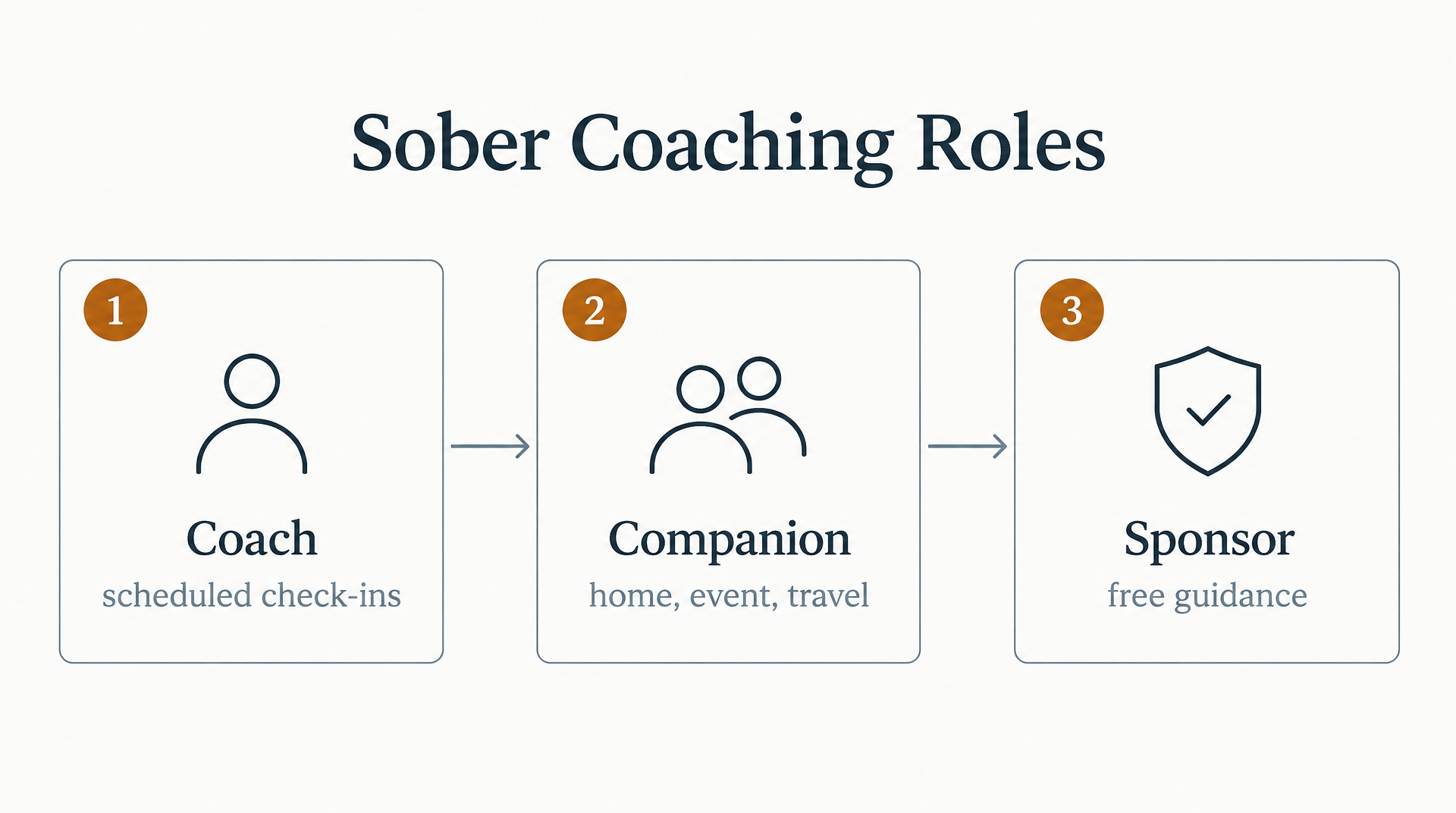
These get blurred constantly, and the confusion costs families money. A sponsor guides you through a recovery pathway for free. A therapist treats mental health clinically. A coach does neither. We work the space between the treatment center and your kitchen table.
The companion piece is where our model differs. Coaching means scheduled check-ins that build routine and accountability. Companionship means someone by your side at home, at a social event, or on a trip. Both matter. A team-based approach layers them: coaching for routine, plus everyday or travel companionship during the hours when relapse risk actually spikes. Evenings. Weekends. A work trip. A wedding with an open bar.
Why the structure matters more than the hourly rate
Early outcomes can look excellent while active support stays in place right after treatment. The harder test comes later, once residential structure is gone and the person has to rebuild ordinary life in ordinary settings.
That's where sustained companionship earns its keep. Treatment gains can weaken when the support around them disappears. A good plan protects the money already spent on rehab by carrying structure into the home, the calendar, and the social situations where recovery is actually practiced.
So evaluate the model, not the sticker. Futures argues that the pricing structure, what's on-call, what's packaged, what's included, matters more than the headline figure. Peer and companion support works because it spreads real contact across the highest-risk windows instead of one weekly slot. A home-and-travel team is built around exactly those windows.
That reframes "expensive per hour" into "reasonable per outcome." When you price coaching, count the full episode of support against the cost of one readmission, not the rate on a single call.
One caveat, said plainly: not everyone needs this. Many people rebuild with therapy, community, and routine alone. The right level of support is the minimum that keeps you stable and moving forward.
Core Features
The features that matter most in sober coaching after rehab are the ones that show up when a treatment team is offline. Evenings, weekends, and travel days are when structure collapses and old patterns creep back. Our model is built to cover those windows, not just book a weekly call.
That coverage is where a team-based, home-and-travel approach separates from a single coach checking in by phone. When support follows you into the airport, the family dinner, or the first Monday back at a high-pressure job, the plan gets tested in the exact settings where it usually breaks.
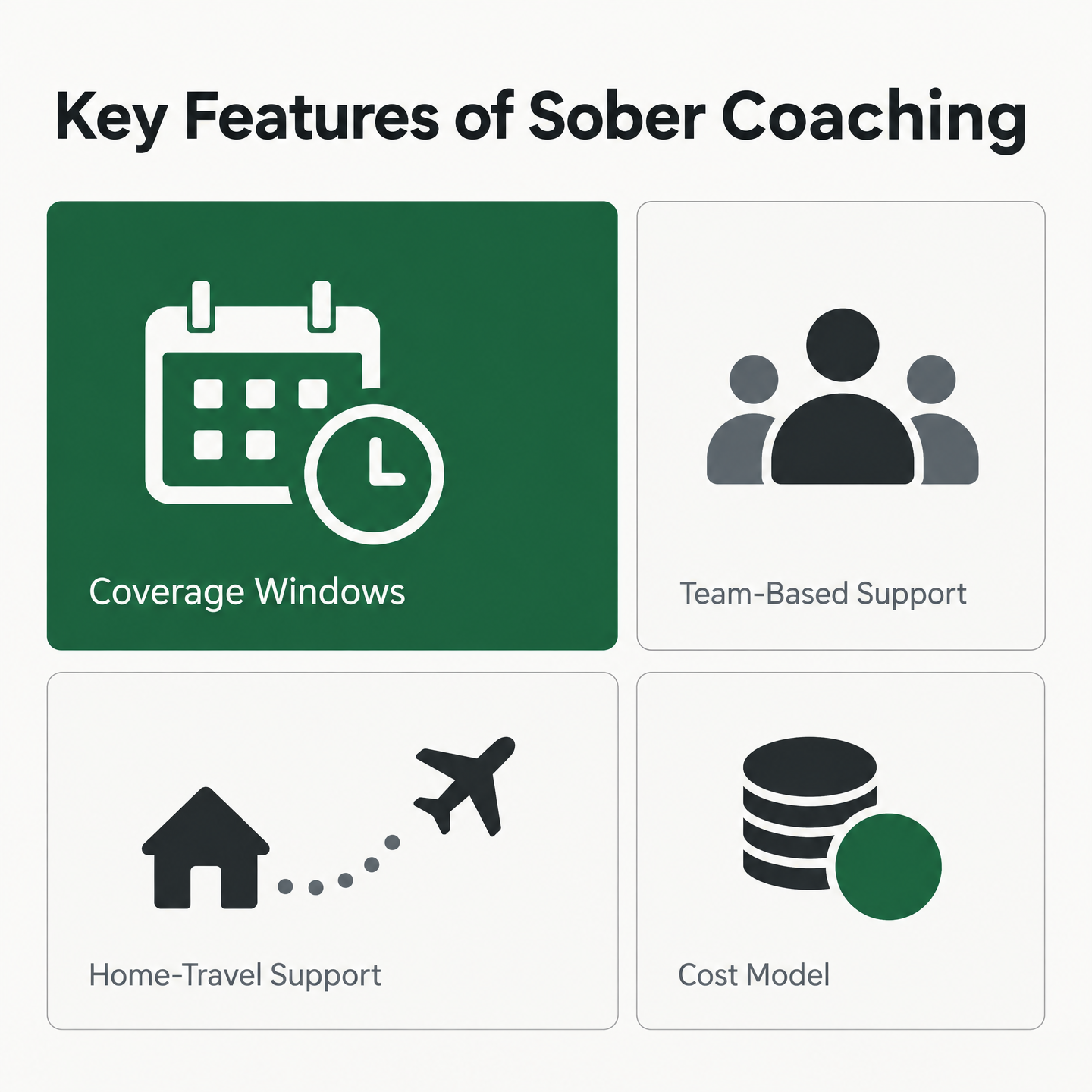
Team-based support keeps someone in reach
The capabilities that matter are practical and grounded in daily life. Futures Recovery Healthcare describes sober coaching as building realistic routines, practicing relapse prevention, and helping people apply what they learned in treatment once they're back in real life. We build around those fundamentals, then offer either a single dedicated coach or a coordinated team so no one is left with only one point of contact.
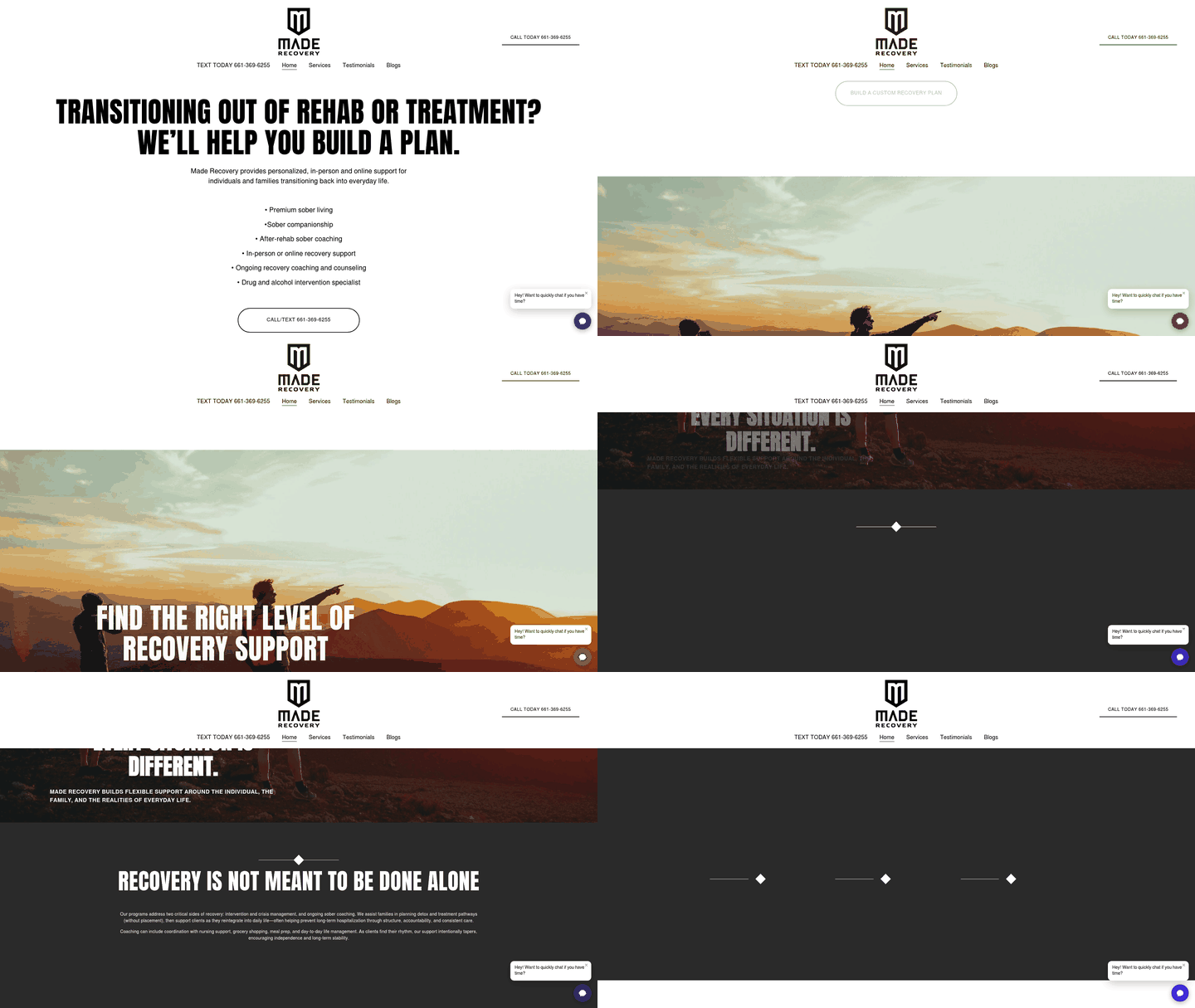
A team model also fixes a quiet failure point. One coach gets sick, travels, or burns out, and support can thin out at the worst moment. Rotating, coordinated companionship keeps accountability continuous. We're a nonmedical recovery support provider, so this sits alongside therapy and medical care rather than replacing it.
Judge the cost by the full episode, not the hour
The question isn't just "What does one hour cost?" The better one is "What does the plan cover when life gets unstable?" That includes response time, coordination, travel support, family communication, and how hours are spread across the week.
A study on peer recovery support services points to the value of support delivered across the full post-treatment period, not a single isolated touchpoint. So when you hear "expensive per hour," ask what the full episode delivers. A home-and-travel team puts contact where the transition is most exposed, which is exactly where it has to land.
Our sober coaching resources go deeper on what those daily touchpoints look like when no one is in crisis.
The coverage paradox families get stuck with
Two findings sit in tension. Coaching is commonly treated as a private-pay service, while long-term post-treatment peer recovery support has been found cost-effective from the payer's perspective.
Read those together and the conclusion is hard to dodge. The economics may support structured recovery help, but the funding system often lags the need. Families end up paying for the layer of accountability that can protect the much larger investment already made in treatment.
Best Practices
The best practices for sober coaching after rehab aren't about spending more. They're about spending where relapse risk is highest, so the money buys prevention instead of cleanup.
The pattern we lean on is simple: more support during the transition home, then less as routines become reliable. Early is when the return on the spend is largest, because early stability can keep the most expensive consequences from ever entering the picture.
How to get the most out of the spend
Match coverage to the calendar, not to a flat weekly rate. The riskiest hours are often the ones least served by standard appointments. Concentrate support around those pressure points and you get more protection per dollar than a routine check-in that misses the actual danger zone.
Build a written relapse plan before day one at home. We help clients map their specific triggers, the people they call, and the steps that follow a hard moment. A plan that lives only in someone's head is the plan that fails when stress is high and everyone is tired. Our guide on daily check-ins and relapse plans walks through what that structure looks like.
Loop the family in early. When families know their role, they stop guessing and stop absorbing the emotional and financial cost of every wobble alone. That shared visibility is where team-based support quietly pays for itself.
When coaching is the wrong spend
Skip intensive coaching if someone still needs active medical care or detox. That's clinical work, and we're a nonmedical support team. Pushing coaching into that gap wastes money and delays the care that actually matters.
Also skip the premium home-and-travel model when a client is stable, months into recovery, and holding routines without help. At that point a lighter touch is the fair recommendation. Paying for high-coverage support you no longer need isn't ROI. It's a bill.
The spend pays off when it's timed to risk and tapered to progress. That's the whole discipline.
Comparison with Alternatives
When families weigh sober coaching after rehab against the alternatives, the comparison usually gets framed as coaching versus therapy versus a support group. That framing misses the point. These aren't competitors. They solve different problems, and the fair way to compare them is by what each one covers.
Therapy and clinical treatment handle diagnosis and the medical side of recovery. Support groups give you a peer community for free. Coaching does what neither does well: it holds daily structure during the unsupervised hours. So the useful question for a sober coach after rehab isn't "which is best" but "which gap are you covering, and what does leaving it open cost you."
Where each option earns its keep
A weekly therapy hour isn't built to catch an urge that hits between appointments. A free support group meets on its own schedule, not yours. Both matter, but neither is designed to stand beside someone in the exact moment a treatment plan is being tested.
That's the distinction Caron draws between a coach and a companion: a sober coach checks in throughout the week, while a companion stays physically present. Our team-based, home-and-travel model sits between the two. You get presence during the high-risk windows without paying for around-the-clock live-in coverage you may not need.
Skip intensive coaching if the person is stable months into recovery and their triggers are well managed. The case for more support is strongest during transition and known stress, not indefinitely.
The risk window other guides skip
The stretch right after treatment changes the comparison. Once residential structure falls away, the person is back inside the same home dynamics, job stress, travel demands, and social cues that may have shaped the addiction in the first place. That's the window coaching is built to cover.
A relapse rarely stays contained. It can mean another treatment episode, another admission, another round of the most expensive events in the recovery timeline. Coaching works to hold structure and accountability through the period where those events tend to cluster. You're not just buying hours. You're working to buy down the odds of the most costly post-discharge scenario.
The coverage gap working against families
A contradiction sits at the center of this market. Structured support can be most useful during the transition out of treatment, yet families often have to make the case for funding it themselves.
That leaves them carrying a cost during the very window where consistent accountability matters most. It also means the decision often gets made under pressure, after a discharge date is set and everyone is scrambling to build a plan.
One more mismatch worth naming. Treatment can look solid at discharge, then erode as everyday life returns. The gap between an encouraging early result and a shaky longer-term one is exactly where sustained companionship does its work. If you're pricing alternatives, price that gap too.
Troubleshooting
Even a well-built plan hits friction in the first weeks home. When sober coaching after rehab stalls, it usually traces back to one of a few predictable problems. Naming them early is how you protect the spend instead of watching it leak.
One to watch: coverage that maps to convenience, not risk. Families book support when everyone is available, then find the real pressure hits at inconvenient times. The fix is boring but effective. Move the hours to where the danger actually sits, even when that means odd times.
Why the support feels like it stopped working
Usually because it tapered too fast. String together a few good weeks and the instinct is to cut back. Sometimes that's right. Sometimes it pulls structure away right before a known stressor, like a court date, a job start, or a family holiday.
Before you reduce hours, look ahead for any event likely to unsettle the routine. If a high-risk commitment is coming, hold coverage steady through it. Saving a few sessions is no win if support disappears right before the moment it was meant to cover.
The handoff gap
A quieter failure is the space between a treatment team and daily life. The clinical plan lives in one place, the person lives in another, and nobody owns the ground between. That's where quiet relapse grows. Our team-based approach is built to close it, so no single missed check-in leaves someone alone.
Two more problems worth flagging:
- One coach, one point of failure. If your only support person is unavailable, coverage can thin out fast. A team keeps someone in reach.
- No written relapse plan. Without one, warning signs get debated in the moment instead of acted on.
Our scope limit, said plainly: if someone is in active medical withdrawal or needs a diagnosis, coaching is the wrong tool. That's medical care, and we're not doctors. Coaching holds the daily structure around that care. It doesn't replace it.
Resources and Tools
The resources that help most with sober coaching after rehab are the ones that make cost visible before you commit. Most families start blind, guessing at rates and hoping the plan holds. A little upfront research changes the math.
Start with an independent coaching directory. Sites like Recovery.com's California listings publish hourly ranges out in the open, so you can see that private recovery coaching often runs between $150 and $400 per hour before you ever pick up the phone. Seeing that spread early lets you plan coverage around your riskiest hours instead of getting surprised by an invoice.
Tools that put a dollar figure on prevention
The single most useful document for a family or insurer is a written cost comparison: what concentrated support costs versus what a setback might cost. You build it with two inputs. One is the hourly range from a directory. The other is peer-reviewed cost data on recovery support.
The cost-effectiveness research on long-term peer recovery support is worth reading if you want to argue the ROI case. It frames post-treatment support as a spend that can offset more expensive downstream care. That's the framing that moves a coverage conversation away from vague need and toward practical numbers.
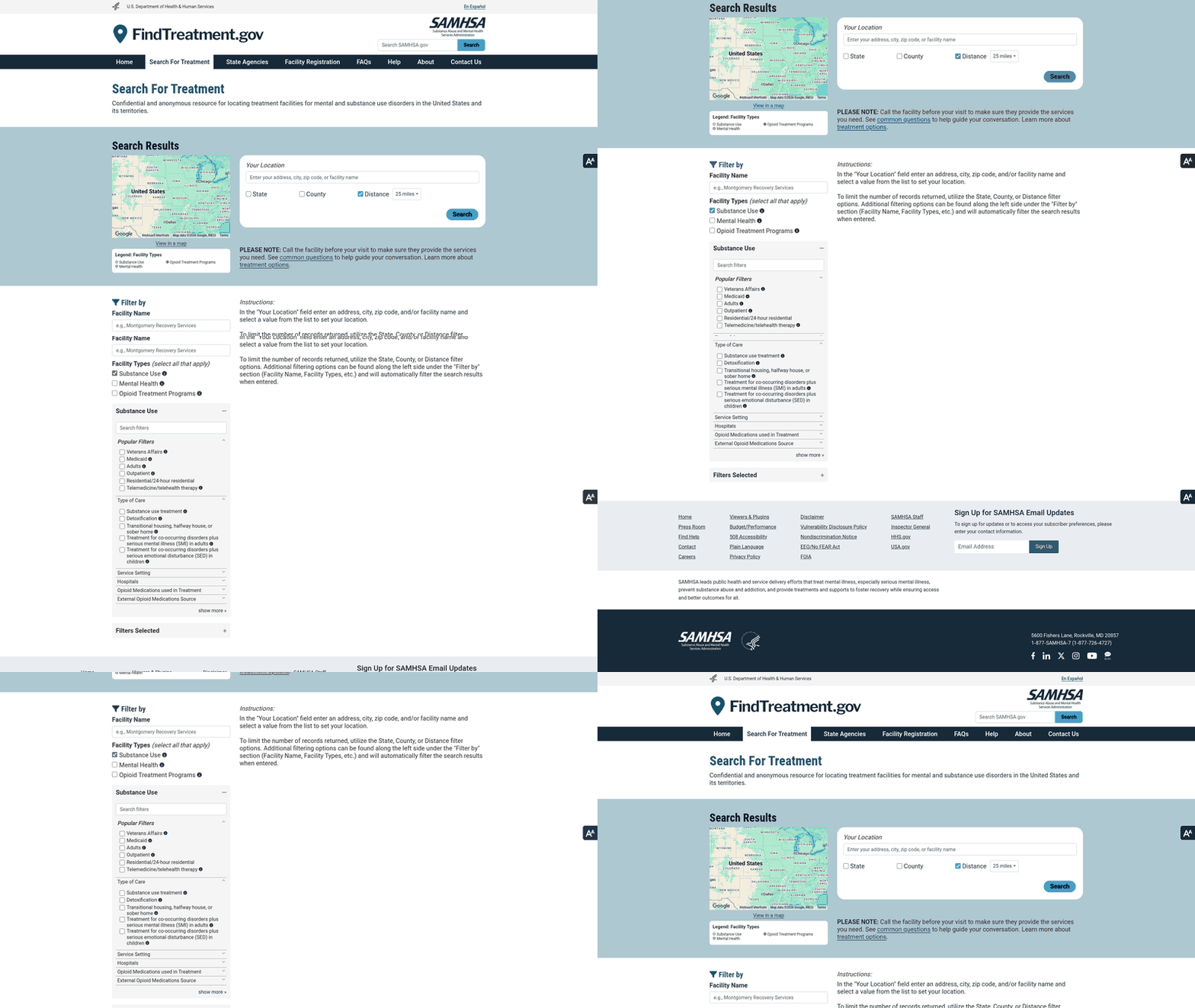
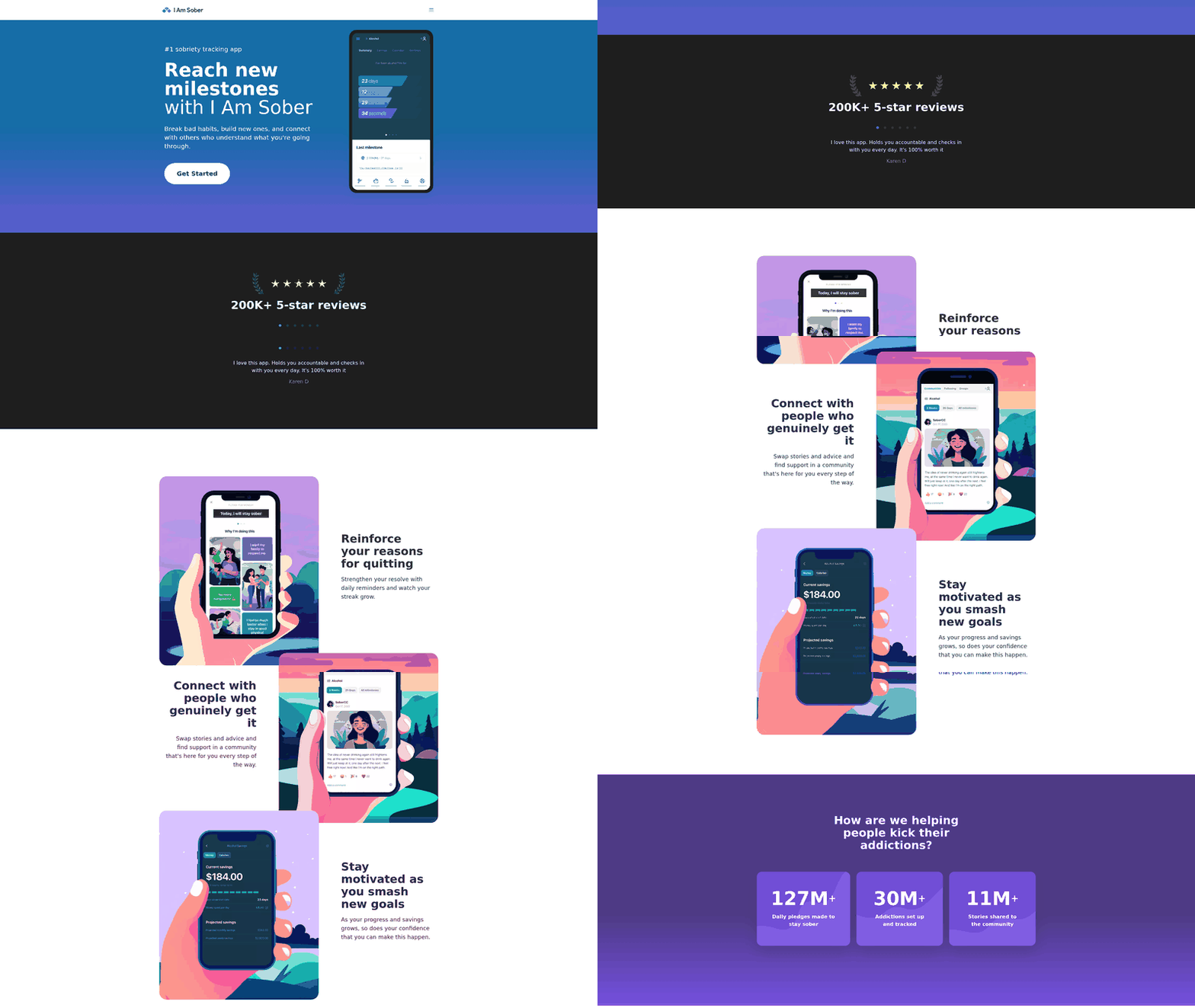
What keeps the plan running between sessions
Beyond pricing, the practical tools are simple and low-cost. A shared calendar that maps coverage to the moments most likely to test recovery. A written relapse plan drafted before day one home. A single contact sheet so everyone on a coordinated team knows who covers which window.
At MADE Recovery, we build our coaching around these same fundamentals. Our support intentionally tapers as clients find their rhythm, and we can coordinate a single dedicated coach or a full team depending on the level of care needed. That structure is designed to hold accountability steady through the quiet stretches that often precede costly setbacks.
One limit worth stating: skip the elaborate spreadsheets if your situation is short and stable. A brief taper with clear check-ins doesn't need a full ROI model. Match the tooling to the risk, not the other way around.
The Bottom Line on Pricing a Sober Coach
If you take one idea from this guide, take this: the price of sober coaching after rehab should be weighed against the cost of the relapse it may help prevent. Set that comparison in front of every other number and the decision gets clearer.
Our support is built around the moments that matter most. Team-based, home-and-travel support puts people alongside you during the hours where relapse and its expensive fallout tend to start. Weigh that coverage against a possible return to detox, another treatment stay, or the wreckage of a lost job, and the spend starts looking like prevention.
Your next three steps
Start by writing down your riskiest windows. Think through the first day back at work, family events, travel, lonely stretches, and any situation where old patterns have historically resurfaced. Those hours tell you where to concentrate coverage and where a flat weekly rate would waste money.
Then build a relapse plan before day one at home, not after the first stumble. We help clients map who to call, what to do, and how support tapers as new habits hold. A plan on paper is what turns coaching from a vague safety net into something you can actually measure.
Finally, get the cost comparison in writing. A one-page sheet lining up coaching hours against the cost of a serious setback gives you something concrete for a family conversation or an insurer. It moves the discussion off gut feeling and onto real figures.
Where to learn more
If you want to see what this support looks like on an ordinary day, our writing on what a sober coach does when you're not in crisis breaks down the quiet, daily work that keeps a plan intact.
We're a nonmedical recovery support team, not a clinic. We don't diagnose, detox, or manage medication. What we do is hold structure during the hours a treatment team is offline. If that's the gap you're trying to cover, we can help you build a plan that fits your budget and your risk.
References
[1] What Is a Sober Coach? | Benefits, Costs, and How to Choose One - https://futuresrecoveryhealthcare.com/alcoholism/what-is-a-sober-coach/
[2] Sober Coaching: How It Works, Key Benefits,… - Caron Treatment Centers - https://www.caron.org/addiction-101/treatment-advice/sober-coaching
[3] 50 Best Recovery Coaching in California (With Pricing) - https://recovery.com/california/recovery-coaching/
[4] [PDF] The Cost-Effectiveness of Long-Term Post-Treatment Peer Recovery ... - https://sph.uth.edu/research/centers/chppr/colab/assets/doc/castedo-de-martell-et-al-the-cost-effectiveness-of-long-term-post-treatment-peer-recovery-support-services-in-the-U.S)
Still Wondering?
Can I get insurance to help pay for a sober coach?
Direct coverage is often difficult, so go into the conversation with documentation instead of a general request. A written comparison of coaching costs, relapse-related expenses, and research on post-treatment support gives families and case managers a stronger basis for discussion.
How long should someone keep a sober coach after rehab?
Use risk as the guide. Start with enough structure to make the transition home realistic, then reduce support as routines become dependable. Once someone is steady and using their own recovery supports well, the plan should get lighter.
Why pay for a coach when a sponsor is free?
A sponsor and a coach serve different roles. A sponsor offers peer guidance through a recovery pathway; a coach helps translate the treatment plan into daily behavior, schedule, accountability, and practical follow-through. Many people benefit from having both.
Can a sober coach travel with me for work or events?
Yes. MADE Recovery offers sober travel companions alongside at-home support for clients who need accountability during trips, professional obligations, or major social events. The point is to keep support close to the setting where old patterns are most likely to reappear.
What happens if my only coach gets sick or goes on vacation?
That is one reason families choose a team-based model. A coordinated team can keep coverage from depending on one person's availability. MADE Recovery can provide one dedicated coach or a broader support team based on the level of care needed.