Sobriety Coach Duties: Daily Check-Ins, Triggers, and Relapse Plans
September 2, 2026

Key Takeaways
- About half of people relapse within the first 12 weeks after intensive treatment.
- That makes the first 90 days recovery’s decisive window.
- Relapse moves through emotional, mental, and physical stages.
- Catch it early, and clients usually avoid physical relapse.
- Frequent phone check-ins raised abstinence to 57% versus 36%.
- That came from a 240-patient randomized trial.
- Daily check-ins work as real-time relapse detection.
- They catch tone shifts before those shifts escalate.
- Text-based monitoring worked well too.
- 94.8% of the text-message group answered regularly.
- Tracking mood, sleep, and cravings surfaces early warning signs.
- One to two daily check-ins fit the first 90 days.
- Then taper gradually as stability improves.
Why the First 90 Days Decide Everything
The stretch after discharge is where recovery is won or lost. About half of people relapse within the first 12 weeks after intensive treatment, according to the StatPearls relapse review. That number is why sober coaching after rehab exists as its own discipline.
Relapse is a process, not a single event. It moves through emotional, then mental, then physical stages. Catch it early, and clients never reach physical relapse. That is the core job.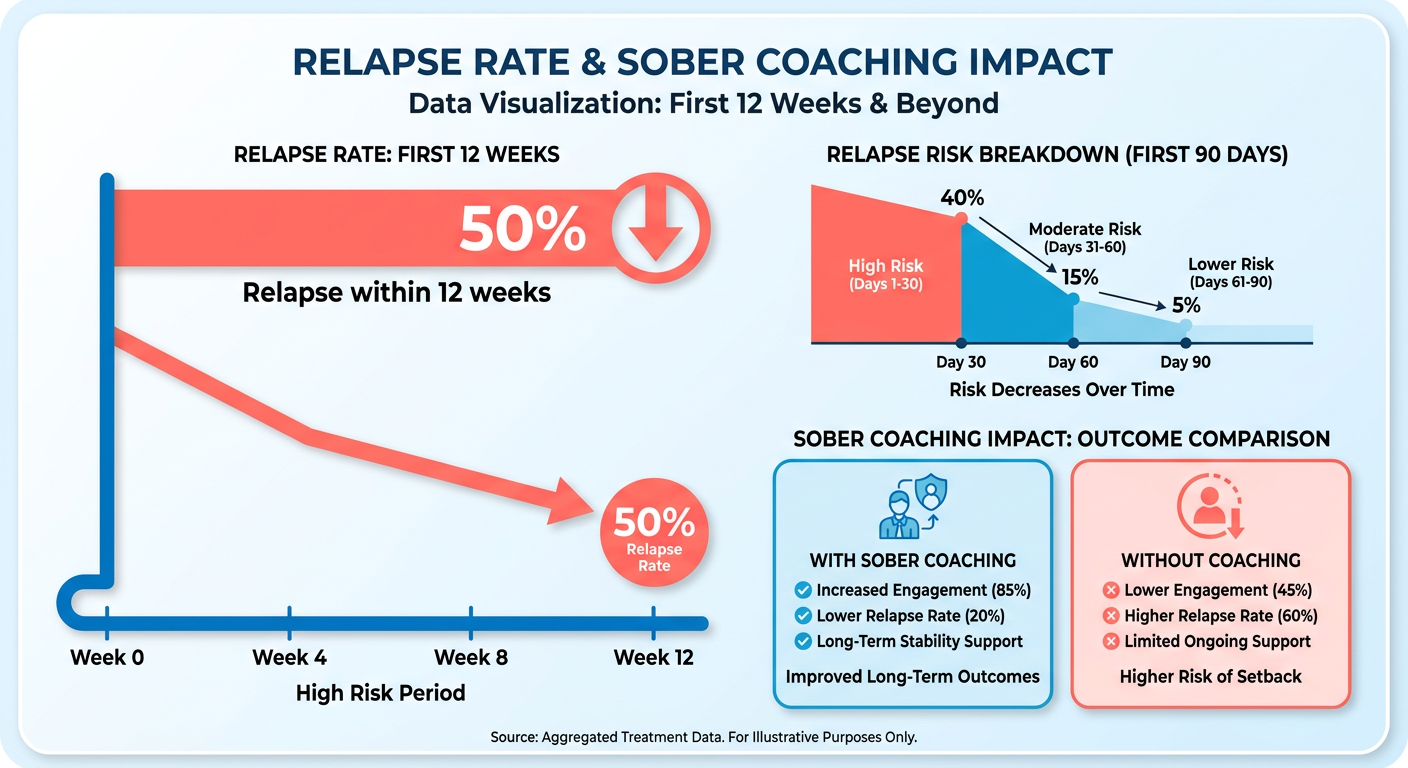
Why daily check-ins change the odds
Daily contact is a real-time relapse detection system. It is not just friendly support. Frequent phone check-ins pushed abstinence to 57% against 36% for a no-follow-up control group in a randomized trial of 240 patients. That is a 21-point swing from staying in touch.
They work because they catch emotional and mental stages early. A coach who hears a tone shift on Tuesday can act fast. There is still time to adjust.
- Schedule 1-2 check-ins a day for the first 90 days, then taper. Text works too. In the same trial, 94.8% of the text-message group answered monitoring questions regularly.
- Track mood, sleep, and cravings at each contact. These are the earliest emotional-relapse signals worth logging.
At MADE, coaching tapers on purpose as clients find their footing. The daily structure does its work, then steps back for independence.
How trigger work bridges the clinic and real life
A trigger diary is more than self-awareness. It gives the coach a map of a client’s high-risk situations. That matches how Relapse Prevention Therapy’s framework was built from interviews with relapsed patients. In practice, the coach runs a small version of that research for one person.
- Log every craving spike with context. The HALT self-check (Hungry, Angry, Lonely, Tired) from Addiction Center's skills list turns a vague urge into a pattern.
- Pair each trigger with a replacement action. Calling a sponsor or exercising instead of using is what Hazelden Betty Ford links to better emotional regulation and fewer cravings.
What a relapse plan actually does
A relapse plan helps clients see a crisis coming. Higher self-efficacy predicts better outcomes. A written plan builds that confidence before the hard moment arrives.
One tension is worth naming. StatPearls warns that normalizing relapse can weaken prevention. RPT frames a slip as an expected setback, not a failure. Our position sits between them. Reduce shame around a slip, but never treat it as acceptable. Those are different messages, and a good coach keeps them separate.
- Write the plan before it’s needed. Name the top three high-risk situations and the exact response to each.
- Rehearse the response out loud. A practiced plan beats one only stored away.
Duty comparison at a glance:
| Duty | Frequency | Typical Duration | Coach Skill Level | Primary Client Outcome | Difficulty (1-5) |
|---|---|---|---|---|---|
| Daily Check-In | 1-2×/day | 5-15 min | High empathy & active listening | Immediate accountability & mood tracking | 2 |
| Trigger Mapping | 2-3×/week | 20-30 min | Pattern analysis & clinical insight | Predictive high-risk awareness | 4 |
| Relapse Plan | Weekly review | 30-45 min | CBT-informed planning | Proactive coping, higher self-efficacy | 5 |
Add it up, and clients get roughly 5-7 hours a week of coach contact. That compares with 2-3 hours of standard outpatient therapy. Families and employers want that extra coverage: accountability outside the therapy hour. As the continuing-care trial put it, "Initial investments in structured post-treatment check-ins are likely to pay for themselves over time."
Identifying and Managing Triggers: A Coach's Playbook
Trigger work is the most-used task in sober coaching after rehab. Do it well, and high-risk situations do not become active use. Recognizing triggers is, as Gateway Rehab puts it, "non-negotiable for achieving successful outcomes."
One useful way to think about triggers: they cluster into three buckets. Naming the bucket tells you which coping kit to use.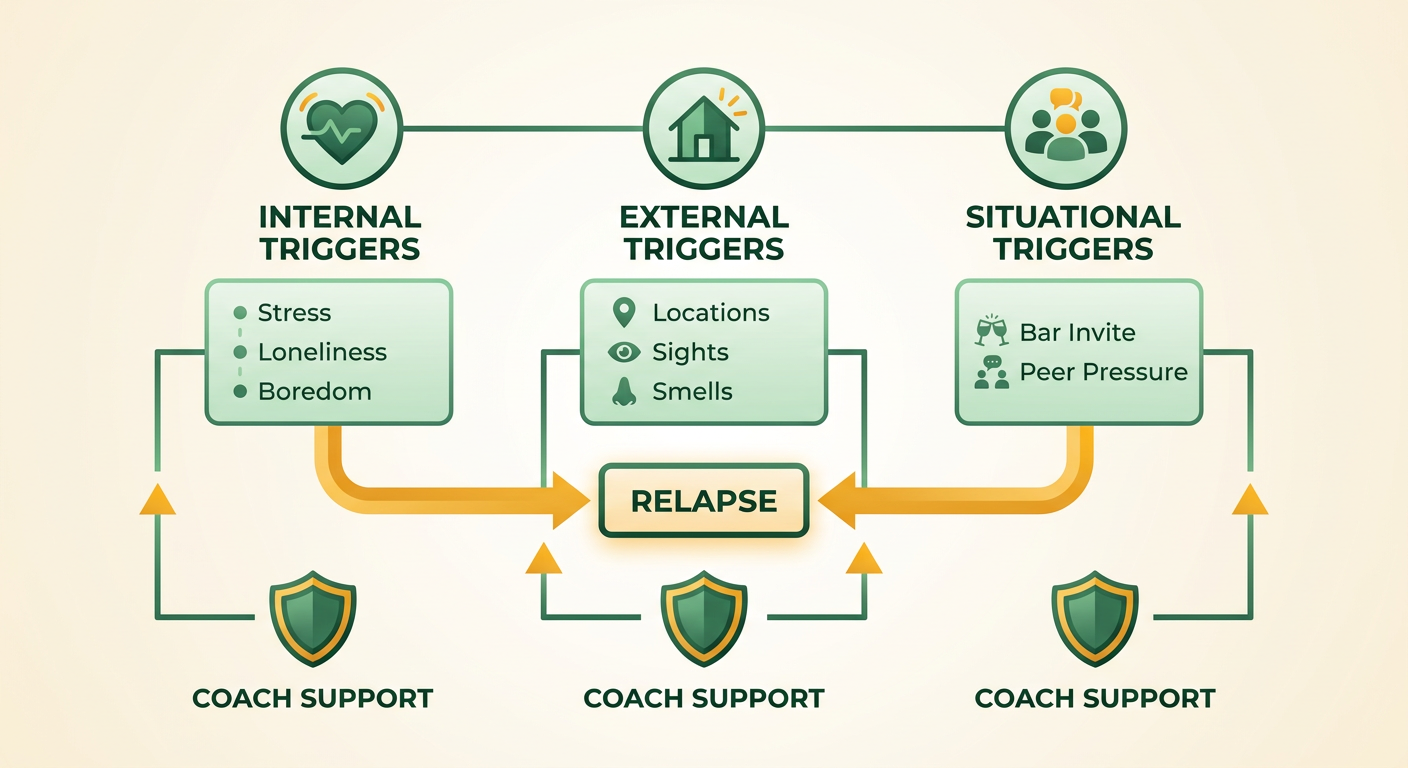
The three trigger categories
Emotional: internal states like stress, loneliness, and boredom. Environmental: familiar places, sights, and smells tied to using. Social: pressure from people or events, like a weekend bar invite.
A simple self-check helps clients read their physical and emotional state before cravings take hold. Catch the vulnerability early, and you can handle basic needs like rest or food before they become a compulsive urge.
- Map emotional triggers with structured self-checks so clients catch physical or emotional vulnerability early.
- List environmental triggers by name. Specific bars, streets, even scents. Vague awareness does not build a coping plan.
- Flag social triggers early, especially recurring events like weekend outings, so a plan exists before the invite lands.
How you surface a client's triggers
Because our programs are built around the individual, trigger work starts with the situations that put that client at risk. That follows the core logic of Relapse Prevention Therapy, which sorts high-risk situations from clinical data. Ground the plan in one person’s real history, and the coping strategy fits their life.
A trigger diary pairs well with this. Gateway Rehab notes that it allows real-time analysis of susceptibility. The record turns scattered self-awareness into a ranked list you can plan against.
- Surface the situations that preceded past slips so the plan fits the client’s real history, not a generic template.
- Have clients note triggers as they come up, turning scattered self-awareness into a clear high-risk picture.
- Sort triggers into the three categories: emotional, environmental, and social. That keeps the map easy to read and act on.
Building tiered coping kits
Match every trigger to a response at three time scales: immediate grounding, short-term support, and long-term routine change. Swapping old patterns for constructive ones, like reaching out to a support network or moving your body, helps regulate emotion and lowers cravings.
Mindfulness earns a spot here. Hazelden calls it more efficient than traditional treatment at cutting cravings. StatPearls also points to rival tools like motivational interviewing and contingency management. Treat mindfulness as one strong tool, not a replacement for the rest.
Take Sarah, who faces standing weekend bar invitations. Her immediate kit is the 5-4-3-2-1 grounding drill. Her short-term move is texting her coach before she says yes. Her long-term fix is a new Saturday routine that does not center on the bar. Each layer links back to her evening check-in.
- Assign an immediate, short-term, and long-term response to every top trigger so clients are not improvising.
- Link each coping kit to daily check-ins so the coach hears which tier got used and adjusts the plan, coordinating with other support services as needs shift.
- Help clients build healthy routines that lower stress and restore balance, so daily structure supports the plan.
Building a Relapse Prevention Plan That Holds Up
A written relapse prevention plan (RPP) is one of the most-used tools in recovery. Clients who put the plan on paper are meaningfully more resilient than those who keep it in their heads. Early warning signs cloud judgment, and a preset roadmap takes decision-making off the client’s plate in a high-stress moment.
We treat the RPP as a living document, not a discharge formality. Because our programs are built around the individual and change as needs change, the plan gets revisited and revised as clients move forward. Update it regularly, and it stays matched to the client’s current environment.
What goes into a relapse prevention plan
A strong RPP generally covers five parts. Each should be a SMART goal: specific, measurable, achievable, relevant, and time-bound. Vague plans fail under pressure.
- Warning signs. List your personal early cues, like boredom, isolation, or skipping meetings. Naming them turns a fuzzy feeling into a checkable item.
- Immediate actions. Write the exact steps you will take when a craving hits, like a grounding drill or self-check.
- Support network. Name three people you will call, in order, with their numbers. Reaching out fast breaks the isolation that often fuels a return to use.
- Professional resources. List your coach, therapist, and prescriber with contact hours.
- Post-relapse steps. Define what you do if a slip happens before shame sets in.
How you frame a slip without excusing it
Clinical frameworks disagree about how to handle a lapse. Some models keep self-efficacy intact by treating a slip as a temporary detour. Other literature warns that over-normalizing setbacks can lower motivation.
We read a lapse as information, not a moral failure. The post-relapse protocol is built to trigger immediate corrective action and get the client back to their support network without delay.
Keeping support within reach when it matters most
The RPP works best when it stays close at hand, not filed away. Recovery is not meant to be done alone, so we provide steady, real-world support in the moments that matter, virtual or in-person as needs change. In a high-risk moment, that means self-help tools, a support network, and professional contacts all within reach.
A sample line for a stress-craving client: "When work stress spikes, I will practice ten minutes of focused breathing before 6 PM, then text my coach if the craving stays elevated." A brief pause helps ease the body’s stress response.
Review the plan regularly, and it stays practical. Professional oversight can then ease off naturally as the client gains confidence.
Team-Based Coaching and Gradual Tapering: Scaling Support Over Time
Solo coaching and team-based coaching solve different problems. A solo coach works when a client has a stable home, one primary trigger cluster, and needs one consistent voice. A team becomes the right call when risks overlap: medical fragility, family conflict, and a high early-relapse window.
The reason to build a team is coverage. One person cannot handle daily check-ins, nutrition rebuilding, and 2 a.m. crisis calls without burning out. Spread those duties out, and the response stays fast. There is no single point of failure for the client.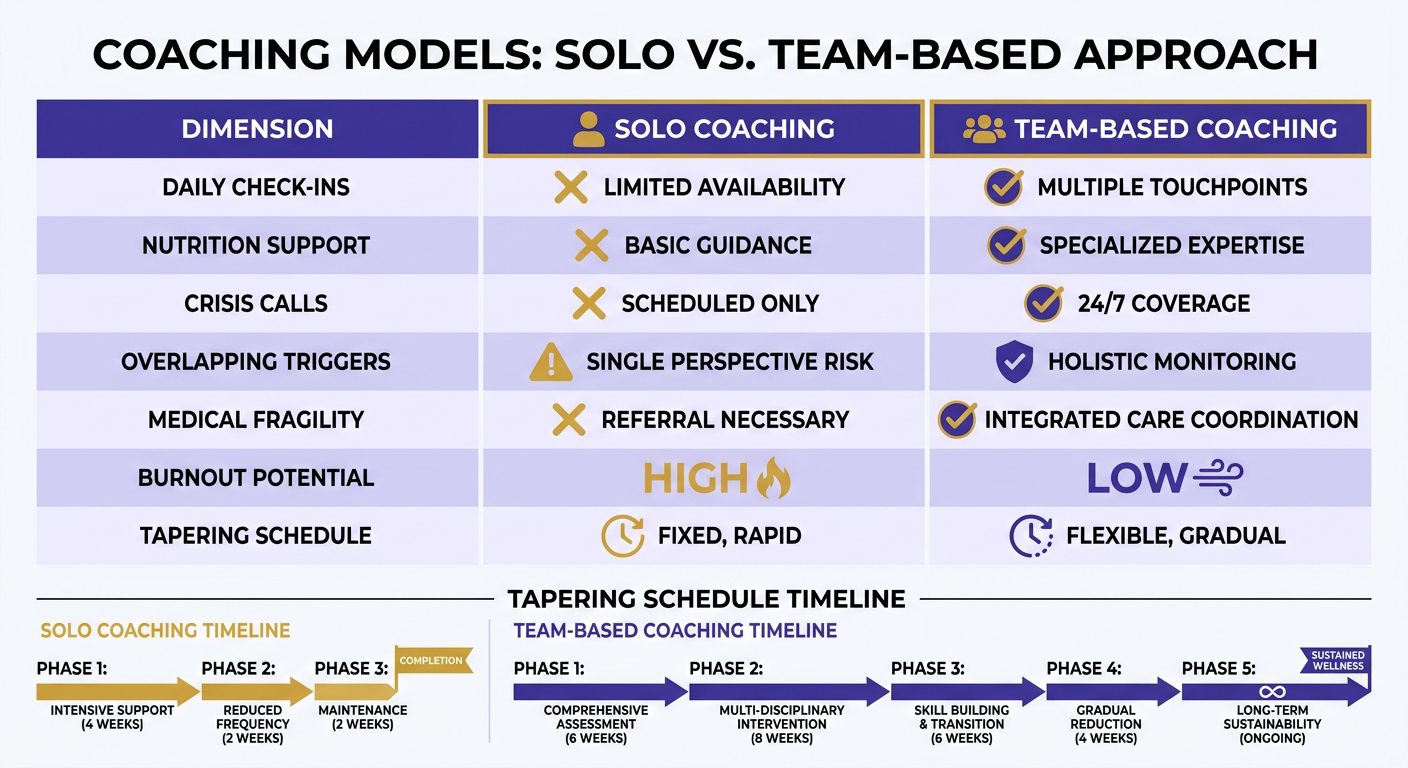
How MADE Recovery structures team-based support
We offer support from a single dedicated coach or a coordinated team, depending on the level of care needed. Coaching can include coordination with nursing support, grocery shopping, meal prep, and day-to-day life management.
- Daily check-ins and relapse prevention. The coaching relationship that anchors everything else.
- Nutrition rebuilding. We help clients rebuild healthy eating habits that support physical healing, emotional balance, and daily energy.
- Consistent, real-world support. Companionship in the moments that matter, so clients do not face cravings alone.
- Community connection. Peer support is a core piece of the interprofessional approach StatPearls calls essential for relapse prevention.
How to taper support without dropping it too soon
Taper against the risk curve, not the calendar. The early months carry the highest vulnerability and call for intensive, structured contact. Clinical guidelines say any rise in warning signs should prompt an immediate step-up in support, not a step-back. That is why front-loaded contact matters. Start there, then ease down as self-efficacy climbs.
As clients settle into stable routines, professional contact scales back systematically. That shift builds self-reliance, with community and personal practice gradually taking over the hours structured coaching used to fill.
Do not taper on time served alone. Watch three signals together: streak length, the direction of craving scores, and the client’s self-efficacy rating. If cravings trend up while the streak grows, hold frequency steady. A growing streak with rising confidence is your green light to step down.
- Track streak length as a floor, never the sole trigger to cut contact.
- Chart craving-score trends week over week, not single readings. Direction matters more than any one number.
- Log self-efficacy ratings so a confidence dip flags before it becomes a mental-stage relapse.
Keep the line clear between understanding a setback and accepting it, especially during a taper. A client has to feel safe reporting a slip right away and stay fully committed to sobriety for the transition to hold.
What keeps the hand-off clean
A team only works if information moves faster than the client’s cravings. Coordinate across the team so everyone stays aligned on where the client is day to day, and nobody has to re-explain the week.
- Coordinated care. The team works from a shared picture of the client’s progress and needs.
- Consistent communication. So a Monday craving spike is visible to whoever takes the Wednesday call.
A client stepping from daily to weekly contact over ten weeks makes the point. A rough Friday gets logged, the coach opens Monday’s check-in already knowing about it, and confidence holds because nobody had to re-explain the week.
Measuring Success and Iterating the Coaching Plan
You cannot iterate what you do not measure. Tracking data helps catch drift early, before a pattern hardens into active use. Numbers turn a vague sense that “something feels off” into a specific conversation.
Pick a small set of metrics and watch them weekly. More data is not better. The right five tell you almost everything.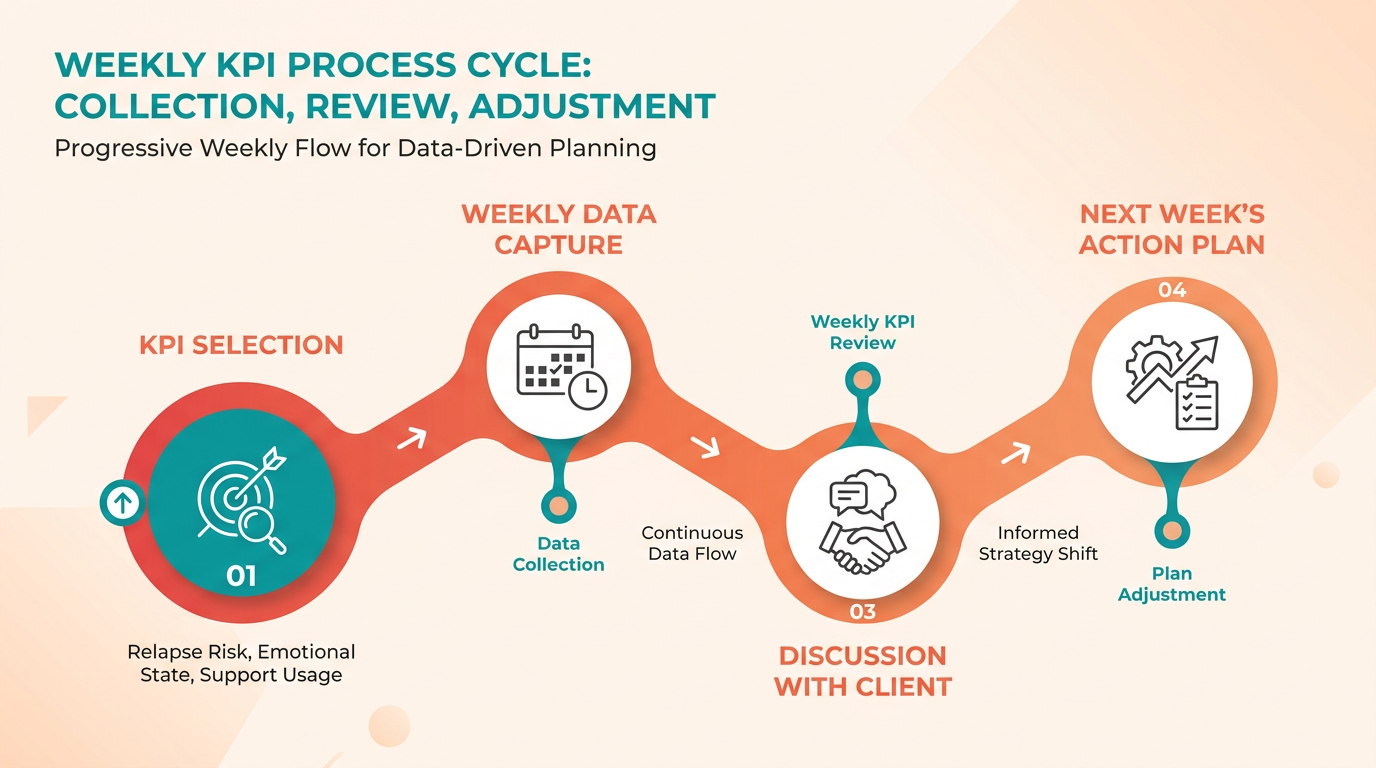
Which KPIs actually matter
Track the signals that predict a slip, not vanity stats. Five core metrics cover the ground without burying you in dashboards.
- Abstinence days: the running count since the last use. The clearest outcome measure, and the one clients feel most.
- Craving intensity average: a daily 1-to-10 self-rating. A rising trend flags emotional relapse before behavior changes.
- Check-in response rate: what share of daily contacts the client actually completes. Missed check-ins are often the first quiet sign of pulling away from support.
- Trigger-handling success rate: how often a client uses a coping tool instead of using. This tells you whether trigger work is sticking.
- RPP activation frequency: how often the written plan gets pulled out and used. Low activation during a rough week means the plan is not reachable in the moment.
Plot these as weekly trends that both coach and client can see. A shared dashboard makes progress visible and turns a bad week into a data point instead of a shame spiral.
How to run a quarterly review
Every quarter, sit down and read the trends together. The script is simple: what improved, what stalled, and what needs to change. Data drives the call, not gut feeling.
- Review each KPI against its starting baseline and name one clear win.
- Adjust duties based on what the numbers show. Steady abstinence with rising energy might mean adding nutrition coaching around week four.
- Send a short satisfaction survey after each milestone so client feedback shapes the next phase.
- Fold in new evidence, like a mindfulness app a client will actually open, when it earns a place in the routine.
Support should taper as the numbers climb. That is the plan working, not ending.
References
[1] Addiction Relapse Prevention - StatPearls - NCBI Bookshelf - NIH - https://www.ncbi.nlm.nih.gov/books/NBK551500/
[2] Relapse Prevention: Make a Plan to Stay Sober - https://www.hazeldenbettyford.org/relapse-prevention
[3] A Guide for Navigating Triggers and Temptations - Gateway Rehab - https://www.gatewayrehab.org/blog/a-guide-for-navigating-triggers-and-temptations
[4] The Top 10 Relapse Prevention Skills - Addiction Center - https://www.addictioncenter.com/community/top-10-relapse-prevention-skills/
[5] (PDF) Clinical Guidelines for Implementing Relapse Prevention ... - https://www.researchgate.net/publication/235326763_Clinical_Guidelines_for_Implementing_Relapse_Prevention_Therapy_A_Guideline_Developed_for_the_Behavioral_Health_Recovery_Management_Project
[6] “Stay in touch”: Phone- and text-based continuing care check ... - https://www.recoveryanswers.org/research-post/phone-text-based-continuing-care-check-ins-residential-alcohol-use-disorder-treatment/
Frequently Asked Questions
1. Can a sobriety coach replace my therapist or clinical treatment?
A sobriety coach complements clinical care rather than replacing it. Traditional outpatient therapy usually uses weekly sessions. Coaching adds continuous, real-world accountability throughout the week. A complete recovery plan includes the coach, therapist, and medical providers. Each supports a different part of daily life.
2. What should I do if I miss several daily check-ins with my coach?
A sudden drop in communication is a primary warning sign. Coaches watch response consistency closely because missed contact often points to avoidance or unaddressed stress. Re-establishing contact quickly helps the coach and client address the problem before it becomes a setback.
3. How is a slip different from a full relapse in coaching terms?
A slip is a brief, isolated event. A full relapse is a return to sustained active use. In coaching, a slip is reviewed objectively to identify gaps in the coping strategy. The goal is to remove shame around a temporary setback, so the client reports it immediately and takes corrective action.
4. When is team-based coaching a better fit than a single coach?
Team-based coaching fits people with complex, layered challenges, such as co-occurring physical health issues, major domestic transitions, or intense environmental stressors. A single coach works well for someone with a stable foundation. A coordinated team shares specialized tasks like nutritional support, daily life skills, and crisis response.
5. What if my cravings are rising even though my sober streak is growing?
If cravings rise while sober days keep adding up, maintain or increase support. A transition to less frequent contact needs stable or declining craving trends, consistent engagement, and high self-reported confidence. A sober streak alone does not justify lowering accountability if distress is rising.
6. Does texting work as well as phone calls for check-ins?
Texting is an effective way to maintain consistent contact, with clinical studies showing very high response rates for digital check-ins. It is an efficient, low-friction way to track daily metrics like sleep quality, mood shifts, and craving levels. It can also be combined with phone calls or in-person visits as needs change.
7. How do I make sure my written relapse plan actually gets used in a crisis?
To work in a crisis, a relapse prevention plan must stay easy to reach and regularly practiced. Rehearsing responses out loud builds muscle memory and makes actions easier to recall under stress. Regular check-ins also keep the strategies fresh and let the coach confirm the client feels ready to use them.