Are Sober Living Homes Really Safe? What You Need to Know
September 30, 2026

Key Takeaways
- Sober living homes often cost $500 to $1,500 a month.
- A study tracking 300 residents over 18 months found improvement.
- NARR certification and Oxford House membership are the first filters.
- Common safety failures include broken locks, missing smoke detectors, overcrowding, weak screening, and no written resident agreement.
- Relapse risk often rises after move-out, when structure fades.
Quick Summary
If you're weighing sober coaching after rehab, the safest sober living home isn't defined by how it markets itself. It's defined by clear rules, written policies, verified oversight, consistent monitoring, and a plan for when a resident struggles.

A home is also only one part of the recovery picture. Residential structure can protect someone during early sobriety, but that protection needs to carry into daily life after move-out.
Sober Living Home Safety, Side by Side
| Criteria | Peer-Run (Level I / Oxford) | Monitored Sober Living (Level II) | Supervised (Level III) | Clinical (Level IV) |
|---|---|---|---|---|
| Typical Size | Single home, small group | Single home with house manager | Larger, program-based | Program with residential beds |
| Licensing / Regulation | Unregulated; NARR-certifiable, Oxford House network | Unregulated; often NARR-certified | Licensed in some states | Licensed; integrates clinical treatment |
| Staffing Model | Resident-governed, no paid staff | Senior resident serves as house manager | Trained or credentialed staff, often supervised | Peer plus professional clinical staff |
| Key Safety Features | Peer accountability, zero-tolerance policy | Random drug testing, curfews, house rules | Structured programming, life-skills support | Above plus on-site clinical services |
| Typical Cost Range | Low | Low to mid | Mid to premium | Premium |
Monthly pricing often looks like local apartment rent, but the advertised number is not the whole safety story. Rent can exclude utilities, deposits, testing, and other required charges. Price alone won't tell you whether a home is safe.
Staffing Isn't a Simple Ratio
There's no universal staff-to-resident number, and any home quoting one as proof of quality is oversimplifying. The NARR Standard sorts homes by staffing intensity instead. Level I runs democratically with no paid staff; Level II leans on a house manager; Levels III and IV bring in trained or credentialed staff. Higher levels mean more oversight, not a guaranteed ratio.
The Enforcement Paradox
Strict rules protect residents only when the home also has a plan for what happens after a violation. The danger isn't the rule itself. The danger is removing housing support at the exact moment someone needs stabilization. The safest homes enforce expectations and refer residents to appropriate care when the situation goes beyond what the house can safely manage.
Top Takeaways
- Certification is your first filter. Ask if the home is NARR-certified or part of the Oxford House network, then verify it independently.
- Get everything in writing. A real resident agreement covers rent, curfews, drug testing, medication rules, and relapse procedures.
- Watch for hidden costs. Budget homes may sit in higher-risk neighborhoods; premium homes can isolate you from treatment and peers.
- Ask about relapse response, not just testing. A clear plan for what happens after a slip matters more than the testing schedule.
- Plan for the move-out. The transition back home is where support gaps open up, so line up ongoing accountability before you leave.
Why the Safety Question Comes First
Safety is the one thing you really can't compromise on when picking a post-rehab residence. The early months out of treatment carry elevated relapse risk, and the place you sleep each night either protects that progress or quietly erodes it. If you're arranging sober coaching after rehab, the physical and social safety of the home is the foundation everything else sits on.
Families often focus on move-in day and miss the longer arc. A safe residence buys time, stability, and structure. The next question is whether those supports continue after the person returns to ordinary routines. That's why we treat the residence and the coaching around it as one connected plan, not two separate purchases.
Does a safe sober living home actually lower relapse risk?
Yes, but the mechanism matters more than the label. A study following 300 residents over 18 months documented real gains in substance use, employment, and psychiatric symptoms, with no formal treatment required inside the home.
Zinnia Health's warning adds the other side: peer support "may not always be conducive to recovery" when housemates aren't getting the help they need. Both are true. The homes that work pair a safe environment with strong peer accountability and outside recovery involvement. The ones that fail mandate neither. Without structure and support, a house is just an address.
Safe walls and a supportive environment create the conditions for recovery, but they work best when combined with ongoing guidance and accountability.
What safety concerns do families and residents raise most?
The recurring red flags are practical, not abstract. HealingUS lists broken locks, missing smoke detectors, overcrowding, weak resident screening, and no written agreement covering rent, curfews, or substance-use policy. Any one of those can turn a "recovery residence" into a liability.
Enforcement is where it gets harder. Rules need to mean something, but consequences shouldn't create avoidable danger. A safe operator can explain in advance which violations trigger warnings, which trigger extra support, and which require a transfer or discharge. Vague answers usually mean the home is improvising.
How does safety support sober coaching after rehab?
A safe, well-run home does the heavy lifting on structure so coaching can focus on the real work: building routines, repairing relationships, and preparing for the day the house structure ends. The NARR standards recognize that recovery residences operate at different levels, and matching the right support level to the person is itself a safety decision.
We built our premium sober living option around that logic. It prioritizes a genuinely safe environment and continuous companionship without pretending to be medical treatment. We're not doctors, and we don't run a clinic. What we do is keep the support consistent through the handoff most people never plan for. If you're weighing sober housing versus going home, that continuity is the piece worth protecting.
The Regulatory Patchwork by Zip Code
Everyone in this field works inside a patchwork of rules, and the rules depend more on your zip code than on any national standard. In nearly all U.S. states, sober living homes are not licensed as treatment facilities. That doesn't mean no rules. Local building codes, health and safety regulations, and landlord-tenant law still apply, and violations can shut a home down quickly.
A few states have moved toward explicit oversight. New York requires certified recovery residences to meet Part 860 standards, including minimum square footage per resident, staff credentialing timelines, and mandatory reporting of all admissions and discharges to OASAS. California created a voluntary certification system through the Department of Health Care Services, though enforcement remains inconsistent. Florida passed legislation in 2017 to crack down on fraudulent operators after patient-brokering scandals, but the statute only covers homes receiving state funding or referrals from certain treatment providers.
Most other states leave recovery residences in a regulatory gray zone. The home is technically a rental property, which means zoning, fire codes, and occupancy limits matter more than addiction-specific regulations. Operators who pack too many beds into a single-family home risk code-enforcement actions, and neighbors can file complaints that force closures even when the home operates ethically. Standard homeowner or landlord insurance policies often don't reflect the actual use of a sober living property, so coverage may be limited or denied if an incident occurs.
National Certification Bodies and What They Actually Measure

Without state licensing, voluntary certification is the closest thing to a safety standard. The National Alliance for Recovery Residences (NARR) developed a four-level framework that affiliate organizations use to certify homes. The Standard is built on the lived experience of operators and residents, not the decisions of an external accreditation body. It distinguishes peer-run Level I homes from clinically supervised Level IV programs.
NARR affiliates conduct site inspections and check for written policies, house rules, resident agreements, and emergency procedures. They verify basic safety: working smoke detectors, functioning locks, adequate bathrooms and sleeping space, and clear substance-use policies. Inspectors also look at governance structures, whether residents have input into house decisions, and how staff respond to relapse or rule violations.
The catch is that NARR certification is entirely voluntary. Most homes operate without it, and families have no easy way to verify whether a home meets any standard. Some operators actively avoid certification to dodge oversight or keep costs down. Research on 21 Philadelphia recovery home operators found that many struggle with funding, insurance, and neighborhood pushback, all of which make formal accreditation feel like an added burden rather than a competitive advantage.
Inspection Frequencies and What Actually Gets Checked
When inspections happen, they focus on structural safety and basic operations, not clinical outcomes. New York-certified homes undergo annual site reviews, with additional spot checks if complaints arise. Inspectors verify fire extinguishers, egress routes, food storage, and whether resident records are kept in a way that protects confidentiality. They check that staff members hold or are working toward a Certified Recovery Peer Advocate credential, and they confirm the home has written discharge policies that prohibit immediate eviction without a transition plan.
Level III and Level IV homes, which offer structured programming and clinical services, face more intensive review. Inspectors verify that staff are trained and supervised, that life-skills programming actually happens, and that the home maintains relationships with external providers for medical and psychiatric care. But inspection frequency is still annual at best, and many states conduct no inspections at all. A home can pass an inspection in January and slide into unsafe conditions by summer without anyone noticing until a crisis occurs.
Fire safety is one of the few areas where enforcers take immediate action. A home with disabled alarms or blocked exits can face immediate consequences. But subtler risks, like too many residents for the space, weak communication, or inconsistent rule enforcement, rarely show up in a single site visit. Homes with weak management, poor communication, or staff who avoid hard conversations often sail through inspections because the dysfunction isn't visible on a checklist.
Recent Legislative Changes and What They Mean for Safety
Florida's 2017 reforms targeted patient brokering. The law required homes receiving state funds or referrals to register with the state and meet basic standards, including background checks for staff and no financial incentives tied to resident placement. It closed some of the worst operators, but it also created confusion about which homes fall under the statute and which still operate in the unregulated market.
California has worked to establish certification programs for sober living homes aimed at preventing fraud and improving transparency, but certification remains voluntary and operator registries are incomplete. Operators who choose not to certify face no penalty, and consumers have limited tools to distinguish certified homes from uncertified ones.
New York's Part 860 regulations, which took effect in 2019, set standards for space and staffing and require certified homes to report outcomes data. Even here, enforcement is inconsistent. Small operators struggle with the administrative burden, and larger providers sometimes use certification as a marketing tool without meaningfully changing how they operate.
Consumer Protection Guidance and Red Flags
State consumer protection agencies rarely issue specific guidance on recovery housing, so families are left to piece together their own due diligence. Watch for these gaps: no written resident agreement, unclear or changing fees, overcrowded or poorly maintained living spaces, no meaningful admission screening, and no clear response to substance use or relapse. If staff are hard to reach, rules are applied inconsistently, or the home pressures you to pay before you've reviewed the property, those are hard stops.
Low rent can hide extra fees for utilities, deposits, testing, or other services. Price does not automatically indicate quality. One negative review may reflect an individual disagreement and should not decide the matter by itself; patterns matter more than isolated complaints. A home that refuses to provide references, won't let you tour before paying, or dodges questions about certification is telling you everything you need to know.
Even the best-run certified home only controls what happens inside its walls. A study tracking 352 sober living residents found that walkability was related to worse abstinence and psychiatric symptom outcomes, because mobility without destination purpose increased exposure to bars, dealers, and old haunts. The neighborhood matters as much as the house, and no inspection regime checks for that. That's where sober coaching after rehab becomes critical: someone who follows you into the transition, maps the risky activity spaces with you, and helps you build routines that direct where you walk, not just whether you stay sober inside the home.
Who Runs the House Matters More Than the Ratio
House managers and staff in many sober living homes wear multiple hats: peer accountability, crisis response, conflict mediation. Yet they often step into these roles with minimal formal training. When operators assume lived recovery experience alone qualifies someone to manage a house full of vulnerable residents, they create a safety gap. The same recovery-residence research that shows peer networks matter also makes one point clear: the people managing the home directly shape whether residents succeed or relapse. If those managers can't recognize suicidal ideation, handle an overdose, or de-escalate conflict without violating fair housing law, the home's recovery framework collapses.
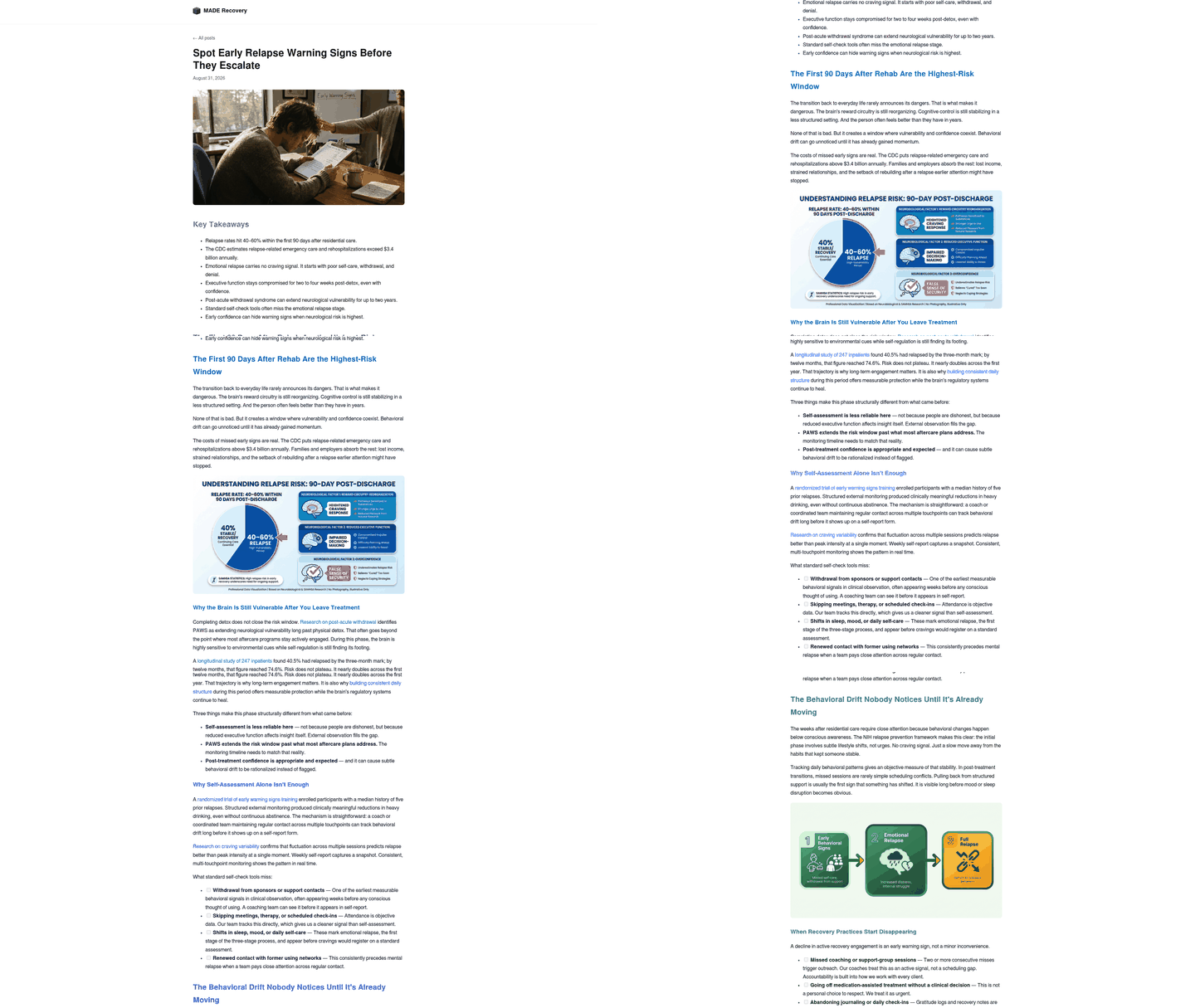
Most states don't require any credential to run a sober living home. In many markets, house managers step into the role with no training in crisis intervention, trauma-informed care, or suicide prevention, three scenarios residents face regularly. New York is an outlier: certified recovery residences must hire managers who hold or obtain a Certified Recovery Peer Advocate credential within one year, and staff turnover triggers new credentialing timelines. That's the exception. In most markets, the barrier to entry is owning a property and renting beds.
What Training Should Staff Actually Have
The NARR Standard doesn't mandate specific training hours, but it defines four residence levels with escalating staff requirements. Level I peer-run homes, Oxford Houses, have no paid staff, so training isn't the issue; residents govern themselves democratically. Level II monitored homes introduce risk because a house manager enforces rules and collects rent. One undertrained person now holds eviction power, handles drug test results, and decides what happens when a resident relapses. At Level III supervised and Level IV clinical homes, staff are expected to be supervised, trained, or credentialed, often with recovery residence graduates filling these roles. That lived experience is valuable, but it doesn't automatically equip someone to write an emergency response plan or recognize early signs of psychosis.
Core training gaps are consistent across the industry: overdose response, including naloxone administration and when to call 911; suicide risk assessment, including how to ask the question without making it worse; trauma-informed communication, including why yelling at a resident who missed curfew can trigger PTSD; and medication-assisted treatment literacy, including how to support residents on buprenorphine or naltrexone without stigma. Some recovery home directors unintentionally employ stigma-driven practices that undermine medication uptake. Staff who believe "real sobriety" excludes MOUD create an environment where residents hide their prescriptions or stop treatment entirely.
Staff-to-Resident Ratios and What They Hide
Higher-level homes advertise closer supervision, but staff-to-resident ratios are not federally regulated. NARR's social model framework prioritizes peer governance over clinical oversight, so even Level III homes may rely on a single supervisor covering many residents across multiple shifts. If that supervisor works days and a crisis happens overnight, residents are on their own unless the home has true round-the-clock coverage, which is uncommon outside more clinically intensive settings. New York's Part 860 standards require one toilet, one sink, and one shower per six residents, but they don't specify staffing presence for every shift.
The hidden variable is staff turnover. Economic instability, residents who can't pay rent, unexpected repairs, and neighborhood pushback all drive managers to quit. High turnover means new staff inherit a house culture they didn't build, with no institutional knowledge of which residents are struggling, which peer conflicts are simmering, or which relapse patterns to watch. When managers cycle out repeatedly, the constant retraining drains time and stability from the home.
The Sober Coaching After Rehab Blind Spot
We treat staff qualifications as a sober living home problem, but the bigger failure happens after residents leave the home. Many residents eventually transition to independent living, a common and positive discharge reason, yet there's no protocol for maintaining the peer accountability and recovery involvement that kept them sober inside the house. Staff may excel at managing house meetings and nightly check-ins, but they rarely coordinate sober coaching after rehab once a resident moves out. That's when the support structure vanishes: no house manager calling you out for skipping a meeting, no roommate noticing you're isolating, no drug test keeping you honest.
Social support that actively discourages drinking tends to be one of the strongest predictors of lasting success. If staff are trained to build that environment inside the home but don't extend it into the transition period, the home creates a recovery cliff. Continuous sober companionship at home addresses this by embedding accountability in the resident's everyday routine, not just the house they're leaving behind.
Ongoing Training, or Lack Thereof
Few sober living operators budget for professional development. NARR's Code of Ethics requires staff to "value and respect each resident" and "put each individual's recovery and needs at the forefront," but it doesn't enforce monthly trainings or recertification. Level IV homes with clinical staff may follow continuing education requirements tied to state licensure. Level II and III homes, the majority of the market, often run on informal, on-the-job learning. That leaves critical skills dependent on the individual manager, not on a reliable system.
Best-practice operators bring in outside trainers quarterly: naloxone certification refreshers, conflict de-escalation workshops, fair housing compliance updates. But most residents pay out of pocket because third-party payer systems are uncommon, so homes run on thin margins. When revenue drops, training is usually the first line item cut. The result: staff competence becomes a function of how much rent was collected last month, not how prepared they are to handle the next crisis.
Screening and Monitoring: The Front Door and the Day-to-Day
When someone applies to live in a sober home, most operators conduct an interview, but many skip the deeper screening that would flag mismatched expectations or safety risks. A thorough admission process protects both the resident and the community. It doesn't require a clinical assessment, but it should clarify whether the home's structure matches what the applicant needs.
What Should Admission Screening Cover?
A responsible screening conversation collects basic demographic information, substance use history, past treatment involvement, legal status, medications, mental health background, and current support networks. This isn't a diagnostic evaluation. It's a mutual fit check. Research on recovery residences consistently shows that the social environment and peer relationships within a home strongly influence individual outcomes. The people you live with matter as much as the house rules.
Some homes admit anyone who can pay rent. That approach creates risk. If you're weighing options for sober coaching after rehab, ask how the home decides who moves in. A vague answer like "we take everyone serious about recovery" usually means no real screening. Operators who skip this step often struggle later with residents who destabilize the house or weren't ready for the level of independence the home requires.
At admission, certified recovery residences must provide residents with a residency agreement, a breakdown of all costs and payment schedules, a written list of rights and responsibilities, house policies, confidentiality agreements, and copies of anything the resident signs. If a home won't show you those documents before you commit, walk away. That lack of transparency is the clearest red flag we see.
How Do Homes Handle Background Checks and Health Disclosure?
Background check policies vary widely. Some homes run criminal history reports; others rely on self-disclosure. New York's Part 860 standards leave the decision to operators, but they require homes to document whatever screening they performed. The bigger issue is what happens with the results. Blanket bans on anyone with a criminal record can violate fair housing law, especially if the exclusion isn't tied to legitimate safety concerns.
Medication disclosure is mandatory in most homes. Residents must report all prescriptions, verify them with a licensed provider, and often store them under staff supervision. This protects everyone, but it also creates tension when homes explicitly deny entry to people prescribed medications for opioid use disorder, despite growing evidence that medication-assisted treatment supports longer-term recovery when combined with structured housing and peer support.
Health screenings typically stop at collecting medication lists and emergency contact information. Very few homes require physical exams or lab work before admission. That means you're trusting the operator to know when someone needs a higher level of care than the house can provide, and not every operator makes that call correctly.
What Does Ongoing Monitoring Look Like After Move-In?
Drug and alcohol testing is the backbone of most monitoring systems. Homes that enforce testing consistently report better outcomes than those with sporadic or selective screening. Testing schedules vary: some homes test weekly, others run random screens, and a few only test when behavior raises suspicion. The key isn't frequency. It's consistency. If rules apply differently to different residents, accountability disappears.
Beyond testing, we look for check-in systems that track attendance at recovery meetings, curfew compliance, house chores, and employment or school enrollment. The best homes layer peer accountability, like house meetings where residents report progress, with staff oversight, like one-on-one check-ins with the house manager. Data from certified recovery residences show that structured routines help residents practice skills they'll need when they leave, but only if the home actually enforces them.
Some newer homes are experimenting with digital wellness logs and app-based check-ins, though adoption remains limited. Paper logs still dominate. The monitoring tool matters less than whether anyone reviews it. We've toured homes with beautifully organized binders that no one opens.
What Happens When Screening or Monitoring Fails?
The riskiest gap we see is no clear response plan when someone uses substances or violates house rules. Homes that handle relapse poorly either ignore the issue, hoping it resolves itself, or remove the resident without meaningful linkage to care. Both responses fail the resident and endanger everyone else in the house.
A solid relapse protocol includes immediate safety steps, an assessment of whether the resident can stay while engaging treatment, and assertive linkage to detox or residential care if they can't. New York's discharge guidance notes that involuntary termination may be warranted when a resident's actions significantly jeopardize the safety, health, or wellbeing of others, but operators must document the incident and provide discharge planning.
The most effective homes treat monitoring as recovery support, not surveillance. When residents understand that testing and check-ins exist to catch problems early rather than punish mistakes, compliance improves. The home becomes a safety net instead of a minefield. That shift only happens when admission criteria are clear, monitoring is consistent, and consequences are explained up front, before anyone signs a lease or pays a deposit.
House Rules and the Culture That Enforces Them
The rules in a sober living home aren't arbitrary. They're the scaffolding that keeps a fragile early recovery from collapsing. When we build out sober coaching after rehab, we treat house rules the same way: as a structure that has to hold up under real-life pressure, not just look good on a resident agreement.
Consistency is what makes that structure work. Homes with clear, enforced policies create environments where accountability becomes predictable rather than personal. A rule enforced for one resident and waived for another isn't a rule. It's a favor, and favors erode trust fast. The homes that protect recovery best are the ones where expectations apply across the board.
The Rule Set That Actually Protects People
Most reputable homes converge on the same core: a zero-tolerance substance policy backed by random testing, set curfews with sign-in, mandatory recovery meeting attendance, chores, and a work or school requirement. Structured routines matter more than they look. Following them rebuilds the daily habits and self-accountability that support long-term sobriety.
Visitor policies and financial rules round out the set. Paying rent on time isn't just about keeping the lights on. It's tied to recovery itself. The small daily obligations rebuild the muscles that addiction let atrophy, and we see the same pattern in our coaching work.
Progressive Discipline Beats the Instant Eviction Reflex
Enforcement is where good homes separate from bad ones. The strongest models use graduated consequences: a documented warning, then increased accountability like extra meetings or curfew restrictions, then a formal review before any exit. Immediate removal should be reserved for situations that create a genuine safety threat.
Regulatory guidance and best practices in states like New York draw a clear line. Involuntary termination is appropriate when a resident's actions significantly jeopardize the safety, health, or wellbeing of others in the home. That's the threshold. Kicking someone out for a single missed curfew, with nowhere to land, often just accelerates the relapse everyone was trying to prevent.
Peer culture is the quiet enforcer underneath all of this. The NARR model leans on it deliberately. Level I homes are democratically governed by residents themselves, and the whole social model rests on shared lived experience rather than top-down control. When the culture is healthy, residents hold each other accountable before a manager ever has to.
When the Community Turns Against Recovery
A recovery community can cut both ways. Peer support inside a home can backfire when fellow residents aren't getting the help they need. One person's lapse can pull others down with it.
That risk becomes harder to manage when someone leaves the shared environment. The daily visibility that made peer support powerful no longer happens automatically. This is the gap we're built to close. Continuous companionship at home carries the accountability forward, so the habits that kept someone safe do not dissolve as soon as they leave the residence. If you're weighing that handoff, our breakdown of sober housing versus going home walks through what to plan for.
Emergencies, Relapse, and the Plans That Matter
Recovery residences that plan ahead for emergencies protect their residents. The ones that don't often scramble in the first moments of a crisis, and that delay can cost lives. When you're considering where to live after rehab or what kind of support to arrange, a home's emergency protocols and medical coordination aren't optional details. They're the difference between a house that protects recovery and one that hopes nothing goes wrong.
Emergency Response Plans That Actually Work
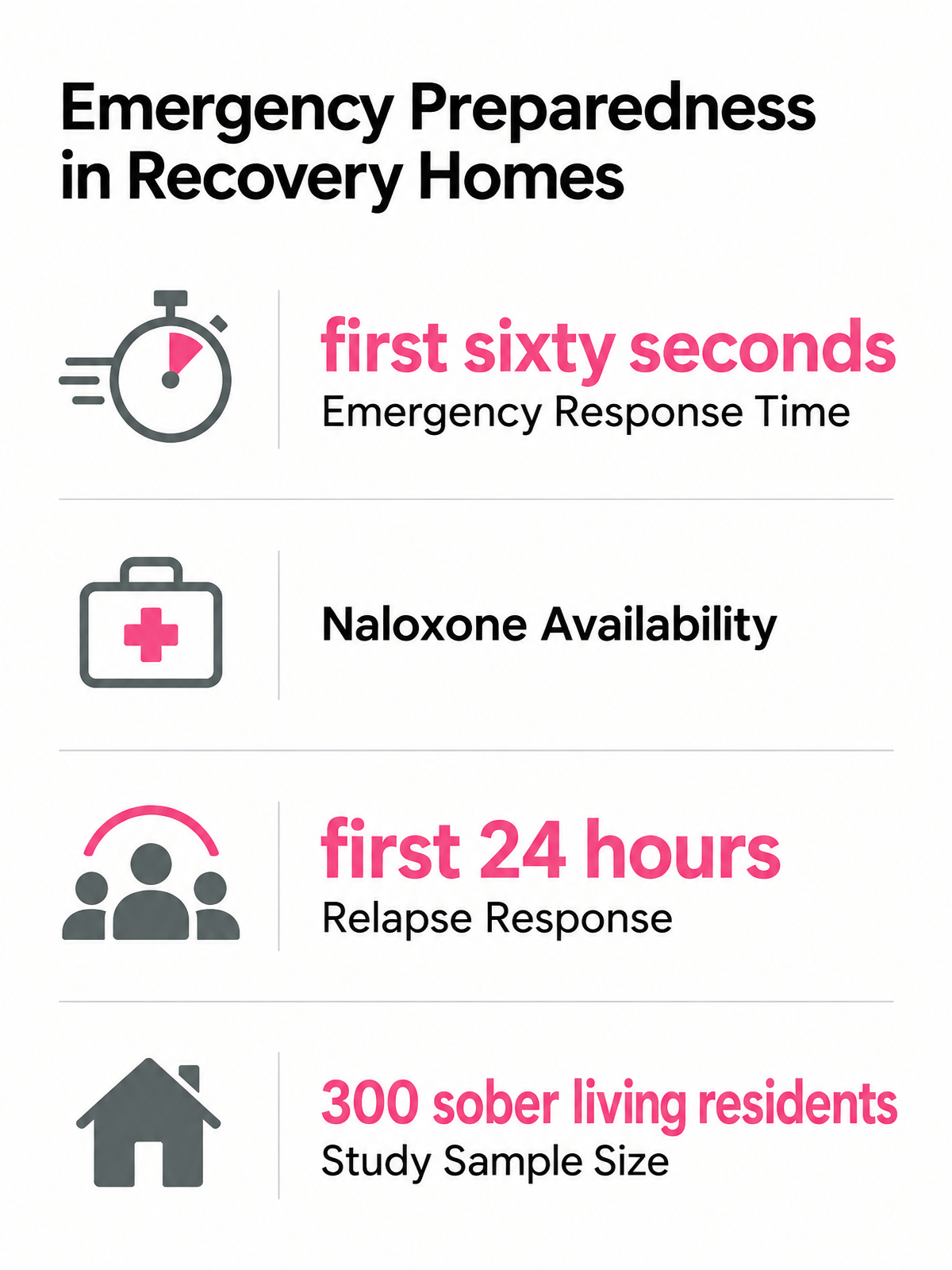
Most sober living homes have fire extinguishers and smoke alarms because the building code demands it. Far fewer have written protocols for overdose response, mental health crises, or acute medical emergencies. Operators in the recovery housing field report that even state-certified homes sometimes lack documented emergency procedures beyond evacuation routes. The gap shows up fast when someone collapses in the hallway or threatens self-harm in the middle of the night.
A functional emergency plan names who does what immediately. One staff member administers naloxone if overdose is suspected, another calls emergency services, and another keeps the surrounding area calm and clear. In New York's certified recovery residences, residence managers must document emergency contact information for every resident at admission, including phone numbers for their treatment provider, primary care physician, and emergency contact person. That list becomes critical when paramedics arrive and ask about pre-existing conditions or current medications.
The homes that treat emergencies seriously practice instead of relying on memory. Staff rehearse naloxone administration, review what to say when calling for help, and make sure residents know where emergency supplies are stored. Peer support can protect recovery, but it can also become risky if residents hide relapse or hesitate to call for help because they fear consequences. The house culture needs to make safety the first priority.
Medical Coordination and Equipment That Belongs in Every Home
Naloxone availability is now standard in many states, but the surrounding infrastructure matters just as much. Kits expire, staff turnover means training lapses, and some operators still believe that keeping naloxone on-site "enables" relapse. That belief is wrong and deadly. The NARR Standard for recovery residences recommends that Level II and higher homes maintain naloxone supplies, train all staff on administration, and document every use with a follow-up incident report.
Beyond naloxone, the medical coordination gap becomes visible when residents need urgent care for issues unrelated to substance use. A resident breaks an ankle, develops severe abdominal pain, or shows signs of a stroke. Does the house manager know which emergency room to call? Does the residence have transportation to get someone to the hospital, or does staff default to calling an ambulance for problems that could be handled with a car ride and waste EMS resources? Some homes have managers who drive residents to the ER personally. That sounds caring until you realize it leaves the house unsupervised and creates liability exposure if the resident's condition worsens in transit.
Coordinating with external medical services means more than keeping a hospital's phone number posted. Certified recovery residences in states with oversight requirements must establish relationships with local treatment providers, mental health crisis lines, and primary care clinics before residents move in. When a resident relapses or experiences a psychiatric emergency, the house manager shouldn't be Googling detox centers at midnight. The referral pathways should already exist, with intake coordinators who know the house and can expedite admission.
How Homes Handle Relapse Without Burning Down the Recovery
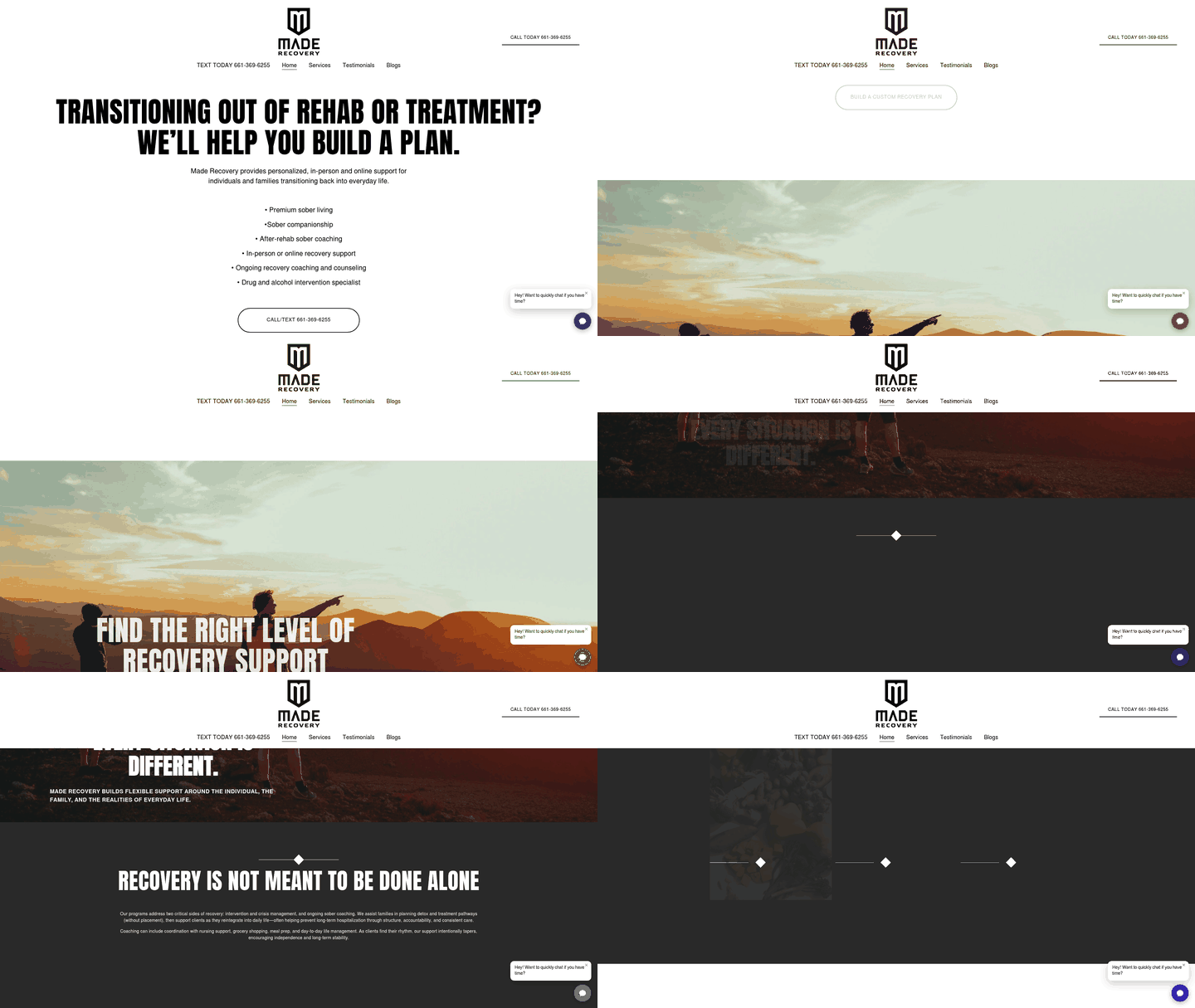
Relapse happens, and homes that pretend otherwise set themselves up for disaster. The question isn't whether someone will use again. It's whether the house can respond safely when they do. When a resident relapses, the recovery network either rebuilds or fractures depending on how the home responds during the initial crisis window.
Safe relapse protocols start with immediate assessment, not immediate ejection. The house manager sits down with the resident, confirms what happened, and determines whether the person needs medical detox, outpatient support, or a temporary transfer to a higher level of care. New York's guidance on involuntary discharge notes that termination may be warranted if a resident's actions jeopardize others' safety, but the regulation also requires homes to document the incident, offer referrals to appropriate services, and allow the resident to return if they complete recommended treatment. The goal is stabilization, not punishment.
Temporary relocation to a detox facility or short-term residential program preserves the resident's connection to the house while addressing the immediate crisis. Some Level III and IV homes maintain partnerships with detox providers specifically for this purpose, allowing residents to return after medical stabilization rather than losing their bed entirely. Continuity matters. Staying connected to a stable recovery environment supports better long-term outcomes, but that benefit disappears if a single relapse episode ejects someone permanently from the support system they were building.
The dangerous alternative is the one-strike policy that treats relapse as betrayal. Homes that instantly sever support after any use force residents into the exact instability that triggered the relapse in the first place. They end up back in chaotic living situations, disconnected from peer support that was working, and often cycling through hospital ERs or jail cells. Ongoing sober coaching, whether someone is living in a recovery residence or transitioning back home, can provide continuous support during vulnerable moments, helping people stabilize and reconnect with their recovery plan rather than face those moments alone.
Cost, Fees, and the Safety You're Paying For
Cost is where a lot of families get blindsided. A room that looks affordable on the tour can carry fees nobody mentioned until move-in day, and those gaps matter more when you're funding sober coaching after rehab on top of housing. Price and safety are linked, but not the way most people assume.
Recovery residences vary widely in cost, often reflecting what an apartment costs in the same area. What that number buys varies wildly. A cheap bed in a high-risk neighborhood is not a bargain if it sits close to liquor outlets and far from meetings. That's the tradeoff we watch for when we help families weigh a residence against continuous support at home.
What Should a Fee Breakdown Actually Show?
A trustworthy home itemizes its costs. You should see rent, utilities, drug testing, deposits, and any staff or program fees written out before you pay a dollar.
Watch for the opposite pattern. Low advertised rent that hides charges for testing, deposits, or "services" is one of the clearest red flags in the field. Unclear or shifting fees signal an operator who either can't budget or doesn't want you to.
The insurance question rarely comes up, but it should. Standard landlord or homeowner policies often don't reflect how a sober living property is actually used, which means coverage can be denied after an incident. Ask directly whether the home carries insurance built for recovery housing. A home that can't answer is telling you how it handles risk.
Does Paying Rent Actually Help Recovery?
Yes, and this is where cost stops being a burden and starts being part of the work. Financial responsibility tracks with better outcomes. Residents who keep up with rent and bills tend to sustain recovery at higher rates, and most homes require monthly payment for exactly this reason.
That reframes the conversation. You're not just buying a safe bed. You're rebuilding the habit of showing up for an obligation, which is a muscle addiction tends to weaken.
Many homes stop at collecting rent without teaching the skill behind it. If budgeting is a struggle, ask whether the home teaches it or just collects payment.
Where Middle-Tier Pricing Wins
After watching where people tend to stabilize, we often see the strongest value in the middle of the market.
Budget homes may cut corners on neighborhood and supervision. Premium homes can isolate residents geographically from treatment and peers. Moderate pricing stays affordable enough to sustain those recovery-linked rent payments while keeping residents connected.
Scholarships and sliding-scale spots exist, and a good operator won't drop safety standards to offer them. If you're comparing a residence against bringing a coach into your own home, price the whole plan, not just the bed. The post-residence support line is the one many budgets forget.

How to Evaluate a Home Before You Sign Anything
The most useful thing we can tell you about touring a home is that the neighborhood matters as much as the house. Proximity to old haunts, bars, and familiar dealers can undermine recovery even when the house itself is well run. When we help someone evaluate sober coaching after rehab or a sober living placement, location and environment are as important as what happens inside.
That is exactly the gap continuous support at home is built to close, because the structure a good residence provides tends to vanish the moment someone signs out.
What Should You Ask Before Signing a Lease?
Bring direct questions and expect direct answers. A legitimate operator can explain rules, costs, and screening before you pay, and evasiveness is itself the answer.
- What regulations apply here, and who certified you? HealingUS recommends asking whether you can verify the certification independently rather than just asking "are you licensed?"
- Can I read the resident agreement now? It should spell out rent, deposits, testing, medication policy, and disciplinary steps in writing.
- What happens in a medical emergency, a relapse, or a conflict at night?
- What is your policy on residents taking medications for opioid use disorder? Some homes have historically denied entry to people on MOUD, which is a safety and ethics red flag.
What Should You Look for During the Site Visit?
Walk the shared spaces and trust what you see. Property neglect, pests, plumbing problems, overcrowded bedrooms, and poor maintenance are visible signs worth never ignoring. Ask how maintenance gets reported and how fast it gets fixed.
Pay attention to how management communicates before move-in. Unanswered calls, dodged questions, or pressure to pay before you have seen the agreement all signal how the home runs day to day.
One caveat on reviews: a single bad one often reflects an individual dispute. Look for patterns and, above all, a refusal to give straight answers.
Red Flags That Should Stop You
Don't assume "no state license" means "no rules." Operators are reminded that local building codes, health regulations, and landlord-tenant law still apply, and standard homeowner insurance may not even cover the home's actual use. No written agreement, changing fees, no admission screening, and no relapse response plan are the patterns we tell families to walk away from.
MADE Recovery's sober living home in Newport Beach is built around structure, peer connection, and access to recovery coaching. That last piece is the one most homes skip. If you want a fuller comparison of the tradeoffs, our team breaks down sober housing versus going home in plain terms. A safe house protects you while you live there. Companionship at home is what protects you the week after you leave.
Your Next Move After the Sober Living Home
Most residents leave a sober living home planning to live independently. That's the milestone everyone aims for: a place of your own, no house rules, no curfew. Yet transition is where outcomes can quietly unravel. The peer network, recovery meetings, and visible accountability that worked inside the house often become optional the moment someone signs the discharge paperwork. Someone can do well in a structured home, move into their own apartment, and destabilize quickly because the scaffolding vanished.
Sober coaching after rehab closes that gap. The same mechanisms that work inside a residence, accountability check-ins, routine-building, connection to a recovery community, can follow you home if someone builds them into your plan before you leave. Without that bridge, you're betting on willpower alone against the same triggers and isolation that derailed recovery the first time.
What a Real Transition Plan Includes
Most homes hand you a discharge summary listing outpatient programs and meeting schedules. That's a start, but it's not a plan. A useful transition protocol connects three elements before discharge day: housing stability, employment or structured daily activity, and ongoing recovery support that survives the move. The point is to carry the social environment forward instead of assuming it will recreate itself.
MADE Recovery builds customized recovery plans that address the practical questions determining whether someone makes it to the next stage or falls back into old patterns. Who will you call when a craving hits late at night? Which meeting will you attend when your old routine was the bar? Where's the grocery store that doesn't sit across from a liquor outlet? These aren't hypothetical. They're the decisions that shape early recovery.
Why Peer Support Disappears After Discharge
Inside a sober living home, peer accountability happens automatically. You see housemates at breakfast, someone notices if you skip a meeting, the group calls you out when excuses start piling up. Once you move out, that environment evaporates unless you intentionally rebuild it.
Virtual coaching sessions and alumni check-ins aren't the same as living with peers, but they preserve the accountability mechanism. Recovery coaching can continue through regular contact during the months after discharge, tracking meeting attendance, employment status, and social network changes, the same data points a house manager might monitor, now delivered through ongoing support.
The Housing-Proximity Paradox
Neighborhoods matter as much as house rules. When discharge day arrives, someone who moved from a higher-cost sober living home to a more affordable apartment may trade physical safety for recovery infrastructure access, closer to old dealers, farther from the meeting that kept them sober.
MADE Recovery works with clients to understand the recovery environment before the lease is signed. If your budget forces you into a neighborhood dense with alcohol outlets, your aftercare plan needs stronger guardrails: more frequent coach contact, peer escort to meetings for the first month, employment that doesn't route you past old haunts. You can't always fix geography, but you can compensate for it with tighter structure.
Employment as a Stabilizer, Not Just Income
Getting a job is on every discharge checklist. What the checklists miss is that not all employment supports recovery equally. Bar-backing pays rent but surrounds you with alcohol for the whole shift. Late shifts leave you isolated when meetings happen. Jobs requiring a car can present relapse risk if your route home passes familiar triggers.
The transition plan should include employment that reinforces routine and social connection. Morning shifts that end before evening meetings. Workplaces with sober coworkers. Jobs you can reach without driving past triggers. If those aren't available immediately, temporary work through a recovery-friendly staffing agency buys time to build both income and structure. Rushing into the first paycheck can undo months of progress if the job itself destabilizes recovery.
How Continuous Support Prevents Drop-Off
Relapse prevention can't stop at the first month. Early recovery often includes another risk window later on, when initial motivation fades but coping skills haven't fully solidified. Someone starts skipping meetings, avoids calls, or lets a work conflict turn into isolation. By the time the warning signs are obvious, the slide may already be underway.
Continuous aftercare extends structured support through vulnerable periods. Contact frequency can taper gradually, from daily check-ins to every-other-day, then weekly, but the accountability doesn't fully disappear. A coach spots warning signs: missed meetings, job loss, relationship conflict, and adjusts support before relapse happens. This isn't surveillance. It's the same peer feedback loop a sober living home provides, now delivered through scheduled contact points instead of shared living space. When that structure stays in place past discharge, individuals are better positioned to maintain recovery.
References
[1] 20 Sober Living Operator Mistakes to Avoid (Business, Compliance, and ... - https://www.vanderburghhouse.com/the-biggest-mistakes-new-sober-living-operators-make-and-how-to-avoid-them/
[2] What Did We Learn from Our Study on Sober Living Houses and Where ... - https://pmc.ncbi.nlm.nih.gov/articles/PMC3057870/
[3] Finding a Sober Living Home - American Addiction Centers - https://americanaddictioncenters.org/sober-living
[4] The Problem With Sober Living Homes | Zinnia Health - https://zinniahealth.com/substance-use/alcohol/sober-living-homes-problems
[5] Best Sober Living Homes - Recovery.com - https://recovery.com/care/sober-living/
[6] What Is A Sober Living Home? - Addiction Center - https://www.addictioncenter.com/treatment/sober-living-homes/
[7] Recovery Residences Guidance - https://oasas.ny.gov/providers/recovery-residences-guidance
[8] 10 Common Sober Living Rules - IKON Recovery Centers - https://www.ikonrecoverycenters.org/10-common-sober-living-rules/
[9] Red Flags When Choosing A Sober Living Home | HealingUS - https://healingus.org/blog/sober-living-home-red-flags/
[10] Standards - National Alliance for Recovery Residences - https://narronline.org/standards/
[11] Sober living house characteristics: A multilevel analyses of factors ... - https://pubmed.ncbi.nlm.nih.gov/30665601/
[12] Recovery Residences and Providing Safe and Supportive Housing for ... - https://www.researchgate.net/publication/282395737_Recovery_Residences_and_Providing_Safe_and_Supportive_Housing_for_Individuals_Overcoming_Addiction
[13] Recovery in context: Sober living houses and the ecology of recovery - https://www.researchgate.net/publication/344303581_Recovery_in_context_Sober_living_houses_and_the_ecology_of_recovery
[14] Activity Space Assessments to Understand the Local Environments ... - https://www.researchgate.net/publication/402039819_Activity_Space_Assessments_to_Understand_the_Local_Environments_of_Sober_Living_Houses
Common Questions
1. How can I verify whether a sober living home is actually certified and not just claiming it?
Use certification as a starting point, then verify it outside the home's own marketing. Check the NARR website or contact your state affiliate directly. For Oxford Houses, use the national directory at oxfordhouse.org. If the operator becomes defensive when you ask for independent confirmation, treat that as useful information.
2. What happens if I relapse while living in a sober living home?
The answer should be in the written resident agreement before you move in. Look for a policy that explains assessment, safety steps, referrals, and whether return to the home is possible after stabilization. Avoid homes that describe relapse only in punishment terms without explaining how they connect residents to the next appropriate level of care.
3. Do higher-cost sober living homes actually provide better safety?
Not automatically. Cost often reflects location, amenities, and local rent more than day-to-day safety. A modest home with clear rules, verified oversight, strong screening, and responsive management can be safer than a premium home with weak accountability. Compare policies, staffing, neighborhood risk, and emergency planning before comparing price.
4. Why do some sober living homes prohibit medication-assisted treatment?
Some operators mistakenly believe medications like buprenorphine or naltrexone conflict with "real sobriety," a stigma-driven stance that can force residents to choose between stable housing and medical treatment. Ask directly whether the home allows and supports MAT before you sign anything. If staff dodge the question or frame prescribed medication as a moral failure, keep looking.
5. What support should I arrange before leaving a sober living home to avoid relapse?
Line up accountability before discharge, not after problems start. That may include outpatient therapy, regular recovery meetings, alumni support, sober coaching that follows you home, or a combination of all three. The goal is to transfer the structure that worked inside the house into independent life instead of letting it disappear all at once.