Recovery Coaching After Rehab: What Happens the Day Your Coach Leaves
September 30, 2026
The Short Version
- Recovery coaches can improve long-term recovery outcomes.
- The most effective post-coaching accountability systems rely on written tracking.
- A functional support network after coaching ends requires multiple people—sponsor, family, peer groups—each holding different pieces of accountability.
- Specific, measurable daily goals like "attend two meetings per week" outperform broad intentions like "stay connected to recovery."
- Recovery companions fill the middle ground between intensive daily coaching and less-frequent sponsor check-ins for clients needing ongoing presence.
Reassessing Goals & Building Self‑Accountability
Your sober coaching relationship ends eventually. When it does, you're not starting over. You've built habits, learned what helps, and figured out what staying sober looks like for you. The work now is taking what your coach helped you build and making it run without their daily check-ins.
We see this go sideways two ways. Some people freeze. They wait for permission that isn't coming anymore. Others overcorrect and ditch all the structure, convinced they've outgrown accountability. Both fail. The point isn't to stop being accountable. It's to shift where that accountability comes from.
How Do You Translate Coach-Driven Goals Into Self-Driven Milestones?
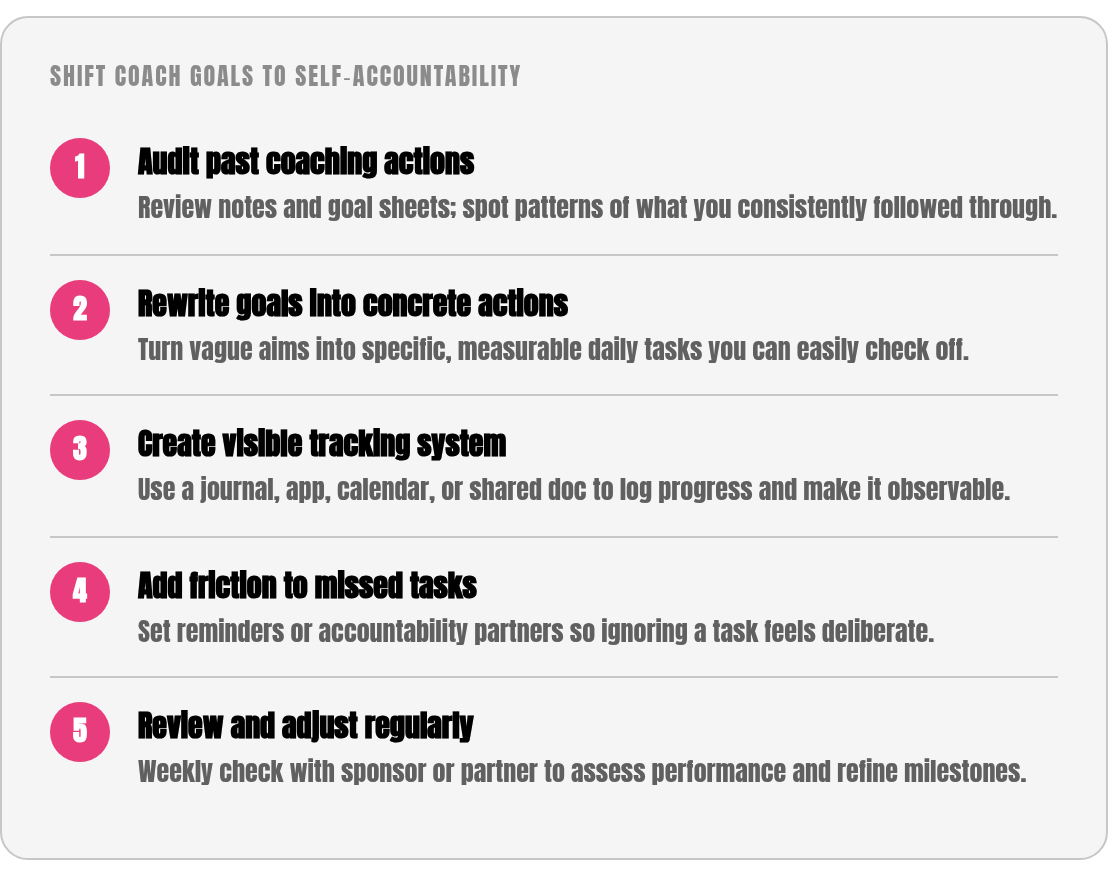
Start by auditing what you actually did with your coach. Pull out your check-in notes and goal sheets, or whatever system you used. Look for patterns in what moved. Not what sounded good in session, but what you followed through on and what felt different when you did. Those are your anchors.
Now rewrite those goals so they don't need translation. Instead of "work on my recovery," write "go to my regular Tuesday group and call one sober contact before work." Instead of "build healthy routines," specify "wake up at the same time on workdays, prep tomorrow's lunch before bed, leave phone outside the bedroom." Tighter language makes it easier to know whether you did the thing or didn't.
We help clients build accountability through small, daily actions that stack. A sobriety journal that tracks mood, cravings, and gratitude each night. A habit-tracking app where you mark off non-negotiables. A daily text thread with a roommate or sponsor where you confirm you hit your morning routine. These aren't busywork. They're tripwires. When you miss one, you notice before the slide gets steep.
What Makes a Goal System Work Without a Coach Watching?
Visibility and friction. You need to see your progress clearly, and you need it to take effort to ignore what you committed to. A calendar on your wall, a spreadsheet that logs sleep and mood, or a shared document your accountability partner can review all serve the same purpose: they make your recovery observable. The format matters less than the fact that it exists and that someone—even if it's just you—looks at it regularly.
We recommend building your daily targets around the basics that held you steady early on: nutrition, routine, and structure. These aren't exciting milestones, but they're measurable and they compound. Did you eat real meals today? Did you wake up on schedule? Did you move your body? These become the floor, not the ceiling. When they're consistent, you have bandwidth for harder work.
The systems that survive coaching are the ones that don't require heroic willpower. They're simple enough to use on a bad day, visible enough that skipping feels deliberate, and tied to something bigger than "I should." You're not tracking habits to impress anyone. You're tracking them because you decided the person you're becoming does these things, and you want proof you're becoming that person.
Rebuilding Your Support Network
The gap a coach leaves isn't filled by one replacement. It's filled by several people, each carrying a piece of what your coach used to hold. This is the shift we push clients toward before the last session ever happens: from a single point of contact to a small team.
Sober coaching after rehab works partly because one trained person tracks everything at once. Your cravings, your schedule, your warning signs. When that person steps back, the fix isn't finding another individual to do it all. It's spreading the load across a sponsor, your family, a peer group, and in some cases a recovery companion.
How Do You Approach a Sponsor When Your Coach Steps Back?
A sponsor is not a paid professional, and that's the point. A recovery coach is trained and compensated, working toward any positive goal that supports your recovery. A sponsor works from lived experience inside a program, typically unpaid, typically available at odd hours.
Approach one the way the rooms have always taught. Go to meetings, listen for someone whose sobriety you respect, and ask directly. We tell clients to be honest that a coach recently wrapped up, so the sponsor understands they're stepping into an active transition, not starting cold.
What Does a Coordinated Team Actually Prevent?
The research backs this structure. People leaving treatment tend to do better when they have continuing contact, practical accountability, and a way to catch risk before it becomes a relapse. Regular post-treatment check-ins also lower relapse risk across that same window.
Families are the piece most people get wrong. Relatives want to help, then either hover or disappear. We coach families to hold structure without policing. Fixed check-in times, honest questions, no interrogations.
Peer groups round out the team. Both in-person meetings and virtual rooms welcome people leaving coached care, and they give you accountability that doesn't clock out.
For clients who need ongoing presence after coaching winds down, our recovery companions can step into real-world situations where a weekly call is not enough. They are not there to replace the whole support network. They help keep the transition steady while sponsors, family members, peers, and house routines settle into their roles.
Adjusting Daily Routines & Structure
When your coach exits, the daily anchor disappears. Not the motivation necessarily, but the external rhythm that used to hold the day together. Your coach called at 8 AM. You checked in before lunch. You reported your evening plan by text. Those weren't just touchpoints—they were the scaffolding. In sober living, you're trading that individualized structure for a communal schedule, and the shift requires deliberate translation.
We see clients stumble here because they assume coaching ends and freedom begins. It doesn't. You're moving from one accountability model to another, and the new one runs on house rhythm rather than personal calls. Meal times are fixed. Group meetings happen whether you feel like attending or not. Curfews exist. The structure is there, but you have to learn to use it instead of resenting it.
How Do You Anchor Your Day When the Coach's Check-Ins Stop?
Start with the non-negotiables your house already imposes. Most sober living programs lock in breakfast, dinner, and at least one evening meeting. Those become your time blocks—the fixed points everything else wraps around. If your house serves dinner at 6 PM and runs a nightly check-in at 8 PM, you're not scheduling conflicting commitments. You're building work, errands, and social plans in the windows between.
The discipline here isn't creating structure from scratch. It's protecting the structure someone else built. Block your calendar for house obligations the same way you used to block coach calls. Treat a Tuesday night meeting like a work deadline. Miss it, and you're drifting.
What Happens to the Sober-Social Planning Your Coach Used to Push?
Your coach probably nudged you toward coffee meetups, gym sessions with sober friends, and weekend plans that didn't revolve around bars. That prompting stops, but the need for intentional leisure doesn't. In a sober living home, the group handles some of this for you—there are housemates, shared meals, and built-in Friday night plans.
The gap is in your personal time. Weekends off-site, afternoons between work and dinner, mornings before the house wakes up. We push clients to calendar-block recovery-focused activities the way they'd block a dentist appointment. A Saturday morning meeting. A Thursday gym slot. A Sunday call with your sponsor. If it's not on the calendar, it dissolves into scrolling or isolation.
Finding New Coaching or Alternative Resources
When you're deciding whether to replace your coach or shift to a different model entirely, start with a blunt question: was the coach working, or was it just present? The answer determines whether you need a new coach or a different kind of structure altogether. A coach alone is a partial fix.
Here's what we tell clients weighing their options after sober coaching ends: the day your coach leaves is rarely a graduation. It's often a money problem, since most insurance plans do not cover sober coaching and the support comes largely out-of-pocket. So the exit can be a predictable resource cliff, and the smart move is to plan the next structure before you hit it.
Vet A New Coach Against Real Credentials, Not A Title
The problem: anyone can call themselves a recovery coach. There is no automatic credential behind the title, as rehabcenter.net puts it plainly. That means the burden of vetting falls on you.
Before you pay anyone, ask about certification through an accredited organization and their background in addiction recovery or a related field. A good coach welcomes those questions and will challenge you rather than flatter you. Interview two or three before committing. How you feel about the person matters as much as their résumé.
One more thing worth naming: a coach isn't limited to sobriety goals. They can work with you on any positive goal that doesn't interfere with recovery, which makes the right fit less about credentials on paper and more about whether they push you in a direction you actually want to go.
A Team-Based Sober Living Home Beats A Single Point Of Failure
The strongest case against replacing one coach with another comes from where relapse actually starts. Much of the risk after treatment is interpersonal: no support network, strained relationships, and friends who still use. A single coach concentrates all your accountability in one relationship. When they leave, that whole system goes dark at once.
A team-based sober living home spreads that load across residents, house staff, and shared routines. If one person is unavailable, the structure holds. That's the continuity this whole approach turns on.
Match The Alternative To What's Actually Missing
Coaching misses the point if your basic needs aren't met. Unmet needs like housing, income, and a job are among the biggest barriers people face when leaving treatment. A coach who's great at goal-setting can't fix a housing gap.
So match the resource to the hole. Lower-cost peer-coaching circles and app-based check-ins cover accountability cheaply. A sober living home covers the structural pieces—safe housing and daily rhythm—that a solo coach never could. When basic-needs stabilization runs parallel to coaching, both start working.
What Stability Looks Like Six Months Out
Recovery doesn't end with a single clean date or a final check-in call. The work stretches across months and years, and the shape of that work changes as you move further from treatment. What kept you stable in month two might not be enough in month six. Recognizing when your existing structure is weakening and when you need to bring a professional back into the picture is a skill in itself.
How Do You Measure Stability Over the Long Haul?
Build regular self-assessment into your recovery from the start. This isn't aspirational planning. It's scheduled accountability. You mark the calendar. You sit down with your support network—a sponsor, a sober living house manager, a family member who knows your warning signs—and you audit what's working and what isn't.
The markers we track are concrete. Are you attending your recovery meetings at the same frequency you committed to three months ago? Have you missed check-ins with your sponsor or your peer group? Is your sleep pattern stable, or are you awake at 3 AM scrolling through old contacts? Are cravings more frequent, more intense, or lasting longer than they did in the first month out of treatment?
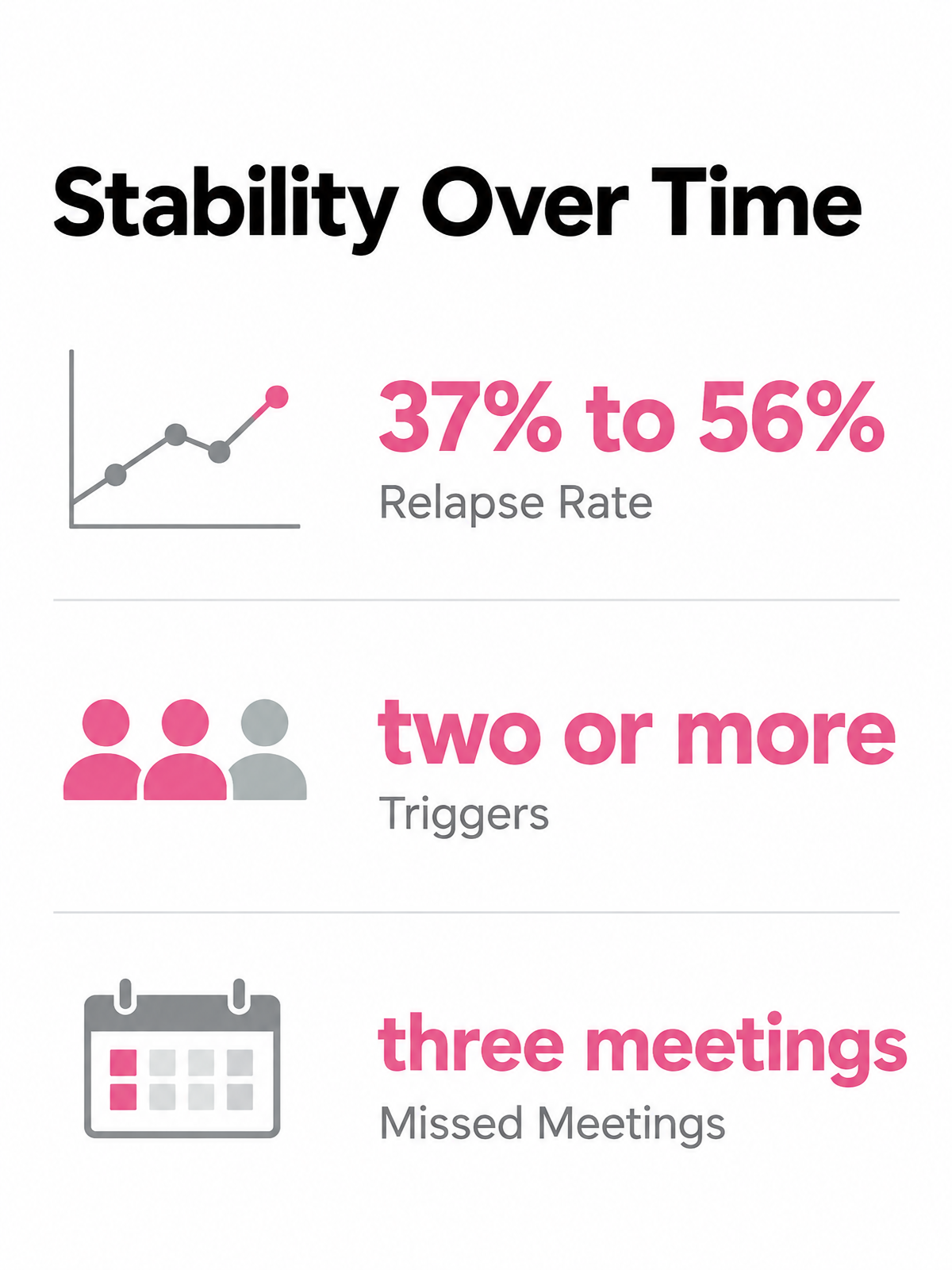
One warning sign we see repeatedly: escalating isolation. You stop answering texts. You skip group dinners. You tell yourself you're fine, that you need space, that everyone's being too much. That's rarely independence. It's typically the first move toward relapse. Research tracking individuals transitioning from residential treatment found that relapse is common within the first year after discharge. The gap isn't random. It opens when people lose connection to aftercare services or let their support network erode.
When Should You Bring a Professional Back In?
If you hit two or more of the following within a two-week span, it's time to re-engage professional support:
Cravings that disrupt your day. Not the passing thought of a drink. The kind that interrupts work, derails your evening, or keeps you awake.
Missed commitments to your recovery plan. You skip three meetings in a row. You stop calling your sponsor. You drop the morning routine that used to anchor your day.
Mood swings that feel unmanageable. Anger that spikes without a clear trigger. Anxiety that doesn't ease after a meeting or a conversation. Depression that lingers for days.
Returning to old environments or contacts. You start texting people who still use. You drive past the bar you used to frequent. You justify it as curiosity or nostalgia. It's not.
The fix isn't always a coach. Sometimes it's a therapist who can address co-occurring mental health issues that coaching doesn't touch. Sometimes it's a medical provider who can assess whether medication-assisted treatment is appropriate. Sometimes it's re-entering a structured sober living environment where the daily rhythm holds you accountable until you rebuild your footing.
Coaching support can ramp back up when you need it. Because our programs are fully customized and shift as your needs do, you can re-engage at whatever level makes sense—whether that's a few check-ins to recalibrate your routine or a more intensive stretch of support to get you through a high-risk period. The research is clear: engagement in aftercare can improve outcomes, but many people leaving residential treatment do not make initial contact with outpatient care, and fewer still stick with it long-term. The gap between knowing you need support and actually accessing it is where most people fall through.
Long-term sobriety isn't about never needing help again. It's about recognizing when the structure you built is no longer enough and acting before the floor drops out entirely.
References
[1] Benefits Of Having A Recovery Coach When Leaving Treatment - https://www.rehabcenter.net/the-benefits-of-having-a-recovery-coach-when-leaving-treatment/
[2] Addiction recovery coach: For therapy and life after rehab - Castle Health - https://castlehealth.com/addiction-treatment/recovery-coaching/
[3] Challenges in going from residential substance abuse treatment to the... - https://www.sciencedaily.com/releases/2016/12/161214115116.htm
Quick Questions, Straight Answers
Does health insurance cover recovery coaching after rehab?
Coverage is usually the first practical constraint to sort out. Before your final coaching session, decide what you can afford, what support is free or lower-cost, and which parts of your plan need to move into sober living, peer meetings, family check-ins, or app-based accountability.
Can a sponsor simply replace my recovery coach?
Usually, no. A sponsor can offer lived-experience guidance and program connection, but they are not meant to manage every part of your post-rehab plan. The safer move is to assign different responsibilities to different supports instead of expecting one person to carry the whole transition.
What's the difference between a recovery companion and a sponsor?
A sponsor is rooted in program-based recovery and offers support on their own rhythm. A recovery companion is more practical and in-person: they can accompany clients through vulnerable parts of daily life, help reinforce routines, and support accountability while the broader network becomes more stable.
Does a recovery coach only help with staying sober?
No. Sobriety stays central, but coaching can also support the life structure around sobriety: routines, work goals, relationships, health habits, and follow-through. The key boundary is that the goal must support recovery rather than compete with it.
How do I know if a recovery coach is actually qualified?
Ask direct questions before hiring anyone: What training do they have? Who certified them? What experience do they have with addiction recovery? How do they handle relapse risk, family communication, and coordination with clinical providers? A credible coach should be comfortable answering without defensiveness.
Does needing professional help again mean my recovery failed?
No. Needing more support means your current structure needs reinforcement. Recovery changes over time, and responsible people adjust their support before things become unmanageable.
Is a coach or a therapist the right choice when things get shaky?
Choose based on the gap. If the problem is follow-through, routine, and accountability, coaching may fit. If trauma, depression, anxiety, medication, or diagnosis-level concerns are driving the instability, bring in a licensed clinician or medical provider.