Sober Coach or Group Meetings: Which Holds You Through Month One Home
September 4, 2026

Key Takeaways
- Without structured follow-up, 40 to 60 percent of people relapse within the first month after leaving treatment, per SAMHSA's 2023 data.
- The first 30 days home represent the highest-risk period in recovery, and the support chosen during that window often decides the year ahead.
- A systematic review of peer recovery services covering over 12,600 participants found clear gains in treatment engagement and retention.
- Evidence that peer support improves actual substance use outcomes was mixed, suggesting groups get people to show up but don't reliably keep them sober alone.
- Group meetings function passively through attending, listening, and optional sharing, which leaves an accountability gap that one-on-one work fills.
- Sober coaching and group meetings serve fundamentally different functions during month one rather than competing as interchangeable options.
- One-on-one coaching resembles being walked through the terrain, while a map-only approach leaves newly sober individuals white-knuckling through the transition.
The First 30 Days Home Are a Different Animal
Returning home after treatment is a milestone, but it's also the most vulnerable window in recovery. SAMHSA's 2023 data makes that plain: without structured follow-up, 40 to 60 percent of people relapse within the first month. The transition back to daily life brings a wave of old triggers, unstructured time, and stressors that didn't pause while you were away. The support structure you set up in these initial weeks often determines whether the next year is sustained recovery or a return to old patterns.
When we talk about sober coaching after rehab, we're not describing a luxury add-on. We're describing the difference between being handed a map and being walked through the terrain. Group meetings and one-on-one coaching both matter, but they serve fundamentally different functions during month one. Understanding that distinction is the difference between white-knuckling through and building a foundation.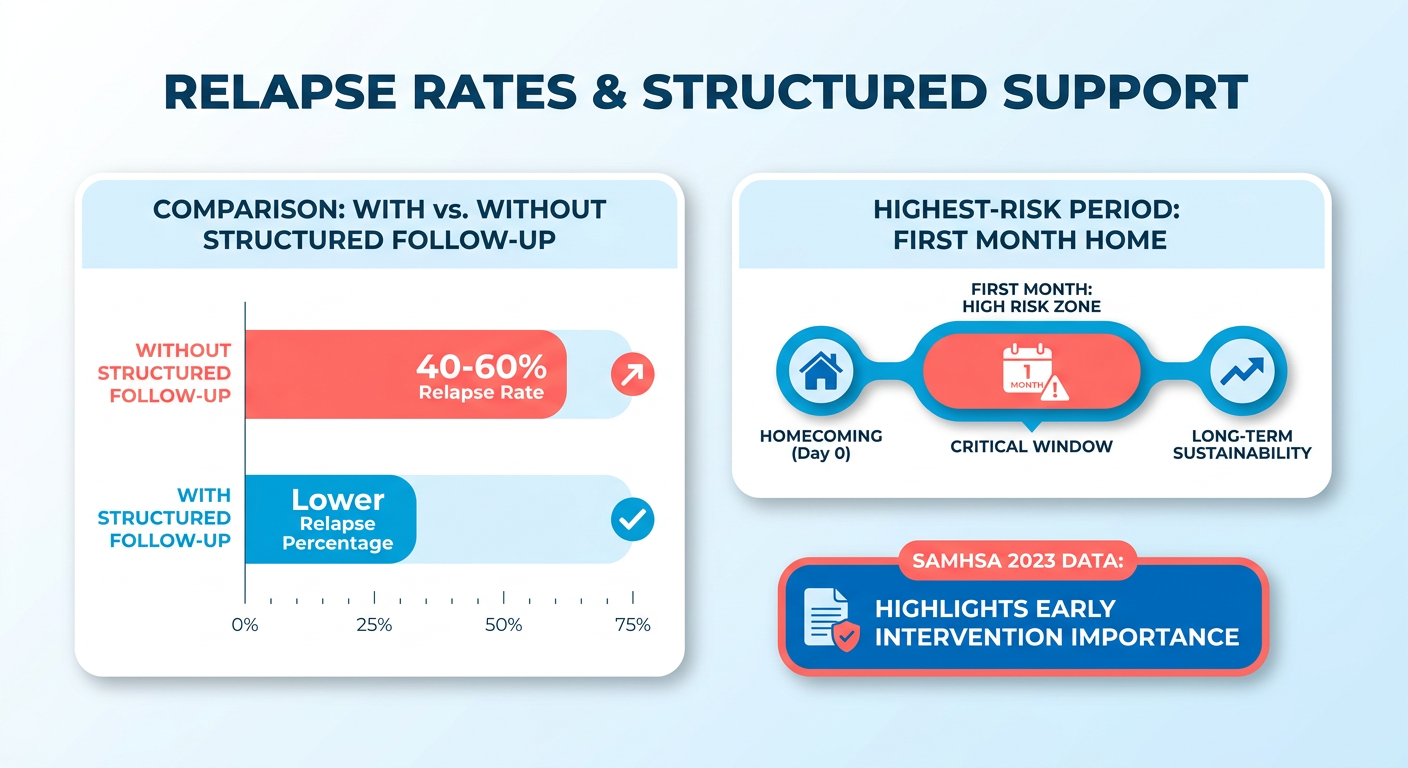
The Accountability Gap That Groups Leave Open
Community support is invaluable. Relying solely on meetings, though, leaves critical gaps. The clinical literature draws this distinction clearly: the systematic review of peer recovery support services shows that peer-led environments excel at fostering belonging, but they don't automatically translate to long-term abstinence when navigated without individual guidance. Showing up to a room is a vital first step. Maintaining sobriety requires active, daily implementation of recovery skills.
Part of the problem is structural. A meeting happens at a specific hour on a specific day. Cravings, environmental triggers, and life stressors don't keep regular business hours. Between scheduled sessions, you're left to navigate high-risk moments entirely on your own—which is exactly where early recovery is most vulnerable.
A dedicated sober coach fills that specific check-in gap. Most recovery coaches recommend 2 to 3 contacts per week during the first month, which is more frequent than the typical weekly meeting schedule. That's not a coincidence. It's a response to the reality that cravings don't follow a meeting calendar.
What One-on-One Coaching Handles That Groups Can't
The first month home isn't just about not drinking. It's about rebuilding a life that collapsed. Housing instability, nutritional chaos, broken routines, the crushing boredom of evenings without substances. Group meetings offer peer validation, which matters deeply. But they don't offer individualized crisis management.
Recovery coaching focuses on present and future goals rather than past trauma, which makes it uniquely suited to month one. A coach helps you build the routine, not dissect the history. When you slip, a coach views it as a learning opportunity, not a moral failure. That reframing is critical in the first 30 days, when perfectionism is often the enemy of progress.
The evidence supports early, tailored intervention. Byrne et al. (2020) found that linking inpatients to recovery coaching services led to greater engagement in recovery support at the 30-day follow-up. Another study by Upadhyaya et al. (2021) showed that engagement with peer recovery services was associated with 56 percent lower odds of all-cause readmission within 90 days. Early support doesn't just feel better. It changes the trajectory.
Who Needs a Coach vs. Who Thrives in Groups Alone
| Need | Group Meetings | Sober Coaching |
|---|---|---|
| Frequency of contact | Weekly or daily meetings, self-initiated | 2-3 scheduled contacts per week, proactive outreach |
| Crisis response | Peer support, often after the fact | Immediate, individualized intervention |
| Practical life rebuilding | General encouragement | Structured routine, housing, nutrition, scheduling |
| Relapse response | Varies by group culture | Framed as learning, not failure |
| Cost | Low or free | $75-$400 per hour (varies widely) |
| Best for | Community connection, long-term maintenance | High-risk first month, co-occurring disorders, transition from residential |
Let's be direct about who should skip one-on-one coaching: if you have a strong sober network already in place, stable housing, and a job that provides structure, group meetings alone may carry you through month one. The evidence on peer support for engagement is solid, and community is irreplaceable.
But if you're leaving residential treatment with co-occurring mental health conditions, a shaky home environment, or a history of rapid relapse after past discharges, coaching isn't optional. It's the bridge between clinical discharge and sustainable daily life. The first 30 days are where that bridge either holds or collapses. We've seen too many people fall because they assumed a meeting schedule would catch them. It won't always. A coach will.
What One-on-One Sober Coaching Actually Looks Like
The gap between discharge paperwork and a stable routine is where most first-month relapses happen. One-on-one sober coaching after rehab closes that gap with something group meetings structurally cannot: proactive, scheduled outreach that comes to you.
The structured timeline outlined in this breakdown of the first 30 days emphasizes how consistent touchpoints outpace the typical weekly group cadence. You're not waiting for a Tuesday night meeting to confess a hard day. Someone is checking in before the hard day becomes a relapse.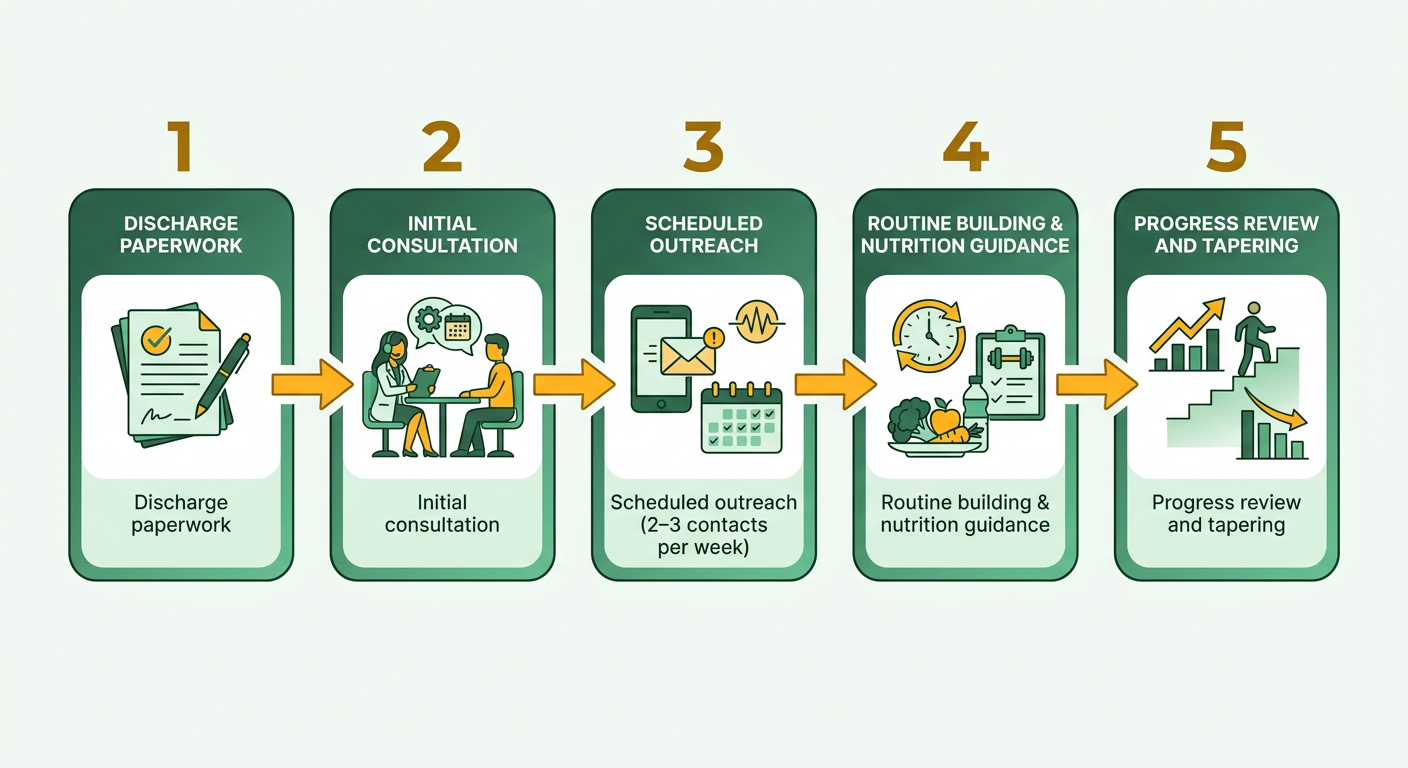
A Structured Month One, Day by Day
At MADE Recovery, each program is fully tailored to the individual, beginning with an initial consultation to assess needs. From there, coaching is built on fundamentals that support lasting recovery: healthy nutrition, routine building, passion discovery, personal empowerment, mentorship, and community connection. Sessions are available virtually and in person, with an à la carte menu of support and customized packages that evolve as needs change.
We deliberately keep the focus forward. Our coaches work alongside you to establish immediate, actionable strategies for daily living. The clinical work belongs in therapy. The coaching work belongs in your kitchen at 7 a.m., helping you decide what your day looks like and how to navigate it successfully.
The Team-Based Difference for Crisis Moments
Here's where our model diverges from the solo private coach. Clients can receive support from a single dedicated coach or a coordinated team, depending on the level of care needed. Our services address two critical sides of recovery: intervention and crisis management, plus ongoing sober coaching. We assist families in planning detox and treatment pathways (without placement), then support clients as they reintegrate into daily life. This often helps prevent long-term hospitalization through structure, accountability, and consistent care. Coaching can include coordination with nursing support, grocery shopping, meal prep, and day-to-day life management.
The clinical literature, including the systematic review of 28 studies, highlights how structured peer services keep individuals actively participating in their own recovery journey. Our read: coaching excels at keeping you in the game during month one, which is the necessary precondition for long-term sobriety. Skip one-on-one coaching if you're looking for a clinical intervention. It is not therapy and should not replace it.
What Success and Cost Look Like
We measure month one by routine stability, not just abstinence. We help clients establish healthy routines that reduce stress, restore balance, and build resilience. Stable routine means consistent sleep, meal times, and scheduled check-ins—the scaffolding that makes sobriety sustainable.
The tapering structure is what separates coordinated coaching from an open-ended service contract. A single coach's calendar caps how much can happen in a week. A team can absorb a bad Sunday without leaving you waiting for the next scheduled slot. At MADE Recovery, we offer flexible, customized packages that evolve with client needs. Because every program is tailored, pricing is discussed during your initial consultation. You're paying for coordinated coverage across the week, not one person's availability. And that coverage contracts as your own routines take over the work.
| Support Element | MADE Recovery Month One |
|---|---|
| Program design | Fully customized to the individual |
| Session formats | Virtual and in-person |
| Support model | Single dedicated coach or coordinated team |
| Coordinated support | Nursing coordination, grocery shopping, meal prep |
| Core fundamentals | Nutrition, routine building, mentorship, community |
As clients find their rhythm, our support intentionally tapers, encouraging independence and long-term stability. Knowing your routines and coordinating the day-to-day support around them is what a team can hold that a weekly meeting cannot.
The Hybrid Approach: Coach Plus Group Meetings
The strongest first-month plan isn't a coach or a group. It's both, running on complementary schedules. Pairing a weekly coaching deep-dive with two to three group meetings gives you proactive accountability and peer connection at the same time—which neither modality delivers alone.
Here's the tension worth naming up front. Some analyses suggest coaching sharply raises first-month success. Broader literature on peer support, like the systematic review, shows mixed results on abstinence when community is the only intervention. Our take: in the first 30 days, both work best not by proving sobriety on their own but by keeping you engaged long enough for the real skills to set. Layer them, and you cover the gaps each leaves open.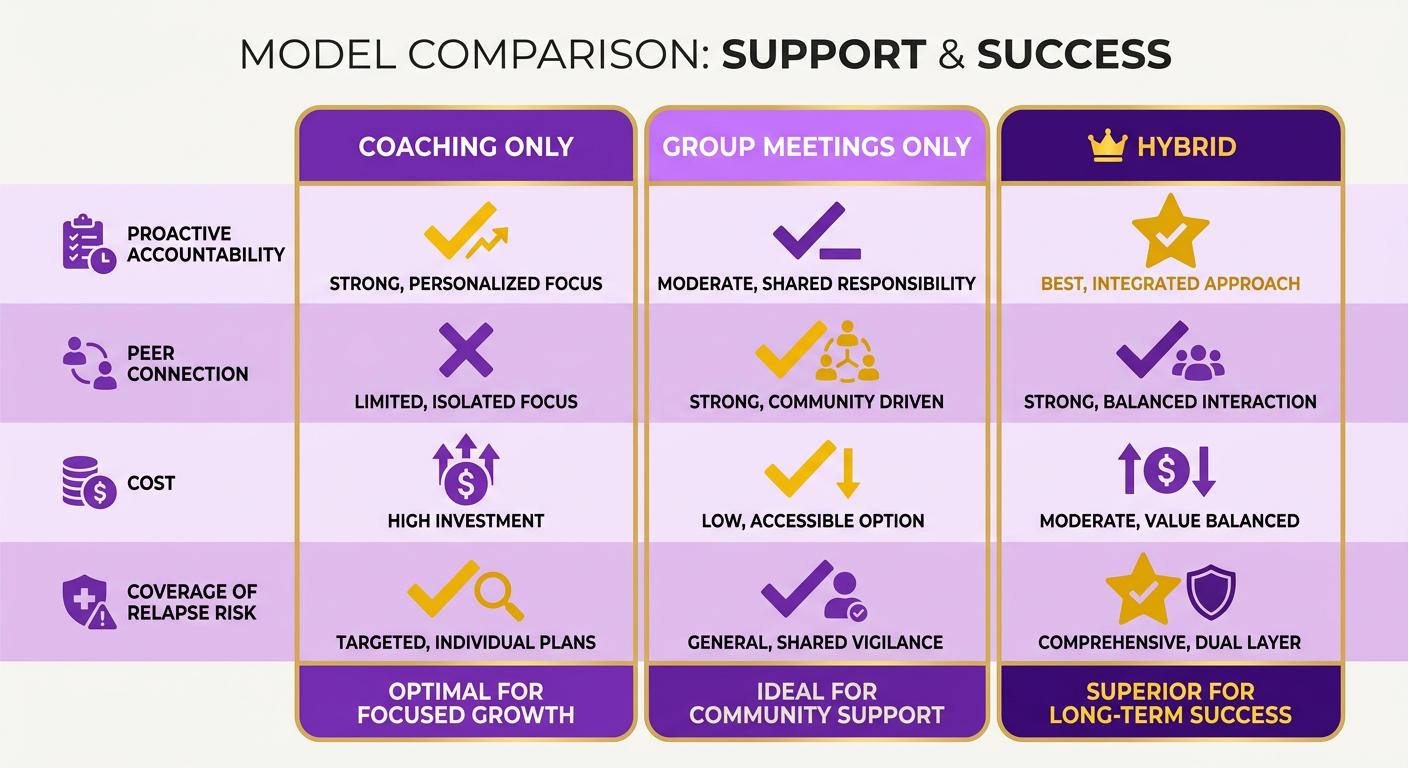
How a Hybrid Plan Actually Splits the Week
A hybrid plan runs one structured coaching session per week alongside two to three group meetings. The coach translates what surfaces in groups into a personal action plan. The group supplies stories and peer accountability. The coach supplies the proactive check-ins between meetings.
That check-in gap is the whole point. Groups meet on a fixed schedule, so a hard Wednesday waits for the next room. Coaching keeps contact frequent enough to catch the slide before it becomes a slip, then uses your group experience as raw material. Heard something in a SMART Recovery session that rattled you? We work it into next week's plan instead of letting it sit.
| Element | Weekly Coach Deep-Dive | 2–3 Group Meetings |
|---|---|---|
| Contact style | Proactive, scheduled outreach | You attend on a fixed calendar |
| Focus | Personal action plan, present-and-future goals | Shared stories, sponsor and peer bonds |
| Relapse framing | A learning moment, not failure | Varies by group philosophy |
| Best at | Closing the between-meeting gap | Community and belonging |
Which Groups Fit a Hybrid Plan?
Most formats pair well with coaching: AA and 12-Step rooms, SMART Recovery, secular groups, and online Zoom circles for anyone who can't get to an in-person meeting. Newcomers often find that attending a few meetings a week provides a solid community foundation without becoming overwhelming.
Choose by fit, not dogma. The systematic review of peer support highlights how staying connected to recovery resources dramatically improves long-term outcomes. That engagement is what a coach protects when a group's philosophy doesn't click for you. If a fixed relapse narrative in one room feels like shame, our stance is simple: we treat a slip as data, and we help you find a room that does too.
Where Hybrid Plans Break Down
The two real pitfalls are over-scheduling and clashing philosophies. Stack five meetings plus daily coaching on top of a new job and you'll burn out by week three. We build the calendar so group nights and coaching sessions don't collide, and we keep the total load sustainable.
Cost matters too. Because free peer groups carry part of the community load, a hybrid plan lets you keep the personalization of one-on-one work without paying for every hour of support. That makes for a more sustainable financial approach while still receiving high-touch individual guidance during the critical transition phase.
A Decision Framework for Your First Month
Choosing the right support for your first 30 days comes down to three things: your relapse risk, your practical constraints, and how much proactive accountability you actually need. High-risk, complex situations call for one-on-one. Lower-risk, budget-tight situations often do fine with group meetings. Most people land in the middle and benefit from a hybrid.
Start by rating yourself honestly. The higher your total, the more structured your month one needs to be.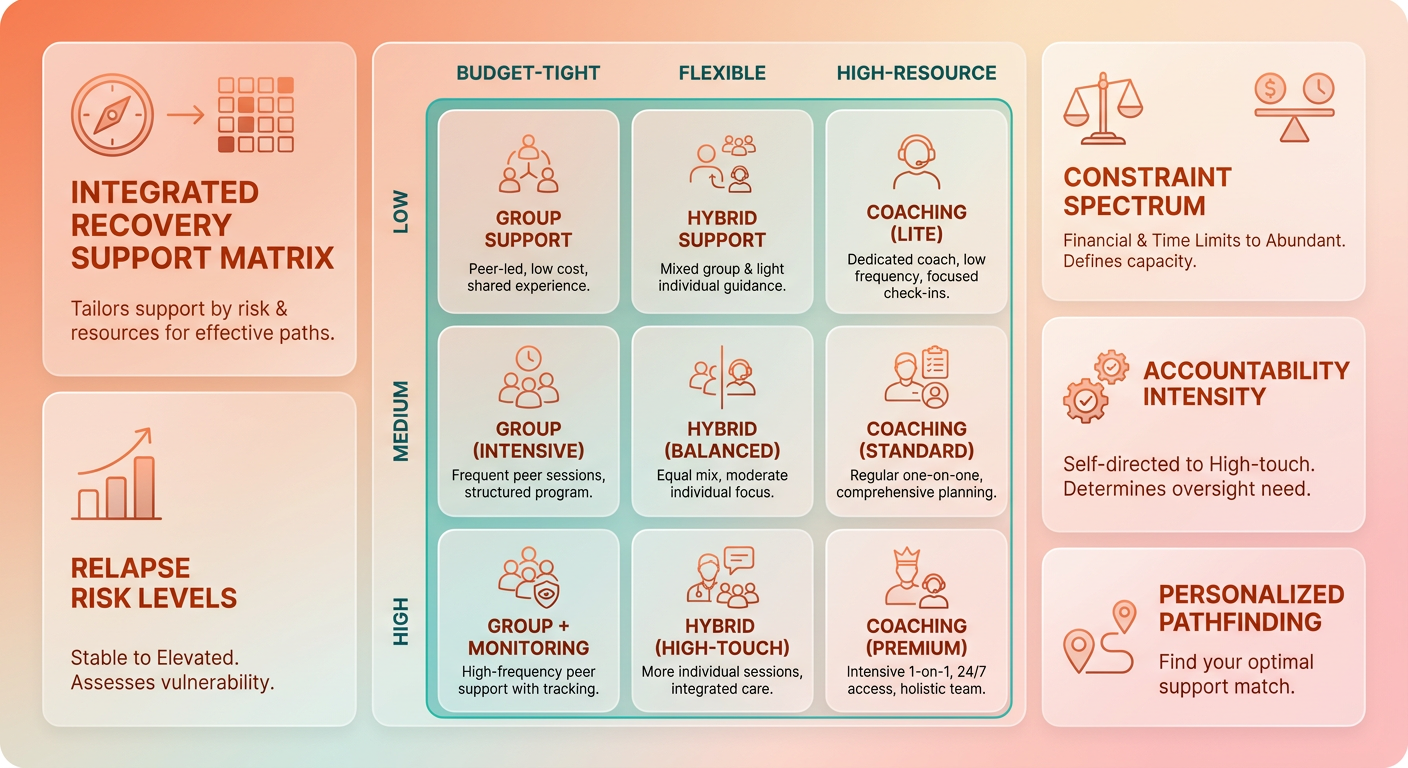
Rate Your Own Risk Level
Score each factor from 1 (low) to 3 (high), then add them up. A total of 7 or higher signals you need dedicated coaching, not just a weekly meeting.
| Risk Factor | Low (1) | Moderate (2) | High (3) |
|---|---|---|---|
| Relapse history | First attempt | One prior relapse | Multiple relapses |
| Co-occurring mental health | None | Managed | Active/unmanaged |
| Social support at home | Strong | Mixed | Isolated or triggering |
Now layer in your practical needs: transportation, childcare, work schedule, and whether nutrition guidance is built into any plan you're considering. If getting to a Tuesday meeting means arranging childcare and a ride, a coach who comes to you removes the friction that quietly ends most first-month plans.
Matching Support to Your Situation
| Your Profile | Best Fit | Why |
|---|---|---|
| High risk / complex needs | One-on-one coaching | Personalized plan, dedicated coach or coordinated team, nutrition support |
| Low budget / community-driven | Group meetings | Free, peer connection, widely available |
| Balanced needs | Hybrid | Weekly coaching plus 2–3 meetings |
Think in personas. The Busy Professional needs flexible, off-hours contact and leans coaching. The Young Parent needs a plan that works around childcare and often prefers a coach who fits their schedule. The First-Timer with strong home support can start with groups and add coaching if the week gets shaky.
"What if I can't afford a coach?" Ask about sliding-scale rates and whether insurance covers peer recovery services. Coaching sessions range widely in price, so start with free groups now and add paid support the moment your risk score climbs. Curious where you fall? An initial consultation with our team can assess your needs and build the right coaching program for your first 30 days.
What I'd Actually Recommend
After weighing all three options, here's the bottom line: for anyone with a moderate-to-high risk profile, dedicated individual support beats going it alone with meetings during that first month home. Group meetings hold their ground on cost and peer connection. But when the accountability gap is widest, proactive one-on-one outreach is what keeps you engaged through the days willpower alone tends to break.
Let's recap where each model actually shines before you decide.
Matching Your Priority to the Right Support
One-on-one coaching wins on proactive accountability, personalization, and crisis availability. Group meetings win on cost and shared experience. The hybrid splits the difference for people in the middle.
| Priority | Best Fit |
|---|---|
| Daily accountability, nutrition guidance, routine building | One-on-one coaching |
| Cost is your primary barrier | Group meetings |
| You want balance without going all-in | Hybrid (coach + 2-3 meetings) |
| Crisis support when a hard night hits | One-on-one coaching |
The honest carve-out: if your risk score sits low and money is tight, don't over-buy coverage you won't use. A strong meeting habit plus stable housing carries plenty of people through month one just fine.
But if daily structure, meal support, and someone reachable during a 2 a.m. craving matter to you, a team is the fit. That's the space we work in. Our programs tailor the intensity to where you actually are, helping you build independence over time.
What to Do This Week
Pick one concrete step. Book a discovery call to map your risk and constraints. Sit in on a trial group session to feel the room. Or reach out to explore your options.
If you want to talk through how our team-based coaching fits your situation, start with a call—help starts with a conversation—and see how the structure holds past the first month.
Month one home is the hardest stretch you'll walk. The right support doesn't just keep you sober. It helps you build a life worth staying sober for. Choose the level that matches your risk, and start this week.
References
[1] The First 30 Days with a Recovery Coach: What to Expect - https://allthewaywell.org/first-30-days-with-a-recovery-coach/
[2] Peer Recovery Support Services and Recovery Coaching for Substance ... - https://pmc.ncbi.nlm.nih.gov/articles/PMC12811009/
Frequently Asked Questions
1. Can a sober coach replace my therapist or addiction treatment?
No. Recovery coaches operate in a non-clinical capacity, focusing on action plans, daily logistics, and lifestyle adjustments. While therapists help you process past experiences and treat underlying mental health conditions, a coach helps you navigate the practical realities of your day-to-day schedule, nutrition, and immediate accountability.
2. How much does one-on-one sober coaching typically cost?
Pricing varies widely depending on the provider, the frequency of contact, and whether you are working with an individual coach or a coordinated team. While group meetings are free, professional coaching is an investment. Many organizations offer sliding-scale rates, and some insurance plans may cover peer recovery services, so it is always worth asking about financial options.
3. I have stable housing and a strong sober network. Do I still need coaching?
Probably not. If your post-discharge environment is highly supportive, predictable, and secure, community-based meetings are often sufficient to maintain momentum. Individual coaching is designed primarily for those facing higher-risk transitions, such as returning to an unstable living situation, managing co-occurring diagnoses, or navigating a history of early relapses.
4. How often should I expect contact during my first month with a coach?
During the initial transition, communication is highly frequent to ensure you are never left isolated during high-risk windows. This proactive outreach is designed to establish a consistent daily rhythm and catch potential challenges before they escalate, providing a level of continuous support that standard weekly meetings cannot match.
5. What's the difference between a single coach and a team-based model?
A solo coach is bound by their individual schedule, meaning their availability is limited to specific hours. A team-based model provides continuous, multi-layered coverage. This collaborative approach allows different specialists to assist with various aspects of your recovery—such as daily logistics, meal planning, and crisis management—ensuring seamless support even during off-hours.
6. Can I combine group meetings with a sober coach instead of choosing one?
Yes, and this collaborative approach is highly effective. By combining the two, you gain the broad peer connection of a community room alongside the highly personalized strategy of individual sessions. The coach can help you process and apply the insights you gain from group discussions, turning peer support into actionable daily habits.
7. What does success look like in month one beyond just staying sober?
Success is defined by the gradual rebuilding of a functional, balanced lifestyle. This includes establishing predictable daily habits, managing stress effectively, and restoring physical well-being. The goal is to construct a resilient foundation so that recovery becomes a natural part of your daily life rather than a constant struggle.