When Families Hire a Sober Companion: 24-Hour Support or Scheduled Check-Ins
October 23, 2026

Key Takeaways
- Twenty-four-hour companion coverage gives someone immediate support during cravings, conflict, unexpected events, and other high-risk moments.
- Twice-weekly check-ins provide regular reflection, planning, accountability, and practice with coping skills when the recovery environment is relatively stable.
- Continuous companions provide hands-on presence. Recovery coaches focus more on goals, skill-building, and steady follow-up between sessions.
- Families paying for around-the-clock support should get written terms covering service hours, on-call expectations, travel, breaks, extra fees, and staffing continuity.
- Companion and coaching services work best when they support, rather than replace, treatment from therapists, medication supports, treatment providers, and other medical professionals.
Quick Summary
Families should consider 24-hour companion coverage when the environment makes immediate relapse risk difficult to manage. Scheduled check-ins may be a better fit when the person can maintain a daily structure and needs help building longer-term recovery skills.
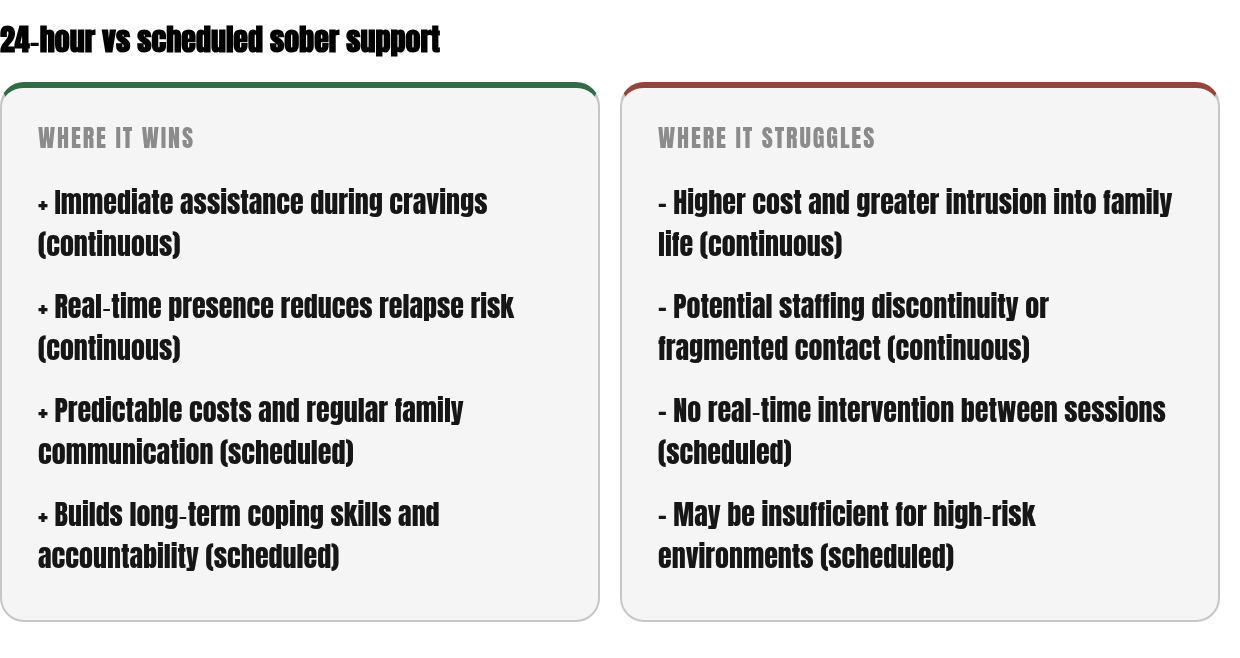
Match coverage to the risk, not the service label
A sober coach after rehab should match the person’s actual risk pattern. Continuous support can be useful when someone has just left treatment, is returning to a high-exposure home environment, or needs help during a vulnerable transition. Scheduled support may fit better when the person has stable housing, reliable routines, and enough confidence to practice skills between sessions.
The distinction matters because sober companion and recovery coaching roles serve different purposes. Companions offer real-time, hands-on assistance during specific situations. Coaches focus on goal-setting, coping skills, accountability, and personal growth.
| Comparison factor | 24-hour companion support | Scheduled check-ins |
|---|---|---|
| Best fit | Immediate transition home or a high-risk environment | Stable routines with ongoing skill-building |
| Main strength | Presence during vulnerable moments | Consistent reflection, planning, and accountability |
| Typical setting | In-home, travel, events, or other exposure-heavy situations | At home, online, or agreed-upon appointments |
| Family benefit | Immediate response and shared support at home | More predictable costs and regular family communication |
| Main limitation | Higher cost and greater intrusion into family life | No real-time intervention between sessions |
Coverage: Twenty-four-hour support means someone is available during a craving, conflict, or unexpected event. Scheduled check-ins create a dependable rhythm for reviewing progress and adjusting the plan.
Routine protection: Families should ask how a companion fits around children, school, work, appointments, and ordinary household life. A companion who disrupts the household can create new instability. One person may need morning support while another needs evening presence. Clear boundaries protect children and help the recovering person maintain a natural daily schedule.
Coordination: Ask how the companion or coach works with therapists, treatment providers, medication supports, and family members. Recovery support should reinforce the broader plan, not replace medical care or issue competing instructions. Combining roles can make sense when someone needs immediate presence and longer-term coaching.
Cost and staffing: Families need a written breakdown of hours, on-call expectations, travel, breaks, and additional fees. Confirm who provides the coverage and whether the same person remains consistent. Otherwise, a family may pay for “around-the-clock support” but receive fragmented contact.
Use a phased decision for families
Start with the least support that safely matches the current transition, then adjust as routines strengthen. Scheduled coaching can help with accountability, planning, and skill development. Intensive companion coverage makes more sense when risk is immediate and continuous presence can reduce exposure to substance use.
Families can review the differences between live-in and phone-based support, then map each need to a schedule, responsible person, and coordination plan. That gives everyone a clear answer before choosing coverage.
Why Hiring a Sober Companion Matters
Families often need more than encouragement between appointments. Sober coaching after rehab can help someone apply what they gained in treatment to ordinary life while preserving family routines and staying connected with outside care.
The goal is not to promise relapse prevention. It is to provide dependable structure, reduce isolation, and help someone respond to triggers before a vulnerable moment gets out of control. Companions offer immediate assistance. Recovery coaches generally focus on planned goal-setting and skill development.
Each Support Format Has a Specific Job
Families hire a companion for immediate support, dependable routine, greater confidence, and practical help managing triggers. Continuous coverage can be most useful during a high-exposure transition, such as the first weeks home, a temporary stay with relatives, travel, or a planned event where substances may be present. Scheduled coaching fits better when someone has stable housing and can practice coping skills between sessions.
| Family Need | Continuous Companion | Scheduled Sober Coach |
|---|---|---|
| Immediate safety | Available during vulnerable moments and transitions | Reviews risks and planned responses between sessions |
| Daily structure | Helps maintain routines in real time | Builds a weekly structure the person can own |
| Confidence | Reinforces decisions in the moment | Practices problem-solving and decision-making |
| Trigger navigation | Helps interrupt exposure-heavy situations | Identifies patterns and develops coping plans |
| Care coordination | Supports communication between family and outside providers | Keeps goals and progress visible to the family |
Giving each service a clear role is more useful than assuming more contact is always better. The guide to companion and coach responsibilities distinguishes immediate support from longer-term skills work. That helps families keep work, meals, and recovery responsibilities from competing with one another.
Family Responsibilities Shape the Plan
A companion should support stability without taking over the household. In a family setting, that may mean helping preserve normal routines and reducing stress while the recovering adult works on their recovery. It may also mean helping the family identify which communication, transportation, or housing problems need outside assistance.
One family might use continuous coverage for the first transition home, then move to scheduled coaching once transportation and daily structure feel reliable. That is not a failure of the companion. It means the support has adapted to the person’s needs.
Families should establish the limits of the service before it begins. Medical decisions, medication management, detoxification, and treatment remain the responsibility of licensed professionals. Scheduled coaching may be the better fit when the immediate environment is stable and the main task is rebuilding confidence and responsibility.
Cost, Logistics, and Insurance Considerations
The first question families should ask is not about cost. It is who responds at 2 a.m., who calls the family, and who steps in when the plan changes? A sober coach after rehab needs a clear emergency protocol, especially when children, transportation, or a crowded home make the recovery environment unpredictable.
What Should Families Ask Before Choosing Continuous or Scheduled Support?
Ask every provider the same operational questions, regardless of whether they offer live-in support or scheduled check-ins. The answers show how the service fits your family’s routines and responsibilities.
| Area | Continuous support | Scheduled check-ins | Family question |
|---|---|---|---|
| Availability | Defined live coverage | Fixed contact schedule | Who covers absences and urgent changes? |
| Emergencies | Clear response and escalation process | Clear escalation process | Who contacts the family, care team, or emergency services? |
| Coordination | Ongoing plan across support roles | Reviews between sessions | How will information reach therapists and family meetings? |
| Travel | Rules for movement and destination changes | Rules for extended travel | What happens when the person leaves the usual area? |
| Provider standards | Documented training and screening | Documented training and screening | What background checks and supervision apply? |
Questions to put directly to the provider
-
What are your availability rules? Ask how quickly someone responds, what happens after hours, and who covers illness or other absences. Clarify whether continuous means round-the-clock presence or on-call assistance.
-
What is your emergency protocol? Ask about reaching the family, contacting a designated medical professional, and arranging transportation when needed. MADE Recovery provides nonmedical recovery support. Companionship is not detoxification, medication management, or emergency medical care.
-
How do you coordinate care? Ask how appropriate updates reach therapists, case managers, and family meetings while protecting privacy. For families with children, include school schedules, transportation, and safe adult handoffs in the plan.
-
What do your policies cover? Ask about screening, training, supervision, travel, confidentiality, and service boundaries. Red flags include vague answers, no screening process, or pressure to commit before the family understands the arrangement.
At MADE Recovery, we take a practical approach to these questions. We offer virtual and in-person sober coaching, sober companionship at home, sober travel companionship, and a premium sober living home, with support tailored to each client’s needs. Support can also taper as clients build stability and independence.
MADE Recovery’s Hybrid Approach (Featured Option)
Families evaluating a sober coach after rehab should look past labels such as “continuous” or “scheduled” and ask how each service responds to the risks inside their home. MADE Recovery offers personalized sober coaching and companionship through virtual and in-person options, with support tailored to each client’s needs.
How Do You Compare Coverage, Staffing, and Coordination?
The overview of sober companion roles distinguishes real-time support from scheduled goal-setting and skill development. These roles also inform how families evaluate different levels of support. Companion coverage can provide practical help during vulnerable moments, while scheduled coaching supports routine building and longer-term planning.
| Evaluation area | Continuous companion support | Scheduled check-ins | What families should clarify |
|---|---|---|---|
| Coverage | Defined periods of immediate availability | Fixed contact schedule | Who responds when the schedule changes? |
| Supervision | Active presence during agreed hours | Remote or arranged contact | Who monitors concerns between sessions? |
| Staffing | Named coverage and backup plan | Assigned coach and contact cadence | Who covers illness, travel, or absences? |
| Coordination | Communication with family and care team | Progress updates and goal review | What information gets shared, and with whom? |
| Family fit | Protection during vulnerable transitions | Support for routines and skill-building | How will the arrangement affect work, childcare, and transportation? |
Skip full-time companion coverage when someone has stable routines, reliable housing, and confidence managing the schedule between check-ins. The extra presence may disrupt family life without addressing the main need. In that setting, scheduled coaching with a clear escalation plan may be a better fit.

A family with two young children and an adult returning from residential treatment may need support during mornings, school runs, and evenings. Companion coverage can help during the initial transition, especially when extra presence matters. Scheduled coaching can then support routine building, practical coping strategies, and coordination with outside professionals without requiring a companion in the home every day. Each support format has a defined role in that sequence.
What Should You Ask Before Choosing a Hybrid Plan?
Ask for the schedule in writing. Families should know when a companion is present, when coaching occurs, who handles urgent concerns, and how outside clinicians receive relevant updates. They also need a clear answer about when the arrangement will step down. Review actual needs before changing the plan rather than adding hours by default.
MADE Recovery’s coaching and companionship services should be evaluated against those operational details. For families, the right plan is the one that protects children, preserves workable routines, and assigns each form of support a clear responsibility. Discuss the structure directly with the provider and confirm it before starting.
References
[1] Sober Companion and Recovery Coach: Professional Support for ... - https://www.addicted.org/after-treatment/support-programs/sober-companion-and-recovery-coach/
FAQ
1. Does 24-hour sober companion coverage always mean someone lives in the home?
No. “24-hour” can mean round-the-clock in-person presence or on-call availability, so families must clarify the distinction before hiring. Ask who responds at any hour, how quickly they can arrive, and who provides backup coverage. A live-in arrangement may also affect household privacy, childcare, routines, and cost, so it should be based on immediate risk rather than the label alone.
2. Can families with children use limited companion coverage instead of full-time support?
Families with children can use limited companion coverage instead of assuming full-time support is necessary. A written schedule can focus presence around mornings, school runs, transportation, and evenings when risk is highest, while coaching addresses planning and coping between visits. This protects children from unnecessary disruption and keeps adult responsibilities predictable. Coverage should include clear boundaries, safe handoffs, and coordination with the care team.
3. Who should receive updates about the person’s recovery support?
Updates should be shared appropriately with the person, designated family members, and relevant care professionals, while protecting the recovering person’s privacy. Families should clarify what information the companion or coach may share, with whom, and through what method. If the provider offers hybrid virtual and in-person support, confirm how scheduled progress reviews and urgent companion coverage communicate with therapists, medication supports, and family members.