How a Sober Coach Coordinates With Your Therapist, Psychiatrist, and Outpatient Program
November 22, 2026

Getting the Releases Right Before Anyone Shares Anything
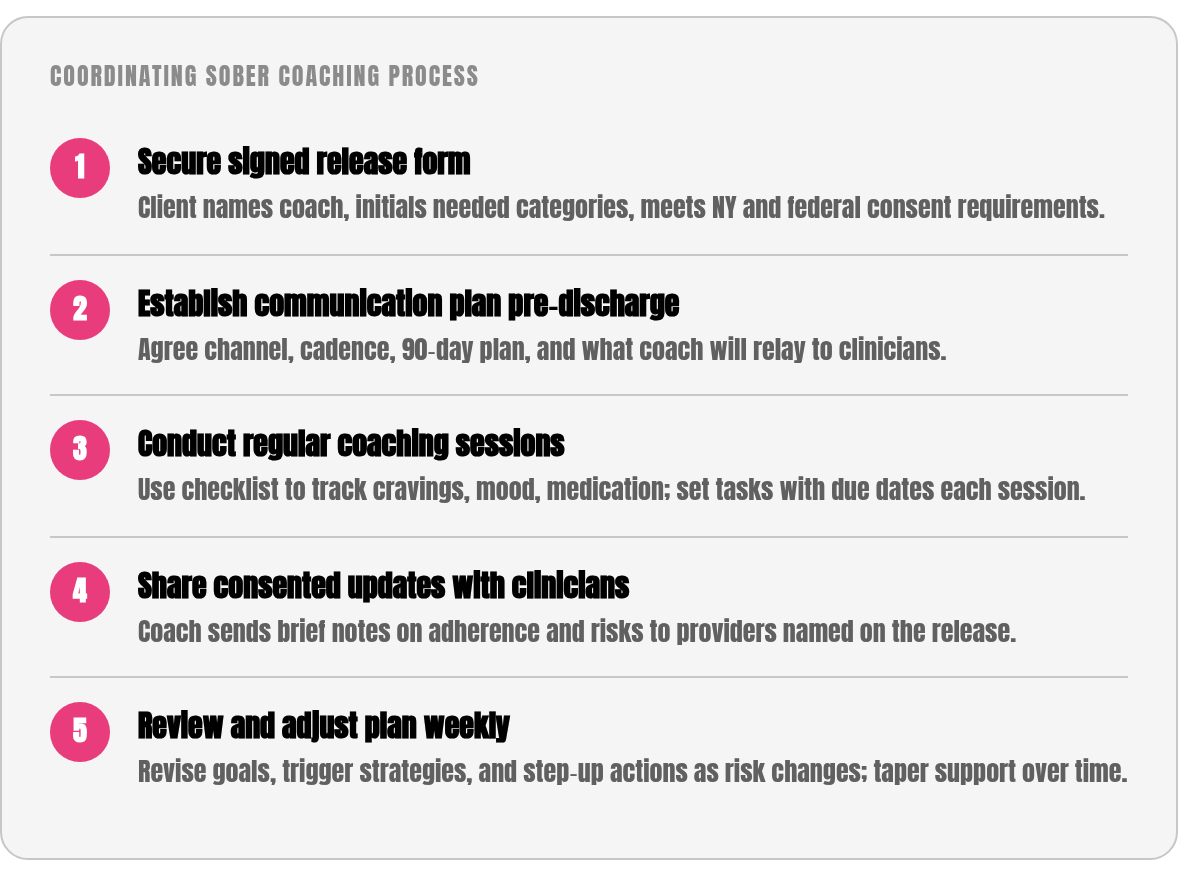
Coordination between a sober coach and a client's clinicians starts with a signed release that names the coach specifically. New York's Authorization for Release of Health Information form (DOH-5032) is a good model. It has separate fields for the releasing provider, the recipient, and the purpose, and it spells out the client's right to revoke. Federal law adds a second layer. 42 CFR Part 2 covers substance use disorder records. § 2.31 sets the consent requirements. General wording may not reach a nonmedical coach. The safer move is for the client to name the coach individually and initial every category the coach will actually need.
A signature still doesn't make anyone share. Mental health records go only to people with a demonstrable need for them. A narrow written purpose, such as relaying medication adherence, keeps the release focused and gives a clinician something easy to say yes to.
In practice, expect information to flow from the coach to the clinicians more often than the other way around. That's normal, and it's still useful.
Set the Update Rhythm Before Discharge
Agree on the channel and the cadence before discharge, not in the middle of a bad week. Secure telehealth is the channel the sources directly support. Portals, email, and phone are options too, but confirm each one with the client and with every provider before anything gets sent.
One sober coaching program pairs one or two weekly sessions with texts or calls around known triggers. Each session check-in tracks cravings, mood, sleep, stress, medication adherence, and wins, and each one ends with concrete tasks that have due dates. A state-published recovery coach guidebook from the MISSION program opens every session with a checklist covering substance use, symptoms, motivation, and medication adherence.A consent-bound note to a psychiatrist can be this short: "With the client's consent: she reports taking her evening medication six of seven days. She has a side-effect question, which we've directed to you."
| Phase | Who and consent | Routine and therapy prep | Medication relay |
|---|---|---|---|
| Pre-discharge | Client, coach, treatment team; releases signed | Schedule the first community provider appointment; draft the 90-day plan | Agree on what the coach relays |
| Weeks 1–4 | Therapist, psychiatrist, outpatient program | 1–2 sessions weekly plus trigger check-ins; list topics for therapy | Self-reported adherence only |
| Weeks 5–12 | Same team | Revise the plan | Same; medication questions go to the psychiatrist |
That program's plan includes a step-up path, agreed on in advance, for when risk increases. At MADE Recovery we tailor coaching to each client. This kind of structure may support accountability between sessions and give the team a cleaner way to hear about adherence. If a client declines the releases, coaching still works. Coordination with the clinical team doesn't.
A Sample Coordinated Week, Session by Session
What follows is an illustrative week, not a real client. We built it from two published structures: the coaching program's session format and the Recovery Status Checklist in the MISSION guidebook. Neither source publishes a daily checklist, so treat this as a session-based template your sober coach adapts to your plan.
What Does a Sober Coach Check at Every Session?
The MISSION checklist opens each session with a review of substance use, mental health symptoms, motivation for recovery, and adherence to prescribed medication. The coaching format adds its dashboard of cravings, mood, sleep, stress, medication adherence, and wins since the last session.
We keep tracking to those items.
A sample week with two sessions:
- Monday session: checklist and dashboard, then 12 minutes of urge-surfing practice. The trigger map flags Friday's departure for a celebration involving travel.
- Tasks set Monday: book a Friday-evening walk with a sober friend, text the coach before and after the travel window, and confirm the step-up plan and companion handoff.- Thursday session: dashboard again, a thought-log drill, and confirmation of who receives consented updates while the client is away.
- Friday: short texts before and after the travel window.The MISSION guidebook warns that good news carries its own relapse risk. Anyone who has worked in early recovery has seen it: the bad day gets planned for, and the celebration catches people off guard. A good week deserves as much planning as a hard one.
What Goes to the Therapist, and What Doesn't?
After each session, the client decides what gets shared. An approved update might read: "Cravings lower than last week. Sleeping about six hours most nights. Reports taking medication as prescribed. Win: finished résumé." That's our own format, not a standard or a researched tool, and it goes only to people named on the release.
Medication is where we hold a firm line. With permission, we pass along what the client tells us about adherence. If the client asks whether to skip a dose or change the timing, that question goes to the psychiatrist. The program we drew from puts it plainly:
"Coaches are trained to work alongside clinicians for co-occurring disorders; they do not replace therapy or prescribe medication." - the sober coaching program page We work the same way. If you want to see what the first days look like before a weekly rhythm settles in, read what a sober coach does in your first week home.
Coaching vs. Going It Alone: What the Evidence Does and Doesn't Say
Going solo after treatment means carrying every appointment, refill, and risky weekend in your own head. A sober coach can take some of that load. Before we describe how, we want to be precise about the research.
Much of the outcome research near this topic studies clinical treatment, such as the incentive-based and community reinforcement approaches discussed in SAMHSA's chapter on intensive outpatient treatment. Those studies did not compare coordinated sober coaching with going solo. So don't read findings about clinical treatment as coaching results, whether they're ours or anyone else's.
Structure Helps While It Lasts
Intensive outpatient programs give your week a built-in shape: scheduled groups, regular check-ins, and people who notice when you miss. The SAMHSA chapter describes Milby's post-incentive return to baseline, a reminder that a clinical support's effects can fade when the support stops. That is not a coaching result, and the research does not tell us how coaching attendance or client satisfaction fits in afterward.
We take that as a reason to overlap coaching with IOP before discharge, then taper support on purpose as you gain independence. The question to answer is simple: what holds your week together once the clinic schedule stops? Structure should step back gradually instead of disappearing on a single Friday.### What a Sober Coaching Plan Adds Between Appointments Coaching providers like to call themselves the bridge between treatment and real life. That's how they describe their own service, not an independent clinical endorsement, and it's fair to read it with some skepticism.
What a coaching plan can add is concrete. The published program we've referenced includes brief texts or calls before and after known triggers, plus 3 to 5 tasks with due dates at each session. Our coaching works on the same kind of day-to-day logistics, built around your situation. When your support spans 12-Step, CBT, and MI approaches, we can keep goals and language consistent between sessions without replacing your clinicians or mutual-support group. One task might be confirming a psychiatry refill with your prescriber. Another might be picking the IOP group that fits a new work shift. With your consent, coordinating with your other support services gives your therapist something specific to work with.
Coaching may help you build routines. It doesn't treat anything. If you need withdrawal care or a medication change, call your medical team first, not us.
Getting Coordinated Sober Coaching Started
The New York form shows two details worth knowing before you sign anything. You can revoke the authorization at any time by writing to the provider, though that doesn't undo action already taken based on it. And as covered above, a signed release makes coordination possible without obliging any clinician to share.The checklist below is a general starting point for clients and families, not our intake paperwork. Its job is to make your sober coach's requests specific enough that a clinician can agree to them.
What Should You Gather Before Coaching Starts?
Start with names and contact details for your therapist, psychiatrist, and outpatient program, plus your upcoming appointment dates. Then agree with your coach on the minimum information the coach may receive or pass along. That might be appointment attendance, broad treatment goals, and whether you're taking medication as prescribed.
You don't need to hand over a full treatment summary or a medication list to begin. Every extra item should have a stated purpose. Name the coach individually on the release, and on a state form like New York's, initial only the sensitive categories the coach actually needs.Families can help a lot here. They can collect contacts, track appointments, and handle logistics within the role you approve. Clinical decisions stay with you and your licensed clinicians. We don't diagnose, and we don't manage medications.
How Often Will a Sober Coach Check In?
Settle the schedule before the first session. The program structure described earlier, with one or two sessions a week, trigger-based texts or calls, and a written 90-day plan, is a sensible benchmark. That structure doesn't include a standing weekly coach-therapist meeting. We won't promise one either, because clinicians set their own availability.We offer coaching virtually and in person. Virtual sessions suit scheduled check-ins and quick contact before a hard weekend. In-person support matters more when the risk sits in your first days home, at a social event, or on a trip. As support tapers, the format can shift with it.
References
[1] Sober Coaching - https://elkridgerecovery.com/treatment/sober-coaching/
[2] Chapter 8. Intensive Outpatient Treatment Approaches - NCBI - NIH - https://www.ncbi.nlm.nih.gov/books/NBK64102/
[3] Substance Abuse: Clinical Issues in Intensive Outpatient Treatment - https://store.samhsa.gov/sites/default/files/SAMHSA_Digital_Download/sma13-4182.pdf
[4] MISSION Navigating Transitions Program: - https://www.mass.gov/doc/mission-navigating-transitions-program-recovery-coach-guidebook-submitted-by-siu-ping-chen-feman/download
[5] Authorization for Release of Health Information (Including alcohol/drug treatment and mental health information) and confidential hiv/aids related information - https://www.health.ny.gov/forms/doh-5032.pdf
[6] eCFR :: 42 CFR Part 2 -- Confidentiality of Substance Use Disorder Patient Records - https://www.ecfr.gov/current/title-42/part-2
[7] eCFR :: 42 CFR 2.31 -- Consent requirements. - https://www.ecfr.gov/current/title-42/section-2.31
[8] Strategies to support substance use disorder care transitions from acute ... - https://pmc.ncbi.nlm.nih.gov/articles/PMC10168484/