Sober Companions vs Recovery Coaches: Different Roles, Different Results
November 21, 2026

Sober Companion vs. Recovery Coach: What Each Role Actually Does
A sober companion works alongside you during the day. A recovery coach helps you organize the week. If you’re considering a sober coach after rehab, that distinction matters when two problems can show up at once: a difficult moment becomes overwhelming, and your recovery routine gradually starts slipping.
This overview from Addicted.org places coaching later, once someone has stabilized. We often start sooner. People leaving detox or residential treatment can benefit from structure, accountability, and practical guidance while they’re still adjusting to life at home. Coaching can then step down as independence grows, rather than staying at the same intensity indefinitely.
The practical decision rule is this: consider coaching when disengagement from treatment or recovery routines is the main risk, companionship when there is foreseeable acute exposure to a high-risk situation, and a coordinated team when both failure points are present.
The evidence is not equally strong for these options. A review of peer recovery support and recovery coaching found improved retention, while its substance-use findings were inconclusive. Comparable outcome data for sober companionship are absent. Neither role—and no combination of the two—should therefore be presented as proven to prevent relapse.
What does each role handle day to day?
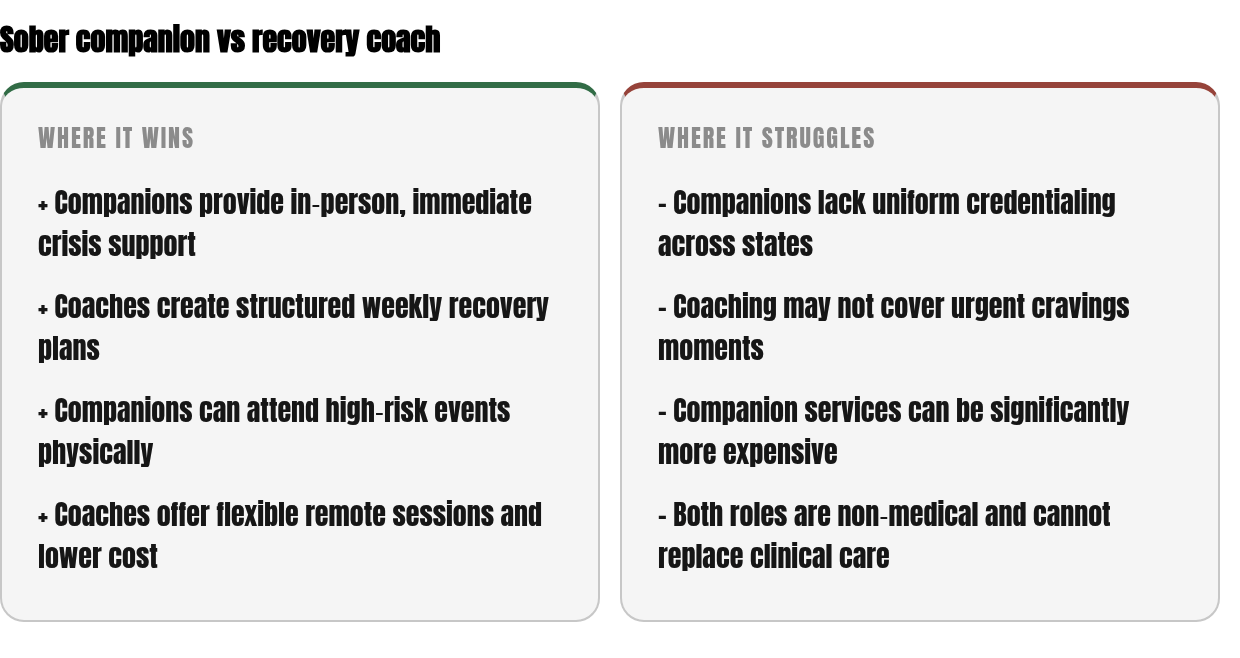
Companions provide in-person support during live, higher-risk situations. Coaches build a recovery plan and review it on a set schedule. There is some overlap around routines and accountability, but responsibilities vary widely between providers. Get the scope in writing before hiring anyone.
| Task | Sober companion | Recovery coach |
|---|---|---|
| Family dinners, events, travel | Attends in person | Plans ahead, debriefs after |
| Cravings in the moment | Immediate de-escalation | Builds coping skills |
| Morning routine | Runs it with you daily | Designs it, adjusts weekly |
| Nutrition and sleep | Reinforces | Builds the plan |
| Meetings and appointments | Accompanies | Tracks attendance |
| Weekly progress review | Reports observations | Leads it |
In-the-moment support is the companion’s lane. Goal-setting and skill-building belong primarily to the coach, as we explain in our sober coach overview.
If your housing is stable and you don’t have high-risk events coming up, full-time companionship may be unnecessary. Scheduled coaching can cover much of the planning, follow-through, and accountability you need.
TL;DR
- Sober companions can attend high-risk moments in person, while recovery coaches build plans and review progress on a scheduled basis.
- Leaving detox or residential treatment can be a vulnerable transition that benefits from structured support.
- Choose coaching when disengagement is the main concern, companionship for foreseeable acute exposure, and coordinated support when both risks are present.
- Requirements attached to these titles can vary. Ask who issued any credential and verify its status directly before hiring anyone.
- Some companions quote by the hour, day, or event, while some coaches offer sessions, packages, or subscriptions; request a detailed quote rather than assuming a standard billing model.
- Insurance coverage should be confirmed in writing with your insurer before signing an agreement.
- A review found retention benefits for peer recovery support and recovery coaching, but substance-use findings were inconclusive; companion outcome data are absent.
Credentials Vary, So Verify Them Yourself
The titles “sober companion” and “recovery coach” may not carry consistent requirements across locations and issuing organizations. A certificate displayed on a website means little until you confirm who issued it and whether it remains current.
Before hiring a sober coach after rehab, check certification claims with the issuing organization and any license claims with the relevant authority. Don’t assume the rules where you live match those where the provider trained. We expect families to ask us these questions, and any provider worth considering should answer them directly.
How do you verify a coach’s certification?
Ask for three things: the exact certification name, the issuing body, and any available credential or directory reference. Look the person up in the issuer’s directory or contact the issuer. Confirm that the credential is current and in good standing.
If a provider can’t supply enough information for you to check its claims, consider looking elsewhere.
The credential is only part of the picture. Ask both companions and coaches about the safeguards around their work:
| What to ask | Sober companion | Recovery coach |
|---|---|---|
| Background check | Who ran it and when, since they may live or travel with you | Who ran it and when |
| Insurance | Liability coverage for in-home and travel work | Professional or liability coverage |
| Supervision | Who they report to during a placement | Who reviews their client work |
| Scope limits | What they do in a crisis, and when they call medical help | Where coaching stops and clinical treatment begins |
That last row deserves a real answer, not a vague reassurance. Recovery coaching and companionship are nonmedical support services. They don’t replace detox, clinical treatment, therapy, medication management, or emergency care.
Compare the Whole Quote, Not Just the Rate
Two providers can quote very different numbers because they’re pricing very different arrangements. Some sober companions bill by the hour, day, or event. Some recovery coaches charge per session, sell packages, or offer subscriptions.
When comparing a sober coach after rehab with companion support, ask each provider to break the quote into details you can compare directly.
| Ask about | Sober companion | Recovery coach |
|---|---|---|
| Billing unit | Hourly, daily, or per event | Per session, package, or subscription |
| Hours | Which hours, overnight, live-in | Session length, contact between sessions |
| Travel | Who pays, how it's billed | In person or remote |
| Staffing | Solo or rotating team | Same coach each week? |
| Changes | Cancellation and step-down terms | Pausing or downgrading |
Location, intensity, working hours, travel, and team-versus-solo staffing can all affect a quote. Round-the-clock coverage from a rotating team is not the same service as having one person on call, so compare the staffing and covered hours alongside the price.
Also ask what happens when your needs change. A lower quoted rate can lose its appeal if the agreement makes it difficult to reduce hours or cancel coverage you no longer need.
Get Insurance Answers in Writing
Don’t assume coaching is reimbursable or that companionship automatically isn’t. Ask your insurer, in writing, whether the specific service is covered and under which category.
Then ask the provider whether they bill insurance directly or supply receipts for you to submit. Finding out that a service isn’t covered is frustrating. Finding out after you’ve signed and received the bill is worse.
Four Questions That Point You Toward the Right Support
Before choosing a sober coach after rehab, work through four questions:
- Is there foreseeable acute exposure to a high-risk situation, or is disengagement from treatment and recovery routines the main concern?
- Do you need someone physically present, or would scheduled check-ins be enough?
- What can you afford, and for how long?
- Do you want face-to-face support, remote contact, or a combination?
Families often choose based on which service sounds more thorough. The better question is which service fits the situation in front of you.
A companion may make sense when someone leaving treatment faces high-risk circumstances every day, such as family conflict, substances in the home, or no sober support network. Coaching may fit when basic safety is already in place but the person needs structure, accountability, and help rebuilding daily routines. Providers differ on when coaching should begin: Addicted.org places it after stabilization, while our model can begin earlier.
Start with the immediate situation. Someone who has just left detox, has no sober housing arranged, or is returning to an environment where substances are present may benefit from companion support. Someone whose main risk is drifting away from appointments, goals, or routines may be better served by coaching. When both exposure and disengagement are concerns, ask how a coordinated team would divide responsibilities.
| Your situation | Companion may fit | Coach may fit |
|---|---|---|
| Just discharged, no safety plan | ✓ | |
| Stable housing, needs weekly structure | ✓ | |
| High-risk events (travel, family gathering) | ✓ | |
| Building long-term habits and goals | ✓ | |
| Budget allows daily support | ✓ | |
| Budget allows weekly sessions | ✓ |
Needs rarely stay fixed. Either form of support can be adjusted as circumstances change, and some people use both while the intensity tapers. There is no universal service duration; ask each provider how reviews and step-down decisions work.
One role doesn’t automatically replace the other. A companion isn’t necessarily there to build your long-term recovery plan. A scheduled coach usually won’t be standing beside you at 2 a.m. when a craving hits. If you’re stuck between the two, identify whether immediate exposure, loss of routine, or both is the central problem. That tends to clarify what kind of support should come first.
MADE Recovery: Coaching With Practical Support Built In
We built our coaching model to cover ground that people often think requires choosing between two separate roles. You can receive practical, day-to-day support during vulnerable situations, such as a wedding or family event, alongside the structure, habit tracking, and accountability of ongoing coaching.
Depending on your needs, you may work with one dedicated coach or receive support from a coordinated team. Each program is shaped around where you are in recovery and how much support fits your circumstances.
That flexibility can be useful after detox or residential treatment. The routines that worked inside a structured program don’t always transfer neatly to home, work, family responsibilities, and unstructured weekends.
Our services provide nonmedical recovery support. We don’t diagnose conditions, provide detoxification, manage medications, or replace care from outside medical and clinical professionals.
How We Deliver Support in the First Weeks
The initial consultation is where we map out your high-risk situations, daily schedule, and the support you had before leaving treatment. From there, we build a plan around your actual week rather than handing you a generic routine.
The plan changes as you gain stability. Support tapers intentionally to encourage self-sufficiency, with the timing based on what you’re facing instead of a predetermined calendar.
We help establish daily routines and track habits that support recovery. The purpose is to spot drift before it becomes a crisis, not to monitor every hour of your life.
Where I’d Start After Treatment
Look at immediate safety first, then at the support you can realistically sustain. Daily exposure to family conflict, substances at home, or the absence of a sober network may call for companion coverage. Stable housing and basic safety, paired with a need for routine and accountability, may point toward coaching.
People leaving detox or residential treatment may need something between a weekly check-in and full 24/7 coverage. That’s where our team-based model can fit, combining practical support during vulnerable moments with structured coaching from week to week. That combination is a way to organize support, not a proven method of preventing relapse.
Before signing with any provider, confirm credentials, pricing, covered hours, staffing, and step-down terms. Ask who provides support outside scheduled sessions and what happens when your needs change. Clear answers now prevent confusion later.
If you’d like to talk through your situation, contact MADE Recovery. We’ll help you assess what level of support makes sense right now and build a practical plan for the next step.
Disclaimer: This article is for informational purposes only. It does not provide medical advice and is not a substitute for professional clinical care or emergency services. If you or someone you know is in crisis, call 911 or text 988.
References
[1] Sober Companion and Recovery Coach: Professional Support - https://www.addicted.org/after-treatment/support-programs/sober-companion-and-recovery-coach/
[2] Peer Recovery Support Services and Recovery Coaching - https://pmc.ncbi.nlm.nih.gov/articles/PMC12811009/
Frequently Asked Questions
Can someone work with both a sober companion and a recovery coach at the same time?
Yes. Support can combine both roles, with a companion handling high-risk moments in person and a coach building your structure and accountability. This coordinated approach may be useful when both immediate exposure and disengagement are concerns, with intensity adjusted as your needs change. It should not be assumed to prevent relapse.
How long does each type of support typically last?
There is no universal duration for either service. Companion support and coaching can be adjusted as your situation, risks, and independence change. Ask the provider how progress is reviewed and how support can taper intentionally without leaving you unsupported.
What actually happens when a craving or trigger occurs with each role?
A sober companion can provide in-person support during the situation, within the scope agreed with the provider. A recovery coach builds coping skills during scheduled sessions so you have strategies ready when triggers arise. In general, companions address live situations while coaches emphasize planning and skill development; confirm exactly what any provider will do in a crisis.
If someone is stable in recovery, can they start with coaching and skip companion support entirely?
Yes. You can skip full-time companionship if you have stable housing and no high-risk events coming up. In that case, scheduled coaching can cover accountability, habit tracking, and structured planning without the intensity of in-person companion coverage during daily activities.