Back to Work After Rehab: What Your Sober Coach Plans Before Day One
November 22, 2026

Key Takeaways
- A return-to-work plan is two or three measurable first-week goals, not a mission statement. "At my desk by 8:30, four days out of five" qualifies. "Be more disciplined" doesn't.
- The trigger map has four columns: the situation, the hour it tends to hit, what it usually leads to, and the exit line you'll say out loud.
- Every boundary needs a name and a time attached. Tuesday at four with a specific person, not someday. A protected lunch break counts as a boundary too.
- The example week leans on three small pieces: a three-minute midday break, ten quiet minutes before the phone, and two closing lines at the end of the day.
Quick Summary
This is the framework our team builds with clients before a first shift back. It's illustrative, a set of planning elements rather than a research-derived checklist, and no sober coach should hand it over as a finished document. The order changes with the job.
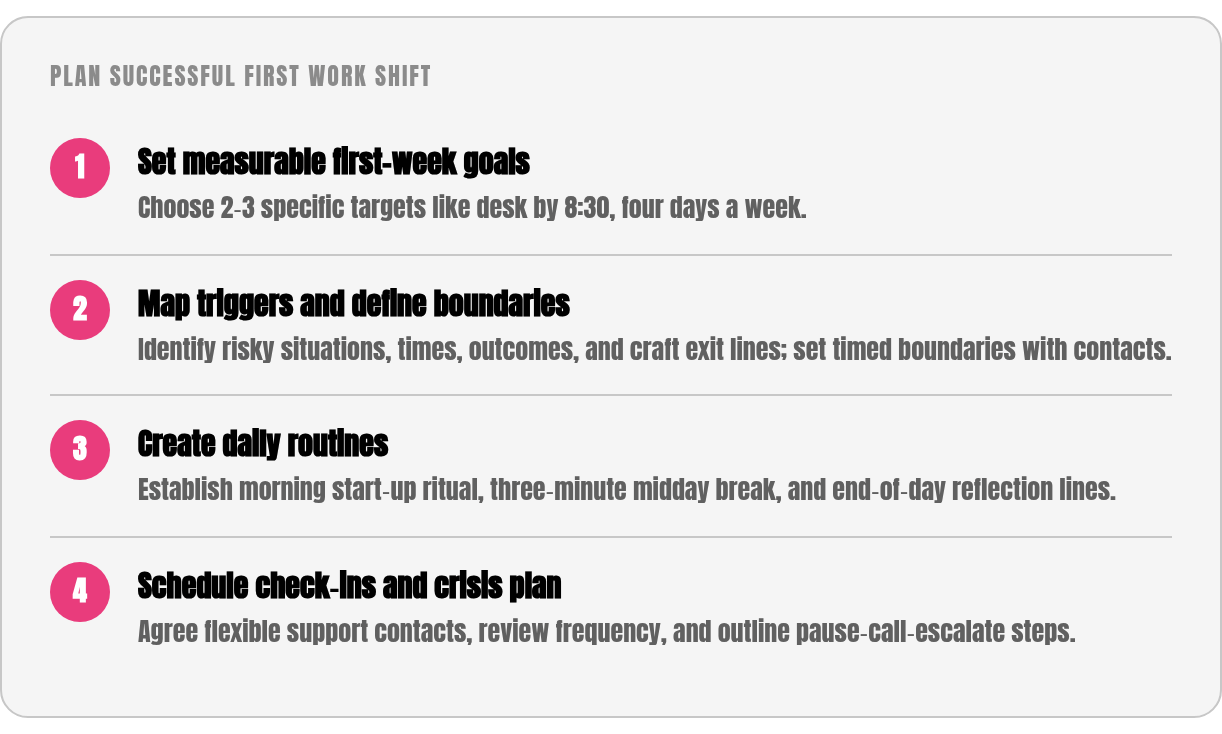
| Planning element | Purpose | Possible coach action | Client responsibility |
|---|---|---|---|
| Goals | Defines what "going well" looks like in month one | Helps you name two or three measurable targets | Chooses them and says what you'll drop to protect them |
| Routines | Gives mornings and evenings a fixed shape | Walks through sleep, meals, and commute timing | Tests the routine on real days before day one |
| Triggers and boundaries | Names the people, places, and hours that raise risk | Rehearses exit lines and scripts for after-work drinks | Sets the boundary and tells the people affected |
| Support check-ins | Keeps contact steady as structure returns | Proposes a rhythm and adjusts it as weeks settle | Answers honestly and flags when a check-in feels thin |
| Crisis planning | Puts a written plan in reach before you need it | Confirms who to call, in what order | Keeps the numbers on your phone and in your bag |
If treatment already gave you a written safety plan, don't rebuild it. We adapt what you have. The rest is worth drafting now, because the first week back rarely leaves room for it.
Why the first shift back deserves a plan
Income and identity come back in the same hour, and so does the stress that rides with both. That combination is the reason to think the return through before day one instead of reacting after something goes sideways.
Most of the groundwork is unglamorous: the commute, the coworkers you'll pass in the hall, the answer you'll give when someone asks where you've been. Recovery providers raise return-to-work planning for exactly this reason. Hope and risk show up together, and neither one waits until you feel ready.
Skip the heavy version if your job is calm, your hours are fixed, and nobody around you drinks. Save it for the returns with real exposure: old using crews, late shifts, business travel, long stretches alone.
A coach can work through that plan with you ahead of the first shift, and check-ins can be scheduled around the shift itself rather than after something breaks. Flexible check-ins are one way we can help you protect the routine you built in treatment.
Readiness, goals, and the first real conversation
That first conversation isn't an intake with a score attached. We sit down, ask what the client is actually worried about, and build from there.
Three topics open it: how ready they feel to walk back through that door, what the week's logistics look like, and who they can call at four on a Tuesday afternoon. Conversation starters, not three validated domains a sober coach is supposed to measure.
Then we get specific. Two or three goals, written down, measurable inside the first week. "At my desk by 8:30 four days out of five" beats "be more disciplined" every time. Concrete targets give us something to check together next session, and something the client owns rather than rents from us. We plan the return itself the same way in our return-to-work guide.
Skip the structured version when the job carries little exposure and the people around them are steady. In our experience that time is better spent rehearsing the first morning than filling out a framework.
Trigger mapping and boundary planning
The trigger map is the least glamorous tool we build and the one clients keep using. Sheet of paper, three columns, filled in together: the situation, the hour it tends to hit, what it usually leads to. Friday at four. The parking lot. Someone who still uses. Then a fourth column for the exit line they'll say out loud. A sober coach can help you write that line before you need it, not after.
Boundaries come next, and they're boring on purpose. We protect the lunch break, because a skipped meal is how a bad afternoon starts. Alcohol-centered gatherings stay off the calendar for month one, including the ones people insist are mandatory. One support contact gets named before day one with a time attached: Tuesday at four, not someday.
Keep the map short. One that covers every hour of the week protects nothing. Work travel and client dinners deserve their own version, which we cover in our guide to coaching around travel and work events.
Building the first week: routines, food, check-ins
No two first weeks look alike, so we don't hand out one schedule. We build an example week with each client and redraw it until it fits the job. The point is to make the shape of the day visible before it arrives. Treat the plan as illustrative, not a researched standard.
Mornings get one repeatable start-up ritual: feet on the floor at a set time, water before coffee, ten quiet minutes before the phone. Pick something you could do half asleep.
The midday pause does the quiet work
A three-minute break away from the desk interrupts the stretch where stress builds without anyone noticing. Meals and water go on the calendar as appointments, not leftovers. Close the day with two lines: what went well, what to watch tomorrow.
Check-ins stay flexible. We agree on the timing and format together, by text or a five-minute call, then adjust after week one. Stretching, journaling, a glass of water before you walk through the door: try one and keep what helps.
After the workday: support that keeps adjusting
The workday ends and the support shouldn't. Check-ins keep running past the first week, and then we ask whether the schedule still fits the life in front of you.
Frequency moves on evidence, not a calendar. Some clients want a call after every shift for a while. Others step down to once a week and text when something shifts. A sober coach sets a review date and adjusts contact from there. No fixed four-week taper, and no pretending one schedule fits every job.
What an after-hours craving plan actually looks like
Four moves: pause, get away from the trigger when you can, call the person you named before day one, and escalate to emergency services or a crisis line if safety is at risk. We're nonmedical support. That last step belongs to professionals, not to us.
Signal for more help with a phrase agreed in advance. "I need this week" is enough. No explanation, no renegotiation.
Skip the nightly call if your evenings are quiet and the job carries no exposure. Tell us early and we'll drop it.
How to start, and what we can actually confirm
Plans fail quietly. The morning ritual slips, Tuesday at four gets moved, and nobody notices for a week. That's why we'd rather you bring a plain question than guess what a sober coach does or doesn't cover.
Ask directly: does our current work include trigger mapping, nutrition help, or check-ins after an evening shift? We'll tell you what's on offer right now and what isn't. Details shift, and we won't describe a service we can't confirm.
What we can say plainly
We provide nonmedical recovery support. We don't diagnose, prescribe, run detox, or manage medication, and we don't stand in for treatment. If what you need is clinical, we'll say so and point you toward it.
Call or message us with the shift you're returning to, your hours, and the people you'll be around. We'll talk through whether sober coaching with us fits. If your return involves travel or a family event, that's a separate conversation we're glad to have. And if we're not the right fit, you'll hear that too.
References
[1] 3 Tips for Returning to Work After Rehab - https://americanaddictioncenters.org/blog/work-after-rehab
Frequently Asked Questions
How is this different from the safety plan my treatment center sent me home with?
It doesn't replace it. If treatment already produced a written safety plan, the coaching work adapts that document rather than duplicating it. What gets added is the job-side layer — two or three measurable first-week goals, a trigger map by hour, and one support contact with a fixed time attached.
What changes if I work nights or rotating shifts?
The structure holds and the clock moves. The morning ritual attaches to when you actually wake, the three-minute midday pause lands wherever that shift's stress peak falls, and check-ins get scheduled around the roster instead of office hours. The example week is redrawn until it fits the job you have.
What happens if the first week falls apart and the goals aren't met?
Goals get reviewed, not graded. Week one is where you say plainly the schedule isn't holding, and contact frequency adjusts on that evidence rather than a preset taper. A phrase agreed in advance — "I need this week" — raises support without requiring an explanation or a renegotiation.
What's the difference between a trigger map and a crisis plan?
The trigger map is preventive: the situation, the hour it hits, what it usually leads to, and the exit line you'll say out loud. The crisis plan is reactive — a written record of who to call and in what order, kept on your phone and in your bag, confirmed with your coach before either is needed.
Do I have to tell coworkers where I've been?
Nothing requires disclosure. What the planning does require is settling on your answer before day one instead of at the coffee machine, since the reply is part of the same groundwork as the commute and the people you'll pass. Scripts for after-work drinks get rehearsed the same way.