Spouse Leaving Rehab Early Again? Set Boundaries Before Calling an Interventionist
November 23, 2026

The five steps at a glance
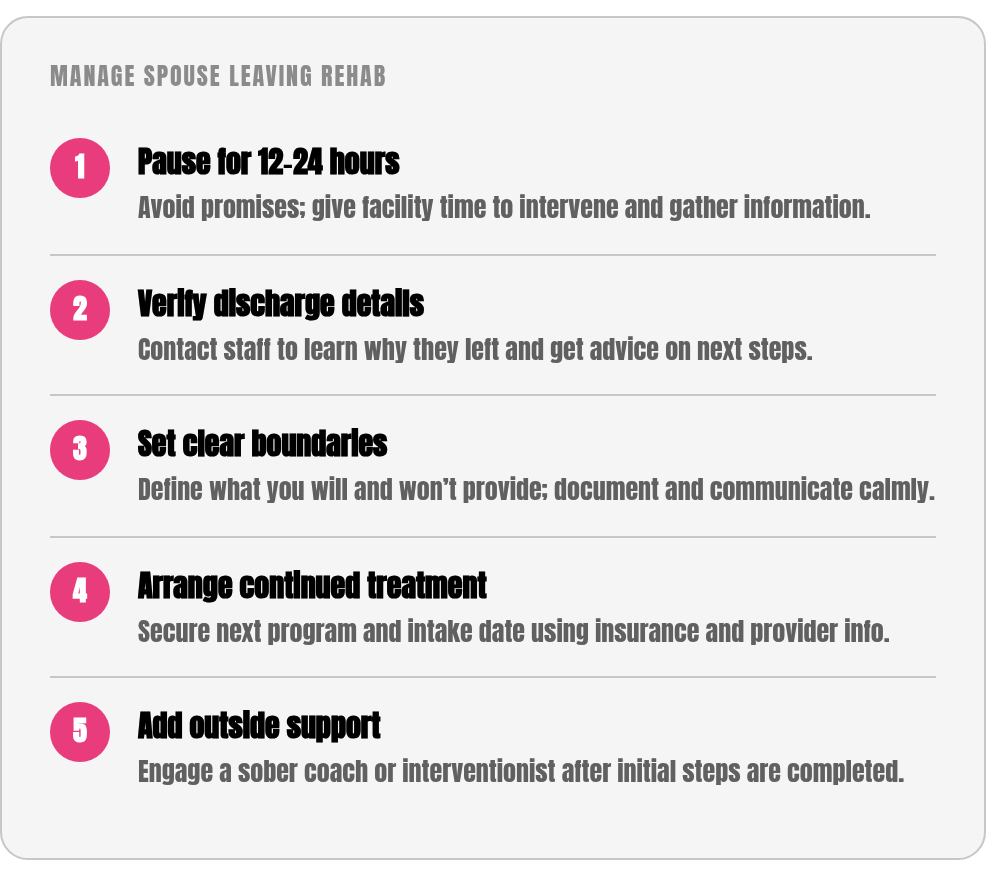
If your spouse has left rehab early again, this plan covers five steps to take before you call an interventionist or hire a sober coach. Boundaries sit at the center of the plan. They decide what you will and won't do while you find out what actually happened.
| Step | Goal | Who Takes Action | Approx. Time Needed | Success Indicator |
|---|---|---|---|---|
| 1. Pause | Avoid promises made under pressure | You | 12 to 24 hours; phone, journal; load: high | No money, housing, or ride promised yet |
| 2. Verify | Learn how and why they left | You and facility staff | 1 to 3 hours; phone; load: medium | You know discharge status and staff advice |
| 3. Set boundaries | Decide what you will and won't provide | You, plus a support person | 1 to 2 hours; journal, legal or financial documents; load: high | Boundaries written and stated once, calmly |
| 4. Arrange continued treatment | Line up the next level of care | You, your spouse, providers | 1 to 3 days; insurance card; load: medium | A named program and intake time |
| 5. Add outside support | Bring in a coach or interventionist | You | A few days; contact list; load: low to medium | You've spoken with one provider |
| Key takeaway | Boundaries define your role while you verify, arrange care, or seek help. They don't guarantee your spouse stays in treatment. |
The time and emotional-load ratings are rough estimates to help you plan your own rest and support. They are not researched averages.
Why the timing of the call matters
Exit calls tend to come at predictable points. This American Addiction Centers guide to leaving rehab early names day one or two as a common exit point. The next is 48 to 72 hours in, when withdrawal from opioids or benzos peaks. Then come days 7 to 14, when people either feel cured or start reporting dead bugs in the food. The guide counts any exit before 30 days, or any exit against medical advice, as early.
Those windows give you time to prepare before the phone rings: write your boundaries, arrange your own support, and speak with a coach or the facility about what you will do if the call comes. Your spouse will usually call you, not the facility. So you're the one hearing the pleading, the promises, and the stories. After enough of these calls, the stress, guilt, and burnout stop being just feelings. We recommend deciding now what you will and won't provide, because pressure and exhaustion make a ride, a bed, or money easy to promise before anyone knows what happened.
So our recommendation is simple. Before you start the car or hire a sober coach, ask firmly for 12 to 24 hours.
That pause has a practical purpose. The same guide notes that an experienced detox facility can often walk a person through the hardest stretch of withdrawal, which is when many people push hardest to leave. Giving it a day gives the facility a chance to do that work. Use the time to call the facility, confirm discharge status, and line up a different placement if a complaint turns out to be real. Sometimes it is.
A word on the research, because families ask. In the randomized pilot trial on involving family members in treatment, 10 of the 12 sessions occurred without the patient. Drug use improved significantly, but overall retention did not reach significance; the significant retention benefit was limited to parents. That distinction matters for spouses. Partner-side work can continue without your spouse, but it should target your safety and reduced use rather than guaranteed retention. Nothing here shows that boundaries set by a spouse prevent early exits. Set your boundaries to protect your own safety and stability, not as a tool to control the outcome.
What's really behind the exit call
Almost nobody calls and says, "I want to use again." The real reason shows up dressed as something else: mean staff, a dangerous roommate, claims that everyone inside is using, or a calm, reasonable insistence that they're fine now.
We recommend matching the reason they give to where they are in treatment. The timing gives you something concrete to check with the facility and, later, something useful to hand a sober coach.
Calls during the withdrawal window often trace back to physical and mental cravings, and a detox team is set up to handle exactly that. Second-week calls usually come from one of two places. Either your spouse feels cured, or old feelings are surfacing after detox and they want to use. Neither one is a reason to send the car.
A simple log to keep before you call a sober coach
Keep this log yourself, on paper or in your phone. It's a private record for spotting patterns across calls, not something to read back to your spouse in an argument. For each exit call, write down:
- The date, time, and how many days into treatment they were
- The reason they gave
- What they asked you for (a ride, money, a place to stay)
- What the facility staff told you when you checked
After a repeat exit, the pattern is often plain on the page. The roommate story from last time may show up again on the same day of treatment.
The boundaries to set before the phone rings
The boundary we'd hold above all others: if your spouse walks out against medical advice, you don't drive over, you don't offer the couch, and you don't negotiate terms over the phone. You confirm what happened with staff, then help line up another treatment center. A sober coach can support that handoff. Ordinary rides and housing stay off the table.
Your home, your money, and your car give you real influence. That's exactly why your spouse calls you first. Write your house rules before anyone asks for anything. These are our examples, not clinical guidelines:
- No alcohol or drugs anywhere on the property.
- No visitors who use, and no overnight guests without your agreement.
- No moving home without an active treatment or aftercare plan.
Emotional boundaries hold up better when they describe your limits instead of their failings. "I love you, and I won't pick you up. I'll help you find another program today." Or: "I can't talk while you're yelling. I'll call back in an hour."
What could a day with a sober coach look like?
This routine is an illustration we wrote, not one taken from an actual coach. Wake by 7. Eat breakfast. Do a midday recovery check-in. Eat dinner at a set time. Finish with one planned evening activity.
The point is the shape of the day. Set hours leave fewer empty stretches for old habits to fill.
What to say on the call, and when to bring in an interventionist
Your spouse may beg, promise to follow every rule you've got, or threaten. On that call, your job is narrow. Stay calm, use "I" statements, name your limit, and ask for the 12- to 24-hour pause. Don't bargain, and don't argue the details. A sober coach or the facility staff can work through those later.
Boundary breach script (illustrative): "I love you, and I'm not picking you up. I'm calling your treatment team, and I'll call you back tomorrow. Until then, I won't send money or open the house."
When should you bring in an interventionist?
Two signs say it's time for professional guidance. One is a second or third exit against medical advice. The other is a spouse who refuses to wait while you verify. A repeat exit after little more than detox is exactly when your independent support plan matters: keep your own coaching, boundary planning, and professional guidance going even if your spouse won't participate.
That second sign deserves weight. American Addiction Centers notes that people who want to leave in the first week or two typically believe they're cured or want to drink or use again. If your spouse won't give you one day to check in with the treatment team, you're past the point of handling this alone.
An interventionist doesn't provide medical treatment. They plan and lead a structured family conversation, recommend treatment options, and handle the logistics of the next step.
Intervention request script (illustrative): "I'm asking you to meet with the family and a professional this week. I've stopped handling this alone, and I want us to decide on treatment together."
Where a sober coach fits once treatment ends (MADE Recovery)
Getting your spouse back into treatment is one problem. The stretch between discharge and ordinary life is the next one. A sober coach can cover part of that stretch with nonmedical support: company, structure, and someone to answer to. The plan below is illustrative. It doesn't replace the aftercare plan from the treatment team, and it doesn't promise results.

Coaching support should step down over time
A sober companion can reduce isolation and add in-the-moment accountability during high-risk hours, like evenings or the first weekends home. We think that support works best when it starts close and steps down as your spouse keeps the routine on their own. Your boundaries stay in place the whole time, whatever level of coaching is in the picture.
When you talk to a coach, ask what you'll actually get. Useful deliverables include:
- An accountability log that tracks check-ins and missed commitments.
- Prompts for planning routines and meals.
- A crisis plan review that spells out who calls whom if a relapse or another exit happens.
If your spouse just left treatment again, start with the pause and the call to the facility.
References
[1] Leaving Rehab Early (What Happens & Can You Voluntarily Leave?) - https://americanaddictioncenters.org/blog/leaving-rehab-early
[2] A randomized pilot clinical trial - PubMed - https://pubmed.ncbi.nlm.nih.gov/24656054/