Is a Sponsor Enough After Rehab? 4 Signs You Need a Sober Coach
November 23, 2026

Why a Sponsor May Not Be Enough After Rehab
Sponsorship was built for one job, and it does that job well. A sponsor "can help solve only one problem: how to stay sober," and does it with "personal experience, not scientific wisdom" (as quoted by The Retreat).
AA is also clear, in writing, about what it doesn't do. It doesn't provide counseling, housing, jobs, money, detox, or medical treatment. That leaves gaps once you step down from residential care, PHP, or IOP. A sober coach is a nonclinical recovery-support professional who gives practical, one-on-one help through that transition. A coach is not a doctor, a therapist, or a treatment program.
The outcome data doesn't settle much. Researchers have studied the effects of sponsorship in 12-step treatment of injection drug users, asking whether having a sponsor relates to staying abstinent. Asking whether having a sponsor relates to abstinence is not the same as asking whether being one does, and neither question measures everything community involvement adds. That work looks at injection drug users in 12-step treatment, one specific population, so it can't speak for everyone leaving rehab. Those limits don't erase the distinction. Early AA history claims that sponsees' job and housing problems often eased once they focused on sobriety. That claim is anecdotal.
So we read this as a design gap in sponsorship, and we don't count it as a failing. A sponsor shares experience with the 12 Steps. Nobody in that relationship is responsible for the structure of your day.
| Area of Support | Documented Sponsor/AA Scope | Nonclinical Coach Role |
|---|---|---|
| Staying sober | Shares personal experience | Supports follow-through on your plan |
| Counseling | Not provided | Not therapy; refers to counselors |
| Housing, employment | Not provided | Helps with these issues |
| Detox, medical care | Not provided | Not provided; refers out |
| Framework | The 12 Steps | Yours; you decide what matters |
Signs a sponsor alone may leave you short
Use these four patterns to check where your support stands a few weeks out of treatment. If none of them fit you, you probably don't need a coach.
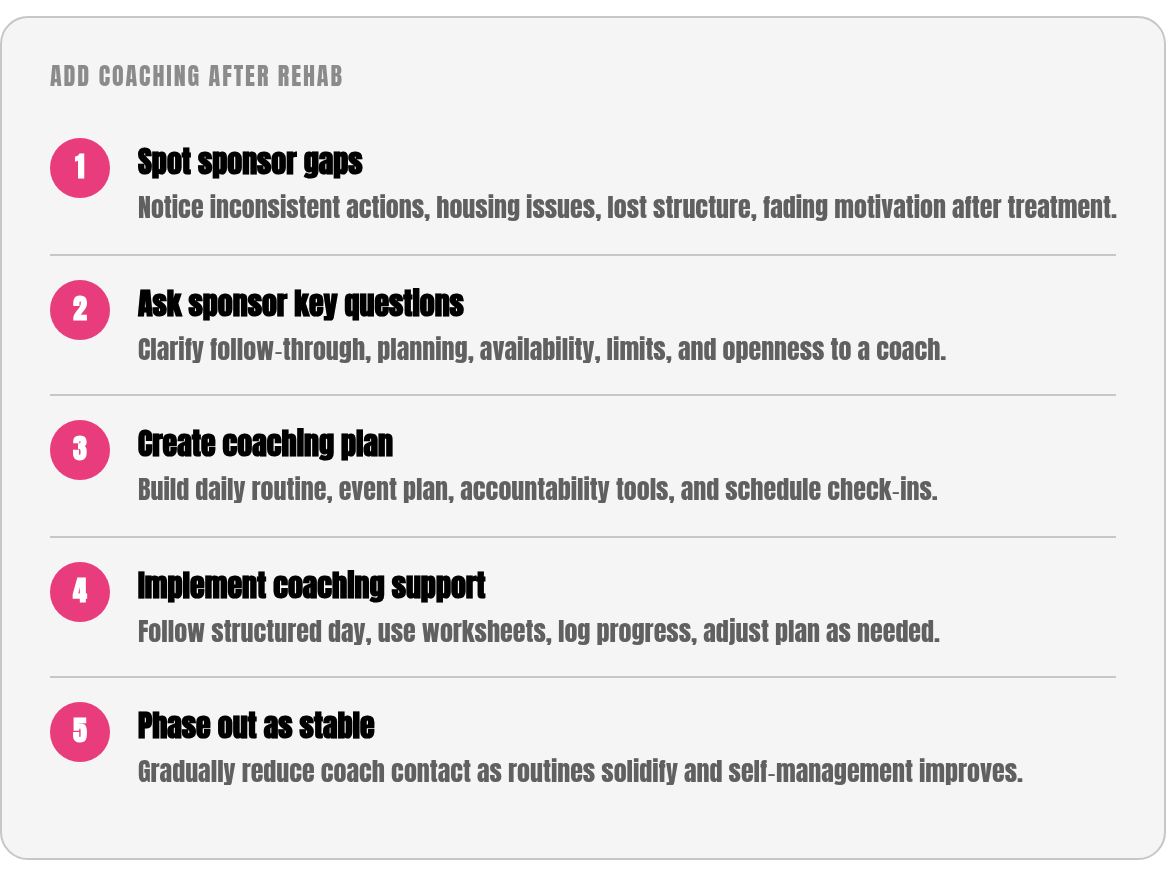
- Sign 1: You know what to do but don't do it consistently.
- Sign 2: Housing or work problems are crowding out recovery.
- Sign 3: Your days lost their structure after discharge.
- Sign 4: Your motivation is fading and accountability feels thin.
What we recommend:
- Keep your sponsor. When you're ready, think about sponsoring others and staying active in your recovery community.
- Add a coach when your gap is follow-through rather than knowledge.
- Treat coaching as optional, added support. It never replaces treatment or medical care.
Sign #2 – Your Days Have No Shape (and Nobody's Asking If You Ate)
Early AA members deliberately stayed out of newcomers' marriage, job, and housing troubles. They were not equipped or trained to take those on. That restraint kept sponsorship focused. It also means nobody in the sponsor relationship owns the question of when you wake up, whether you ate lunch, or what you do at 7 p.m. on a Friday.
A sober coach often fills that gap. One treatment provider lists building a realistic daily routine (sleep, meals, movement, appointments, support meetings) among common coaching tasks. The same provider names decision fatigue as a risk after leaving treatment. What we see in practice is simple. A set schedule cuts the number of choices you face each day. It also makes a skipped meal or a four-hour night easier to catch before it turns into a bad week.
There are limits here. We found no research review or case study on routine or nutrition outcomes after rehab. We don't run a nutrition protocol, and not every coach plans meals. Diet questions tied to a medical condition belong with your doctor.
What could a structured day look like?
We wrote this schedule as an illustration for this article. Coaches don't use it as a standard template.
- 7:00 a.m.: Wake at the same time every day. A fixed start anchors everything after it.
- 7:30 a.m.: Eat breakfast and drink a full glass of water. Hunger and thirst wear down your patience before you notice them.
- 12:30 p.m.: Eat lunch and refill your water. A planned meal takes one decision off a busy afternoon.
- 5:30 p.m.: Walk or exercise for 30 minutes. Movement fills the stretch before evening.
- 7:00 p.m.: Go to a meeting or other recovery support. Evenings can feel vulnerable after treatment.
- 9:00 p.m.: Check in with a coach or support person. Five minutes is enough to flag a rough day.
- 10:30 p.m.: Lights out.
If your days already run steady, skip this sign.
Sign #3 – Weddings, Work Trips, and Family Visits Without a Plan
A sponsor can take your call from a hotel parking lot during a wedding reception. Planning that trip three weeks earlier is a different job. Where will you sleep? How will you get home early? What will you say when a colleague hands you a drink? A sober coach can work through those details with you one-on-one. Weddings, business trips, and family gatherings pull you out of the routine you built after treatment. In our experience, these events go better when the plan exists before you leave the house. Our guide to hiring a sober coach for travel, work events, or family visits goes deeper.
Your event plan starts before you pack
Write this list down and share it with whoever supports you.
- List your likely triggers. An open bar, a difficult relative, and a long layover each need a different plan.
- Save three support contacts and tell them your dates. Pick people who will actually answer during the event.
- Find a nearby meeting or schedule daily check-in calls. A fixed time anchors each day away from home.
- Arrange your own transportation and, if you can, your own room. Relying on someone else's ride means staying until they leave.
- Choose your exit strategy and the exact words you'll use to leave.
- Rehearse one short answer to drink or drug offers. "No thanks, I'm good" needs no explanation.
Set boundaries for the event the same way. Decide your limits beforehand, tell the host or a trusted guest plainly, and bring a sober friend if you can. If the situation starts to feel unsafe, leave. You don't owe anyone a reason.
Sign #4 – Motivation Fades and Nobody's Checking In
We treat accountability as a planning problem more than a test of willpower. Motivation comes and goes. A written system keeps working on the days you don't feel like it.
Accountability tools to bring to a sober coach
These are examples to start the conversation. They aren't a fixed method every coach follows.
- A goal-setting worksheet with a few concrete goals for the coming month. Specific goals give each check-in something real to measure.
- Scheduled check-ins booked in advance. A fixed time removes the daily decision about whether to reach out.
- A simple written progress log covering meetings, sleep, cravings, and small wins. Patterns often show up on paper before they show up in behavior.
- Agreed roles. With your consent, a coach can handle practical check-ins while a sponsor, if you have one, offers experience-based peer support. Clear lines keep tasks from getting duplicated or dropped.
Here is a hypothetical step-down. A plan starts with daily check-ins. It moves to three a week only after a goal review shows the log has stayed consistent, then shifts to weekly. Our post on what happens the day your recovery coach leaves covers that last transition.
Your Next Move: Sponsor Only, or Sponsor Plus a MADE Sober Coach
Not everyone needs sober coaching. One treatment provider's guide says so plainly: many people build strong recovery with therapy, community support, and consistent routines. If that describes your last month, keep doing what you're doing. A coach won't improve something that already works.
If it doesn't describe your last month, use the checklist below to sort the gaps your sponsor covers from the ones a coach could. You don't have to choose one. As a longtime AA member explains, sponsors and coaches work on different parts of recovery, and plenty of people keep both.
Is your sponsor covering what you need?
Start with an honest look at your past week. Then ask your sponsor three direct questions. Their answers show where their support stops, so you can decide whether to cover the rest yourself or get more help.
- I follow through most days. If you know the plan but keep skipping it, that's a follow-through problem. Coaches work on exactly that.
- I plan ahead for hard situations. A sponsor's phone call helps in the moment. The planning before the moment is the part a sponsor often can't cover.
- Ask your sponsor: "When can I reach you, and when can't I?" Once you know their hours, you can plan who covers the rest.
- Ask: "What won't you help with?" Work schedules, housing, and daily structure often fall outside a sponsor's role.
- Ask: "How do you feel about me also working with a coach?" Both people should know about each other from the start.
What happens when you call us
We start with an initial consultation to understand your situation. From there, we build a coaching plan around you, delivered virtually, in person, or both. As your routines get steady, we step support down on purpose so you rely on us less over time.
Our packages are customized, so contact us for pricing. On that first call, ask us the screening questions that same provider's guide recommends, including what our coaches don't do, how we handle relapse risk, and how we work with your sponsor and recovery community.
Schedule a discovery call. We'll talk through where your current support ends and what to add, if anything.
References
[1] Sponsorship and Sober Coaching - Blog - The Retreat - https://blog.theretreat.org/sponsorship-and-sober-coaching
[2] What Is a Sober Coach? | Benefits, Costs, and How to Choose One - https://futuresrecoveryhealthcare.com/alcoholism/what-is-a-sober-coach/
[3] The effects of sponsorship in 12-step treatment of injection drug ... - https://pubmed.ncbi.nlm.nih.gov/11841900/