Sober Coach Credentials: What Certification Actually Means for Your Recovery
November 21, 2026
Related Video
**[Watch: So You Want to Become a Recovery Coach? | Addiction and Recovery | CCAR Training](https://www.youtube.com/watch?v=Whm_0ExtDGo)** by CCAR Training ## Sober coach credentials at a glance If you're vetting a **sober coach after rehab**, "certified" can mean very different things depending on who issued the paper. One organization, IAPRC, offers two routes by itself: an 80-hour self-paced certificate, and a 14-hour intensive for coaches who already hold another coaching credential. Other programs are built to sit on top of an existing clinical career.Below are the three programs we researched. This is not a ranking, and it is not a complete list of national credentialing bodies.| Program | Training hours | Experience or supervision | Cost | Renewal | What it verifies |
|---|---|---|---|---|---|
| CCAR Recovery Coach Professional | 60 hours: 30-hour Recovery Coach Academy, 16-hour ethics course, and 14 continuing education credits | No clinical background required; resume or written summary of lived or professional addiction-recovery experience | $149 application and interview; $1,200 package includes education, application, and interview | Not stated | Training, ethics, experience summary, and scenario-based panel interview |
| CCAPP Professional Recovery Coach | Not stated | Clinical-career eligibility under its SUD career ladder; six months of clinical supervision or mentorship, plus a supervisor, interventionist, or employer letter | Not stated | Not stated | Documentation and letters confirming supervision and service delivery |
| IAPRC Recovery Coach Certificate | 80, self-paced (most students finish in 4 to 6 months); separate 14-hour intensive for already-credentialed coaches | None stated for the 80-hour certificate | $997 | Not stated | Assessment method not described in the reviewed material |
What a credential does and doesn't prove
A credential tells you a coach finished a minimum amount of training. Depending on the program, it may also show ethics education, supervised experience, or a passed interview. It says nothing about how any particular client will do after treatment.The programs also check competence in different ways. CCAR uses a scenario-based panel interview. CCAPP reviews documentation and supervisor letters. IAPRC's assessment method was not described in the material we reviewed, and IAPRC states that its certificate "is not a state license."
Two coaches, both "certified," different tiers
CCAR's RCP is open to people with no clinical background. CCAPP's PRC sits within its SUD career ladder and has its own eligibility rules. Holders of either can call themselves "certified," so ask which one your coach actually has.Researchers are still working out how recovery coach training should be designed. One example is this published paper on developing a recovery coaching training curriculum.## Judge a program by how it tests coaches Look at how a credential ends. That tells you more than anything on the certificate.CCAR's Recovery Coach Professional designation closes with a panel interview. CCAR leaders and existing RCPs judge how the applicant applies their training to real-world scenarios, in person or virtually. A Kentucky program built for coaches who support people on medication for opioid use disorder (MOUD) went a different direction, with a curriculum written specifically for that population.Both approaches are trying to answer the same question: can this person do the work, or did they just sit through the hours? When you're comparing coaches, ask how their program found out.### What do these programs actually require?CCAR's 60-hour RCP requirement comprises the 30-hour Recovery Coach Academy, a 16-hour ethics course, and 14 continuing education credits; the Academy is one component, not the full requirement. Published training ranges from IAPRC's 14-hour intensive for already-credentialed coaches to its 80-hour online certificate, with CCAR at 60 hours. CCAPP's hours were not stated. The Kentucky curriculum adds motivational interviewing, one-on-one role-plays, and dedicated MOUD training.Experience requirements vary more than training does. CCAPP's Professional Recovery and Wellness Coach (PRC) credential is part of its SUD career ladder, with its own eligibility rules. Check those directly rather than assuming they match another program.CCAR's RCP process has three parts:
- Training completion: the full 60 hours, including the Academy and the ethics course
- Experience: a resume or written summary of your lived or professional experience in addiction recovery
- Vetting: an interview with a panel of CCAR leaders and Recovery Coach Professionals Notice that CCAR's experience step is a written summary. Nobody has to have watched you coach. IAPRC lists no comparable practicum at all.### Is there one national standard for a sober coach?Not in the sources we reviewed. We found no single standard and no model curriculum. Even inside CCAR's rules, the 14 additional hours can come from CCAR or from a pre-approved outside provider.What a certificate does tell you is that the coach met one program's rules for training, ethics, experience, and vetting. So the next question is always which program. If you take MOUD, ask directly whether the coach was trained and tested on medication. We wouldn't assume a general credential covers it.
Where a coach's job ends and your treatment team's begins
A recovery coach credential certifies training. It does not license anyone to treat you. Recovery coaching is a nonmedical role, even when a credential sits within a clinical career ladder; a separate clinical license may authorize treatment, but the coaching credential itself does not. Coaches aren't therapists, they don't diagnose, and they don't provide clinical care. Their job is to help a person stay engaged with treatment and build the practical skills that sobriety takes day to day.That line matters most in the first months after discharge. A sober coach after rehab can help you keep appointments, plan around triggers, and rebuild routines that fell apart during active addiction. Your doctors and licensed clinicians keep the diagnosis, the medication decisions, and the therapy. If you take medication for opioid use disorder, ask how the coach coordinates with your prescriber or treatment team.MADE works on the nonmedical side of that line, and we lay out how the roles split in our coach vs. therapist guide.None of the programs we reviewed published a formal scope-of-practice statement. So ask any coach to put in writing what they will and won't do. A good coach won't flinch at that request.### Who checks a coach's ethics and judgment?Ethics training does appear in the requirements. CCAR makes its Ethical Considerations for Recovery Coaches course mandatory for the RCP. Peer Washington's course listing for the CCAR academy says participants "address ethical and boundaries issues" and examine their attitudes about self-disclosure.Self-disclosure is a real issue in this field, because so many coaches are in recovery themselves. Sharing your own story can build trust fast. It can also turn a session into the coach's story instead of the client's. We couldn't find the text of the ethics code itself, so we won't claim it sets specific rules on confidentiality or dual relationships. Ask the coach which rules they follow.Supervision is where accountability actually shows up. CCAPP lets PRC applicants meet the experience requirement with six months of clinical supervision or mentorship. The Kentucky MOUD program trained 16 supervisors alongside its coaches, ran weekly supervision, and had both a supervisor and a physician check each coach's medication competency.A supervised coach has someone reviewing their judgment calls, and that review protects you. If a coach works alone with no supervisor or mentor, ask who they call when a situation goes past their training. Listen closely to the answer. A vague one is a preview of how problems will get handled.## Vetting a sober coach: paperwork, supervision, and fit The most useful document a coach can show you is a letter from someone who has watched them work. CCAPP's Professional Recovery and Wellness Coach endorsement requires one. Applicants submit a letter from a clinical supervisor, a supervising interventionist, or an employer confirming that they actually deliver the service.We think families and clients hiring a sober coach after rehab should ask for the same kind of proof. A certificate shows someone finished a course. A supervisor's letter shows someone has done the job.### What should you ask a coach to show you?- The credential's exact name and issuing body. "Certified" alone tells you nothing. Get the full title and the organization behind it.- Certificates and training records. Completion certificates or transcripts for each course.- Experience and supervision. Credentialing bodies expect coaches to document real-world experience. Ask who supervised them and whether they can share that documentation.- Professional-association membership, if the coach claims one.- A license number, only if a separate license applies, such as LCSW or LPC. A coaching credential is not a state license, so many coaches won't have a license number, and that's normal.Then confirm the coach's current status with the issuing organization by phone or email. Don't rely on the paper. If a coach holds CCAR's RCP, ask when they earned it and check with CCAR that it's still current.### What do you need from a sober coach?This is our working list, not a validated questionnaire.- [ ] How often you want contact: daily check-ins, weekly sessions, or on-call support
- In-person support, virtual support, or a mix
- Support during travel
- How much your family will be involved
- Training specific to medication for opioid use disorder, if you take it Specific situations make better questions than general ones. Ask a team-based service who would cover a weekend family wedding, a three-day work trip, or a bad night at 2 a.m., and what each coach on the team specializes in. If you're leaning toward a solo coach, ask who covers when they're sick, traveling, or asleep.## How to check a coach's credential before you sign on
What coaches pay to train (not what you'll pay them)
Every price in this section is what a coach pays to train or earn a credential. None of it is what you'd pay for coaching. We found no source comparing fees between certified and noncertified coaches, so these numbers show how much a coach invested in training and nothing more.The pages below belong to the programs themselves. They are not lookup tools or registries, so confirm any credential directly with the issuer.- CCAR RCP: The interview and application fee is $149. A $1,200 package covers education, the application, and the interview. Supplemental CCAR courses cost $150 for 12 CEs each, and webinars count as one CE per presentation.- CCAPP PRC: CCAPP describes the Professional Recovery and Wellness Coach credential on its PRC endorsement page. Check current fees and requirements with CCAPP.- IAPRC: The International Association of Professional Recovery Coaches offers online training. Confirm current programs and tuition with IAPRC.The closest price comparison is CCAR's $1,200 education, application, and interview package and IAPRC's $997 certificate; CCAR's $149 fee alone does not include education. CCAR's continuing education is relatively cheap, which makes it a fair question to ask: what has the coach completed since they were certified? Someone who stopped learning the day they passed is a different hire from someone who keeps up.Standard coursework, documented experience, and interview-based vetting give every credential holder a shared floor and a reason to keep training. Those are the issuers' descriptions of their own programs. They haven't been independently tested against client outcomes. The curriculum research linked above explains how training gets designed. It doesn't show that a credential produces better results in the daily work of rebuilding a life after treatment. A credential is a reasonable starting filter, and you still have to judge the person.### Run This Checklist Before You Hire
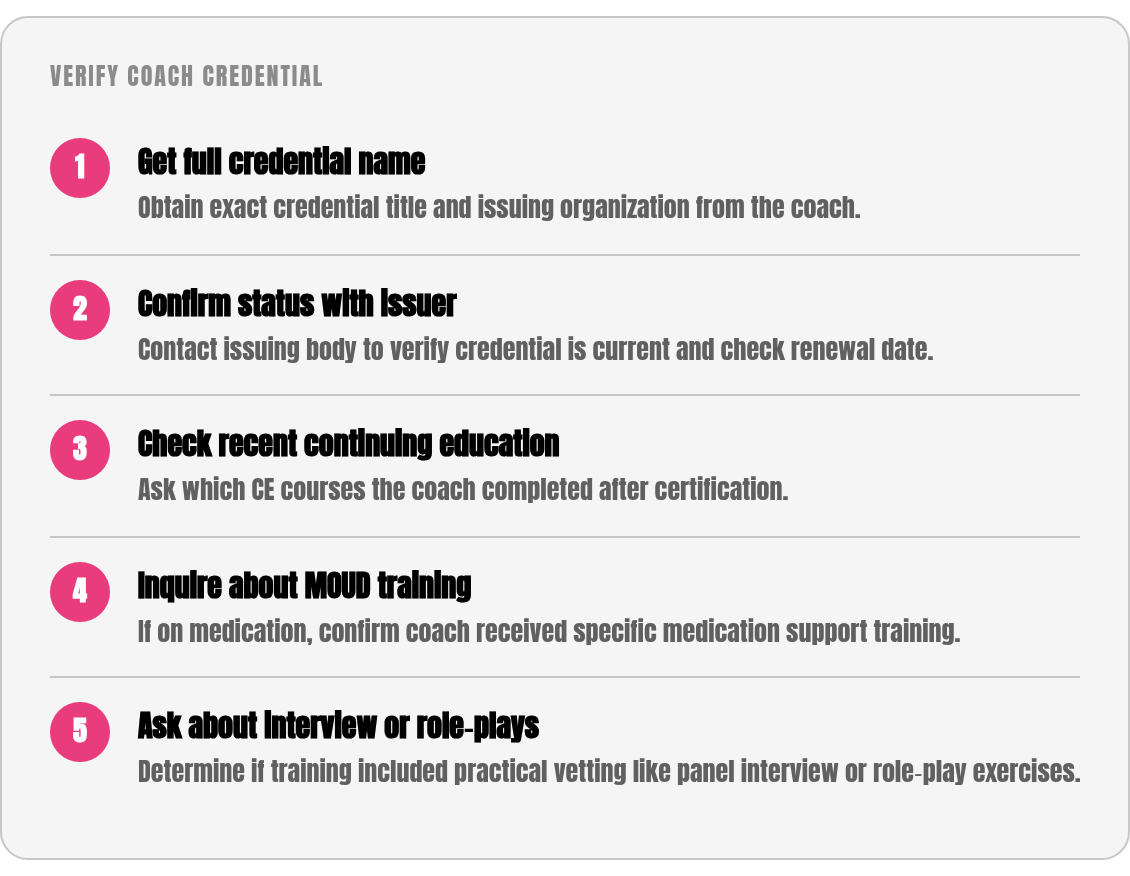
- Get the credential's full name and confirm it with the issuer.- Ask whether the credential is current and when it renews.- Ask which CE courses the coach has completed recently.- If you take MOUD, ask what medication-specific training the coach has had.- Ask whether the coach's training included role-plays or an interview, or only self-study.
References
[1] CCAR Recovery Coach Professional (RCP) Designation - https://addictionrecoverytraining.org/rcp/
[2] Certified Recovery Coach (CCAR) | Peer Wa - https://www.peerwa.org/courses/certified-recovery-coach-(ccar)
[3] Professional Recovery and Wellness Coach (PRC) - https://ccappcredentialing.org/sud-career-ladder/prc/
[4] IAPRC: Professional Recovery Coach Training Online - https://iaprc.org/
[5] The development of a recovery coaching training curriculum to ... - https://pubmed.ncbi.nlm.nih.gov/38425462/
[6] So You Want to Become a Recovery Coach? | Addiction and Recovery | CCAR Training by CCAR Training - https://www.youtube.com/watch?v=Whm_0ExtDGo