Can You Hire a Sober Coach Just for Travel, Work Events, or Family Visits?
October 28, 2026

Why a sober coach for one trip or event can make sense
Work trips, weddings, holidays, and family gatherings are where a fresh aftercare plan gets tested first. Someone a few days out of treatment shows up to a hotel before a work event. They slept badly. They don't trust themselves with the minibar. Their family may not know they were in treatment. Their aftercare plan is a list of phone numbers nobody has called yet. A short, focused engagement is built for exactly that gap.
Providers describe these occasions as ones that call for a specific support plan, because travel disrupts routine and introduces new triggers. If you're weighing a sober coach after rehab, an event stacks several pressures at once: broken sleep, unfamiliar rooms, people expecting you to drink, time alone after dinner wraps up, and confusion about what the coach is actually there to do.
Where the risk sits on a trip
A trip has two changes of environment, going out and coming home. Both carry risk. Most event coverage only plans for the first one.
We treat the return home as a small discharge. You go from structured support straight back into your daily setting, often with nothing planned for the days after.
One provider says that for touring performers, the road is often where relapse happens. Another argues that vulnerability peaks after clients return home. They're both right, about different legs of the trip. That's why MADE Recovery's travel companionship covers getting back to family as well as getting somewhere. It's also why coverage doesn't need to run forever. As clients build independence, we deliberately pull support back.
What I'd recommend: plan the step-down before you leave
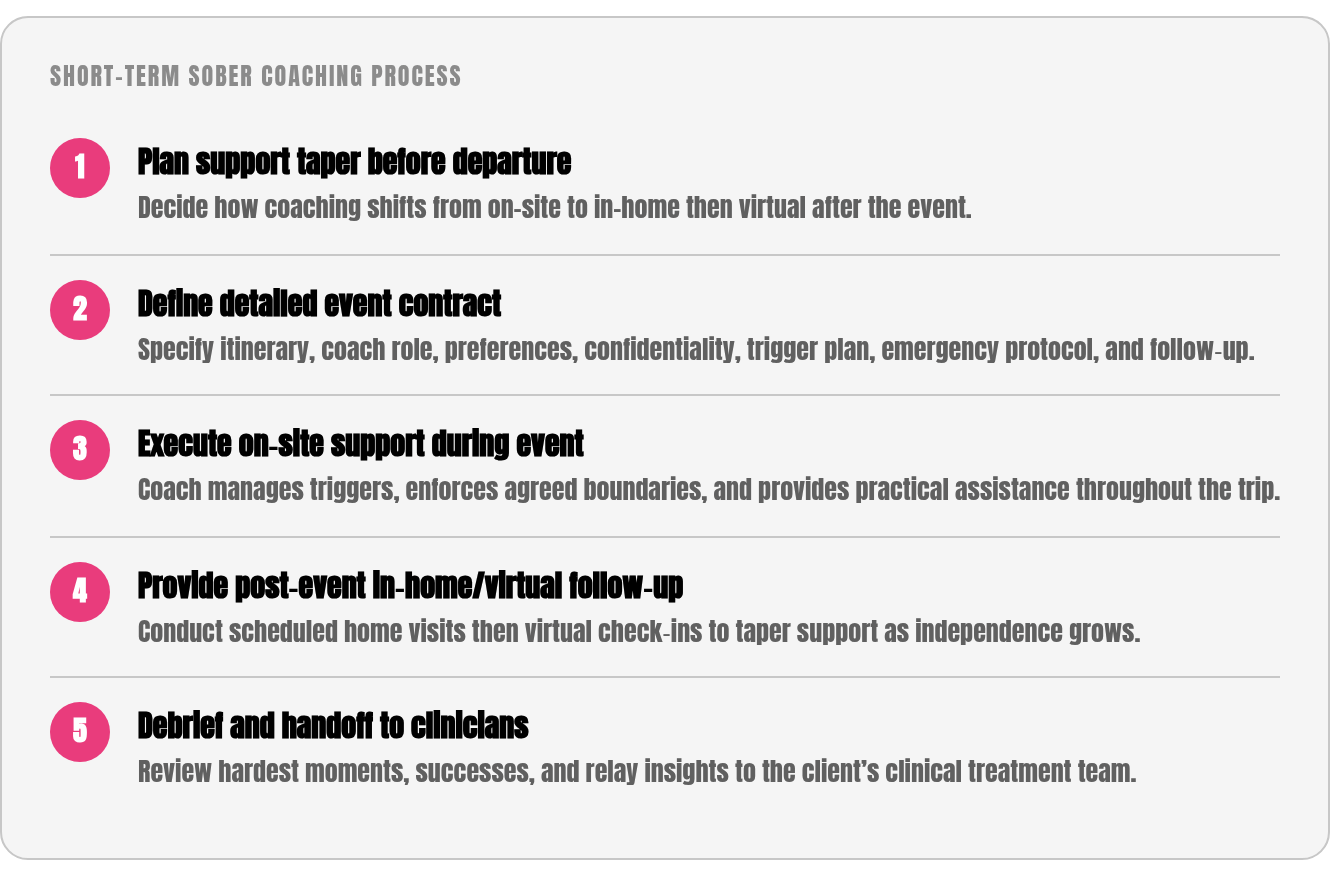
Decide before departure how support will taper. It can move from on-site presence to scheduled in-home visits, then to virtual check-ins. The coach hands you back to your everyday routine instead of disappearing at baggage claim.
A few honest limits. We won't claim event-specific outcomes, because no one has published them. A companion can provide the practical support you agreed to, but as one provider puts it, no provider can guarantee another person's behavior or recovery. A coach also has no authority to restrict an adult's movement, so agree on your exit options ahead of time.
And if you already have stable months behind you and a routine that works, one event may not justify the cost. Our guide on turning your discharge plan into routines shows what that routine can look like.
Quick facts before you book
- Short-term sober coaching is usually built around a defined trip, event, or visit, not an open-ended arrangement.
- The coach's role should be settled before you arrive: introductions, privacy, triggers, exits, and who gets updates.
- Coverage should match risk. A single dinner may need light support. Repeated instability since discharge calls for more continuity.
- MADE Recovery provides nonmedical support. Medication questions, clinical readiness, and treatment decisions stay with licensed treating professionals.
What short-term sober coaching actually covers
Most short-term engagements are scoped to the trip and end at the front door. That's exactly where the planning needs to tighten up. One provider describes its companion meeting the client at home, traveling with them, and accompanying them back home.
The end of an event is deceptively loose. Luggage, delayed flights, family tension, exhaustion, and the same old household routines all land at once. If you're hiring a sober coach after rehab for a wedding or conference, plan the week after as carefully as the event itself.
Don't expect a sponsor to cover that week. A sponsor is an unpaid 12-step volunteer who shares lived experience at meetings and by phone. Short-term coaching is paid, one-on-one, and bound by a plan you both agreed to. Different jobs.
Matching the level of support to the trip and the return
Providers offer a wide range: hourly or day-rate coverage for a single event, one-on-one travel companionship, 24/7 live-in support, scheduled in-home visits, and virtual oversight.
The strongest plans we see use these in sequence. The companion covers the event. In-home check-ins cover the first days back. Virtual contact follows. The debrief goes to the home clinical team instead of getting filed away.
What doesn't fit: live-in support for one company dinner. That's more structure than the situation calls for.
What the plan should spell out before anyone packs
Some companions sweep hotel rooms and venues for alcohol before arrival. Others stress that a companion has no assumed authority over an adult. Both positions hold up when the client agrees to the terms in advance. So environmental controls go in writing, right next to clear exit options.
- Itinerary: which journeys, events, and hours are covered, and what happens outside them
- Role: how the coach gets introduced and who knows why they're there
- Preferences: rest periods, private space, meetings to find at the destination
- Confidentiality: who the coach updates and on what terms
- Trigger plan: flights, open-bar receptions, the quiet hotel room afterward
- Emergency protocol: how to take a break or leave, and who approves changed flights or extra nights
- Follow-up: in-home or virtual support booked for the days after you return
Questions about medication or whether you're ready to travel go to your treating professionals before departure, not to us.
How a coach handles travel, work events, and family visits
Boundaries come first. The coach's job is to support the plan you consented to, not to invent new rules in the moment. That covers privacy, how visible the coach should be, whether alcohol gets removed from a room, and what happens if you want to leave early. A good plan is firm enough to hold during a hard moment and clear enough that everyone knows its limits.
Each setting has its own pressure point:
- Travel. We map the itinerary and flag flights, hotel downtime, and late evenings as high-risk windows, as one travel companion guide recommends. Before check-in, you decide whether the minibar stays stocked.
- Work events. The open bar is only half of it. A client dinner can end with hours alone in a hotel room, and that stretch can be just as risky as the event. We set a leave time, an easy exit line, and how you'll introduce your coach: a friend, a colleague, or an assistant. At the networking hour, discretion usually works best. Back at the hotel, the coach can be fully visible.
- Family visits. Family gatherings can bring old dynamics right back up, and alcohol is often on the table. We settle ahead of time who knows, which topics are off-limits, and where you can step away.
If you're well into stable recovery and the trip is a quiet weekend with sober friends, you probably don't need a full companion. Save the money.
What a daily check-in should ask
These are practical prompts, not a sourced protocol. They just tend to cover the ground:
- What's today's highest-risk moment?
- What's the exit plan?
- Who else is in the support loop?
- What routine needs protecting?
What happens once you're home
One provider closes its travel model with a post-trip debrief. A useful debrief covers what was hardest, what worked, and what carries into next week.
A conversation by itself isn't continuity, though. Another provider runs three tiers: live-in support, scheduled in-home visits, and virtual oversight. Ours follows a similar idea. Through virtual and in-person coaching, support tapers gradually as you gain independence instead of ending at the airport.
Clinical questions that come up during the trip belong with your therapist or treatment team. After that, the plan folds back into the daily routines from your discharge plan.
How to vet a coach for your event this week
Most hiring conversations stop at the event date. Ours starts with the week after. If you're interviewing a sober coach after rehab for a conference, wedding, or holiday visit, use this checklist to cover both the event and the handoff back into ordinary life. That handoff is where loosely scoped arrangements tend to fall apart.
Questions to ask every candidate first
Each answer should tell you whether this person can handle your situation, not just recovery in general.
- Event experience. A corporate dinner and a family holiday are different animals. Ask which they've worked and how they handled the hardest hour.
- Crisis plan. What happens at 2 a.m. if you want to leave? Who gets called, and in what order?
- Information needed. A good coach asks about your trigger history, current supports, emergency contacts, and treatment-team contacts. Your medication schedule stays with your prescriber. Travel readiness and medication questions belong with your treating professionals, not a coach.
- Discretion. Ask how they'll be introduced. One provider says its companions may appear to outside observers as an executive assistant or a friend.
- Coordination. With your consent, will they talk with your therapist, sponsor, or family, and how often?
Put the return trip in the contract
Ask about duration, scope, cancellation terms, emergency protocol, and communication expectations. Don't treat the day rate as the whole budget. Travel days, lodging, meals, and changed flights need their own agreement, along with who signs off on extra nights.
Then ask what follow-up looks like. Hourly and day-rate arrangements exist for one-off events. Extended live-in support is a much bigger commitment. In-home visits and virtual oversight can work as the step-down once you're home. Compare each option on three things: presence, privacy, and continuity after you return.
One caution. If you've relapsed repeatedly since discharge, a single-event booking is the wrong size. Plan for ongoing support instead, built around the daily routines in your discharge plan.
On timing, ask us directly how quickly we can assign a coach for your dates. An initial inquiry doesn't confirm local staffing with any provider, so reach out early.
References
[1] Sober Companion for Travel and Events - https://www.thefirmaddictionconsulting.com/travel-event-sober-companion/
[2] What Does a Sober Companion Do? (And How to Know If You Need One) - https://www.insightfulrecoverysolutions.org/blog/what-does-a-sober-companion-do
[3] Travel Sober Companion Services For Stress-Free Recovery - https://conciergecarecollective.com/travel-sober-companion-services/
[4] Las Vegas Private Live-In Sober Companion for Addiction Recovery - https://koplinconsulting.com/las-vegas-substance-abuse/
[5] Can a Sober Companion Travel With You? - Spearhead Health - https://spearheadhealth.com/blog/can-a-sober-companion-travel-with-you/
[6] Travel Sober Companion - Coast Health Consulting - https://coasthealthconsulting.com/sober-companion/travel-support
[7] Sober Travel Companion | Trips and Events | NMG Recovery Consulting - https://nmgrecovery.com/sober-companion-travel-events/
[8] Sober Companion & Coaching Services Canada | Michael Walsh - https://michaelwalsh.com/sober-companion/
FAQ
1. Can a sober coach stop me from drinking or leaving during a trip?
No. A sober coach is support, not security. If you want accountability around drinking, privacy, or leaving an event, put those preferences in the written plan before departure. In the moment, the coach can remind you of that plan, help you pause, contact the agreed support people, or help you leave safely if that is the chosen next step.
2. Is a sober coach the same thing as a sponsor for travel support?
No. Think of the sponsor relationship as fellowship and lived-experience support, while the travel coach is a paid professional presence tied to a specific itinerary. Many clients use both: they may call a sponsor for recovery connection and use the coach for logistics, accountability, discretion, and real-time support during the event.
3. Do I need a sober coach if I've been sober for months?
Not always. Look at the actual risk profile: recent cravings, isolation, family conflict, work pressure, alcohol exposure, and how well your daily routine is holding. A low-pressure trip may only need a lighter plan, while a more volatile visit may call for structured support even if the occasion looks simple on paper.
4. What costs should I expect beyond a sober coach's day rate?
Ask what the quote includes and what it excludes. The contract should spell out transportation, lodging, meals, schedule changes, cancellations, and after-hours availability. Also ask how costs are handled if the safest decision is to leave early, stay longer, or change the itinerary.