How to Turn Your Discharge Plan Into Daily Routines a Sober Coach Enforces
October 2, 2026

Related Video
Watch: What happens after discharge from inpatient addiction treatment by Detox Library
The Short Version
- Discharge plans work only when each recommendation becomes a time-bound daily action.
- The four-phase rollout spans the first week through six months, with support starting high and easing as routines prove reliable.
- Idle time is a major relapse risk. Structured hours matter as much as insight or motivation.
- Sober coaches bridge the gap between written aftercare instructions and real follow-through.
- Physical improvement after detox can create misplaced confidence before a client has enough structure to manage open time.
- Contact frequency should match real exposure level and taper with stability, not follow a default schedule regardless of circumstances.
Quick Summary
A discharge plan is only a document until someone turns it into daily motion. Sober coaching bridges the gap between what the plan says and what happens after treatment ends.
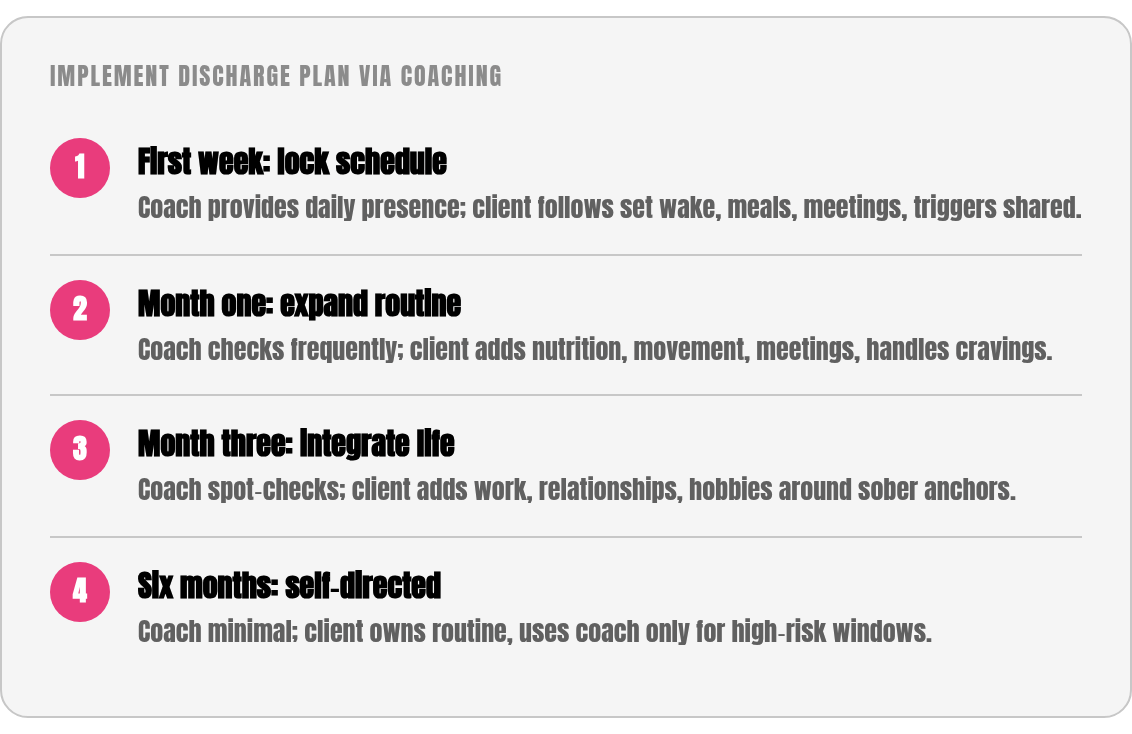
The table below maps four phases commonly seen in early recovery transitions, from the ride home to running your own routine with light oversight. If you are heading home across the country or back into a travel-heavy job right after discharge, the plan has to move with you. That is where a sober travel companion keeps the routine intact in hotel rooms and airports, not just in a stable home.
The Four-Phase Routine Rollout
| Phase | Key actions | What the coach holds | Client effort | Red flags we watch |
|---|---|---|---|---|
| First week | Wake, meals, sleep, meetings locked to set times; triggers named and shared | Daily or in-person presence; warm handoff from the treatment team | Highest; just follow the schedule | Missed first morning check-in, skipped meals, isolating |
| ~30 days | Build out nutrition, movement, support meetings into fixed slots | Frequent check-ins; enforce the plan through the craving peak | High; execute daily with reminders | Canceling check-ins, idle time, "I've got this" overconfidence |
| ~90 days | Add work, relationships, hobbies around the sober anchor | Fewer contacts; coach shifts to review and course-correct | Moderate; you run the day, coach spot-checks | Routine slipping on weekends, dropped gratitude or sleep habits |
| 6 months | You own the schedule; coach is a backstop | Minimal oversight; available for high-risk windows | Low; self-directed | Returning triggers unspoken, re-isolating under stress |
Why four phases and not one steady plan? Because the danger is not evenly spread. Clients may leave treatment feeling stronger in their bodies while their home routine is still fragile. The Addiction Policy Forum connects daily discipline with lower exposure to the empty hours that can pull people off track.
Contact Frequency Should Flex, Not Follow a Default
The right amount of coach contact is the minimum that keeps you stable and moving forward, as Futures Recovery Healthcare describes. For someone with a steady home and a sponsor calling daily, a few check-ins a week may work. If your routine is scattered across unfamiliar settings, daily or near-continuous companion presence during the highest-risk stretch may be needed. The point is to match contact to real exposure, then taper as you prove you can run the day yourself.
Not everyone needs a full coaching team. If home already has strong structure and support, lighter touch is fine. One thing stays true: a sober coach is most useful when the problem is not knowledge, but follow-through. For a deeper build-out, see our guide on building your routine before discharge.
Why Discharge Plans Fail Without Daily Execution
A discharge plan reads well on paper. The failure often happens during ordinary unsupervised time, when treatment staff are no longer managing the room, the schedule, or the next decision. That gap between the written plan and the lived day is exactly where a sober coach after rehab earns their keep.
Plans don't fail because they're badly written. They fail because they assume you'll self-execute every routine during the precise window when self-execution is hardest. The early post-discharge period is when old habits start looking familiar again. A sober coach enforces the plan during that gap, so your routine doesn't depend on willpower alone.
Why Does Routine Create Stability?
Structure removes the dozens of small decisions that drain you when you're already stretched thin. When wake time, meals, movement, and meetings are already set, you're not negotiating with yourself all day.
The Addiction Policy Forum notes that boredom and idle time are common triggers, and that people in active addiction often struggle to stick to any schedule at all. Soberlink's discharge guide adds another warning: the point at which the acute physical crisis passes is not the same thing as being fully protected from relapse. The empty hours still have to be planned.
A coach fills those hours with repeatable actions. If you want to get ahead of it, we help clients build the routine before discharge day so the first week home isn't improvised.
What Makes a Coach Better at This Than Family?
Family loves you. That's often the problem. They're too close to hold a firm line without it turning into an argument about the dishes.
The real value in coaching is making sure you actually do it. A coach handles accountability as a job, not a relationship, so they can enforce the plan without the emotional static. We are not clinicians and we don't replace therapy or medical care. Our work is implementation: turning the plan into what actually happens.
Where Do Travelers Fit In?
Standard advice usually assumes a stable home: the same bed, the same kitchen, the same meeting options, the same people nearby. Session-based coaching can work well in that setting because the environment itself carries some of the routine.
That assumption breaks the moment you fly out for work or move across the country right after discharge. Airports, delayed flights, hotel rooms, and restaurant-heavy workdays can strip away every environmental cue your routine relied on. For that segment, the minimum level that keeps you stable isn't a weekly call. It's a sober travel companion embedded in the trip, keeping meals, meetings, and sleep intact in unfamiliar settings.
One caveat worth saying plainly: this model is not routine maintenance for everyone. If you're home, stable, and following your plan, weekly check-ins may be plenty. Embedded support is for the transition where risk and disruption are both high.
Mapping the Discharge Plan to Everyday Life
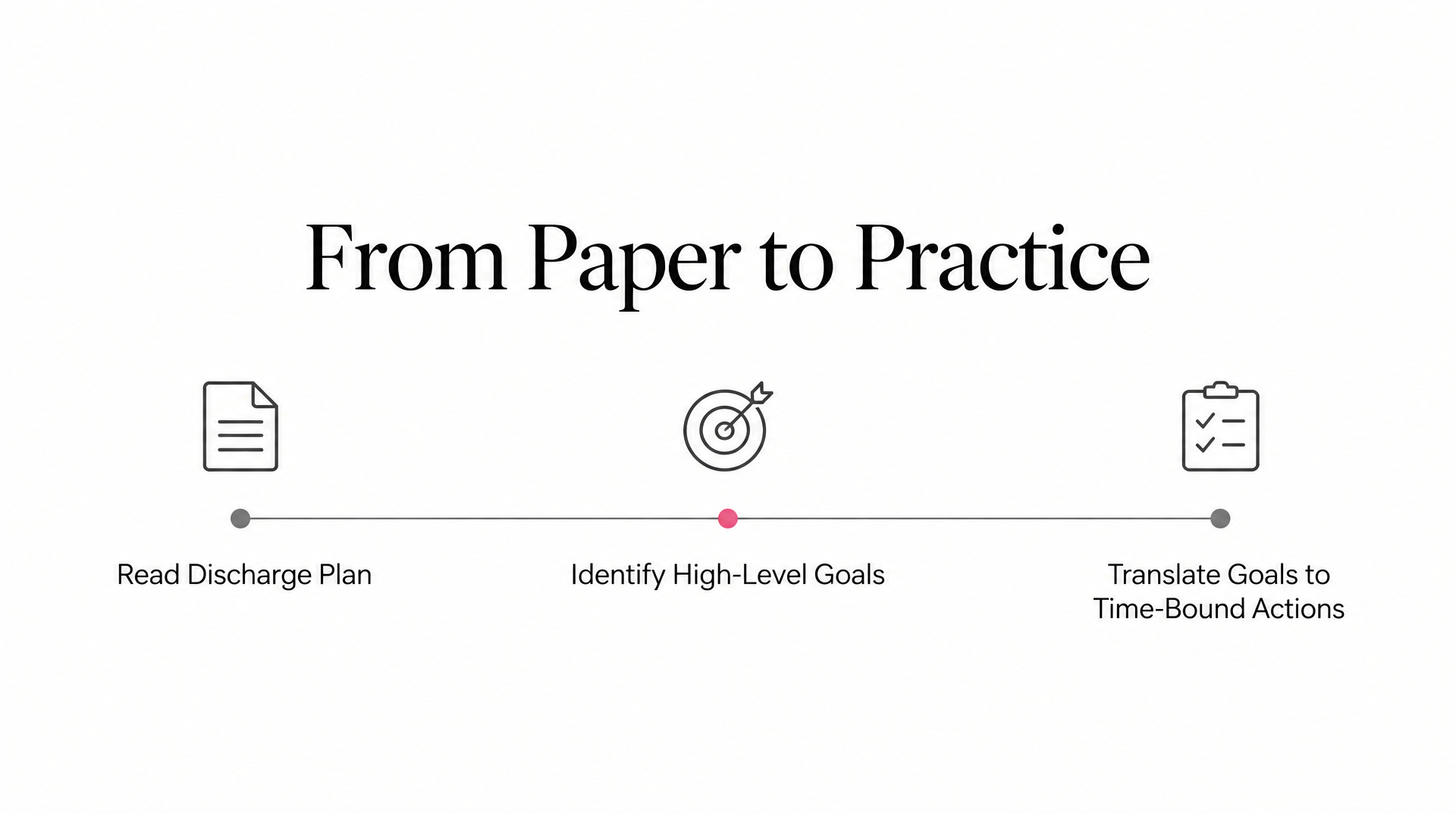
Start with the plan itself. Pull out the actual document and read it line by line. Most discharge plans list high-level goals: attend therapy, stay connected to support, eat well, avoid triggers. None of that is a daily action yet. The work of a sober coach after rehab is turning each line into something you actually do at a specific time, on a specific day.
We translate every goal into a time-bound action you can check off. "Stay connected to support" becomes "text my sponsor by 9 a.m., attend the 7 p.m. Tuesday meeting." The Addiction Policy Forum breaks a daily plan into pieces like this: a support check-in, movement, eating, and a fixed bedtime that protects sleep. Vague goals don't survive first contact with a hard day. Specific ones do.
How Do You Chunk a Plan That Feels Overwhelming?
Don't map all twelve goals at once. Identify the goals that carry the most relapse risk and build the day around those. Safe Harbor Recovery notes that a good plan should spell out your first therapy appointment, your support contacts, and your structure down to wake time and bedtime. That level of detail turns aftercare from an idea into a day you can follow.
Habit-stacking makes this easier. Attach a new routine to something you already do. Gratitude list with your morning coffee. A walk right after lunch. You're not adding ten new behaviors; you're anchoring recovery actions to habits that already exist.
What Changes When the Client Travels?
The sections of a discharge plan most often ignored are the environmental ones: home setup, social support, and what happens when you leave the house. For early-recovery travelers, every one of those variables resets the moment you board a plane.
A paper planner or app only works if the structure around it holds. Futures Recovery Healthcare points out that evenings, weekends, and travel days are especially vulnerable. A sober travel companion rebuilds the schedule on the road: a morning check-in before the first meeting, a mapped evening when the minibar is right there, a plan for the 6 p.m. work reception.
Stable home environments may need only periodic check-ins to maintain accountability. That cadence doesn't fit someone three time zones from their support network. We scale presence to the setting. The right level of support is the minimum that keeps you steady, and on a chaotic travel week that may mean a companion beside you, not a text thread.
How Do You Bring Family In Without Overloading Them?
Family can hold a routine together or quietly dismantle it. Assigning specific, limited roles can help: one person handles the morning check-in, another provides transportation to meetings. The goal is support that fades as your own system takes hold, not a household that polices you forever.
Building Core Routines with Coach Guidance
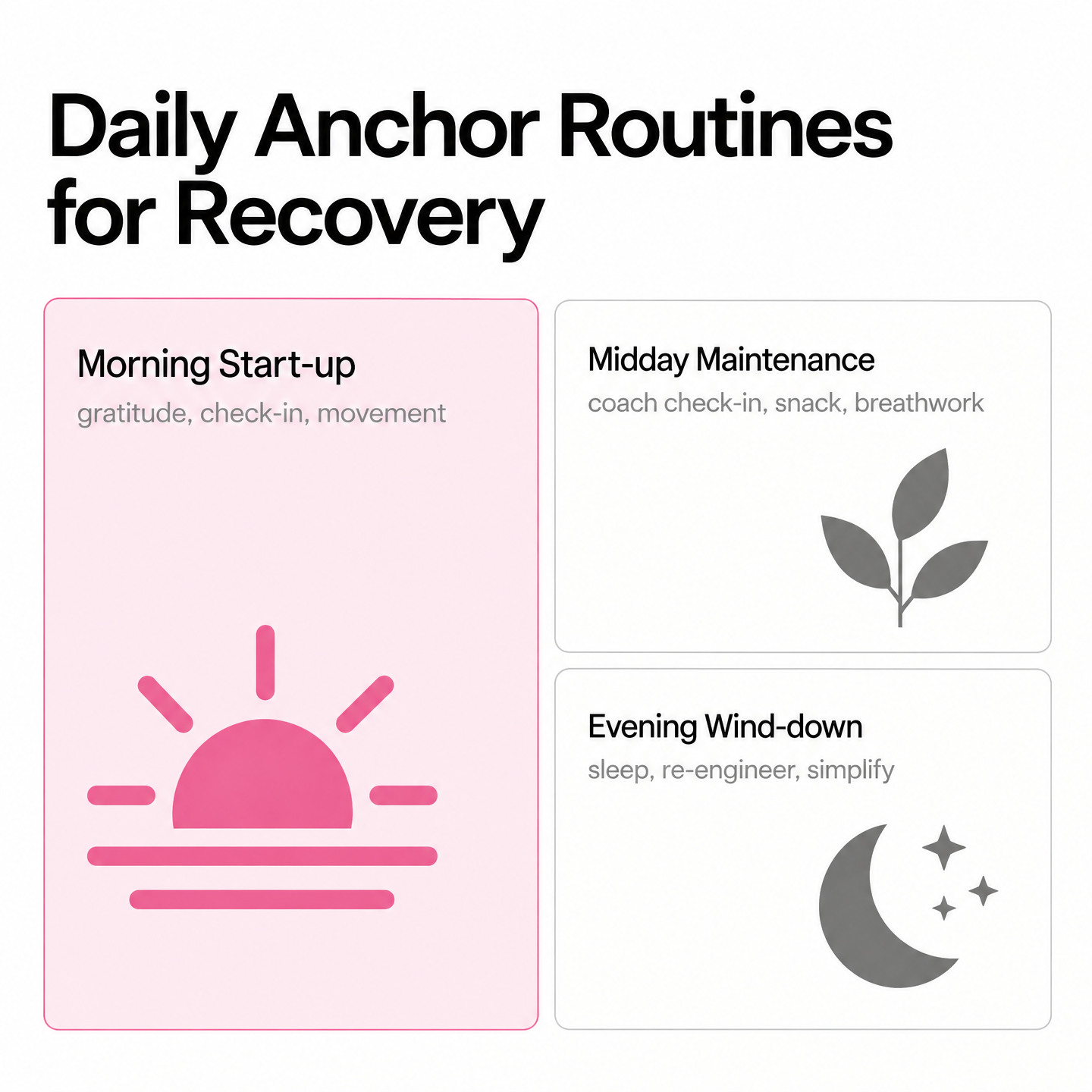
Three anchor routines hold up early recovery: a morning start-up, a midday maintenance check, and an evening wind-down. We build each one with you, then enforce it during the hours when self-execution breaks down. A sober coach after rehab is most useful here not because you lack knowledge, but because follow-through is the gap.
For early-recovery travelers, these three blocks are the thing that moves with you. A hotel room and an early flight will erase a routine built only for your kitchen. So we design each anchor to survive a changed location. That is the whole point of embedding them before discharge day.
What Does a Morning Start-Up Routine Look Like?
We co-design a morning you will actually do. A structured daily plan includes pieces that matter: a gratitude practice, a support check-in, and movement. We stack these onto habits you already have. Brush your teeth, then write three gratitude lines. Pour coffee, then text your sponsor.
The common obstacle here is low motivation at the exact moment the day needs direction. Early recovery often means rebuilding the discipline to complete everyday tasks. We do not expect discipline to appear overnight. We expect the stack to carry you until it does.
How Does the Midday Checkpoint Prevent Afternoon Slips?
A midday checkpoint is a brief, scheduled pause that interrupts drift before it becomes risk. It usually takes five minutes: a quick coach check-in, a real snack, and a few rounds of breathwork or urge surfing if cravings are rising.
Afternoons are deceptively dangerous because they often look harmless on the calendar. Morning momentum has faded, dinner is still far away, and a client may have just enough privacy to start negotiating with the plan. The midday block is where we catch that before it turns into a missed meeting, skipped meal, or unplanned detour.
For travelers, this checkpoint may be short but nonnegotiable. A call between meetings, a text from the cab, or a photo of lunch can keep the day connected to the plan. The format matters less than the interruption: someone sees the routine before it disappears.
Why Does the Evening Wind-Down Protect Sobriety?
The evening wind-down protects your sleep, and sleep protects everything else. Consistent sleep is one of the schedule items recovery experts treat as nonnegotiable. Night also tends to be when the day's stress, loneliness, and unspoken resentment finally surface, so this block has to be more than "go to bed earlier."
When a routine collapses after a hard day or a setback, we re-engineer it rather than scold. Relapse and slips read as information, not failure. We find the block that broke, simplify it, and rebuild. Recovery happens in daily choices, not in the appointment slot.
One honest limit: not everyone needs this level of support. If you have a stable home, a strong community, and routines that already hold, session-based check-ins may be plenty. We reserve embedded, travel-companion support for the transitions where the pressure is highest.
Accountability Structures: Check-Ins, Tracking, and Coaching Tools
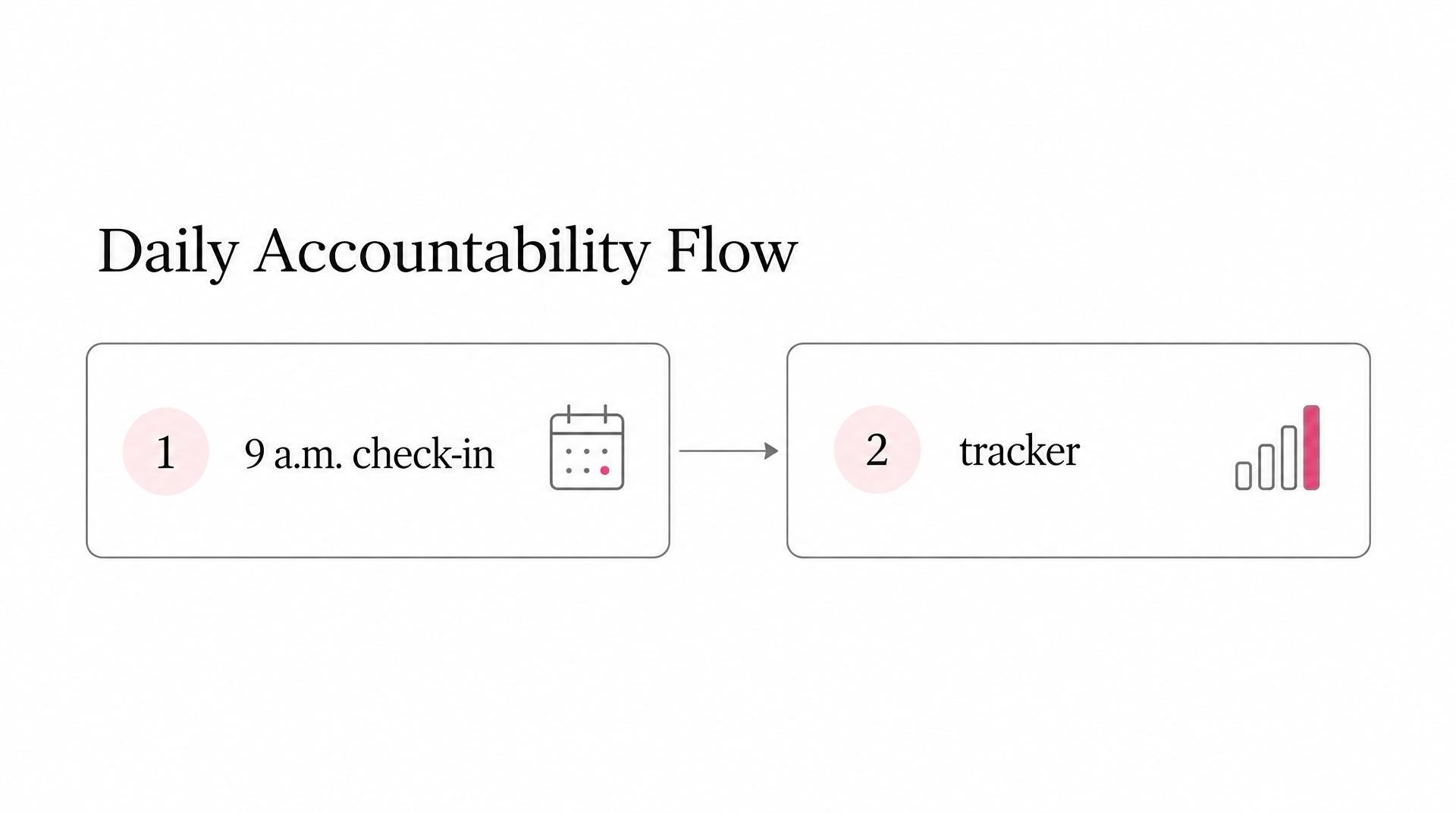
Accountability only works when it has a schedule and a scoreboard. A plan you promise to follow "every day" dies quietly. A plan with a 9 a.m. check-in and a tracker someone else can see tends to hold. That is the real job of a sober coach after rehab: not to lecture, but to build the contact points that keep a routine from drifting once treatment structure is gone.
Our check-in rhythm matches the risk curve. The guide to the first 30 days with a recovery coach notes most coaches recommend two to three contacts per week in the first month, mixing phone, video, and in-person. For early-recovery travelers, standard twice-weekly calls can leave too much silence. During travel we may go daily, sometimes with a companion physically present through the highest-risk window.
Match Frequency to the Environment, Not the Calendar
Support intensity should match the setting and disruption level, not a rigid calendar. A client back in a steady home with family can taper fast. Someone flying into back-to-back work trips needs more hands-on contact. We set frequency by where you'll physically be and how disrupted your routine gets, not by a template.
What Tracking Can Look Like
The point of a tracker is to make follow-through visible. Concrete, limited metrics work best: sleep hours, meals logged, meeting attendance, and whether each anchor routine got done. A shared sheet or a habit app works fine. The tool matters less than the fact that someone reviews it with you.
Tracking also catches early warning signs before they become relapse. A string of missed meals or sleep dropping for several nights tells us more than any mood rating. The all-the-way-well guide points out that as physical symptoms fade in week three, emotional challenges often intensify. The log is where that shows up first.
Reinforce Wins Without Building Dependence
A missed day is data, not a verdict. We frame it as a chance to adjust the plan, not a shame cycle. Positive reinforcement sounds like "you hit all three anchors in a strange hotel room, that's the hard version." Not empty praise. Specific credit for the thing that was genuinely difficult.
Then we step back on purpose. As clients gain independence, our support intentionally tapers, encouraging self-sufficiency. Recovery happens in daily choices, not just coaching appointments. The scoreboard is temporary. The habit of checking it yourself is the goal.
One honest caveat: a scoping review of acute-care to community transitions found these handoff strategies vary widely and are inconsistently measured. The field isn't standardized. That's exactly why the tracker has to be yours, specific, and reviewed, not a generic checklist handed over at discharge.
Stepping Back Without Letting the Routine Slip
The goal of good coaching is to make itself unnecessary. A sober coach should be building your capacity to run your own day, not creating a dependency that lasts forever. We focus on helping you reach the minimum level of support that keeps you stable and progressing.
We take that seriously. The taper is where the whole plan either becomes yours or quietly collapses. So we treat your routine itself as the safety net, and we pull back our presence only as that net proves it holds.
When Is It Safe to Reduce Check-Ins?
Timing matters more than any calendar. The appropriate cadence depends on your stability and home environment. For early-recovery travelers, we hold the line longer when the setting keeps changing and the routine has not yet proved portable.
We look for evidence first: a run of consistent morning and evening anchors and routines that survived at least one trip without us hovering. That last signal is the real test. If your anchors held through a hotel stay and an early flight, the routine is doing the work. That is when we step back.
How Do Booster Sessions Keep the Routine Intact?
A soft landing beats a hard stop. Rather than ending abruptly, we schedule periodic booster sessions timed around known high-risk events. We tie boosters to your actual situation instead. A family gathering, a work conference, a wedding with an open bar. These are the moments where a quick session to rehearse an exit plan earns its place.
What Does Independent Routine Management Look Like?
Independence does not mean you stop needing structure. It means the structure no longer depends on someone else reminding you to start. You know your anchor routines, you know your warning signs, and you have a realistic plan for the places where your routine is most likely to bend. We work with you to build the tools and habits that sustain your routine, covered in our guide to pre-discharge routines.
One caution. If relapse is part of your history or your travel schedule stays heavy, do not rush the taper. Reduced check-ins are earned by a stable routine, not by a date on the calendar.
References
[1] Discharge and Aftercare Planning in Addiction Recovery - Soberlink - https://www.soberlink.com/addiction-recovery-blog/discharge-and-aftercare-planning-in-addiction-recovery
[2] The First 30 Days with a Recovery Coach: What to Expect - https://allthewaywell.org/first-30-days-with-a-recovery-coach/
[3] Discharge Planning for Drug Rehab: A Comprehensive Guide - https://safeharborrecovery.com/blog/preparing-for-discharge-from-addiction-treatment/
[4] What Is a Sober Coach? | Benefits, Costs, and How to Choose One - https://futuresrecoveryhealthcare.com/alcoholism/what-is-a-sober-coach/
[5] The Importance of a Daily Schedule - Addiction Policy Forum - https://www.addictionpolicy.org/post/the-importance-of-a-daily-maintenance-plan
[6] Strategies to support substance use disorder care transitions from acute ... - https://pmc.ncbi.nlm.nih.gov/articles/PMC10168484/
[7] What happens after discharge from inpatient addiction treatment by Detox Library - https://www.youtube.com/watch?v=MDYUiT3vwEw
Frequently Asked Questions
1. What's the difference between a sober coach and a therapist or sponsor in early recovery?
A sober coach focuses on implementation. Therapists handle clinical care, sponsors offer peer guidance, and coaches help translate aftercare instructions into completed actions: the meeting attended, the meal eaten, the ride arranged, the evening plan followed. Coaching should complement treatment and community support, not replace either one.
2. How long should someone expect to work with a sober coach after leaving treatment?
The length depends less on a preset package and more on whether the client can run the routine reliably without outside pressure. Some people need only short-term help through the first transition home. Others benefit from a longer step-down if work travel, isolation, relapse history, or weak home support keeps disrupting the plan.
3. Can a discharge plan work without hiring a coach if family members provide accountability?
Yes, if the family system is calm, consistent, and clear about roles. The risk is that family accountability can become emotionally loaded fast. It works best when relatives are assigned narrow tasks—such as transportation, meal support, or one scheduled check-in—instead of being asked to manage the whole recovery structure.
4. What happens if someone relapses while working with a sober coach?
The coach helps slow the situation down and identify the sequence that led to the slip: the missed call, the skipped meal, the unplanned stop, the isolated evening, or the trigger that went unspoken. From there, the plan gets simplified and tightened around the weak point so the next version is easier to follow under stress.
5. Why do people in early recovery often feel confident right when they're most vulnerable?
Because visible improvement can arrive before dependable habits do. A person may sleep better, eat normally, and feel sharper, but still lack a tested system for evenings, weekends, conflict, travel, or loneliness. Coaching treats that confidence as useful energy, then channels it into structure before it turns into overconfidence.
6. How does sober coaching adapt when someone travels frequently for work immediately after discharge?
Travel support starts by rebuilding the routine around the trip itself: flight times, meals, hotel setup, meeting options, evening commitments, and exit plans for work events. If the trip is especially risky, support may include closer contact or in-person companion coverage, then scale back once the client shows they can keep the routine intact away from home.
7. What specific metrics should someone track to know if their post-discharge routine is actually working?
Track completion, not personality traits. Useful markers include sleep, meals, meetings, sponsor or support contact, movement, and whether the morning and evening anchors happened. The most meaningful sign is consistency under disruption: a hard workday, a family conflict, a weekend, or a trip where the routine still holds.