Build Your Post-Rehab Daily Routine Before Discharge Day Arrives
August 7, 2026

Key Takeaways
- The weeks right after discharge carry the highest relapse risk. An empty calendar is the primary danger.
- Adults leaving treatment face 16 to 18 newly unoccupied hours every day. Those empty blocks map directly onto the most trigger-prone moments.
- Habits take roughly 66 days to become automatic. Routine-building must start at discharge, not weeks later.
- Nearly half of all readmissions happen within the first two weeks, before new routines take hold.
- About 13% of patients return to inpatient care within 30 days of discharge.
- A structured daily routine is visible relapse prevention, not a wellness extra. It fills the hours treatment used to organize.
- Family and support contacts notice when unoccupied hours start to slide.
Why Building a Routine Before You Leave Matters

A daily routine after rehab is the structure that fills the hours treatment used to organize for you. It matters because the weeks right after discharge carry the highest relapse risk, and an empty calendar is where that risk lives. The routine is a practical framework for daily life, visible on a clock.
Here's the number that should reframe how you think about discharge day. Adults in early recovery report 16 to 18 hours of newly unoccupied free time once they stop using. That's not free time in the pleasant sense. Participants in that research described the hardest, most trigger-prone moments mapping directly onto blocks of unused time. One person said free time made them nervous.
Family and support contacts earn their place in the plan here. They're the ones who notice when those empty hours start to slide.
Early routine-building reduces relapse risk because waiting increases cognitive load
Waiting to build structure increases the cognitive load of early recovery. The habit-formation process requires consistent repetition. The transition back to everyday life must run on pre-established patterns rather than real-time decisions. We help clients establish daily routines that reduce stress and promote balance, so the critical initial weeks are supported by habits that have already begun to take root.
Discharge is just the beginning of the recovery journey, not the finish line. Building the routine early means your support system is already in place when you need it most.
What a working routine actually includes
A defensive plan that fills your highest-risk empty hours with sleep, meals, movement, support meetings, work or chores, and connection time. Gateway Foundation's structure guidance lists these building blocks as elements many people in recovery find helpful.
We focus on what each client needs. We help you identify which hours feel most vulnerable and build in specific support during those times. A midday gap that used to end in using becomes a scheduled walk or a check-in call. Our coaches provide consistent support during the moments that matter most, helping you establish routines that fit your life.
Simple tools belong here too. The HALT check for Hunger, Anger, Loneliness, and Tiredness gives you a fast read on why a bad hour feels bad.
Who this is for
Anyone leaving detox or residential care, and the families walking beside them. When self-control is treated like a muscle you strengthen, routine is the daily rep. One carve-out: if you're still deep in acute withdrawal or medical instability, stabilize first. Routine-building is for the transition, not a substitute for clinical care.
Mapping Your Current Lifestyle and Spotting the Gaps
The hours you'll fill at home are already decided—you just don't know what's filling them yet. Mapping existing routines and pinpointing which time blocks will empty out after discharge helps identify which habits from active use might silently reassert themselves. The goal isn't a lifestyle audit for self-improvement. It's a defensive scan for the structural holes relapse walks through.
The unoccupied hours don't spread evenly
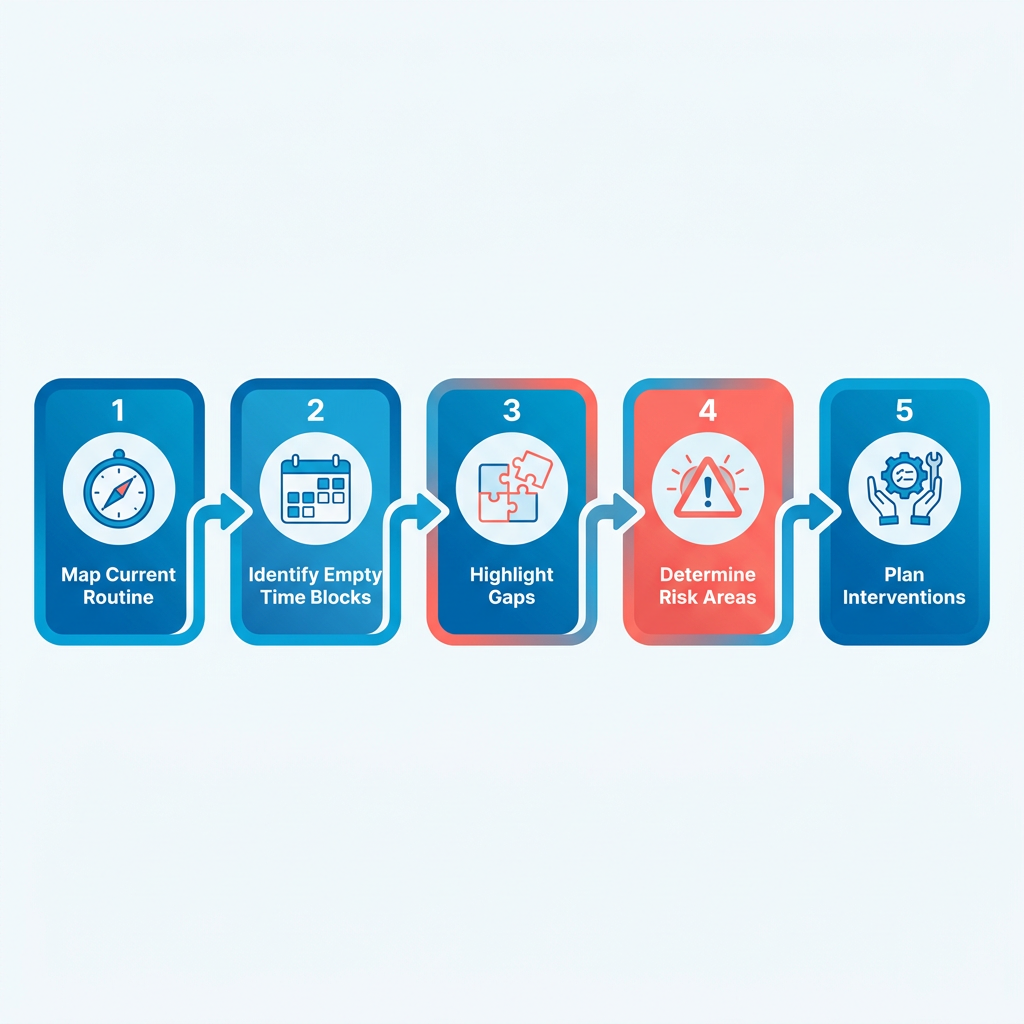
The empty hours aren't distributed evenly, and that's what makes them dangerous. Research on early recovery found that the highest-risk moments cluster around specific, predictable windows—late afternoons, weekend evenings, the stretch right after work. Cravings and relapse-prone moments map directly onto these blocks where structure has disappeared, making targeted scheduling necessary.
Reconstructing a typical weekday and weekend from the month before treatment helps identify structural vulnerabilities. Not the aspirational schedule—the real one. What time did you wake up? When did cravings or use typically start? Which parts of the day felt most chaotic or empty? This isn't about shame. It's about identifying which hours are structurally vulnerable when you're back home, so you can pre-assign safe, sustainable activities instead of improvising under pressure.
Basic needs give you an audit framework
A routine fails when basic needs go unmet long enough to erode self-control. Evaluating daily physical and emotional states offers a practical lens for identifying vulnerabilities. It's a checklist: which physiological or emotional deficits are you chronically experiencing, and what in your current plan prevents them from escalating?
If you're consistently skipping breakfast and hitting an energy crash by 11 a.m., that's a predictable craving window. If evenings are when you feel most isolated and your plan has no peer support scheduled after 6 p.m., that's a structural gap. If you're routinely getting five hours of sleep because your old pattern was late-night use, the fatigue alone can overwhelm willpower before you rebuild the habit of earlier nights. Mapping these gaps and building countermeasures—meal timing, support meeting frequency, sleep hygiene protocols—into the routine creates a foundation that holds up under real-world pressure.
The gaps that keep showing up
Certain vulnerabilities surface repeatedly when assessing lifestyle patterns during the transition from treatment. The most common is social time without a plan—weekends with no structure, invitations to settings where substances will be present, or isolation mistaken for safety. Aftercare planning research notes that many programs recommend frequent peer support early on, including the "90 meetings in 90 days" model, because unplanned social gaps carry relapse risk that climbs the longer they're left empty.
Another pattern: overconfidence about self-control in high-risk environments. Returning to the same job, friend group, or living situation without adjusting which hours you'll spend there or what boundaries you'll enforce leaves old patterns intact. The work isn't about abandoning your life—it's about naming which aspects of those environments were entangled with use, then designing friction points (scheduled check-ins, accountability contacts, exit strategies) before they're needed.
Physical health neglect is the third gap. Treatment typically includes regular meals and enforced sleep schedules. At home, those disappear unless you pre-commit. Habit formation research shows that establishing new patterns requires significant time to become automatic, yet the highest risk of readmission occurs very early in the transition, long before those habits solidify. This timing mismatch is exactly why starting the routine-building process early matters.
Coaching turns assessment into structure
Listing gaps doesn't prevent relapse. Filling them with pre-tested, sustainable structure does. Customized coaching takes the vulnerabilities surfaced in assessment and translates them into calendar blocks, backup plans, and accountability loops. That means scheduling peer support sessions in the time slots most likely to go empty. It means pre-identifying which meals you'll prep on Sundays so weekday hunger doesn't become a decision point. It means testing an 11 p.m. wind-down routine so you're not trying to invent good sleep hygiene at home under stress.
Dr. Ashish Bhatt describes aftercare as "the bridge between the structure of treatment and the realities of daily life." Assessment is how you measure that bridge before you cross it, spotting which supports are missing and which old patterns are weight-bearing in ways you didn't recognize. The routine you build from that assessment isn't motivational. It's architectural—designed to hold weight in the places you've already proven are weak.
Setting Recovery Goals That Actually Fill Hours
Goals fail in early recovery when they look like aspirations instead of schedules. We see clients arrive home with vague intentions—rebuild relationships, stay healthy, find purpose—and no plan for the newly opened blocks of time. That gap is where relapse lives. The routine you build before discharge needs concrete, time-blocked goals that directly fill the hours treatment used to occupy, rather than abstract concepts you'll figure out later.
The first 90 days are when your structure hardens or collapses
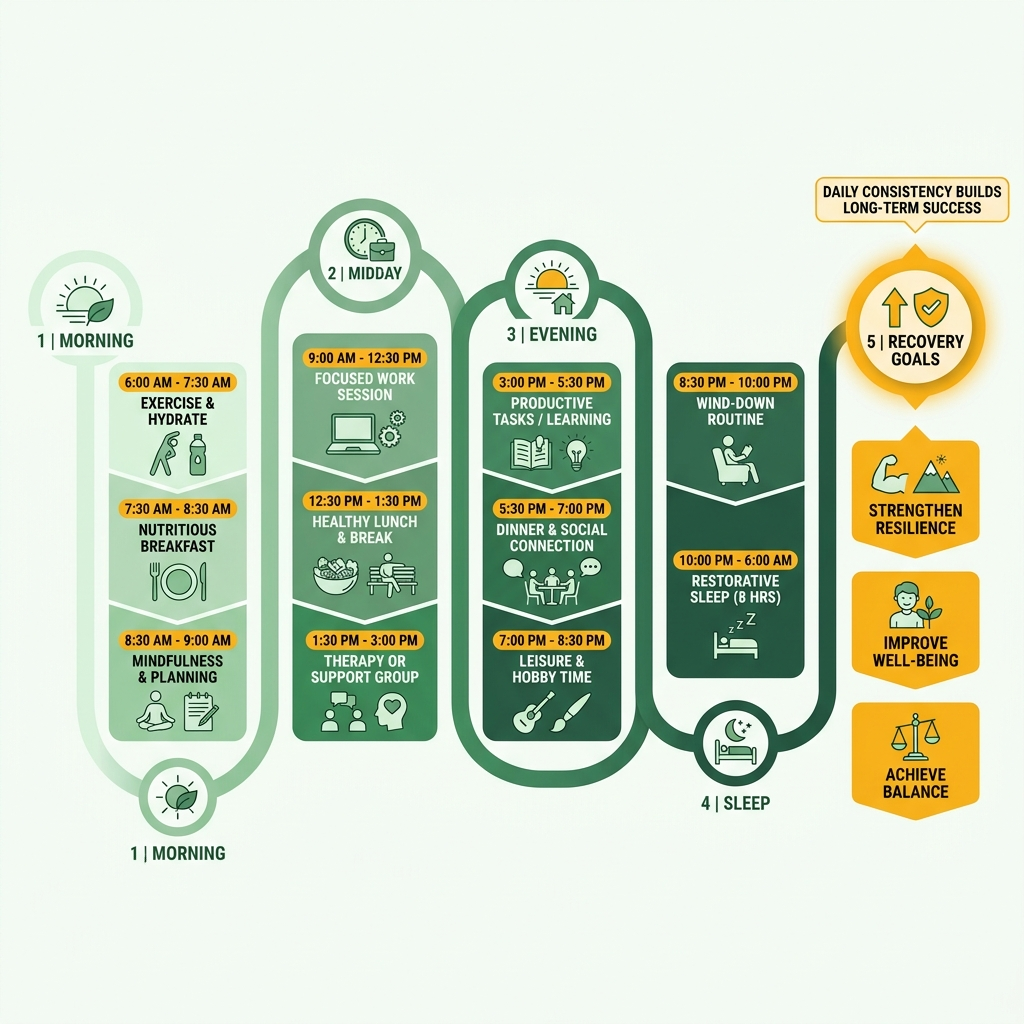
Start by defining what needs to be established in the first 90 days, not the first year. Research on habit formation shows that the timeline for establishing automatic behaviors is a race against the clock. The first two months are when your daily structure either hardens into protective habit or collapses under the weight of empty hours. Goals during this window should answer one question: what will I do from 8 a.m. to 10 p.m. on a Tuesday?
SMART goals work here, but only when they translate into calendar entries. "Attend three support meetings per week" becomes useful when you block Monday 7 p.m., Wednesday 6:30 p.m., and Saturday 10 a.m. into your schedule during pre-discharge planning. "Rebuild family relationships" stays abstract until you commit to Sunday dinner at 6 p.m. and a Tuesday phone call at noon. The T.E.A.M. Framework—Therapy, Environment, Association, and Medication—outlined in clinical aftercare planning gives you four categories to audit. Each category should yield at least two time-blocked weekly commitments before you walk out the door.
A sober coach can help identify which high-impact activities genuinely prevent relapse for your pattern of use: peer support networks for someone whose isolation fed their addiction, daily outpatient therapy for someone who needs accountability at 9 a.m., a structured job or volunteer role for someone whose longest trigger window is 1 p.m. to 5 p.m. These aren't bonus wellness activities—they're the structural beams holding the day upright. Our customized coaching programs help clients map these commitments before they transition home, turning discharge planning into a working schedule rather than a list of good intentions.
Priority goals target your highest-risk hours
Not all unoccupied time carries the same relapse risk. Participants in recovery studies report the most difficult moments mapping directly onto blocks of unused time. That vulnerability is data. Your priority goals should target the specific hours when you historically used, the times of day when boredom or isolation hit hardest, and the transition windows like leaving work or finishing dinner when routines collapse.
Pre-discharge goal-setting means auditing your upcoming week for these danger zones and assigning a defended activity to each one. If evenings after 8 p.m. were your heaviest use window, the evening goal isn't "practice self-care"—it's a scheduled 8:15 p.m. commitment to a recovery meeting, a gym session, or a standing phone call with your sponsor. The activity itself matters less than the fact that the calendar block is no longer empty. Aftercare frameworks often recommend front-loading peer support for this exact reason: it turns the hardest hour into a recurring scheduled event before you're home trying to improvise.
When building a daily routine that supports long-term sobriety, focus on depth over breadth in the first month. Three high-impact commitments executed daily beat seven aspirational goals executed sporadically. If your top three risks are evening isolation, morning purposelessness, and weekend unstructured time, lock in one recurring activity per window—outpatient therapy at 9 a.m., a part-time job or volunteer shift for the afternoon, and Friday evening peer meetings or a structured sober social event. Everything else can wait until those anchors hold.
Building accountability into the plan before you leave
Goals without external accountability tend to quietly disappear weeks home. Effective transition planning identifies who will track your progress and when the first check-in happens. That might mean a scheduled call with your coach on day three, a family member reviewing your daily schedule each Sunday, or a standing weekly session with an outpatient therapist starting 48 hours post-discharge.
The timing matters. Clinical aftercare guidance notes that continuing treatment right after an inpatient stay reduces relapse risk, but most people wait days or weeks to schedule their first outpatient appointment. Planning ahead closes that gap by booking the first session before you leave, adding peer support commitments to your calendar during treatment, and creating a written schedule that includes built-in check-ins. Our team-based coaching provides ongoing support during these critical transition moments, with coaches available to help adjust your routine as you regain stability and independence.
Tracking tools—journaling apps, habit trackers, simple paper logs—work when they feed into an accountability relationship. We recommend clients choose the simplest tool they'll actually use daily, then commit to sharing the log with their accountability partner weekly. Self-monitoring techniques mentioned in post-rehab planning guides become more useful when you're tracking physical and emotional states daily and reviewing patterns with a coach who can spot when fatigue at 7 p.m. starts predicting missed evening commitments.
Building a Morning Routine Before You Need It
We focus our transitional coaching on the morning because that's when the difference between a sustainable routine and an empty promise gets decided. Clients who leave treatment without a tested morning structure hit home and find the first three hours of the day—the block that treatment used to fill with scheduled programming—now sits completely open. That gap is where the highest relapse risk lives, and it appears before most people have finished their first cup of coffee.
The timing matters because the vulnerable window opens right away, not gradually. Early transition research shows that the first unstructured morning at home carries significant risk. We work with clients, and when it helps their families, to design a morning routine tailored to their needs, then refine it based on what actually happens when the alarm goes off. The goal is to have a working system in place before discharge, not to figure it out under pressure at home.
The morning is vulnerable because it was previously structured for you
The morning isn't inherently harder than other parts of the day—it's vulnerable because it was previously structured by treatment staff or, before that, by the logistics of active use. A study on early recovery habits highlights that mornings represent the first unsupervised block of the day. The routine's real job is defensive. It fills hours that would otherwise sit empty, and empty hours are what participants consistently identified as their most difficult, trigger-prone moments.
Clients underestimate how much of their morning was consumed by treatment schedules. Meditation at 7:00 a.m., group therapy at 8:30, breakfast in the cafeteria at 9:00—that structure vanishes on discharge day. The newly unoccupied time that appears after treatment doesn't distribute evenly across the day. The morning takes a disproportionate share, and it arrives before most people's self-control reserves have fully rebuilt.
Map what the first four hours at home will look like if nothing is scheduled
We start by mapping what the first four hours at home will look like if nothing is scheduled. Where will you be when you wake up? Who else will be in the house? What used to fill that time before treatment, and which of those patterns could reassert themselves? This isn't a lifestyle assessment for self-improvement—it's a gap analysis for the structural holes relapse walks through. Once we know which hours are highest-risk, we work backward to design a sequence of non-negotiable anchor points that defensively occupy that time.
The structure we build isn't aspirational. It's the minimum viable routine that keeps the dangerous hours filled and simple enough to feel automatic. A typical example includes a fixed wake time, 20 minutes of movement (not exercise in the gym sense—walking, stretching, anything that gets blood moving), a planned breakfast that requires preparation rather than grabbing something quick, and one scheduled check-in with a family member, coach, or sponsor before 10:00 a.m. That check-in serves double duty: accountability and social contact during the block when isolation risk is highest.
Breakfast is a structural anchor, not a nutritional event
We treat the first meal of the day as a structural anchor rather than a nutritional event. The act of preparing breakfast—measuring coffee, cooking eggs, sitting down to eat rather than standing at the counter—consumes 15 to 20 minutes and creates a natural transition point between waking and the rest of the morning. Research on structured routines in recovery shows that predictable physical tasks help stabilize self-control, and food preparation is one of the few activities that naturally occurs at the same time every day without requiring willpower to initiate.
Hydration works similarly. A small, fixed action first thing in the morning—a full glass of water before anything else—sounds trivial, but it happens at a set time and takes less than 60 seconds to complete. It's the first proof point of the day that the routine is operational. The goal isn't hydration for health reasons—it's hydration as a behavioral checkpoint that confirms the plan is being followed.
Test the routine while support is still available
Early coaching sessions treat the routine as something to test, not just plan. Clients wake at their planned home time, execute the morning sequence, and report what broke. The alarm didn't wake them. The planned breakfast took 40 minutes instead of 20. The 9:00 a.m. check-in conflicted with something else. We adjust the routine based on what actually failed, not what we think might fail. Running the sequence repeatedly with a coach's support builds familiarity and reduces the friction of starting each day with a new pattern.
We also keep the structure simple during this phase, pairing each anchor point with a coaching check-in so the routine stays easy to follow. These aren't motivational tools. They're scaffolding that reduces the cognitive load required to remember what comes next, which matters because decision-making capacity is often limited in early recovery and mornings are when focus can be hardest to maintain. The routine needs to be simple enough to execute on autopilot, and testing it with coaching support is how we confirm it actually is.
Adding Physical Activity and Balanced Meals to Your Schedule
Physical activity and balanced meals are core structural elements in a post-rehab routine. They're two of the most dependable time-blocks you can put on the calendar, and they pull double duty: they fill open hours and they rebuild a body that active use wore down. A healthy recovery routine should include exercise, healthy meals, sleep, and social time as named, scheduled components, not vague good intentions.

Your immediate support network plays a practical role in planning. When you build your routine with coaching support, the practical questions get mapped early: who shops and cooks, who walks with you in the morning, which family members or friends can anchor a shared workout. Working through those roles while you have guidance is what keeps the schedule alive once you're on your own. Discharge planning that involves a wide range of support people is far more durable than a solo plan you improvise alone.
Exercise gives your day structure and a mood floor
Exercise gives your day both structure and a mood floor. A structured schedule minimizes stress and builds accountability, as Brian Lynch, MD notes, and movement is one of the easiest blocks to make non-negotiable. It also directly supports neurological recovery. Gateway Foundation describes how physical activity helps restore neurotransmitter balance, and a repeatable workout provides the daily structure to sustain it.
Physical activity placed during vulnerable hours isn't just healthy, it's defensive.
Simple activities stick better than ambitious routines
The ones that stick are simple, cheap, and repeatable. A daily walk, a morning stretch block, a swim, a bike ride, or a bodyweight circuit all work because they need no gym membership and no perfect mood. Ambitious routines built during early recovery, when energy and confidence are high, often crumble once fatigue sets in or real-world pressures return.
Pair the activity with something already fixed in your day. Walk after breakfast. Stretch before your support meeting. Anchoring exercise to an existing block means you don't rely on willpower to start.
Balanced meals stabilize the rhythms active use scrambled
Balanced meals stabilize the body's rhythms that active use scrambled. A consistent daily routine that includes regular meals helps steady sleep, energy, and mood, which makes every other block easier to keep. Skipped meals and blood-sugar crashes read a lot like early cravings, so regular eating is quiet relapse prevention.
Keep the tooling light. A fitness tracker to log walks and a meal-planning app to build a repeatable grocery list are enough. Planning that first week of meals with your coach means your health needs are handled before the fridge is empty and the day is wide open.
Locking Therapy and Support Groups Onto the Calendar Before You Leave
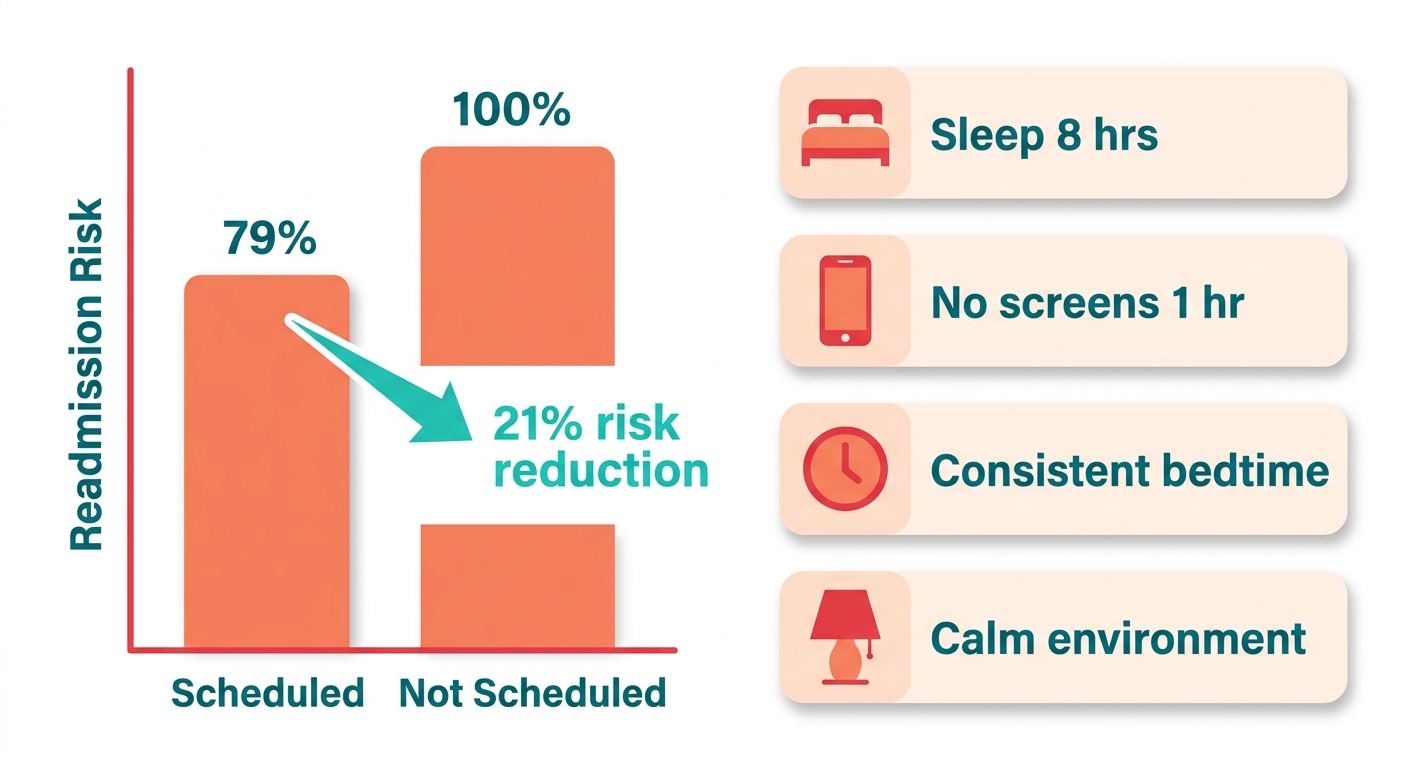
Locking therapy and support group sessions onto a fixed calendar before you leave treatment is what turns aftercare from a good intention into a defense. The data backs this up: follow-up appointments within 30 days of discharge cut readmission risk by roughly 21 percent. You don't schedule those sessions after you get home. You co-create the whole week with your coach while you still have the structure of the program around you.

Peer meetings and family sessions move from abstract support to fixed appointments with names and times attached. When we map the week before discharge, we decide which nights are group nights, who drives, and which family members sit in on the sessions built for them. Family-focused sessions only help when they're on the calendar the same way a therapy hour is, and pinning them down early keeps them from quietly falling off once the house gets busy.
Front-load the first 90 days with more meetings than you think you need
Front-load the first 90 days with more meetings than you think you need, then taper. A widely used aftercare benchmark suggests daily attendance early on, as detailed in aftercare planning resources, which sounds heavy until you remember those meetings are filling the highest-risk hours, not padding your week.
Build the schedule in layers. Individual therapy anchors one or two fixed slots. Peer support groups fill several evenings, since that's when unstructured time bites hardest. A structured aftercare plan serves as a vital link between clinical treatment and daily life. That link only works if both ends are anchored, and the discharge-side anchor is the version of your week you and your coach test before you walk out.
There's a real reason to start this early. Sources disagree on relapse rates: one study found 85 percent relapse within the first year, while other clinical figures put it at 40 to 60 percent over the long run. Both are probably true at different scales. The first year is the acute danger zone your session schedule is built to survive. Lifetime risk settles into chronic-disease territory after that.
Consistent sleep is a scheduled recovery input, not a personal preference
Consistent sleep is a scheduled recovery input, not a personal preference. Gateway Foundation lists sleep alongside meals, meetings, and exercise as a named component of a healthy routine, because erratic sleep destabilizes mood and self-control right when you need both most.
Set a fixed wake time and a fixed lights-out, and protect them the way you protect a therapy appointment. We build these anchors during coaching so your first week home isn't an experiment.
Then hold the whole structure together with plain tools. A shared calendar with reminders for every session and both sleep anchors keeps the plan visible. Structured routines prevent relapse partly by killing the boredom that empty evenings create, and a calendar you built before discharge is what makes that structure real on day one.
Using Journals and Tracking Apps to Close the Feedback Loop
A journal and a tracking app turn your routine from a plan you hope to follow into data you and your coach can actually read. The value is the feedback loop: you log what happened, patterns show up, and you adjust before a bad stretch becomes a slip. Working through that loop with a coach during your program means it starts producing usable signal as you reintegrate into everyday life.

Family support gets a real job instead of a vague supportive role. MADE assists families in managing recovery pathways, so the people in your support circle understand the routine and the moments that matter most. That coordinated support matters given the stakes. Research on early recovery indicates that the transition period is highly vulnerable, and the earliest weeks are the sharpest edge of that risk.
Track the few things that predict a bad day
Track the few things that predict a bad day, not everything you did. The most useful metrics tie directly to the trigger-prone empty hours: sleep, mood, cravings, and whether each scheduled block actually happened. A daily journal entry plus a quick mood rating gives you and your coach enough signal to spot drift early.
Keep the tracking light. A paper planner with habit boxes works. So does a shared calendar where your coach adds reminders, or a habit app that logs sleep and mood for weekly review. The tool matters less than the honesty of the entries. Log the missed block, not just the completed one.
Feedback tells you which parts of your routine are load-bearing
Feedback tells you which parts of your routine are load-bearing and which are dead weight. When your logs show cravings spiking every afternoon, that's not a willpower problem. It's an unfilled hour asking for a new block. Gateway Foundation notes that regularly reevaluating your routine helps you adapt to life changes and avoid overwhelm.
Progress reports also build the capacity the work depends on. As that same source puts it, consistent routine-building reinforces long-term recovery behaviors. Every logged week that shows consistency is a rep. Seeing the streak makes the next entry easier, and your coach can point to the trend when motivation dips.
Here's the honest part on the numbers. The high rate of early relapse sounds bleak against the long-term statistics for chronic disease management. The initial transition is the acute danger zone your routine is built to survive, while the long-term figures represent lifetime risk settling into chronic-disease territory. Tracking is how you navigate the first window.
Skip the app if logging becomes another source of shame
Skip the app if logging becomes another source of shame. If you're the type who spirals over a broken streak, a rigid tracker can backfire and add stress, which is itself a relapse trigger. In that case, drop the metrics to one simple daily check-in with your coach and let the human accountability carry the weight. The goal is signal, not self-surveillance. When the data stops helping you adjust, simplify it.
References
[1] What Should I Do After Completing Inpatient Rehab? - https://bradfordhealth.com/what-should-i-do-after-completing-inpatient-rehab/
[2] Discharge Planning for Drug Rehab: A Comprehensive Guide - https://safeharborrecovery.com/blog/preparing-for-discharge-from-addiction-treatment/
[3] Aftercare Planning in Rehab: Essential Steps for Lasting Recovery - https://www.thehopehouse.com/addiction-treatment/related/aftercare-planning-in-rehab/
[4] Returning Home After Rehab: How to Transition Smoothly & Stay Grounded - https://pinnaclerecovery.org/returning-home-after-rehab-transition-guide/
[5] What to Do After Your 30-Day Inpatient Rehab Stay - https://www.gatewayfoundation.org/what-to-do-after-30-day-inpatient-rehab-stay/
[6] Life After Rehab | What to Expect & How SaVida Can Help - https://savidahealth.com/life-after-rehab-what-to-expect-how-savida-can-help/
[7] Addiction Rehab Daily Schedule Example - https://www.addictioncenter.com/treatment/rehab-daily-schedule/
[8] Habits and Routines of Adults in Early Recovery From ... - PMC - https://pmc.ncbi.nlm.nih.gov/articles/PMC9926005/
[9] Why Structure and Routine Are Important in Recovery - https://www.gatewayfoundation.org/blog/benefits-structure-addiction-recovery/
Frequently Asked Questions
1. Should I start building a routine if I'm still in acute withdrawal?
Prioritize medical stabilization. Routine-building is designed for the transition back to daily life, not as a substitute for clinical care. If you're still experiencing acute withdrawal symptoms, that stage requires clinical treatment. Once you are stable and preparing to leave care, you can begin structuring your daily schedule.
2. What is the HALT check and how do I use it?
It is a quick self-scan that identifies physical and emotional triggers: Hunger, Anger, Loneliness, and Tiredness. When you experience a sudden craving or mood drop, check if one of these states is active. You can then use your routine to address it directly, such as adjusting meal timing, scheduling a support call, or going to bed earlier.
3. Is it a mistake to return to my old job or friend group after rehab?
The risk isn't the environment itself, but rather navigating it without clear boundaries. Returning to familiar settings without modifying your schedule or establishing limits can trigger old habits. Identify specific triggers within those environments, then set up pre-planned exit strategies, scheduled check-ins, or accountability contacts before you return.
4. How is a relapse-prevention routine different from a general wellness routine?
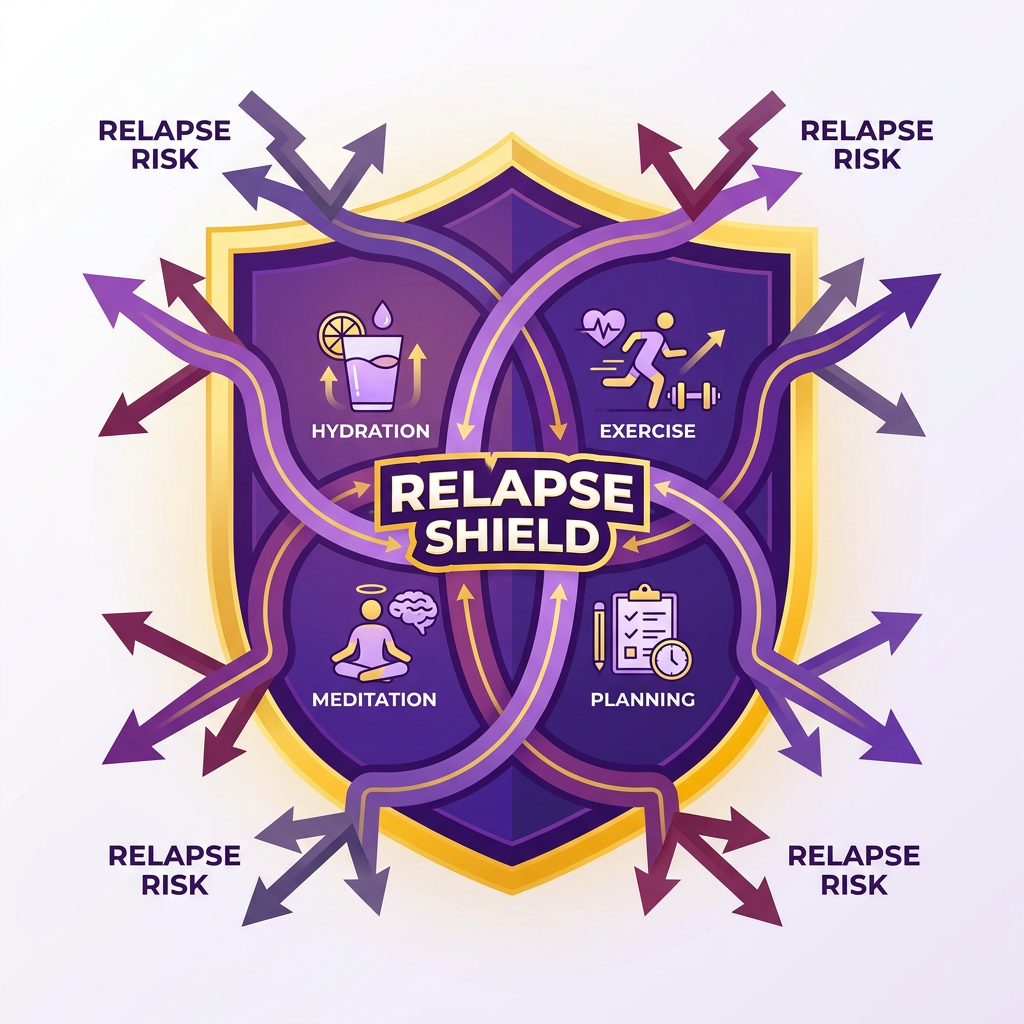
While wellness routines focus on general self-improvement, a relapse-prevention routine is a defensive schedule designed to secure vulnerable time blocks. Its primary purpose is to pre-occupy high-risk hours with structured activities like peer support, exercise, or check-ins. The goal is to eliminate unplanned gaps where cravings typically arise, making the schedule a practical shield rather than an aspirational goal.
5. What role does my family play in my post-rehab routine?
Your support network serves as an external accountability loop. Practically, they can assist with daily logistics like meal preparation or joining you for scheduled exercise. Having a trusted person review your weekly calendar helps ensure you stay committed to your plan during the critical early transition phase.
6. Why do programs recommend "90 meetings in 90 days"?
This recommendation is designed to establish a consistent daily anchor during the most vulnerable phase of recovery. Frequent attendance at peer support groups helps fill empty blocks of time that might otherwise lead to isolation or cravings. By committing to a regular meeting schedule, you create a predictable routine that reduces the need for daily decision-making.
7. Do habit-tracking apps actually help prevent relapse?
Digital tracking tools are only effective when paired with external accountability. Logging your daily habits, mood, or sleep provides valuable data, but the real benefit comes from sharing that information with a coach, therapist, or sponsor. Choose a simple tracking method and commit to reviewing it weekly with someone who supports your recovery.