Returning to Work After Rehab Without Torching Your Recovery Routine
September 21, 2026

Why the Return to Work Tests Everything You Built in Rehab
The return-to-work phase is where recovery meets real life. For gig workers and the self-employed, going back to earning after rehab carries a wrinkle most guidance skips: no HR desk, no medical-leave paperwork, no single boss to ease you back in. You set your own schedule, chase your own clients, and absorb your own stress. That freedom cuts both ways.
Work is one of the strongest protective factors in early recovery. Research on employment interventions points to a positive link between steady work and substance use treatment outcomes, and a job can help prevent relapse. Getting back to work often ranks among the highest priorities for people rebuilding after treatment, right next to recovery itself. Structure, income, and purpose all guard against the drift that leads back to use.
Does going back to work actually protect your recovery?
Usually, yes. Not automatically, though. Employment gives you rhythm and meaning, and those are genuine buffers against relapse. The catch is that the same job can be the hazard. Valley Hope's team notes that the workplace itself may be a trigger, especially if you used in that environment or the stress there fed the addiction. 
So both things are true at once. Work protects you, and work can pull you under. The deciding factor is whether you plan for the pressure before you return, not after. The protective effect tends to show up when someone re-enters a job they've deliberately prepared for, not one they've simply walked back into.
That planning matters because relapse is common, not rare. Treating recovery as a lifelong process to manage, rather than a finish line you crossed in treatment, is what keeps the first paychecks from turning into the first slip. Ongoing accountability during this stretch makes a real difference.
Why do gig workers face a different challenge?
Because the legal safety net baked into standard return-to-work advice can leave them out. Programs like FMLA and protections under the ADA are built around traditional employment relationships. A freelancer juggling five clients has no single employer, so that coverage often doesn't apply.
Traditional returnees also lean on institutional accountability: HR check-ins, workplace agreements, employer-involved recovery plans. Gig workers have none of that scaffolding. Someone has to replace it.
We're a nonmedical sober coaching service, not a clinic or a treatment provider, and we don't diagnose or manage medication. What we can do is supply the accountability structure a gig worker's job doesn't. Weekly check-ins, routine building, and a coordinated support team stand in for the missing HR department. For a closer look at how that steady rhythm works, we break it down in honest weekly check-ins.
The first weeks back should focus on stability, not proving anything. Build the plan first. The income follows.
The Short Version
- Structure and support matter most in the first months after rehab.
- Employment interventions research shows a positive link between steady work and substance use treatment outcomes, with jobs acting as relapse buffers.
- Gig workers and the self-employed lack FMLA and ADA protections, which are built around traditional single-employer relationships.
- The same workplace that protects recovery can also trigger it, especially if someone used substances there or the stress fed the addiction.
- The brain systems governing stress and impulse control keep stabilizing for months after substance use stops, so early recovery is biological as much as emotional.
- Insufficient sleep is a documented relapse trigger, listed by American Addiction Centers alongside stress and isolation.
- Habit stacking anchors new routines to existing ones, so coffee follows breakfast and breathing follows coffee, filling idle time before and after work.
Building a Daily Routine Before Anyone Asks Anything of You
A routine is the one part of returning to work after rehab you can build before the pressure lands. For gig workers, that head start matters more than it does for a salaried returnee. There's no phased ramp-up, no light-duty week. The first ride you accept or the first client call you take is full speed.
So design the day now, while it's quiet, and keep in mind what Country Road Recovery puts plainly: early recovery is biological just as much as it is emotional. The brain systems that handle stress and impulse control are still stabilizing for months after substance use stops. A routine gives those systems something steady to lean on when the workday gets loud. 
Sleep Anchors Everything Else
Not enough sleep is a documented trigger, one that American Addiction Centers lists right alongside stress and isolation. Skimp on it, and every other habit gets harder to hold.
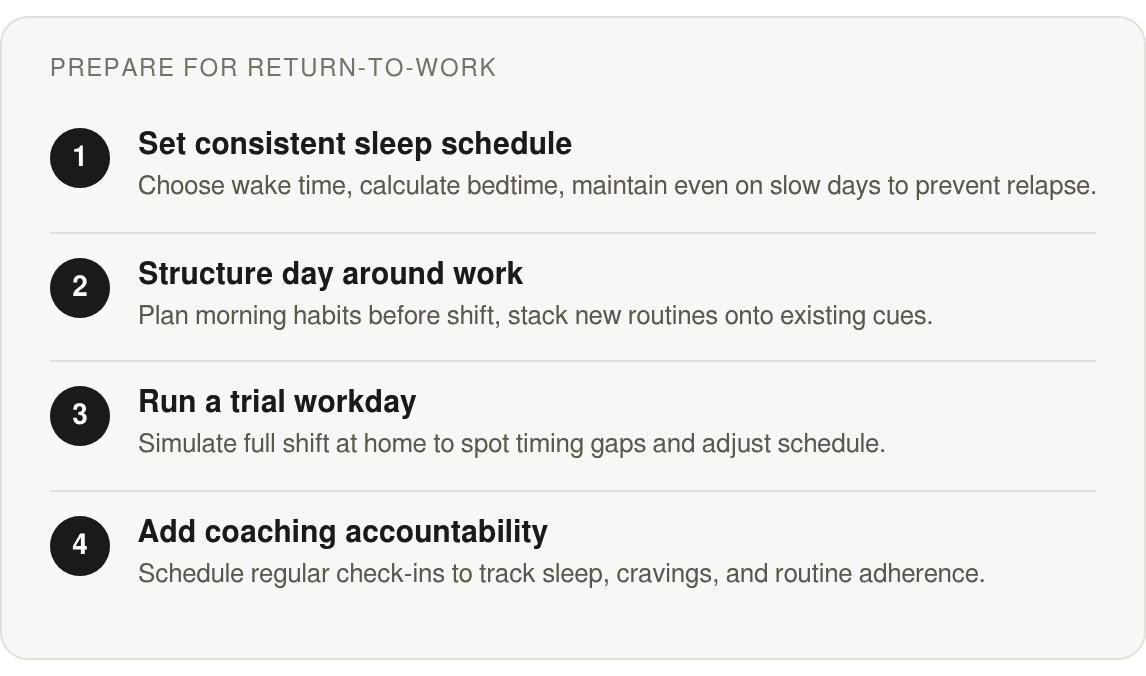
Pick a wake time that matches your earliest likely shift, then work backward to a bedtime that gives you a full night. Gig schedules drift, so anchor the wake time even on slow days. A fixed morning is worth more than a fixed number of hours you never actually hit.
Build the Hours Around Work, Not the Other Way Around
In treatment, your day was scheduled for you. Back home, that structure vanishes, and the open space is where trouble creeps in. The fix is to fill the slots before and after work on purpose.
A morning block can be simple: a real breakfast, five quiet minutes for breathing or reading, a short stretch, then coffee on the way out. American Addiction Centers frames these small anchors as what keeps you from sitting idle and tempted. Stack each new habit onto one you already do. Coffee follows breakfast; the breathing follows the coffee. The old habit becomes the cue for the new one.
Keep the first weeks about stability, not output. Country Road makes the case that productivity isn't the goal at first. That's a real tension for gig workers, since throttling hours means throttling income. You don't have to stop earning. Pace the intensity instead. Take the shifts, but protect the evening wind-down and the recovery meetings the way a salaried worker protects a lunch break.
Do a Trial Workday at Home
Before your first real day, run a dress rehearsal. Wake at your shift time, eat, move, commute if you have one, then sit through the hours you'd normally work. You'll find the gaps fast. Maybe breakfast takes too long, or the wind-down gets squeezed out at night.
This is also where a team-based coaching model earns its keep. Traditional returnees get their accountability from HR and a formal return plan. Gig workers have neither. A coaching team can hold the check-ins and help you track the week honestly, so the routine you tested actually sticks once real work starts. 
What to Tell Clients, and What You Can Keep to Yourself
The disclosure question looks different when you have no HR department to disclose to. For traditional employees, communicating after rehab runs through a formal channel: a manager, an HR rep, maybe a return-to-work agreement. Gig workers and the self-employed skip that whole apparatus. You might be telling a platform, a handful of clients, or no one at all.
That changes the strategy. Start with what you actually owe people, which is less than you think. Federal and state law says employees aren't required to explain where they were or why. As Willingway puts it, "the only details anyone outside of representatives from human resources" need to know is how long you'll be gone and when you're back. For a gig worker, even that shrinks. Clients rarely need a reason for a two-week gap. 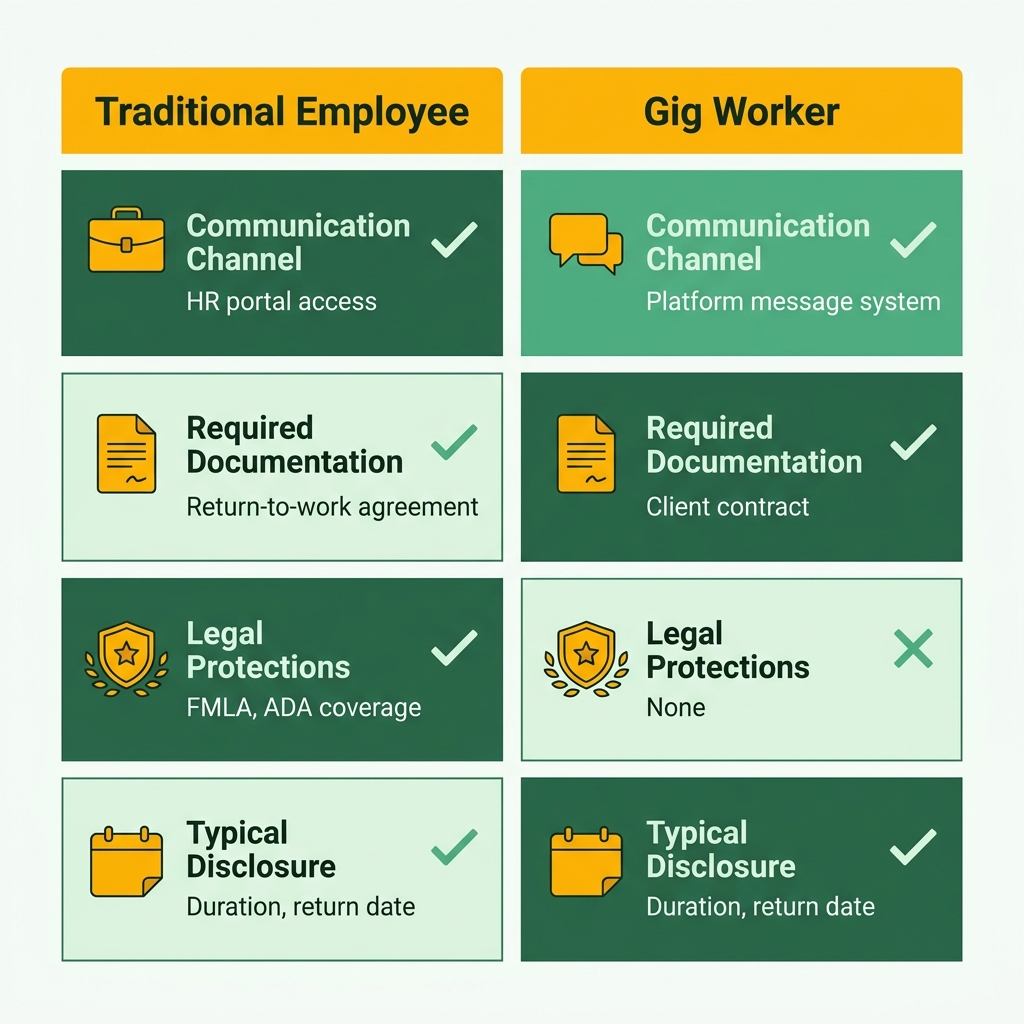
Your Legal Safety Net Probably Doesn't Cover You
Here's the uncomfortable part most return-to-work guides gloss over. The FMLA and ADA protections these articles lean on structurally exclude you.
FMLA only applies if you've worked at least 1,250 hours for a single employer over the prior year, at a location with 50 employees within 75 miles. The ADA protects employees from employer discrimination. A driver juggling three apps or a freelancer with a dozen clients has no qualifying employer, so neither law reaches them.
That's not a reason to panic. It's a reason to build accountability somewhere other than a legal framework. The protections traditional returnees rely on have to be replaced by something you construct yourself.
Disclose Only What Buys You Flexibility
For salaried workers, the Department of Labor recommends a right-to-work agreement co-designed by the employee, HR, and the rehab facility. It formalizes testing, check-ins, and who needs to know. You don't have that scaffolding. But the principle still holds: share information only when it earns you something concrete.
If you need to block off Tuesday mornings for outpatient appointments, a trusted client contact may need a heads-up about your availability. That's a scheduling conversation, not a confession. Country Road Recovery frames it well: disclosure should support your recovery, not satisfy anyone's curiosity.
Sample language that stays professional and honest: "I've got a standing personal commitment on Tuesday and Thursday mornings, so I'll be scheduling client work around those. Everything else stays on my normal turnaround." No medical detail. No apology.
Coaching Fills the Structure You'd Otherwise Get From HR
The accountability a facility usually routes through an employer still has to live somewhere. This is where our team-based model does real work. We help clients establish daily routines, scheduling boundaries, and the kind of consistent accountability that keeps recovery steady as you reintegrate into everyday life.
We can't guarantee outcomes, and we're not a medical provider. What we can do is help you build the routine and support structure recovery depends on. Regular coaching sessions and routine check-ins give you a place to stay accountable. A coach who knows your schedule can support you as you ease back into work.
Protecting your recovery matters more than proving your productivity in week one. Return to work. Just don't sprint.
Mapping & Mitigating Workplace Triggers
Triggers don't announce themselves. They show up as an ordinary moment that suddenly pulls hard, and the work you did in therapy to name them only holds if you can spot them in the wild. For gig workers, that spotting is harder. No fixed desk, no predictable rhythm, no coworker who notices you've gone quiet.
Four triggers come up most often, and they're worth memorizing. American Addiction Centers points to too much stress, too little sleep, isolation, and being around people using recreationally. Notice how the gig economy amplifies every one. Irregular schedules wreck sleep. Solo work breeds isolation. Income uncertainty piles on stress. And a late-night delivery run can drop you straight into a bar at closing time. 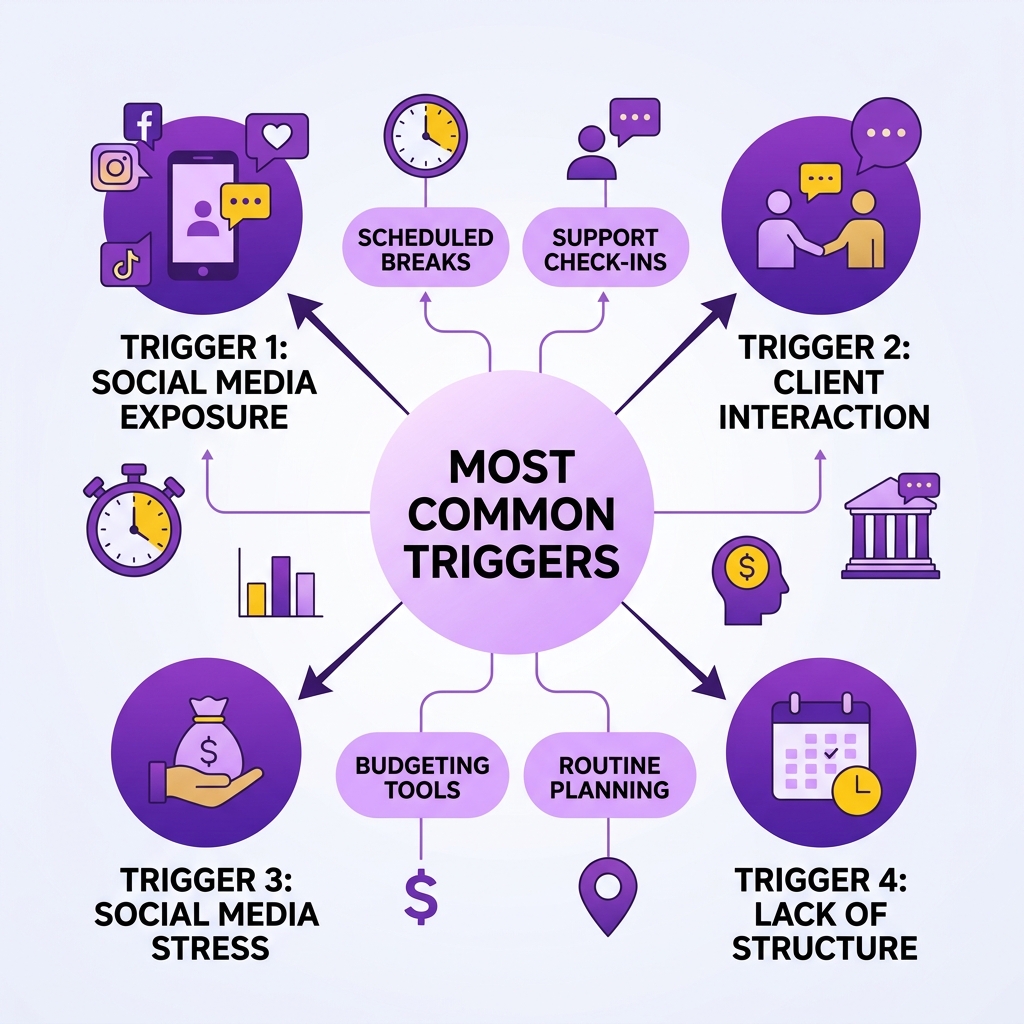
Which of your triggers are internal versus external?
Sort them into two columns. External triggers are the situations you can see coming: a client meeting that runs into happy hour, a rideshare fare to a liquor store, the gap between gigs where boredom sets in. Internal triggers are the states you carry with you, like the exhaustion that builds when you chase surge pricing past midnight or the loneliness of a job with no colleagues.
Naming both is where the pattern usually surprises people. It's rarely the obvious high-stakes moment that gets them. It's the quiet in-between hours, which is exactly where gig work has the most of them. Our coaches can help you work through that map and build routines around the stretches that carry the most risk.
How do you build a sober buddy when you have no coworkers?
The traditional advice here assumes a workplace full of people. Willingway suggests enlisting a few trusted colleagues to lean on when you feel stressed or overwhelmed. Good advice, except a self-employed courier or freelancer has no colleagues to enlist.
This is where the team model does real work. Instead of one buddy who happens to sit near you, a coaching team gives you several points of contact who already know your trigger map. When your day has no fixed shape, consistent real-world support during the moments that matter most can make the difference. That kind of companionship is a large part of what a sobriety coach provides. 
What small changes cut cue exposure fastest?
Environmental tweaks are cheap, and they work. Keep a water bottle or a non-alcoholic drink within reach so your hands have a default. Set your delivery app to decline runs to venues you know are risky. Swap the between-gig scroll for a short walk or a call to someone on your list.
Have a real-time tool ready for the moment a craving hits. A grounding exercise, a breathing pattern, a text thread you can fire off in seconds. The point isn't willpower. It's having the response chosen in advance so you're not deciding under pressure. Early recovery is still biological, as Country Road Recovery puts it, and a stressed brain doesn't improvise well.
Where Your Accountability Comes From Now
The legal safety net traditional returnees lean on isn't built for you, as The Recovery Village lays out. A gig worker juggling three apps and a handful of clients has no qualifying employer, so the accountability a salaried person gets from HR and a return-to-work agreement has to come from somewhere else after rehab. For gig workers, coaching and peer support are that somewhere else. They replace an institutional structure that was never designed with self-employment in mind. 
The Accountability Gap Has No HR Department to Fill It
Relapse isn't a rare event you can assume you've dodged. Research on adults in early recovery found that 85 percent of people with substance use disorder relapse within the first year, many within the initial weeks or months. The career-trajectory scoping review makes a point most return-to-work advice skips: people in recovery need continuous support with their careers, not a one-time hand-off at discharge.
A coach delivers that continuity. Daily or near-daily check-ins do the work an HR check-in never could, because they track the parts of your day a manager never sees. How you slept last night. How high the craving spiked on that late fare. Whether you took the client who pays well but drinks through every meeting.
The Metrics That Flag Trouble Before You Feel It
Good check-ins aren't vibe checks. They log a few numbers you can watch over time: craving intensity, hours slept, a stress rating, and how the work itself is going. Recovery is more than staying abstinent. The scoping review frames it as growth across your physical health, your relationships, and your standing in a community, so the metrics should track more than whether you drank.
The early warning signs are behavioral. A missed check-in, a run of short-tempered replies, canceling the meeting you never cancel. Those are the signals a coach watches for, and catching one early is the whole point. Honest weekly reviews make the pattern visible.
Take a rideshare driver in month one who hits a stretch of 12-hour weekend nights. Sleep drops to four hours, and the craving rating in the log climbs three days running. The coach sees it. They agree to block weekend nights and add a midweek call. No employer would have caught that. The data did.
Virtual Fits the Gig Schedule; In-Person Anchors the Hard Weeks
The flexibility of irregular work cuts against fixed appointments. Virtual sessions bend to a schedule that changes daily, so you can take a 15-minute call between jobs. In-person support earns its place in the weeks that actually threaten sobriety, like a first month back or a client event with alcohol.
A team-based model beats a lone coach here because coverage never drops when one person is unavailable, and a crisis-response plan has more than one number to call. The job is meant to shrink as you steady, which is the honest arc of what a sobriety coach does. Support tapers as your own footing returns.
References
[1] Transitioning Back to Work After Drug Rehab | Legal Protection and More - https://www.therecoveryvillage.com/recovery/going-back-to-work-after-rehab/
[2] Returning to Work After Rehab - Willingway - https://willingway.com/returning-to-work-after-rehab/
[3] Returning to Work After Rehab: How to Set Boundaries and Protect Your ... - https://www.countryroadrc.com/podcast-transcripts-addiction-recovery/returning-to-work-after-rehab
[4] Working through workplace stigma: Coming back after an addiction - https://www.health.harvard.edu/blog/workplace-stigma-addiction-2018010513040
[5] Returning to Work After Rehab - Recovery - Valley Hope - https://valleyhope.org/blog/recovery/education-recovery/returning-to-work-after-rehab/
[6] 3 Tips for Returning to Work After Rehab | American Addiction Centers - https://americanaddictioncenters.org/blog/work-after-rehab
[7] (PDF) The Career Trajectories and Outcomes in Substance Use ... - https://www.researchgate.net/publication/381132618_The_Career_Trajectories_and_Outcomes_in_Substance_Use_Recovery_A_Scoping_Review
[8] The Effects of Employment Interventions on Addiction ... - https://www.researchgate.net/publication/309475252_The_Effects_of_Employment_Interventions_on_Addiction_Treatment_Outcomes_A_Review_of_the_Literature
Frequently Asked Questions
1. What should I do if I relapse after going back to work?
Treat relapse as a signal to adjust, not a verdict on your recovery. Relapse is common in the first year, so it's common, not rare. A coach watching behavioral signs helps you catch trouble early and rebuild the routine.
2. Do I have to tell my clients I was in rehab?
Clients rarely need a reason for a two-week gap. You owe people far less than you think. If you need to block certain mornings for appointments, frame it as a scheduling conversation, not a confession. Share only what earns you concrete flexibility.
3. Can sober coaching replace the treatment I got in rehab?
Coaching supports recovery but does not replace medical or clinical care. MADE Recovery is a nonmedical service. We don't diagnose conditions, manage medications, or deliver treatment. What we provide is accountability, routine building, and companionship that fills the structural gap where a gig worker has no HR department.
4. My job is where I used substances. Should I quit gig work entirely?
Quitting isn't the only answer. The same workplace that triggers can also protect recovery through structure and income. Map which situations pull hardest, then adjust. Decline app runs to risky venues, keep a non-alcoholic drink within reach, and prepare a grounding response before cravings hit.
5. How do I know when to schedule virtual coaching versus in-person support?
Virtual sessions fit irregular gig schedules, letting you take a 15-minute call between jobs. In-person support earns its place during the weeks that genuinely threaten sobriety, like your first month back or a client event with alcohol. Match the format to the risk level of the stretch ahead.
6. What early warning signs suggest my recovery is slipping before I feel it?
The signals are behavioral. A missed check-in, a run of short-tempered replies, or canceling a meeting you never cancel. Logged numbers help too: rising craving intensity, dropping sleep hours, climbing stress ratings. Tracking these over time makes a slide visible before it becomes a slip.