When a Sober Companion Moves In vs. Calls Twice a Week
October 1, 2026

Quick Summary
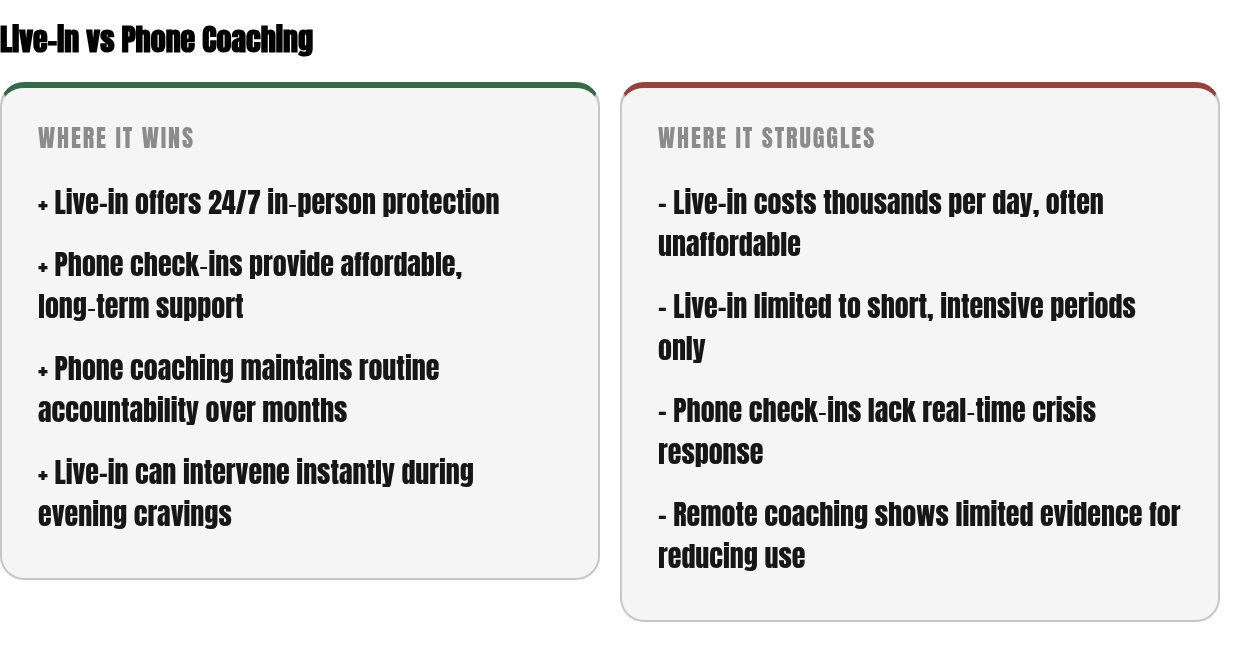
Choosing a sober coach after rehab comes down to one question. Does your home environment and relapse risk justify someone living there, or will structured phone check-ins carry you? Two very different products, two very different bills.
A live-in companion is physically present around the clock during a high-risk window, billed by the day and running into the thousands, per this cost breakdown. Twice-weekly coaching assumes you're on your own for most of the week and gives you the structure to handle that, at a cost that changes with session frequency and support level.
Which Model Fits Your Situation at a Glance?
| Factor | Live-In Sober Companion | Twice-Weekly Phone Check-Ins |
|---|---|---|
| Support intensity | Around-the-clock, in-person presence | Scheduled sessions plus between-session messaging |
| Availability | Continuous during the engagement | Mostly business hours; not a crisis line |
| Privacy impact | High. Someone shares your space | Low. Support fits around your normal life |
| Typical cost range | Thousands per day, rarely insured (source) | Varies by session frequency and support level |
| Ideal client profile | Acute risk, unstable home, first weeks post-discharge | Stable housing, moderate risk, needs duration |
| Primary risk areas | Cost burnout, dependence, no clinical oversight | Gaps between contact, voluntary accountability |
The timeline favors duration, with one exception
Recovery runs on months and years, not days. Families can usually fund high intensity for a short stretch, or low intensity for a long one. The calendar rewards the second option.
The exception is environmental. If your home holds active substance users or heavy evening cues, in-person presence earns its cost. Triggers sitting in your own living room can spark cravings, and that's the deciding variable here, not commitment.
Can you combine both?
Yes, and it's often the smartest play. A short live-in phase through the first vulnerable weeks, then a planned step-down to phone check-ins, matches support to risk as risk falls. We structure programs this way and taper as clients steady out. There's more on that in our guide to what a coach really does.
Two trade-offs worth weighing before you decide:
- The accountability gap is real in open-ended paid setups. One recovery resource puts it bluntly: a paid coach you can simply fire doesn't hold you accountable. Structured programs that lock in testing and result-sharing close that loophole.
- Ask who supervises a live-in companion clinically. One practitioner guide flags that a companion working without oversight is making high-stakes calls unchecked. Verify credentials before anyone moves in.
What you're really deciding: proximity or continuity
This isn't a comfort preference. It's a risk calculation, and you pay for getting it wrong in money or in safety, depending on which way you miss.
Hiring a sober coach after rehab is really a question about how much structure the transition home needs. The answer should come from your environment, your history, and the hours where your day tends to come apart.
The risk sits in the evening, not in your intentions
Craving doesn't wait for a weak moment. Familiar rooms, routines, people, and objects can press on recovery even when your intentions are clean. Which is why we push families past the willpower question entirely.
The variable that actually matters is what happens when the day loses its shape. If someone in your home still drinks or uses, if the old patterns are sitting in plain sight, phone check-ins can't reach into that space. A companion physically can. When a client goes back to an actively using household, live-in support may be necessary rather than optional.
Why the money math favors duration over intensity
Families tend to compare the two models as if they're buying the same service at different strengths. They aren't. One buys proximity. The other buys continuity.
Recovery keeps unfolding long after the first adjustment period. A plan that burns through the family's resources in three weeks can leave the client unsupported by month four. Since the clock favors duration, twice-weekly support is the rational default for most people leaving treatment.
| Factor | Live-In Companion | Twice-Weekly Check-Ins |
|---|---|---|
| Best for | Active-use household, acute crisis window | Stable or neutral home, longer runway |
| Cost | High daily private-pay commitment | Lower recurring program cost |
| Duration it sustains | Brief, intensive coverage | Ongoing structure |
| Reaches evening home triggers | Yes, physically present | No, remote only |
Live-in support is a sprint with a hard stop
Reserve the live-in model for the situation that actually calls for it. Constant supervision can help through an acute stretch, and it can leave you flat-footed the day it ends. Weaning toward self-sufficiency is the part that matters.
Skip the companion if your home is stable and your main need is accountability and routine. We help families run this calculation honestly, then build the plan that fits. Match the tool to the risk, not to the fear.
In-Person Sober Companion: Moving In
A live-in sober companion is a trained recovery professional who stays in your home during the highest-risk window after treatment. The job is simple to state and demanding to do: be physically present through the hours between clinical appointments, which is where recovery is usually won or lost.
The distinction that matters most is spatial. A sober coach you reach by phone offers availability. You can call. A live-in companion offers presence. They're standing between you and the drink when a craving lands at eleven at night. That difference counts most when the house itself is part of the problem.
What does a live-in companion actually do all day?
The day runs on structure. Mornings start with a check-in on sleep and mood, then co-building a written routine so an unplanned hour becomes a sequence instead of a void. Midday means moving through the world together: errands, outpatient appointments, a return to work.
Before any high-stimulus setting, a skilled companion runs a pre-event brief covering exit strategies and rehearsed refusals, so you're not improvising at the table. Evening work is less glamorous and more important. Hold the routine, interrupt spirals early, arrange transportation to meetings, and de-escalate when the urge to isolate shows up.
When is live-in support actually the right call?
Live-in support is the right call when the home itself raises the risk level. That may mean active substance use by someone else in the house, easy access to alcohol or drugs, or a return to the same rooms and routines tied to relapse.
For everyone else, be honest about the tradeoff. A companion can offer protection, but protection has to become practice. If the client never rehearses sober decision-making without someone in the room, the plan hasn't done its job.
| Factor | Live-In Companion | Twice-Weekly Coaching |
|---|---|---|
| Presence | In your home during the engagement | Scheduled sessions, messaging between |
| Best for | Active users at home, acute crisis risk | Stable home, high family duties |
| Cost | Premium in-person support | Lower-cost ongoing support |
| Duration | Short-term deployment | Longer step-down path |
One caution families rarely raise: ask who supervises the companion clinically. We provide nonmedical recovery support, not treatment, and we're clear about where our role ends.
Twice-Weekly Phone Check-Ins: What to Expect
Twice-weekly phone check-ins are the model most people actually need when they hire a sober coach after rehab. Sessions land on a regular schedule and assume you handle the hours in between yourself. That assumption is the point. The structure exists to carry you through unstructured time, not to stand in the room with you.
Coaching programs get built around your needs and can include virtual sessions, in-person meetings, or a mix of both. Sessions focus on the practical work: building routines, planning around triggers, making decisions that hold up over the long term. As confidence and independence grow, the level of support adjusts.
The agenda is fixed so your week doesn't have to be
A good check-in isn't a vibe conversation. It follows a framework that lets you feel the drift before it becomes a slip.
| Call element | Remote coaching | Live-in companion |
|---|---|---|
| Contact | Scheduled sessions, flexible frequency | Continuous physical presence during the engagement |
| Monitoring | Coaching and accountability | Direct observation |
| Documentation | Progress reviewed in sessions | Daily routine built in person |
| Cost footprint | Sustainable for longer planning | Concentrated private-pay spend |
| Best for | Stable home, moderate risk | Acute risk, high-trigger environment |
Coaching can also include coordination with the other services you're working with, help with meal planning and daily life management, and companionship during high-risk situations. Programs are designed to evolve as your needs change.
Remote accountability keeps you engaged. It doesn't guarantee sobriety.
Be honest about what phone support proves. The largest review on this, a systematic review of 28 studies covering 12,601 participants, found peer recovery support reliably improves treatment engagement and retention. Evidence that it improves substance use outcomes on its own is still preliminary and inconclusive. Staying connected to care is the proven win.
Worth saying out loud, because the marketing around coaching tends to skip that sentence.
That shapes who should skip the phone-only model. If your highest-risk moments involve direct access to substances, unsafe people, or a house routine built around use, remote sessions sit too far from the action. ALYST's phase model is right that the earliest return-home stage needs the tightest planning. During that window, presence can matter more than availability.
For most people, the better investment is support that stays with them as work, family, stress, and ordinary life resume. There's more on structured coaching for the long haul. We can help connect you to tighter contact or crisis support when it's needed, and we point you to 988 for anything immediate. Coaching is nonmedical support, not a clinical safety net.
Logistics & Practicalities: Agreements, Space, Scheduling
Setting up a sober coach after rehab starts before anyone shows up at your door. The paperwork, the house rules, and the schedule all get decided up front, and the two models demand very different setups. A live-in companion needs a detailed scope of work and a prepared home. Phone coaching needs a session cadence and a crisis protocol. Get these details wrong and you pay for structure you can't use.
| Setup item | Live-In Companion | Twice-Weekly Phone Coaching |
|---|---|---|
| Scheduling window | Live-in presence or set shifts | Fixed session times, plus agreed escalation path |
| Home prep | Guest space, substance-free zones | None beyond a private spot to talk |
| House rules | Visitor policy, stash clearing, zones | Minimal |
| Typical engagement | Short intensive period | Longer engagement, stepping down over time |
| Billing | By the day or shift | By session frequency |
The agreement decides who answers for judgment calls
The clause families forget to write is clinical supervision. A companion lives in your home making real-time decisions, and who oversees that work rarely makes it into the contract. Put that responsibility in writing before the work starts.
Spell out the scope. We treat ourselves as nonmedical support, so the agreement should say plainly that we don't manage medications, diagnose, or replace the care your physician or treatment team provides. For live-in work, the contract should also cover how the first routine plan gets built, what the companion may and may not do, and how concerns get escalated.
House-rule clauses to settle before arrival: a visitor policy, designated substance-free zones, and clearing hidden stashes. If someone in the home still drinks or uses, that moves to the center of the agreement, not a footnote.
The transition out is the part most plans skip
The dangerous assumption is that constant monitoring automatically builds durable sobriety. It can do the opposite. Lean on round-the-clock presence and then cut it off, and you may be unprepared the day you're on your own. The fix is weaning, not a hard stop.
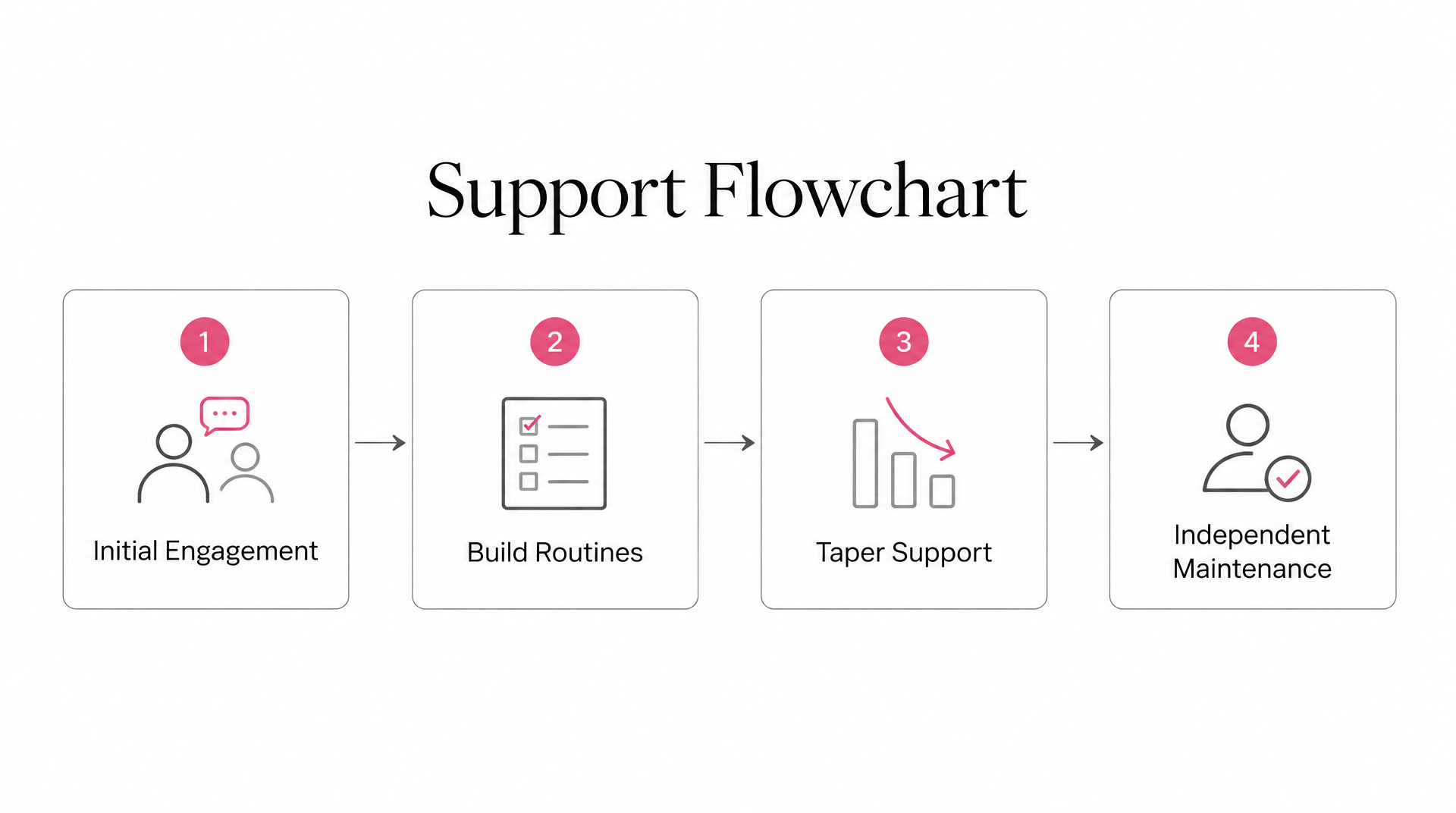
A good transition plan maps the step-down in advance. Intensive support first, then a stage where presence shifts to scheduled visits and daily calls, then as-needed maintenance for high-risk moments like a stressful trip or a hard anniversary. Keeping the same coach through all three phases means nobody restarts from zero on your triggers and history.
That's where logistics become common sense. The schedule should tell you not only when support begins, but how it reduces. Otherwise the family buys relief without building independence. We'll help you draw that line based on actual risk, not a stated commitment level.
Cost & Value Comparison
The money question is where the two models for a sober coach after rehab split hardest. Live-in companionship and structured phone coaching aren't two prices for the same thing. They're two different bets on how recovery unfolds.
Live-in support concentrates money into direct, in-person protection. Phone coaching spreads it across recurring decisions: waking up on schedule, answering stress without using, getting to meetings, repairing sleep, handling family pressure, and going back to work without losing the thread.
What do the two models actually cost?
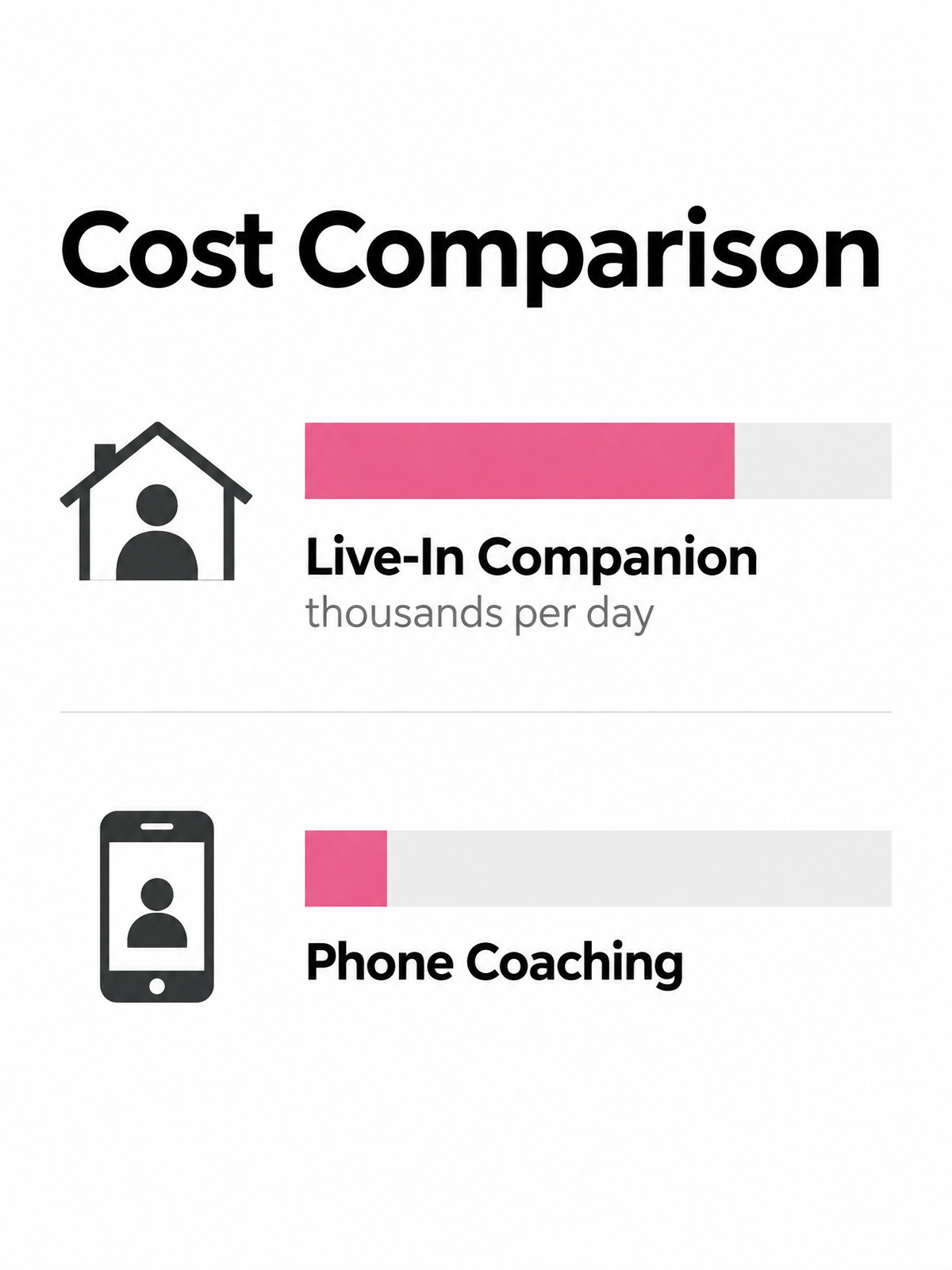
| Cost factor | Live-In Companion | Structured Phone Coaching |
|---|---|---|
| Payment structure | Daily or shift-based private engagement | Recurring coaching plan |
| Who pays | Out of pocket in most cases | Some commercial insurance now covers it |
| Add-ons | Lodging, meals, travel expenses | None beyond the session fee |
The live-in model front-loads your recovery budget into a narrow window. Coaching programs distribute support across the timeline where daily choices keep compounding.
Why duration beats intensity for most people
The paradox families run into: the most reassuring option is rarely the most useful one.
Substance use disorders are chronic conditions. The pressure doesn't lift just because the first stretch home is over. Build the entire plan around an intensive stay and the client may have excellent support through the most visible transition and too little once ordinary stress returns. Consistent structure that lasts is the rational choice. The live-in spend earns its keep only when acute crisis risk justifies it.
Where the live-in spend pays off
Skip the live-in model if your home is reasonably safe and your risk is steady. Paying for in-home reassurance alone doesn't hold up when the real need is routine and accountability.
The spend pays off in two situations. One is a genuinely high-risk home, where someone has to interrupt access, isolation, and impulsive movement in real time. The other is episodic deployment around a defined high-stress event, a model that's underused for otherwise-stable clients.
One caveat on value. A paid relationship only holds you accountable if the structure is locked in. Open-ended arrangements let you game the system; a fixed testing and coaching cadence removes that loophole. Walk through what the spend actually buys before anyone commits.
Crisis Management & Safety
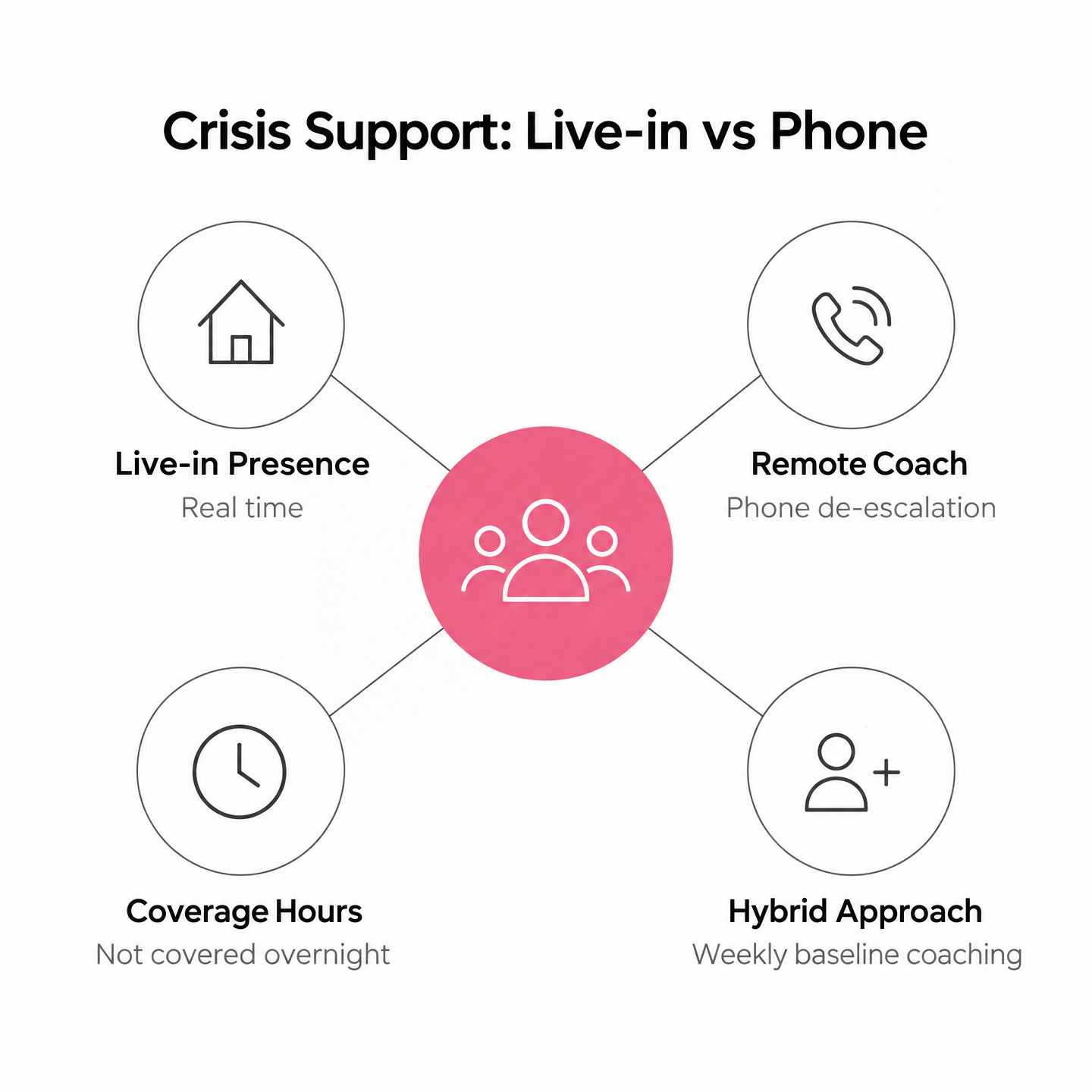
A crisis is where the gap between the two models becomes impossible to ignore. Hiring a sober coach after rehab also means deciding who responds when a craving spikes, a relapse starts, or a medical concern appears. A live-in companion is in the room. A remote coach is on the phone. That distance changes everything about how fast help arrives.
One thing up front. We provide nonmedical recovery support, not treatment. Our role in a crisis is to stabilize, de-escalate, and connect you to the right professionals fast. We don't detox, diagnose, or manage medications. For a medical emergency, the first call is always 911, and the second is the treating facility or physician who knows your case.
Who handles a craving versus a medical emergency?
A craving and a medical crisis need different responses, and the model you choose determines who executes them.
A live-in companion can move before the client has to turn the urge into a phone call. Sometimes the work is as simple as changing rooms, leaving the house, calling the treatment team, removing access, or getting the person to a safer setting. The value is speed and proximity.
A remote coach can't physically intervene. What a good one does is de-escalate on the phone, walk you through a rehearsed exit, and arrange transport to a treatment center if things slip. Many coaches build that handoff into the arrangement from day one.
| Crisis scenario | Live-In Companion | Weekly Phone Coach |
|---|---|---|
| Sudden craving | Present, intervenes in person | Phone de-escalation, rehearsed exit |
| Relapse in progress | Direct intervention, transport | Coordinates transport to treatment |
| Medical emergency | Calls 911, stays on scene | Prompts 911, notifies family |
| Overnight hours | Covered only if included in the agreement | Not covered unless on-call |
What should a family crisis plan include?
Every family needs to do this work before anyone is in danger. A crisis plan written mid-relapse is improvisation, not a plan.
Build it around three things: a named first responder for each scenario, the direct number for the treating facility, and a clear line on what triggers a 911 call. Put it in writing. A live-in companion co-builds a written contingency protocol in the first session, and we apply the same discipline to phone clients so the steps exist before the pressure does.
Does the lighter model leave you exposed?
Sometimes. If the danger is immediate access, unsafe company, or a pattern of disappearing into use before anyone can respond, weekly check-ins leave a gap no phone can close. That's the case for live-in presence, at least through the acute window.
For most people leaving treatment the phone model holds, provided the crisis plan is real. We lean hybrid: weekly coaching as the baseline, with in-home support deployed through predictable high-risk stretches like travel or the anniversary of a loss. That's how we structure daily accountability, and we'll walk you through it before you commit to anything.
Integrating Support into Daily Routines & Long-Term Transition
Support only works if it survives contact with your actual week. Whether you hire a sober coach after rehab for daily visits or twice-weekly calls, the goal is the same: build routines that outlast the professional. The structure is temporary. The habits are supposed to stay.
That's why we treat the first engagement as a handoff, not a dependency. Good support works toward making itself unnecessary. If the plan never tapers, something has gone wrong.
Build the day before the day builds you
The highest-use work happens early. We help you set a morning sequence you can follow without deciding: what happens first, the order that makes sense, and what to do when something breaks the flow. Concierge Care Collective describes the same practice, and it turns an anxious, unplanned hour into something manageable.
From there the day gets scaffolding. Meals planned, not improvised. Movement scheduled, not hoped for. Social plans briefed in advance so a dinner with an open bar has an exit strategy before you walk in. The point is to fill unstructured time with intention, especially in the hours when stress builds and routines fade.
A live-in companion runs this schedule beside you. On weekly phone coaching, you run it and report back. Same framework, different operator.
Tapering is the treatment, not the exit
The strongest outcomes come from stepping support down on purpose. ALYST Health frames it as three phases: intensive presence, a stage where check-ins thin out, then on-call maintenance for high-risk moments like a holiday or a hard trip.
Amethyst Recovery makes the same point from the other direction, that constant monitoring can leave you unprepared the day it stops if you cut off cold instead of weaning toward self-sufficiency. Ethos Recovery flags the same dependency trap: companions are strong short-term tools, not a long-term answer.
The research reality sits underneath all of that. Peer recovery support is most useful for engagement and retention, keeping someone connected to care long enough for habits to set. Which argues for durable contact over maximum intensity, for most people.
| Daily element | Live-In Companion | Weekly Phone Coaching |
|---|---|---|
| Morning protocol | Runs it with you | You run it, review on call |
| Meal and exercise planning | In-person, same day | Planned together, self-executed |
| Social events | Attends, pre-briefs | Briefed in advance by phone |
| Taper path | Phase down to visits, then calls | Already the step-down model |
Our own rule of thumb: reserve live-in support for the acute window, then move to coaching so the taper happens by design. The measure of good support is how little you need it a year out.
The bottom line on hiring a sober coach after rehab
The whole comparison lands on one idea. Support has to last long enough to become habit. Live-in companionship can be worth it when the home environment is unsafe or the transition is unusually fragile, but it should come with a defined purpose and an exit path.
That's why we build coaching programs that adjust to progress: start with the frequency and structure you need, then taper as independence grows. The same coach or team stays with you through each phase, so your history and triggers stay in view even as the intensity steps down.
Match your profile to the right support
Here's the quick-pick we use with families during intake.
| Your situation | What we recommend |
|---|---|
| Prior relapse after returning home, active triggers in the house | Frequent check-ins, then gradual step-down |
| Moderate risk, stable home, work to return to | Twice-weekly coaching from day one |
| High-stakes event or transition on the calendar | Companion on retainer for that window only |
| Family needs their own guidance | Coaching plus family check-ins |
A history of relapse is one of the strongest signals that a longer engagement helps. Notice that's a duration call, not an intensity call.
Why flexible coaching works for most
Three reasons we lean this way. Effectiveness: support should taper as independence grows, and a fixed arrangement that ends abruptly can leave you unprepared when it stops. Continuity: the same team knows your triggers and history from week one through month six, so nothing resets. Value: you pay for the level of contact you need right now, then adjust as confidence and routine solidify.
One caution, named plainly. The paid-coach relationship only becomes a weakness when accountability is optional. Lock in a clear structure up front and that problem goes away.
Skip intensive daily support entirely if your home is stable and you have no relapse history. The evidence doesn't support paying for reassurance alone.
Common questions before you start
How long does coaching last? As long as the transition from treatment to independence requires. We taper support as you build your own rhythm.
Do you provide medical care? No. We offer nonmedical recovery support, coaching, and companionship. For medical emergencies, use emergency services first.
What if I'm not sure which model fits? That's exactly what the consultation sorts out.
Your next step
Contact us to discuss your situation, and we'll map your relapse risk, home environment, and needs to a coaching plan that fits. If you want the day-to-day picture first, read what a coach actually does before you reach out. We'll help you build the plan. The next move is yours.
References
[1] What Is a Sober Coach? Cost, What They Do, and How to Find One - https://www.youareaccountable.com/guides/what-is-a-sober-coach
[2] What A Sober Companion Does All Day, Hour By Hour - https://conciergecarecollective.com/sober-companion-daily-routine/
[3] How Sober Companionship Can Help You Achieve Healing Goals - https://www.ethosrecovery.com/post/how-sober-companionship-can-help-you-achieve-healing-goals/
[4] How Long Should You Work With a Sober Companion? - ALYST Health - https://www.alysthealth.com/sober-companion-timelines/
[5] Sober Companion and Recovery Coach: Professional Support for ... - https://www.addicted.org/after-treatment/support-programs/sober-companion-and-recovery-coach/
[6] Should You Hire A Sober Companion? - https://www.amethystrecovery.org/hire-sober-companion/
[7] Sober Companions - What They Do and Why You Need One In Recovery - https://www.therecoveryvillage.com/treatment-program/aftercare/sober-companion/
[8] Sober Companion Services: Who Are They & What They Do - https://addictionresource.com/treatment/sober-companions/
[9] Peer Recovery Support Services and Recovery Coaching for Substance ... - https://pmc.ncbi.nlm.nih.gov/articles/PMC12811009/
[10] Lived Experience in New Models of Care for Substance Use Disorder - https://pmc.ncbi.nlm.nih.gov/articles/PMC6585590/