What Your Sober Coach Actually Does Between Weekly Check-Ins
October 21, 2026

In short: Caron reports that 65–70% of people relapse within ninety days after leaving sober living—right when structured support often tapers and the discharge packet can become the only plan. Caron reports a 95% recovery rate at 30 days for sober coaching clients. Sober coaches often use brief check-ins between sessions to catch warning signs before they become relapses. Many providers offer after-hours availability so someone can respond when cravings spike outside normal appointment times. Resource coordination may include connecting you to doctors who understand substance use, meetings that fit your schedule, and housing options, so you are not left searching alone. Some coaches can arrange live companionship for high-risk events such as weddings or work dinners, depending on your plan. Progress notes may be shared with your clinician or family only with your consent, so the people supporting you can work from the same picture when appropriate.
Quick Summary
Sober coaching after rehab often includes six recurring activities that fill the gaps a discharge packet leaves blank. The Tuesday morning alone in your kitchen. The business trip where everyone orders wine at dinner. The small decision that compounds into a slide. Below is a general breakdown of common coaching activities, the skill set behind them, and the outcome they aim to protect.
| Activity | Time per Week | Skill Set | Primary Benefit |
|---|---|---|---|
| Daily text or voice check-ins | Varies by provider; often brief | Active listening, crisis triage, motivational interviewing | Can catch early warning signs before they become relapses; maintains connection when formal structure ends |
| Habit-building task assignment | Varies by provider and client plan | Behavioral planning, routine design, nutrition and sleep coaching | Can convert abstract recovery goals into repeatable daily actions; may stabilize energy and mood |
| Crisis-ready outreach | Availability varies; not a guaranteed emergency service | De-escalation, emergency resource navigation, family coordination | Can provide support when cravings or triggers arise outside business hours |
| Resource coordination | Varies based on client need | Community mapping, provider database management, insurance navigation | Can link you to primary care physicians experienced in SUD, mutual-help meetings, and housing programs so you're not searching alone |
| Progress documentation | Varies based on consent and provider | Clinical note-taking, outcome tracking, care-team communication | Can create a shared record for your therapist, prescriber, and family when you authorize it |
| Live companionship (in-person or virtual) | Varies by event and plan | Situational awareness, real-time accountability, exit planning | Can provide backup at weddings, work dinners, or other high-risk settings |
Two things matter here. First, the ninety-day window after leaving sober living is where 65–70 percent of people relapse, according to Caron. Coaches can help fill the gap by building infrastructure: a list of local recovery meetings, providers who understand substance use disorder, and routines around meals or sleep. Second, the work is nonmedical. Coaches do not diagnose, detox, or adjust medications. They operate in the daily-living space between appointments, where discharge-packet instructions either become habits or stay on paper.
Why the Ninety-Day Window Is Where Most People Lose Ground
Caron reports that 65–70% of people relapse within the first ninety days after leaving sober living. Not because treatment failed, but because the world you step back into has no built-in guardrails.
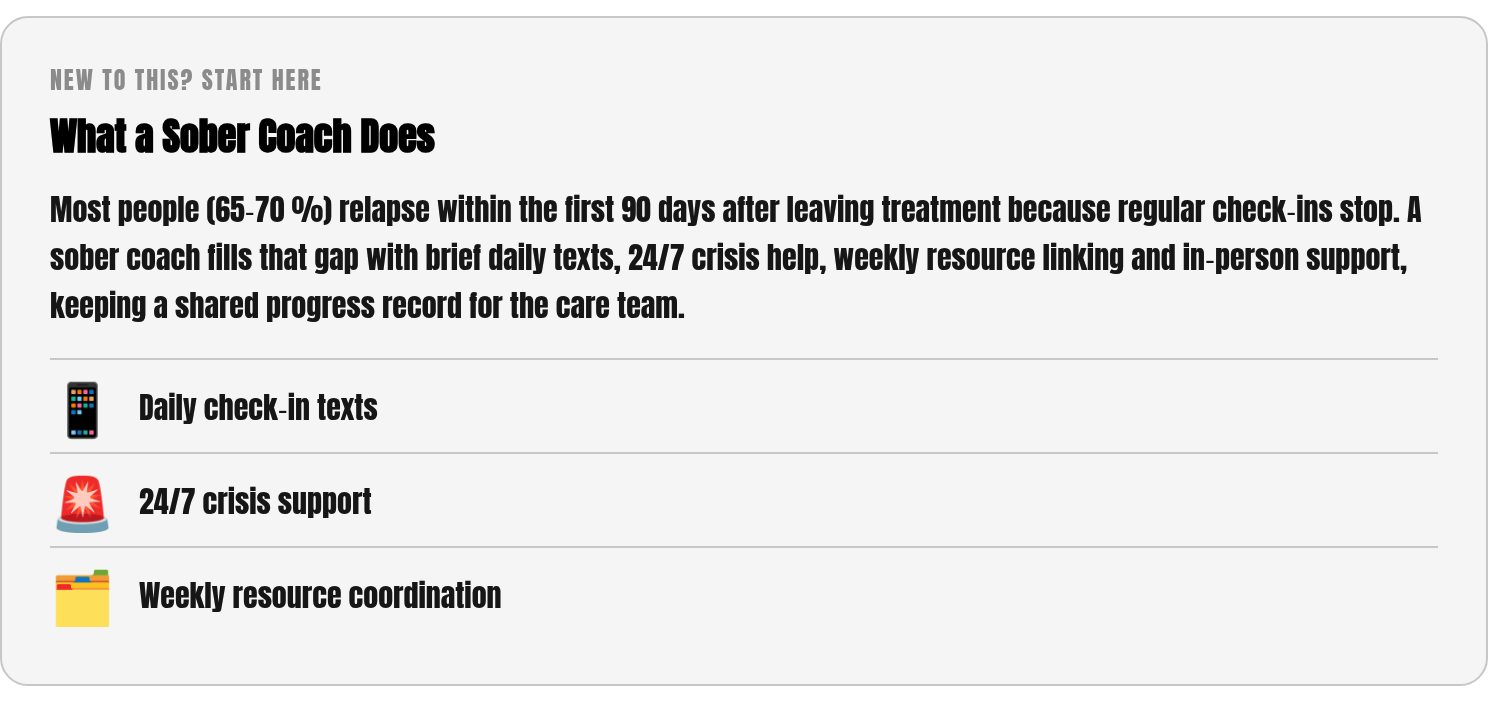
When you leave detox or residential treatment, the structure can disappear overnight. You had daily group sessions, scheduled meals, staff checking in multiple times a day. Now you may be managing triggers, work stress, and old relationships with a discharge packet and maybe a weekly therapy appointment. The transition can feel abrupt, with little guidance on how to manage unstructured hours and familiar environments that still hold old patterns.
Who needs this support most
People who face the highest relapse risk during this transition share a few patterns. Many first-time sober individuals underestimate how many daily decisions involve substances: happy-hour invitations, the grocery store wine aisle, family gatherings where everyone drinks. People returning to demanding jobs often report that stress compounds faster than expected, especially when the old coping mechanism is gone.
Living alone can make evenings harder. Isolation can intensify when professional support diminishes, and the gap between weekly check-ins can feel large when a craving hits on a Wednesday night.
How continuous support changes outcomes
Some coaches use coordinated accountability rather than leaving clients to manage alone. Between scheduled sessions, coaching may involve practical infrastructure: coordinating with a sober living home if the client is in one, looping in family members who want to help but don't know how, and remaining available for challenges that arise outside regular appointment times.
Consistent support with early intervention may help people stay engaged in recovery longer than episodic care alone. Many coaches say they are not waiting for clients to reach out in crisis; they track patterns, watch for warning signs, and adjust the support plan before small slips become full relapses.
Synthesis, not a documented MADE protocol: The early high-contact period—often the first 30 days—can stabilize daily routines. During days 31–90, coaching may shift toward resource-building: identifying local meetings, medical providers, and housing or work logistics that the client can use independently. That resource layer can connect the early high-contact period to later maintenance, because the client is not depending only on the coach's presence once those supports are in place. This is an editorial interpretation of how coaching phases could connect, not a formal description of MADE Recovery's protocol.
Daily Coaching Activities
Some providers talk with clients two to five times a week during the first month after they leave treatment, but those scheduled calls are only the visible part. The real work often happens in the gaps: building the infrastructure that keeps someone stable when the coach is not on the phone.

What a check-in often covers
During a brief morning check-in by text or voice, a coach may listen for three things: sleep quality, whether the client made it to a meeting or work, and any unexpected triggers in the past twenty-four hours. If a client mentions poor sleep or skipping breakfast, the coach may note it. Not as a hall monitor, but because those small disruptions can precede bigger ones. For some people, cravings can peak early in recovery, and catching early warning signs may make it easier to adjust the plan before a slide starts.
Coaches may also monitor habit-building assignments from the previous week. One client might log meals to rebuild nutrition; another might track sleep or practice a brief mindfulness routine. The point is not perfection; it is pattern recognition. If someone consistently misses check-ins at a particular time, the coach may schedule a call or suggest an additional meeting.
Building the resource network between sessions
Resource work is part of why coaching can be more than accountability. Some coaches maintain a local provider database: primary care physicians, therapists, and specialists with experience treating people in recovery and who accept the client's insurance. A client might schedule a first appointment after months of avoidance because the referral list reduced the friction.
Coaches may also map community resources: which 12-Step meetings run on weekday mornings, where the local SMART Recovery group meets, which sober-living operators the coach knows. If a client is traveling for work or visiting family, the coach may research recovery meetings near that location and send options before the trip. That prep work is often invisible, but it can be the difference between walking into a meeting and driving past it.
Coaching may also involve coordination with the other people in a client's support system—family, therapists, sober-living staff—when the client has authorized that communication. Everyone can work from the same plan. If a therapist adjusts medication or a family member reports concerning behavior, a coach may learn about it and adapt the approach, provided consent is in place. This is not micromanagement; it can close communication gaps that let people fall through.
What Families and Clients Get Wrong
Three misconceptions can derail the partnership if families and clients do not understand the scope up front: that coaches guarantee around-the-clock emergency response, that they replace a therapist or medical team, and that the work ends the moment someone feels stable. None of those match how recovery coaching often operates between sessions.
A sober coach isn't your therapist or your doctor
Coaches do not diagnose conditions, prescribe medication, or process trauma in clinical sessions. A sober coach usually focuses on present and future goals rather than past wounds, and works outside the clinical frame a therapist uses. If you are managing depression, anxiety, or PTSD alongside recovery, you still need a licensed clinician handling that piece. Coaching is nonmedical support: accountability, practical guidance, help building routines that support the treatment plan your medical providers create.
Sober coaching and sober companionship serve different needs. Coaching typically means scheduled sessions, virtual or in-person, with support tailored to your situation. Companionship means someone is physically with you at home, at an event, or during a vulnerable stretch when you need immediate support. MADE Recovery offers both, and can help you figure out which arrangement fits your needs. Between scheduled coaching sessions, the work may continue: helping you establish daily routines, coordinating with other parts of your care, and building the structure that keeps recovery moving forward when formal programming stops.
Coaching doesn't stop when you feel good
The second dangerous misconception is that coaching ends once cravings ease up. In the broader recovery field, coaching often continues for several months or longer because the work shifts rather than disappears. Early support centers on accountability and building new habits. Later, the focus may move to the practical challenges that show up once the initial crisis passes: work, strained relationships, boredom, and complacency that can quietly raise relapse risk again.
Families sometimes push to step back the moment their loved one seems stable, assuming more independence equals stronger recovery. A common view in the field is that consistency matters more than intensity. MADE Recovery describes an approach in which support is intentionally reduced as clients gain independence, but structure remains in place. Meeting less often but regularly may work better than alternating between intensive contact and total silence.
- Clarify the difference between coaching, therapy, and medical care before you start. Overlapping roles confuse accountability and leave gaps in your support network.
- Discuss contact and availability during the first meeting. Knowing whether you will work with a single coach or a coordinated team, and how support is structured between sessions, can prevent frustration later.
- Plan for coaching to extend past the early weeks. The transition from structured treatment back to everyday life is when many people lose momentum, and ongoing support can help clients build a life they want to stay sober for.
References
[1] Sober Coaching: How It Works, Key Benefits,… - Caron Treatment Centers - https://www.caron.org/addiction-101/treatment-advice/sober-coaching
[2] How Often To Meet With A Sober Coach For Accountability - https://conciergecarecollective.com/how-often-to-meet-with-a-sober-coach/
[3] The First 30 Days with a Recovery Coach: What to Expect - https://allthewaywell.org/first-30-days-with-a-recovery-coach/
[4] Chapter 4—Counseling Approaches for Sustaining Recovery and ... - NCBI - https://www.ncbi.nlm.nih.gov/books/NBK601481/
Common Questions
1. How quickly should I expect to hear back from my sober coach if I text them during a craving?
Response time depends on the provider and whether the situation is an emergency. Many coaches distinguish between routine check-ins, which may be answered during business hours, and urgent outreach, which may have a separate after-hours process. Availability should be confirmed up front. MADE Recovery structures availability so you know what contact looks like between sessions, which can reduce confusion when you need help most.
2. Can a sober coach replace my weekly therapy appointments after I leave treatment?
No. Sober coaches provide nonmedical support in the daily-living space between appointments—accountability, habit-building, and resource coordination—but they do not diagnose conditions, process trauma, or adjust medications. If you are managing depression, anxiety, or PTSD alongside recovery, you still need a licensed clinician handling that clinical work while your coach focuses on practical infrastructure and real-time accountability.
3. What happens if I feel stable after the first month and want to reduce coaching sessions?
Reducing frequency too early may be risky because the work often shifts rather than disappears. Early support tends to center on stabilizing routines and building new habits, while later coaching may address work stress, relationship repair, and the boredom that can quietly raise relapse risk. MADE Recovery describes reducing support as clients gain independence, but consistency often matters more than intensity—meeting less often but regularly may work better than total silence.
4. Does my family or therapist know what I share with my sober coach during check-ins?
It depends on your consent and the provider's policy. Progress notes may create a shared record so your therapist, prescriber, and family can track the same recovery picture, but only if you authorize that sharing. If your therapist adjusts medication or a family member reports concerning behavior, a coach may adapt the support plan if appropriate consent is in place. Clarify what will be shared during your first meeting.
5. Will my coach physically come with me to events where everyone else is drinking?
It depends on the provider and your plan. When live companionship makes sense, a sober companion can be physically present at weddings, work dinners, or other high-risk settings. The duration and availability vary by arrangement. MADE Recovery offers both scheduled coaching sessions and in-person companionship, and you can decide which arrangement fits the specific risk each situation presents.