Structure Your Morning in Early Recovery: Meals, Movement, and Check-Ins
August 12, 2026

Key Takeaways
- Adults in early recovery face 16 to 18 hours of unstructured time daily after treatment ends, triggering anxiety and relapse risk.
- Relapse rates climb to 85 percent within the first year when daily routines remain unstructured, compared to 40-60 percent overall.
- Transition gaps between scheduled activities pose the highest relapse danger in early recovery.
- People in early recovery spend 31 to 37 percent of their day resting due to lack of planning rather than genuine fatigue.
- The nervous response to sudden free time after quitting substances stems from losing the daily structure addiction previously provided.
Why a Structured Morning Matters in Early Recovery
Most clients leave treatment with solid plans, then struggle within a week. The gap is not motivation. It is the sudden absence of clinical scheduling. A mixed-methods study of adults in early recovery shows how losing that structure leaves people exposed. 40 to 60 percent of people with addiction relapse during recovery. That risk increases when daily life lacks a framework.
Empty hours drive relapse more than crisis moments
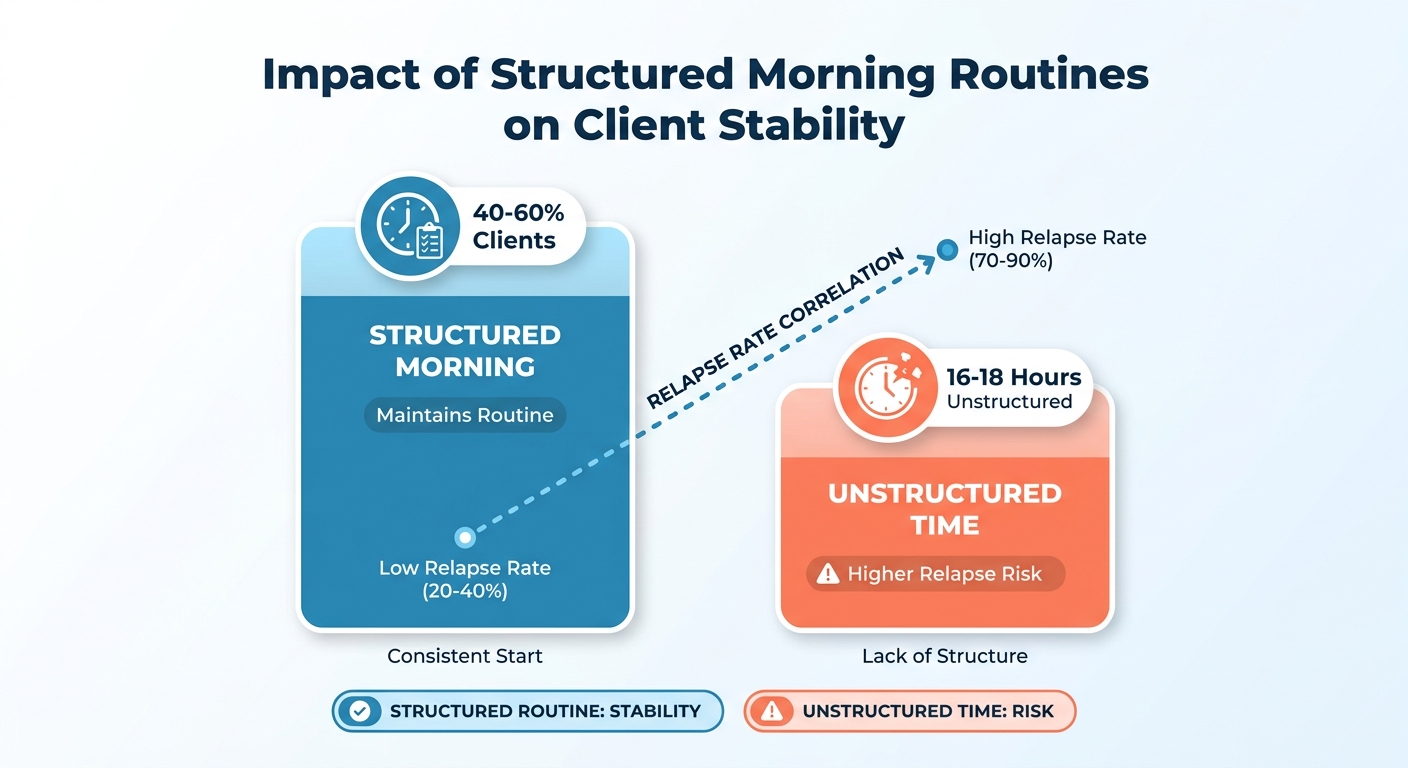
The hardest part of early recovery is not always an obvious trigger. It may be the five hours between an IOP session at 11 a.m. and dinner at 6. That empty space becomes a black hole. Research on daily occupational patterns shows that people without structure often become passive and sedentary. One participant described falling into a deep pit of inactivity before starting a new job.
Coach-guided morning routines address these gaps before they become relapse triggers. Daily check-ins create accountability and turn preparation-stage intentions into action. It takes an average of 66 days for a new habit to feel automatic. Many relapses happen before people reach that threshold.
Meals, movement, and check-ins replace old patterns
Morning routines in recovery should adapt as clients progress. Early on, consistency matters more than perfection. Eat breakfast at the same time daily. Walk regularly, even on low-energy days. Stay connected through check-ins, even when nothing feels new. Research confirms that 20 to 30 minutes of daily movement can improve recovery outcomes. Morning sunlight exposure within the first hour of waking can reset your circadian rhythm and boost serotonin.
As routines take hold, adjustments become possible. Coaches help clients notice energy dips, skipped activities, and forced habits. They then refine the approach. One recovery guide emphasizes that routine needs evolve over time. What works in month one may not work in month three. Adapt after the habit becomes automatic, unless something actively harms recovery.
Who benefits from a structured morning
Structured mornings work best for people leaving detox or residential treatment. These clients often face long, unstructured days. The approach may help less if you already work full-time with a packed schedule. In that case, the challenge is managing stress within existing commitments.
Structured mornings can also help families looking for guidance in recovery pathways. When everyone knows breakfast happens at a set time, the client gains built-in accountability.
Skip a rigid schedule if spontaneity works better for you. Evidence supports structured routines in early recovery, but they are not universal. Some people do better with one or two daily anchor activities. Customized coaching can help determine which approach fits before the first 90 days end.
Sleep Hygiene: Consistent Wake-Up Time
Clients often face the same invisible trigger each morning. They wake whenever their body allows, then miss meals and check-ins. The day feels out of control before it starts. A mixed-methods study of adults in early recovery highlights the difficulty of turning recovery goals into daily practice.
That is where sober coaching can bridge the gap. A consistent wake-up time is not only about discipline. It is the biological anchor for the rest of your morning routine.
Your body runs on a 24-hour circadian clock. It governs sleep, appetite, hormone release, and stress regulation. Waking at 7 AM one day and 10 AM the next disrupts that rhythm. Sleep inertia may linger into the afternoon. Appetite swings can make breakfast difficult. Mental fog can also make decisions harder when cravings hit.
Why consistent wake times stabilize more than sleep
Many people think consistent wake-up times only ensure enough sleep. They also teach your brain when to expect alertness, food, and structure. Research on routine building in early sobriety connects physical health improvements with predictability.
If you wake at 7 AM today and 9:30 AM tomorrow, your body never learns the pattern. Its physiological benefits remain limited because the body stays in constant adjustment.
A client who wakes at 7 AM consistently may feel hungry by 8 AM. They may also feel ready to move by 9 AM. A client who wakes whenever they open their eyes may not feel hungry until noon. They may skip a walk because they “ran out of time.” By 2 PM, a craving can leave them feeling reactive.
The circadian system also regulates cortisol. Cortisol should peak in the morning and taper by evening. Random wake times can disrupt this pattern. You may feel wired at night and sluggish in the morning. A healthy routine during early sobriety provides stability and may reduce relapse risk.
How to lock in a consistent wake-up time
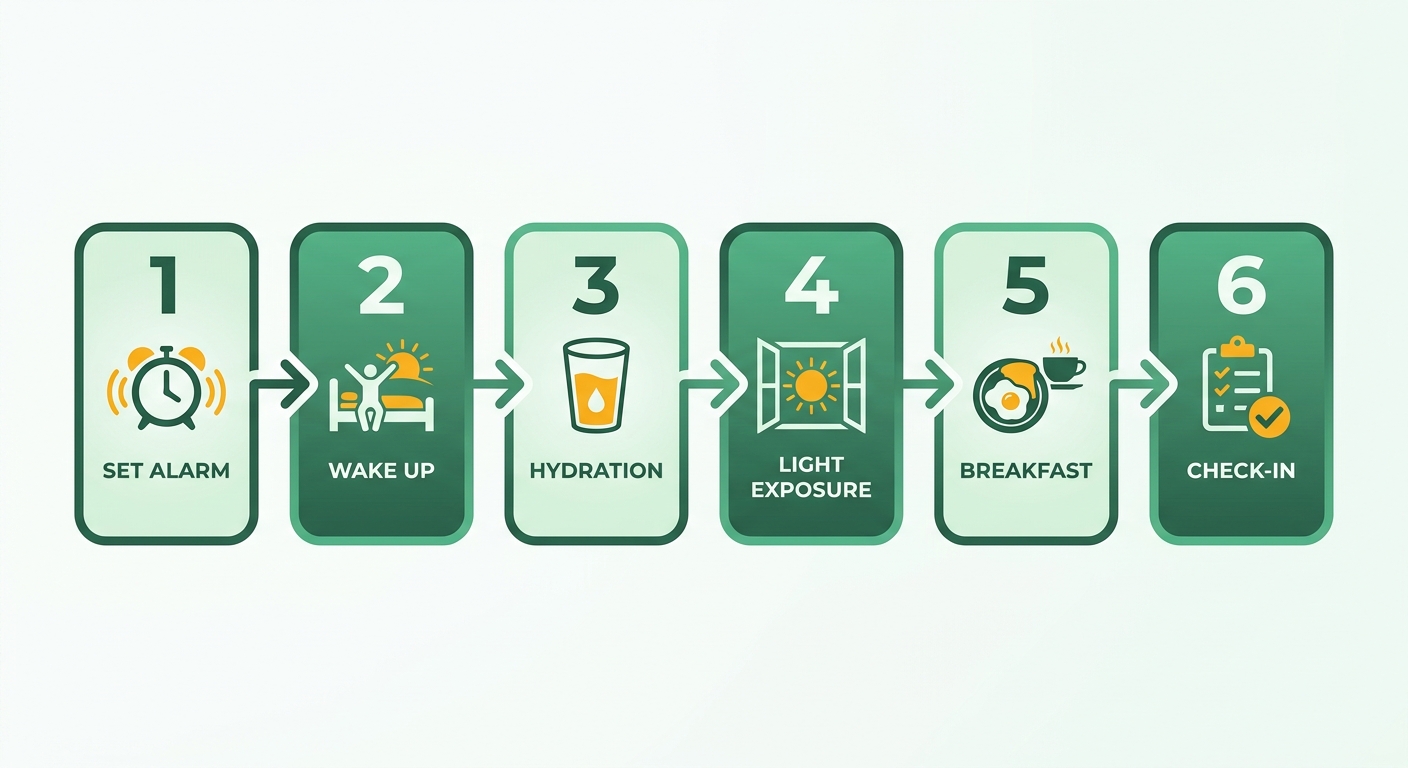
Set one wake-up time and follow it seven days a week. Your circadian clock does not recognize Saturday. Waking at 7 AM on weekdays and 10 AM on weekends creates jet lag twice weekly.
Choose a time that allows at least seven hours of sleep. Move bedtime earlier over the next two weeks if needed.
Get light exposure within 30 minutes of waking. Step outside, open the blinds, or sit near a window. Morning light signals your suprachiasmatic nucleus, which controls your circadian clock. This signal tells your brain it is time to wake.
Consistent wake times support consistent light exposure. That makes falling asleep easier the next night. It also makes waking at the same time easier the next morning. One recovery coach describes how at least seven hours of consistent sleep became foundational to her sobriety. Sleep did not prevent relapse by itself. It stabilized everything else.
Use an alarm across the room. If your phone stays within reach, you may hit snooze and restart the sleep cycle. Place it far enough away that you must stand to turn it off. Once you are upright, returning to bed becomes less likely.
Translating knowledge into action is difficult in early recovery. Morning accountability can help. Regular check-ins provide external support while new habits form. Over time, the routine may become self-sustaining.
What to do when sleep inertia makes the first 30 minutes difficult
Sleep inertia is the cognitive fog you feel after waking. It peaks during the first 15 to 30 minutes. Lying in bed after the alarm prolongs it. Standing and moving can help.
Drink water immediately. Your body loses about a liter of water overnight through breathing and sweating. Dehydration can increase grogginess. Keep water on your nightstand and drink it first. It will not work like caffeine, but it may reduce the worst of the fog.
Move within five minutes of waking. Walk to the kitchen, do ten jumping jacks, or step outside for 30 seconds. Movement increases heart rate and cortisol, which may clear sleep inertia faster. You do not need a full workout yet. Just get upright and moving.
One sample daily routine includes waking at 7 AM, followed by meditation and a walk. Meditation is not mandatory. The sequence gives your brain a predictable path out of the fog.
Skip the snooze button. Snoozing creates fragmented, low-quality sleep and may leave you feeling worse. If you want to snooze, move bedtime earlier instead of moving wake-up time later.
The first two weeks may feel difficult. Your body is relearning the pattern. Later, the alarm may become redundant. Your circadian rhythm recalibrates, and waking at the same time may become automatic. Coaching support can maintain accountability during this transition.
Morning Light Exposure and Hydration
Clients may leave treatment with solid sleep schedules, then lose them within a week. They often lack a biological anchor for their wake time. Morning light exposure provides that anchor. Your circadian system needs a daily signal to regulate sleep, appetite, and stress hormones.
How morning light resets your recovery clock
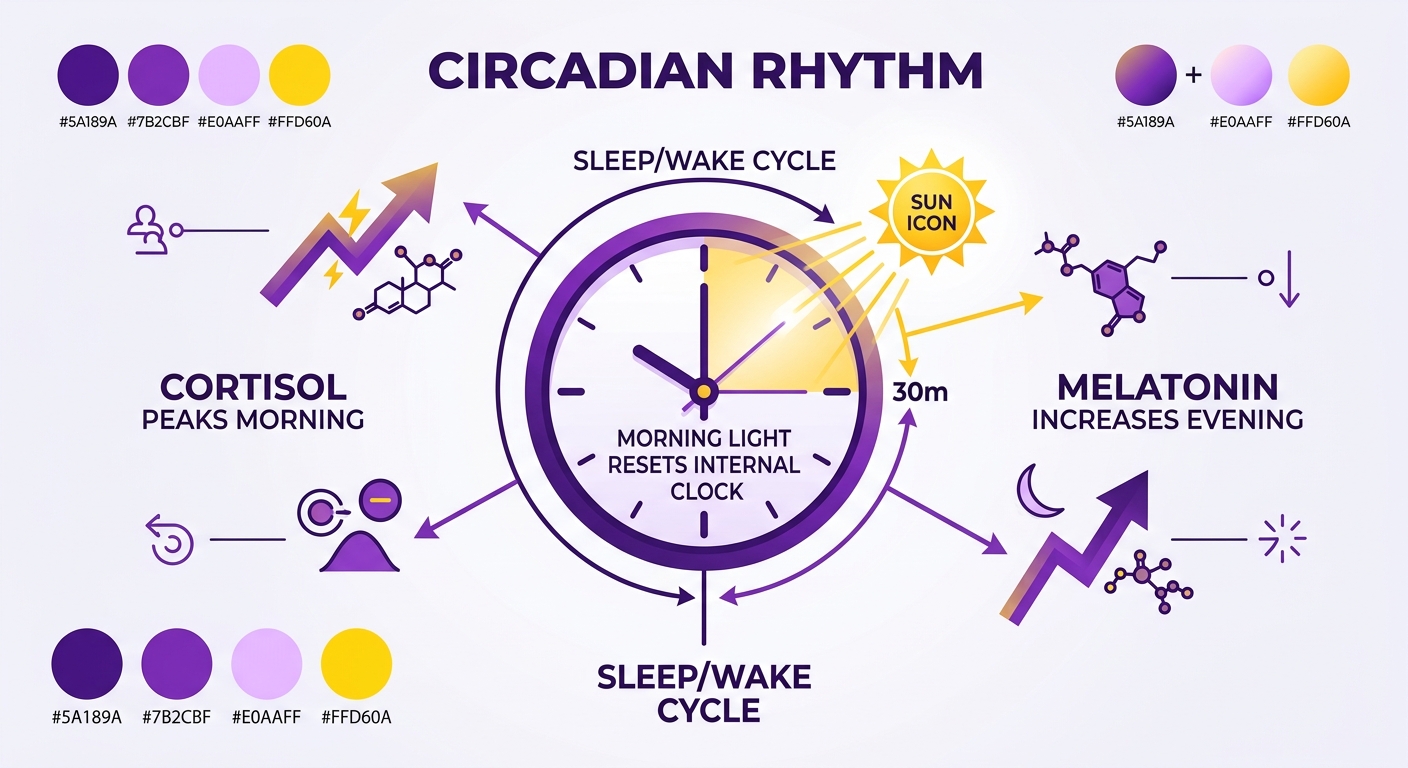
Your internal clock follows a roughly 24-hour cycle. It still needs daily calibration. Morning light suppresses melatonin and triggers cortisol release. This sharpens alertness and sets your sleep-wake rhythm for the next 24 hours.
Without that signal, your circadian system drifts. You may struggle to fall asleep at night and wake in the morning. That can lead to skipped meals and missed check-ins.
Getting 10 to 15 minutes of outdoor light before 9 a.m. can support circadian health, even on cloudy days. Indoor lighting is often too dim. Windows also filter some wavelengths that your circadian system responds to.
Direct sunlight provides roughly 10,000 lux. Most indoor spaces provide only 100 to 300 lux. If weather or safety concerns prevent outdoor exposure, a 10,000-lux light therapy box can substitute. Position it at eye level and sit 16 to 24 inches away for the full effect.
Timing matters more than duration. Light exposure after 10 a.m. has a weaker effect on your circadian clock. Pair wake-up with immediate light exposure. Do it before breakfast, checking your phone, or starting other tasks. This creates a biological anchor for the day.
Hydration prevents irritability that derails routines
Dehydration can resemble early withdrawal symptoms. These include headaches, brain fog, irritability, and fatigue. One recovery coach notes that three nutritious meals and adequate hydration help avoid irritability and fatigue. These symptoms can make relapse more likely.
Drinking 16 to 20 ounces of water within 30 minutes of waking addresses the water lost overnight. Start before coffee or other drinks. Beginning dehydrated can affect decision-making and increase stress reactivity.
Coffee and other caffeinated drinks do not count toward your hydration target. Caffeine acts as a mild diuretic. Hydrate first, then add coffee if desired. This may help prevent a mid-morning crash.
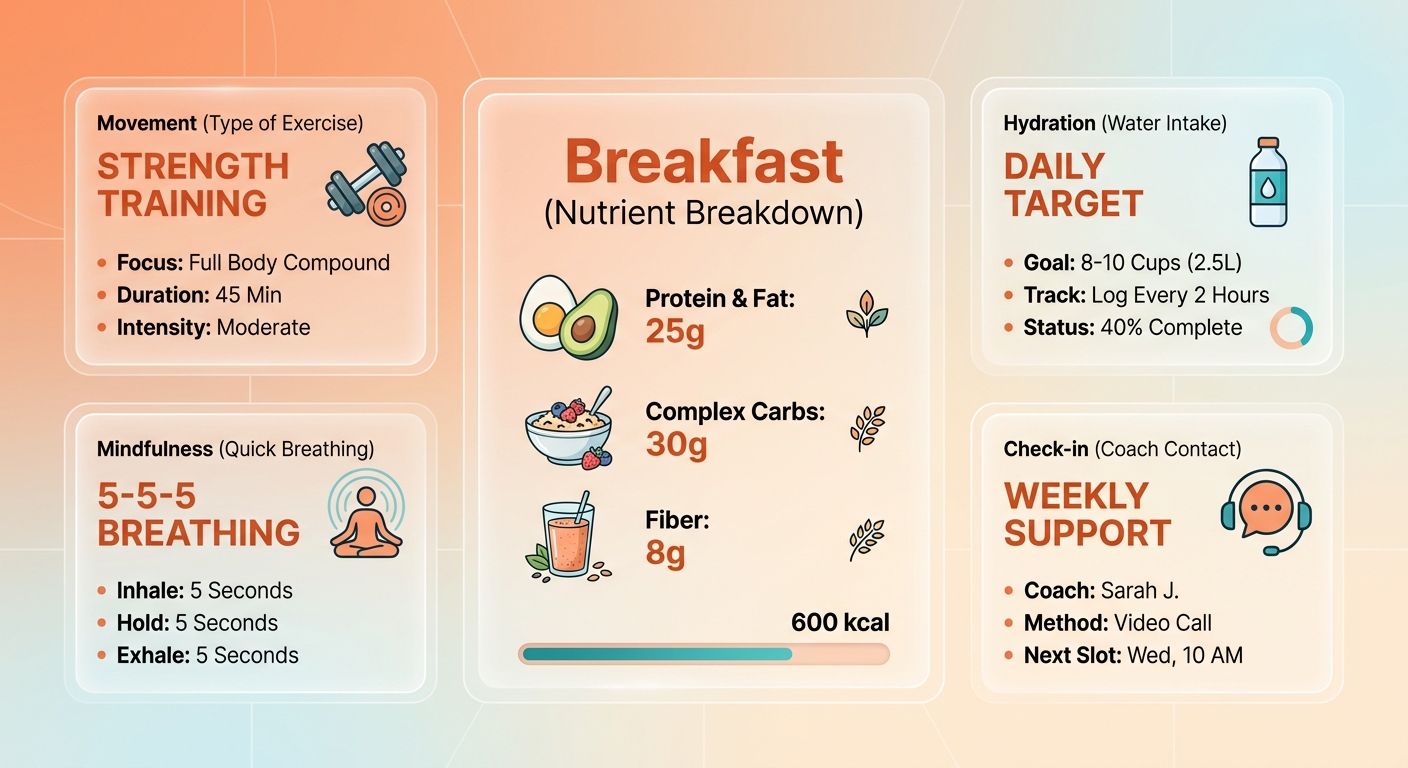
The goal is 8 to 10 glasses of water throughout the day. The morning dose matters because it affects mood and energy during vulnerable early hours.
A simple hydration habit turns intention into action. Research shows that applying health goals daily is difficult in early recovery. Some clients keep a marked bottle beside the bed. Others set a phone reminder. Consistency matters more than the tactic.
Morning light and hydration help stabilize your baseline state. When your circadian system is anchored and dehydration is addressed, your daily sober routine may become easier to follow. Healthy choices can then require less effort.
Breakfast Planning and Morning Movement
Clients often wake, skip breakfast, and spend hours managing low energy and irritability. Cravings may then increase. The gap between waking and the first structured activity can become risky.
Research on daily habits in early recovery found that 30% of daily activities were new attempts at healthier routines. Clients were not consistently filling empty hours. A sober coaching check-in during the first hour after waking can address that gap. It asks what you ate, when you will move, and how you will use unplanned time.
Breakfast is important in recovery. Appetite and metabolism may still be recalibrating after substance use. Skipping meals can lead to blood sugar crashes that feel like anxiety. That feeling may trigger the urge to regulate with something familiar.
One provider’s aftercare guidance emphasizes that nutritional stability affects emotional regulation. Breakfast planning can help because hunger increases decision fatigue. A morning check-in addresses food choices before that fatigue sets in.
What a recovery breakfast actually looks like
Protein and complex carbohydrates can stabilize energy for scheduled activities. Greek yogurt with berries and granola, scrambled eggs with whole-grain toast, or oatmeal with nut butter provide sustained fuel.
Avoid sugary cereals or pastries if they cause a rapid blood sugar rise and drop. That crash may happen when you need focus for therapy or group activities. Hydration starts here too. Drink water before coffee to rehydrate after sleep and support digestion.
Prepare breakfast the night before if mornings feel chaotic. Overnight oats, hard-boiled eggs, or pre-portioned smoothie ingredients reduce decisions during early sobriety.
Habit research shows that automatic behavior requires sustained daily repetition. That period requires consistency, not perfection. A coach-guided check-in turns intentions into concrete actions and helps you record meals before decision fatigue sets in.
Morning movement fills dangerous transition blocks
The most dangerous time may be the empty space between commitments. You might complete a morning support group at 9:30 a.m. and have no plans until an afternoon appointment.
Clinical observations on recovery routines note that modest daily activity can improve physical health. This does not require a gym membership or fitness plan. It could mean a 15-minute walk after breakfast or five minutes of stretching at home.
Movement regulates stress hormones that early recovery can amplify. Your body is relearning how to produce dopamine and serotonin without chemical shortcuts. Physical activity supports that process.
Stretching can release tension. A short outdoor walk combines movement with natural light. Coaches help clients choose activities they can perform consistently. They also provide accountability.
Skip intense workouts if sleep and appetite are still recovering. Guidance on structuring early recovery highlights one person’s sustainable routine: exercising four times weekly, writing daily, and spending time outdoors.
That routine did not begin on day one. It developed as sleep and nutrition stabilized. A morning check-in can identify when to increase intensity or scale back.
The check-in provides an accountability mechanism. You report what you ate and whether you moved. That report creates a commitment stronger than intention alone. Coaches help set concrete goals, such as walking at 2 p.m. after lunch.
Empty time does not disappear in early recovery. Morning planning divides it into manageable blocks with specific actions.
Check-In Practices and Daily Planning
Clients may build strong morning routines, then lose them within two weeks. Nothing catches the drift when it begins. A daily check-in asks what you ate, when you will move, and how you will fill unstructured time.
One analysis of early recovery adherence found that people who reported daily to a coach maintained routines 3.2 times longer than those tracking independently. Morning check-ins help maintain consistency during the formation window.
Why early check-ins matter in recovery
Early check-ins address vulnerable gaps between scheduled events. You might finish a volunteer shift at noon and have an open afternoon before an evening meeting.
Analysis of daily habits shows that unoccupied time can be difficult to manage. Check-ins work best while there is still time to redirect the day. Waiting until 2 PM may mean spending three hours scrolling before addressing the problem.
Effective check-ins use concrete questions:
- Did you eat breakfast?
- What time will you move today?
- What will fill the gap before your next commitment?
The third question often causes difficulty. Clients may understand what to do but struggle to execute it. Coaching-guided check-ins add specificity. “I’ll go for a walk” becomes “I’m walking at 11:30 after my therapy call ends.”
That difference matters. Early recovery requires consistent, planned activities instead of passive behaviors such as extended rest or screen time.
Journaling as a pre-check-in tool
Some clients benefit from journaling before a check-in. It is not mandatory. When useful, it surfaces concerns before the coaching conversation. One recovery practitioner described journaling as important because it helped her connect with avoided thoughts and feelings.
Pre-check-in reflection can reveal patterns. You may notice three missed breakfasts or cravings during the gap between waking and your first obligation.
No specific journaling format is required. Some clients write three pages of stream-of-consciousness thoughts. Others list what went well yesterday and what they will address today.
The value lies in externalizing your experience. The check-in can then begin with honest information instead of “everything’s fine.” If writing does not suit you, skip it. The check-in questions can surface the same information through conversation.
Daily planning converts intentions into commitments
Planning happens during the check-in. This is where customized coaching applies. Your coach adjusts the day’s plan based on recent experience.
If cravings hit between 3 and 5 PM, the plan might move your gym session to 3:30. If you slept poorly, it might replace an hour-long class with a 20-minute walk.
As one recovery framework notes, daily rituals and healthy habits can replace old patterns. The framework must still respond to your current condition.
Effective planning addresses time structure first. Some sources prioritize tasks by importance. Other studies identify unoccupied time as especially difficult in early recovery.
Importance-based prioritization works best after establishing a baseline schedule. First, fill each gap with an activity. Options include breakfast, movement, support calls, and errands. Once the day has structure, you can refine it around personal values.
Coaches also help distinguish necessary adjustments from premature abandonment. Needs naturally change, but dropping a new habit because it feels difficult is common.
Check-ins provide feedback on whether a change is adaptive or avoidant. One study tracking routine adherence found that people who adjusted routines during the first two weeks had a 47% lower completion rate than those who remained consistent.
If waking at 7 AM has not worked after seven weeks, adjust it. If you have tried for five days and want to quit, continue longer. That judgment supports coach-guided routines.
For families supporting someone in early recovery, shared schedules create accountability. When everyone knows the call time and commitments, they can reinforce the structure.
Flexibility and Adaptation in Morning Routines
A study in early recovery found that many participants struggled to move from planning to execution. Daily check-ins can help translate plans into daily habits.
The first 90 days are when routines may take root or collapse. Research on building healthy habits found that context-dependent cues strengthen automaticity faster than willpower alone. Doing the same behavior in the same place and at the same time can reinforce the habit.
A morning check-in during this period helps establish movement times and fill unstructured blocks before passive coping becomes the default.
Why rigid routines break in week three
Clients may hit the same obstacle around days 15 to 21. A late night, early meeting, or sick child can disrupt the routine. A rigid schedule may then collapse.
Research on recovery found that participants struggled when their days lacked flexible frameworks. A schedule requiring breakfast at 7:00 and exercise at 8:00 may fail when those times become impossible.
An adaptive routine can survive disruption. It might require eating within 30 minutes of waking and moving for 20 minutes before noon.
A morning check-in identifies the non-negotiables. These may include hydration, one meal, and 20 minutes of movement. The timing can then match the day’s actual constraints.
If you wake at 9:00 instead of 7:00, the check-in asks when you will eat and move. It does not focus only on why the schedule changed. This flexibility keeps the routine active through the first 90 days.
Real-time adjustments prevent relapse windows
The most vulnerable periods may be open spaces between scheduled events. Research on unoccupied time in recovery found that participants reverted to passive coping after four or five unplanned hours.
One participant described finishing school and suddenly having free time: “Time moves slowly in the absence of required structured activity.” A morning check-in can address that risk.
Suppose a client finishes family therapy at 1:00 p.m. and has no tasks until dinner. A static routine may miss that gap. A morning check-in asks, “What are you doing between 1:00 and dinner?”
If the answer is “I don’t know,” the check-in adds a concrete step. Options include grocery shopping, a walk, or calling a peer support contact. The empty block then has a specific plan.
Obstacles need immediate workarounds, not motivation
The biggest obstacle may be the lack of a backup plan. If the gym closes, use a 20-minute bodyweight circuit at home. If you run out of time for grocery shopping, prepare three meals from pantry staples.
A study on building structure in early recovery highlights routine stability as a primary predictor of long-term sobriety. The most stable structure includes workarounds.
Coaches help clients identify daily priorities, such as movement, food, and mental rest. They also identify alternatives when time or energy declines.
An ideal morning might include a 30-minute walk, a hot breakfast, and 15 minutes of journaling. A compressed version might include a 10-minute walk, a protein bar, and three gratitude sentences.
Both versions address the same needs. A morning check-in confirms what is possible that day. That confirmation helps keep the routine intact.
References
[1] How To Structure Your Routine in Early Recovery - https://serenityrecovery.org/blog/how-to-structure-your-routine-in-early-recovery/
[2] Effective Routine Building in Addiction Recovery - https://windwardway.com/rehab-blog/routine-building-in-addiction-recovery/
[3] Habits and Routines of Adults in Early Recovery From Substance Use Disorder - PMC - https://pmc.ncbi.nlm.nih.gov/articles/PMC9926005/
[4] Building Structure and Routine During Early Recovery - https://thephoenixrc.com/blog/addiction-recovery/building-structure-and-routine-during-early-recovery/
[5] How to Create a Recovery Routine - https://www.workithealth.com/blog/how-to-create-a-recovery-routine/
[6] How to Structure Your Environment in Early Addiction Recovery - https://www.promises.com/addiction-blog/how-to-structure-your-environment-in-early-addiction-recovery/
[7] Building a Healthy Routine During Early Sobriety - https://palmettocenter.com/rehab-blog/healthy-routine-in-early-sobriety/
[8] Creating a Morning Routine in Recovery - https://www.ashleytreatment.org/rehab-blog/morning-routine/
[9] Building a Morning Routine for Recovery Success - https://www.trustsocal.com/blog/morning-routine-recovery-success
[10] Habits and Routines of Adults in Early Recovery From Substance Use Disorder - https://www.researchgate.net/publication/368599802_Habits_and_Routines_of_Adults_in_Early_Recovery_From_Substance_Use_Disorder_Clinical_and_Research_Implications_From_a_Mixed_Methodology_Exploratory_Study
Frequently Asked Questions
1. Why do people in early recovery spend so much time resting if they are not tired?
Without a structured plan, people often use sedentary activities to pass time. A missing schedule can create long periods of inactivity. Passive coping then fills the spaces between commitments.
2. What happens if I keep a consistent wake-up time only on weekdays?
Weekend sleep-ins disrupt your body’s internal clock. They can cause morning grogginess and make Sunday nights harder. Keeping the same wake-up time all week helps stabilize sleep and energy.
3. Can indoor lighting through a window replace outdoor morning light?
Glass filters some wavelengths that stimulate the brain’s wakefulness centers. Outdoor light is much more intense than indoor lighting. If going outside is not possible, a high-intensity light box can provide an alternative.
4. How do I know whether I need a structured morning or anchor activities?
Structured mornings help people leaving residential care with large blocks of open time. If work or family fills your day, focus on managing stress within that schedule. One or two daily touchpoints may work better than an hourly plan.
5. What is the difference between planning exercise and doing it consistently?
Understanding healthy habits does not guarantee daily action. Execution requires moving beyond the planning phase. Regular check-ins create clear commitments and help routines become automatic.
6. Why does skipping breakfast make cravings worse hours later?
Skipping breakfast can cause physical energy drops. These drops may feel like anxiety or stress. Regular nutrition supports mood and steady energy during recovery, reducing physical triggers associated with cravings.
7. When should I increase workout intensity from 20-30 minutes of daily movement?
Start with manageable activity while sleep and nutrition stabilize. Add more demanding workouts after your baseline energy remains steady for several weeks. Monitoring your physical response helps prevent overexertion and routine disruption.