State Recovery Programs vs Private Sober Coaching: Which Covers Your Needs?
September 24, 2026
Quick Answers
- State recovery programs often run at low or no out-of-pocket cost because of public funding, but may involve waitlists and services tied to one location.
- Sober coaching prices vary widely, from low-cost peer support options to higher-cost intensive packages.
- Insurance coverage for sober coaching varies; many plans may not cover it, so private after-rehab support can require out-of-pocket payment.
- State-funded programs may not typically offer sober travel companions for flights, work conferences, weddings, or relocations. Some private coaching services, including MADE Recovery, describe offering this kind of support.
How the Two Paths Actually Stack Up
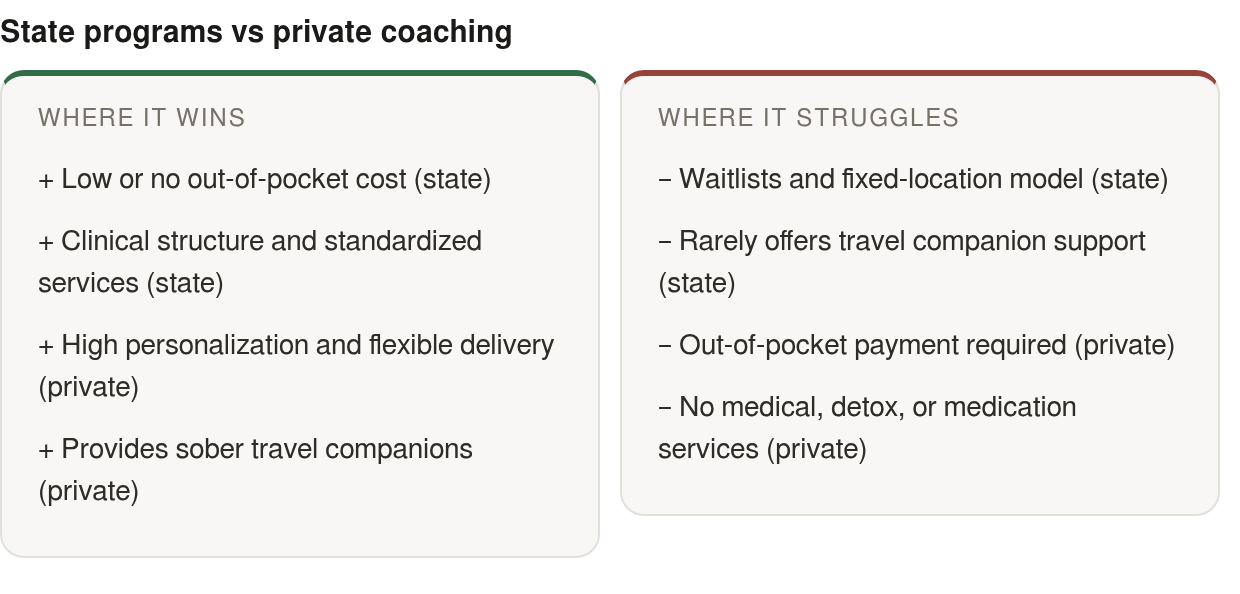
State recovery programs and private sober coaching both fill real gaps after rehab. They just solve different problems. State programs often lean on subsidized access and clinical structure. Private coaching often leans on personalization and being physically present when it counts.
The difference can matter most when your needs fall outside a standard menu. Sober travel companions are one clear example. State-funded programs may not cover someone accompanying you on a work trip, a family wedding, or a move across the country. That is a gap where some private after-rehab coaching may be useful.
The Feature Split That Decides Your Choice
State recovery programs are often government-funded, clinically structured, and low or no out-of-pocket cost. They may also be waitlisted and tied to one site. Private sober coaching is often more flexible and personalized, available virtually or in person, but may be paid out of pocket.
| Feature | State Recovery Programs | Private Sober Coaching | MADE Recovery |
|---|---|---|---|
| Cost model | Often low/no cost, subsidized | Often out of pocket | Reviewed in an initial consultation |
| Personalization | Standardized | High | Described as tailored per client |
| Delivery | In person, site-based | Virtual or in person | Virtual and in person |
| Support model | Individual/group | Coach-led | Single coach or coordinated team |
| Sober travel companions | Rarely offered | Sometimes offered | Described as offered |
| Support tapering | Program-length limited | Varies | Described as gradual |
The Pricing Gap Nobody Prices In
Sober coaching costs vary widely. Peer support can be low cost or free, while intensive coverage may sit at the premium end. Insurance coverage for coaching is not guaranteed, so private support may need to be paid directly.
State programs often win on affordability. But affordability may not help if the service you need is not offered.
So the call often comes down to this. A state program may fit when cost is the deciding factor and your needs match a standard clinical track. Private coaching may fit when you need flexibility, day-to-day companionship, or travel support that public programs may not staff for.
Private coaching may be unnecessary if all you need is a weekly group and low-cost accountability. Its value is more likely to show up when life gets complicated and the structure has to move with you.
Why This Choice Is Really About Your Calendar
The decision often comes down to one question: what does your life actually look like in the months after rehab? Not the clinical version. The real one, with its work trips, family obligations, and the specific moments where staying sober gets hard.
Both paths fill gaps in after-rehab support, but they may map onto different lives. If your recovery unfolds close to home with a predictable routine, a structured state program can carry a lot of weight. If your life moves, involves travel, or drops you into high-pressure situations a clinic never sees, the fit may change.
Match The Option To Your Actual Week
We built our approach around moments that do not fit a standard menu. Travel is one clear example. State-funded programs may not assign someone to accompany you on a flight, a work conference, or a cross-country move. Those are moments where old patterns can resurface, and where a sober companion in the room may change the outcome.
| Your situation | Stronger fit |
|---|---|
| Stable home routine, tight budget | State recovery program |
| Long waitlist locally, need help now | Private sober coaching |
| Upcoming travel, wedding, or relocation | MADE Recovery (sober companions) |
| Clinical detox or medication needs | Licensed medical treatment (neither replaces this) |
| Family wants coaching on how to help | Private coaching |
One note on scope. We provide nonmedical recovery support: coaching, companionship, sober living, and intervention help. We are not doctors, and we do not handle detox or medications. If that is what you need, a medical facility comes first.
The Needs State Menus Skip
The common threads we hear from families are timing, personalization, and presence. State programs often win on cost and clinical structure. They may struggle with waitlists and rigid formats.
Families weighing these paths often need support beyond the individual, too. Our guide on support groups for families covers that side. Pick the option that meets the need you actually have, not the one that looks most complete on paper.
What Happens When Support Has To Leave The Building
Let us get specific about what each option may do when the calendar gets complicated. A key difference is whether your after-rehab support can leave the building with you.
Many state programs run on a fixed-location model. You show up, you get services, you go home. That can work until your recovery has to move. A relocation. A court date in another county. A wedding three states away. These are moments where after-rehab plans can crack, and they may also be moments a facility-bound program cannot follow you into.
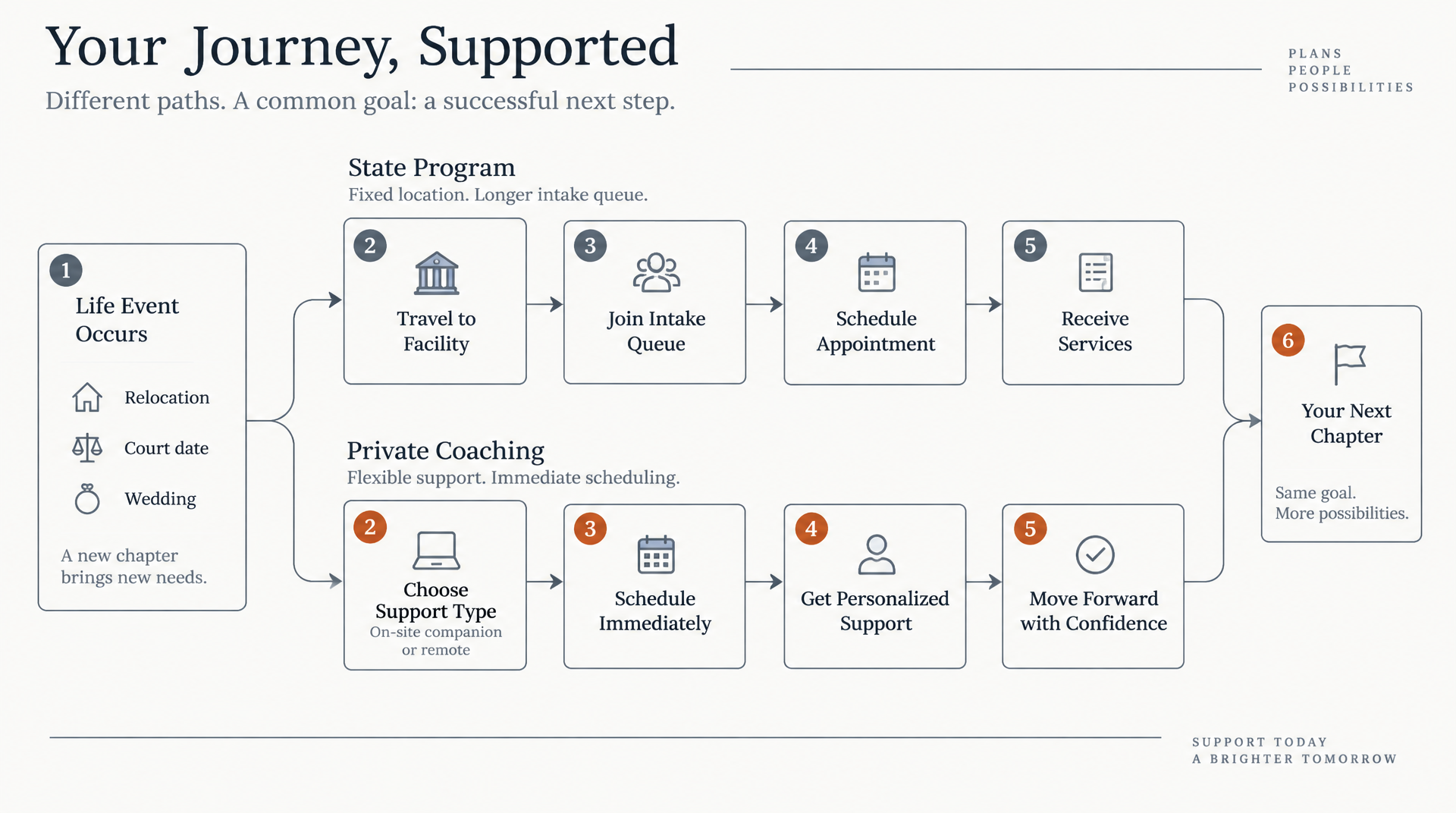
The Feature Table That Actually Matters For Travel
| Capability | State Recovery Programs | Private Sober Coaching (our model) |
|---|---|---|
| Cost structure | Often low or no out-of-pocket | À la carte menu and customized packages |
| Location model | Fixed site, often waitlisted | Can come to you, including on the road |
| Sober travel companions | Rarely covered | Described as a core service |
| Schedule flexibility | Set hours | Built around your week |
| Personalization | Standardized menu | One-to-one, situation-specific |
| Medical treatment | May include clinical services | Nonmedical support only |
That last row is scope-setting. We are not doctors, and we do not provide detox, medication management, or clinical therapy. If you need medical care, a state program or licensed facility may be the right call, not us.
Where A Companion On The Trip Changes The Math
Consider a trip with high relapse risk and no one to travel it with you. State-funded coverage may not include someone physically present at the airport, the hotel bar, or the family dinner where old patterns wait.
That is the gap some private coaching models, including ours, aim to fill. Our coaches may accompany clients through situations treatment does not typically see, then help build a plan for the next one.
If you are considering a sober travel companion, confirm during planning how screening, boundaries, travel logistics, relapse planning, and handoff to local care will be handled. This kind of support is not a substitute for medical treatment.
Pick a state program when your recovery stays close to home and cost decides it. Pick coaching like ours when your life moves and you want someone in the room. If you are weighing the money side too, our breakdown of post-rehab financial assistance programs is worth a read.
How Fast Each Path Can Move
Speed is where the two paths can diverge fastest. When an after-rehab plan needs to move on short notice, a flight tomorrow, a family emergency two states over, the question is not which program looks better on paper. It is which one can respond before the moment passes.
State programs often run on intake queues and fixed schedules. That structure can be a strength for steady, local recovery, but it may be slow to flex. Private coaching may trade subsidized access for responsiveness. Our packages can be customized and adjusted as needs change, and a sober travel companion is one option we can coordinate when a trip enters the picture.
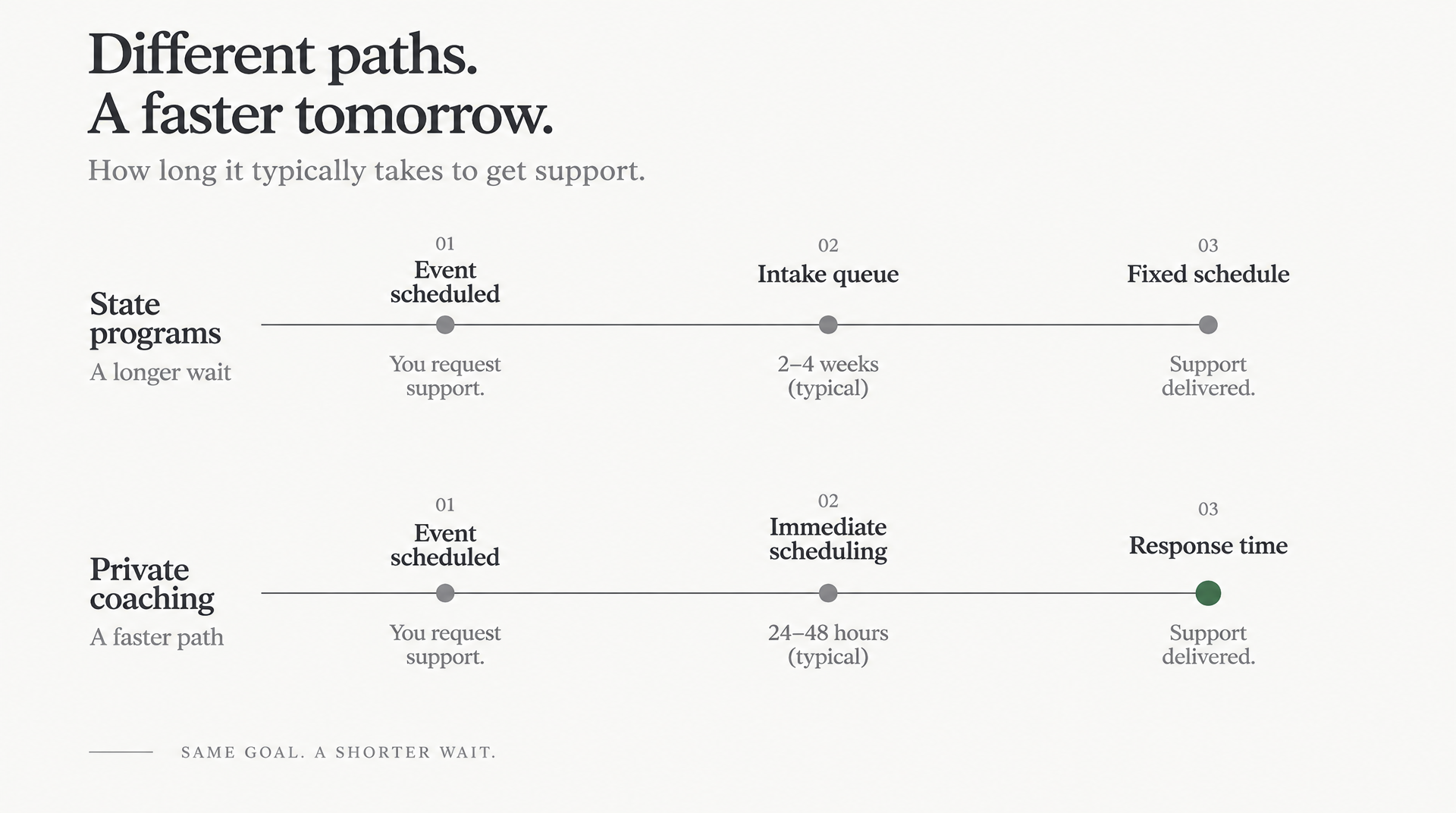
The Response-Time Gap That Shows Up When Life Speeds Up
Think of performance here as three things: how fast support arrives, how well it scales with a changing schedule, and how much of your own energy it burns to coordinate.
| Performance factor | State recovery programs | Private sober coaching (our model) |
|---|---|---|
| Speed to mobilize | Intake-dependent, can take time | Built around your schedule |
| Scales with travel | Location-bound | Can move with you, trip to trip |
| Your coordination effort | May be higher | May be lower |
Scalability is the quieter difference. A state program often scales by adding more clients to the same building. That can be efficient for the system and fine if your week is predictable. It may not scale to your life moving. Our model is intended to scale with you. If this month is quiet and next month has three work trips, support may ramp up and down with you.
Your Energy Is a Cost Too, Not Just Your Money
A hidden cost of a rigid program can be the effort you spend making it fit. Rescheduling. Re-explaining your situation. Arranging your own coverage for the days it cannot reach. That coordination load can land on you right when your bandwidth is thinnest.
Our approach is designed to absorb that load. You tell us what the week looks like, and we handle the logistics of being present for it.
Private coaching may be unnecessary if your recovery is stable, local, and well-served by a program you already trust. The flexibility edge may matter more when your life will not sit still.
Pros and Cons
Every option has a shape it fits and a shape it does not. The honest way to weigh after-rehab support is to look at where each path may break down, not just where it shines.
State programs often win on cost and clinical backing. Private coaching often wins on flexibility and presence. Neither is universally better. The right pick depends on whether your recovery stays put or moves.
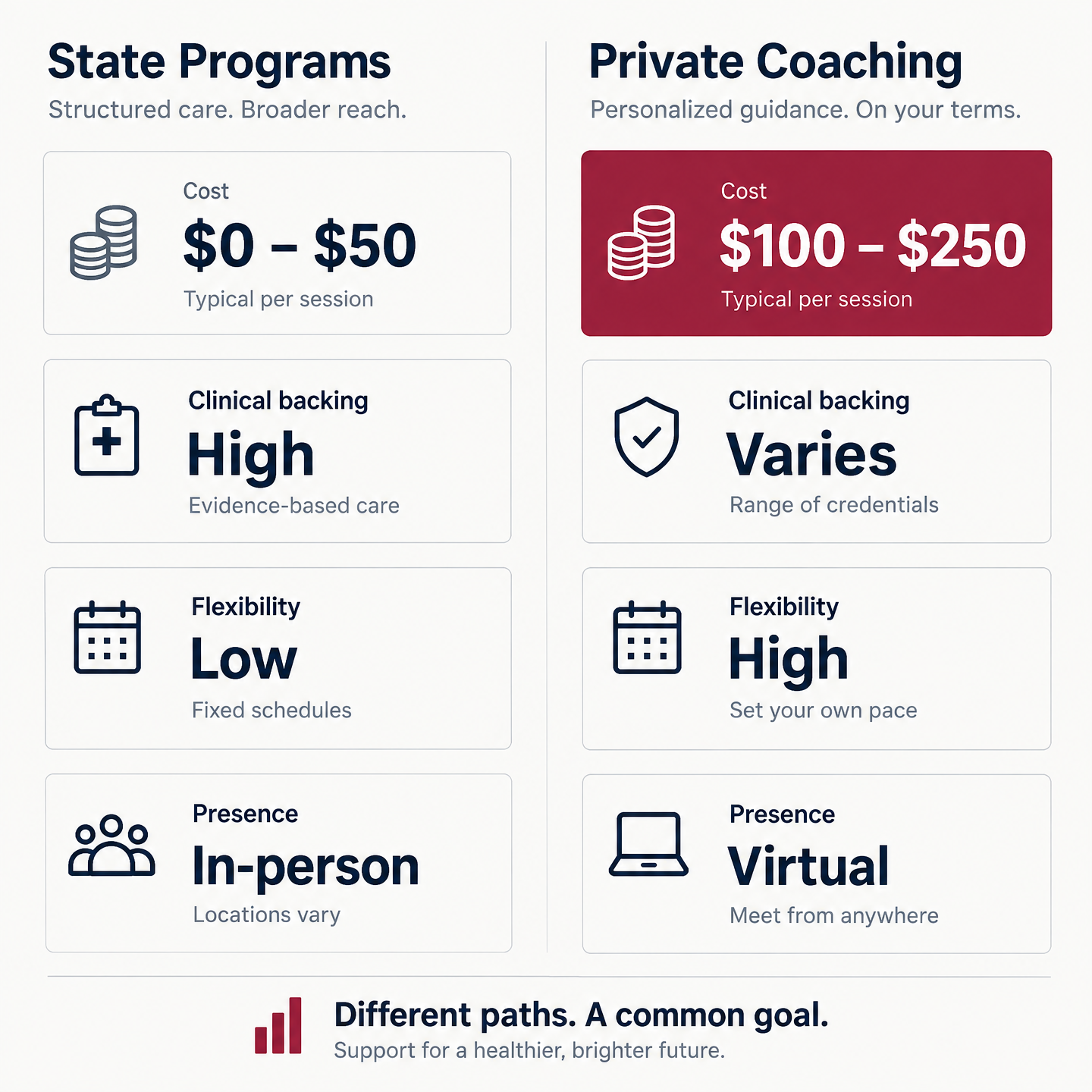
The Trade-Offs Each Path Forces You To Accept
State recovery programs can carry genuine strengths. Subsidized or free access may remove a money barrier that stops some people from getting help. The clinical structure can be real, and for someone rebuilding a stable, local routine, it may do heavy lifting.
The weakness may show up the moment your life stops being predictable. Waitlists, fixed hours, and county lines do not always bend for a wedding out of state or a job that requires flying. If you need someone beside you during a high-risk trip, that may not be on the state menu.
Private sober coaching flips the equation. We aim to build packages around your actual week, and a sober travel companion is one piece we can arrange when a trip is the risk. The downside is straightforward: you may pay out of pocket, and we do not provide medical care, detox, or medication management. Those belong with licensed providers.
| Factor | State Recovery Programs | Private Sober Coaching (our model) |
|---|---|---|
| Biggest strength | Low or no cost, clinical structure | Personalization, real-world presence |
| Biggest weakness | May be rigid, location-bound, waitlisted | Out-of-pocket, nonmedical scope |
| Travel support | Rarely covered | Coordinated as needed |
| Best fit | Stable, local routines | Lives that move or hit pressure points |
So the plain call: if your recovery is steady and homebound and budget is tight, a state program is often the smart first stop. You may not need private coaching.
But if travel or high-pressure moments are part of your reality, the gap may be real. That is the gap sober travel companions and companionship during critical moments are designed to fill. For families weighing cost against fit, the clearest next step is often a conversation about what level of support matches your situation.
Who Each Path Is Really For
The clearest way to pick between these paths is to stop thinking about features and start thinking about people. Who is likely to thrive in a state program, and who may need something a fixed-location model cannot give them? After-rehab life can sort into a few recognizable profiles, and each one may point to a different fit.
If your recovery is settled and local, a state program may serve you well. If your after-rehab reality involves movement, high-pressure events, or a schedule nobody can predict, private coaching may start to matter.
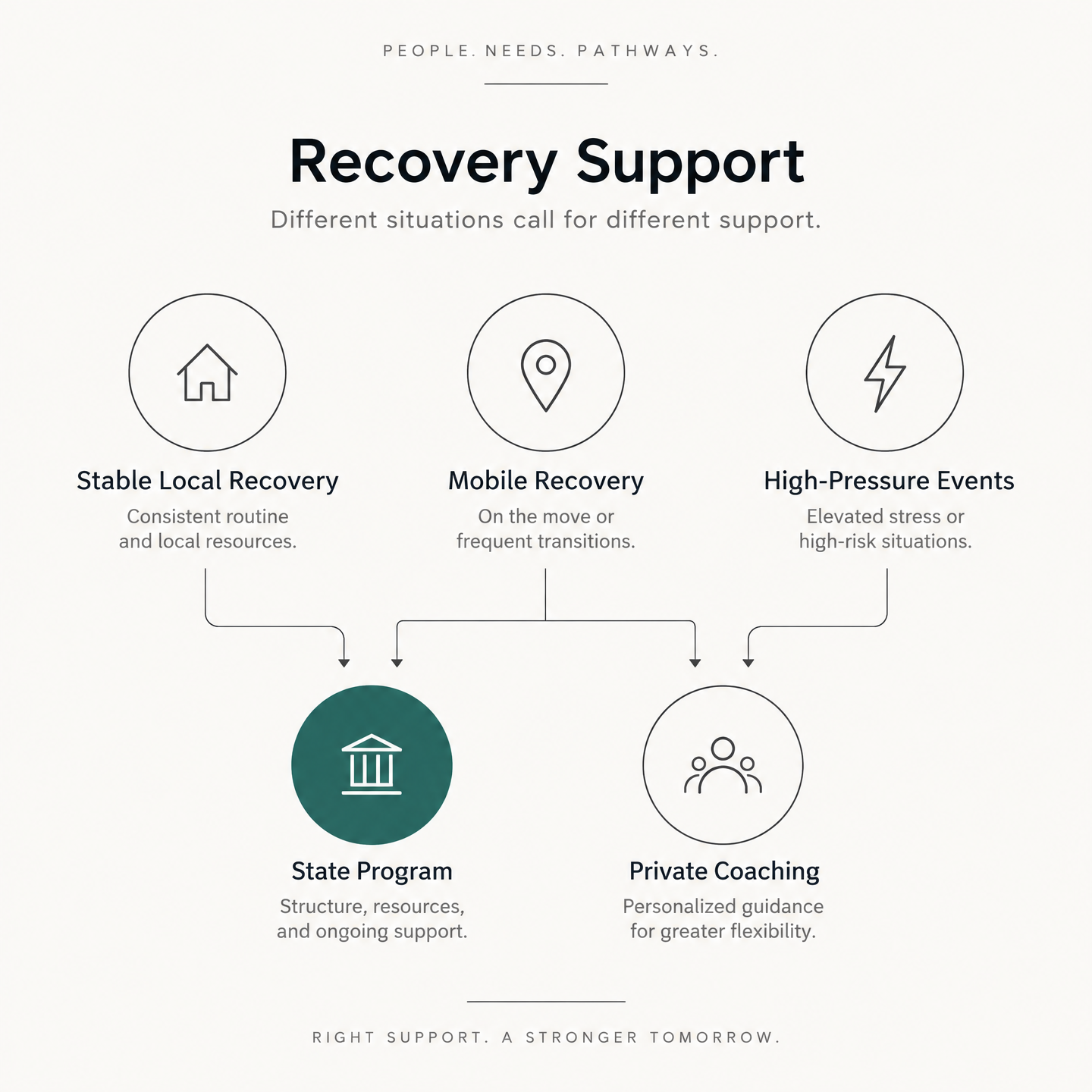
Who Fits A State Program Best?
State recovery programs may suit people rebuilding a stable, local routine. You live in one place. Your week looks similar most weeks. Cost is a real constraint, and subsidized access may remove the biggest barrier to getting help.
For someone in that situation, the clinical structure can do genuine work. Regular check-ins, group meetings, and a predictable schedule can give recovery a spine. We would point that person toward a state program first, honestly. If your life stays put, you may not need what we offer.
Who Needs A Sober Travel Companion?
The profile we are built for looks different. It is the person whose recovery has to leave town. A work trip that cannot be declined. A family wedding two states away. A relocation that lands you somewhere with no support network yet.
State-funded programs may not cover someone traveling with you through those moments. That gap is where a sober travel companion may earn its place, and it is one use case where our model may fit clearly.
| Reader profile | Best fit |
|---|---|
| Stable, local, cost-sensitive | State recovery program |
| Predictable routine near home | State recovery program |
| Frequent travel or relocation | Private coaching (our model) |
| High-pressure events away from home | Sober travel companion |
Families weighing these options often start with cost, which is fair. If that is your first question, our guide to post-rehab financial assistance programs is a better starting point than any sales pitch. Match the option to the life you are actually living, not the one on paper.
What I'd Actually Recommend
The right after-rehab support is not the one with the best brochure. It is the one that fits the actual shape of your recovery, week to week, trip to trip.
State programs and private coaching are not really competitors. They are different tools for different lives. If your recovery holds still, a subsidized state program can do real work at a price that removes the money barrier. If your recovery moves, that is where our model may earn its place, and it is the exact gap many after-rehab plans ignore.
The Best-Fit Breakdown By Scenario
We built our approach around moments a fixed-location program cannot reach. Travel is the clearest. When a work trip, a relocation, or a family event lands on the calendar, a sober travel companion can turn a high-risk stretch into something you do not face alone.
| Your Situation | Better Fit |
|---|---|
| Stable, local routine, cost is the main barrier | State recovery program |
| Waitlist is fine, you value clinical structure | State recovery program |
| Travel, relocation, or high-pressure events ahead | Private coaching with a sober companion |
| Schedule changes fast, support has to keep up | Private coaching |
| You want both subsidized care and travel coverage | Start with a state program, add coaching for the trips |
Notice the last row. These paths are not mutually exclusive. Some people lean on a state program for their steady weeks and bring in private coaching for the situations that program was not designed to cover.
Our Honest Recommendation
If your life is local and predictable, start with a state program. The value can be genuine and the cost savings may matter. We would rather point you there than sell you support you do not need.
If travel, transitions, or unpredictable weeks are part of your reality, that is our lane. We are a nonmedical recovery support team, not a treatment facility, and we can help you build a plan around the moments that actually threaten your progress. When you are ready to map out what that looks like, reach out and we will start with your real calendar, not a standard menu.
References
Frequently Asked Questions
Can I combine a state recovery program with private sober coaching?
Yes, these paths are not mutually exclusive. Some people lean on a subsidized state program for steady, predictable weeks and bring in private coaching for situations the program was not built to cover, such as a work trip or relocation. Use the state track for cost savings, and consider adding coaching for the moments that move.
Will my insurance help pay for a sober coach?
Insurance coverage for sober coaching varies, and many plans may not cover it, so private after-rehab support may need to be paid directly out of pocket. State recovery programs may be more affordable through public funding. With MADE Recovery, the cost model is described as à la carte or customized packages, reviewed during an initial consultation.
I still need detox or medication management. Can a sober coach handle that?
No. Sober coaching is nonmedical recovery support: coaching, companionship, sober living, and intervention help. It does not include detox, medication management, or clinical therapy. If you need medical care, a licensed facility or state program comes first. MADE Recovery is designed to work alongside medical treatment, not as a replacement for it.
How do I know if I actually need a sober travel companion?
A sober travel companion may fit when your recovery has to leave town and the trip carries relapse risk, such as a work conference, a family wedding two states away, or a relocation with no support network yet. State-funded programs may not staff someone to accompany you, so that gap is where private coaching may earn its place.