State Directories List Addresses but Skip House Culture, Peer Dynamics, and Rules
November 3, 2026

What you need to know upfront
- Many state directories stop at address, license status, and bed count. Governance, peer dynamics, and house rules may not show up.
- The SAMHSA Best Practices framework points to written resident expectations, NARR support level, and certification as relevant evaluation criteria, and address-based listings often don't capture those.
- NARR's support spectrum runs from peer-run homes with minimal oversight to clinically supported residences. Many directory entries don't distinguish between the two.
- SAMHSA's Best Practices framework includes research on Oxford House, including findings related to lower substance use, higher income, lower incarceration, and economic benefits. The framework presents those findings in the context of peer-run recovery housing, not as a guarantee that every sober living home will produce the same result.
- Curfew times vary by home. For example, one home might use a 10 PM weekday curfew and a midnight weekend curfew. Ask what the home requires instead of treating those times as norms.
- Use a checklist of categories such as substance policy, curfews, visitor rules, rent schedule, work/school expectations, and recovery meeting requirements. Directories sometimes mention meeting requirements, but the rest may not appear.
- Some homes restrict overnight guests, and those restrictions may include family members. Ask how the policy applies; providers may describe it as protecting the peer environment.
What state directories actually give you
State directories often list sober living homes by address, license status, and sometimes basic capacity. That's a starting point for families who need to know what exists in their area. It falls well short of what someone needs to evaluate a home.
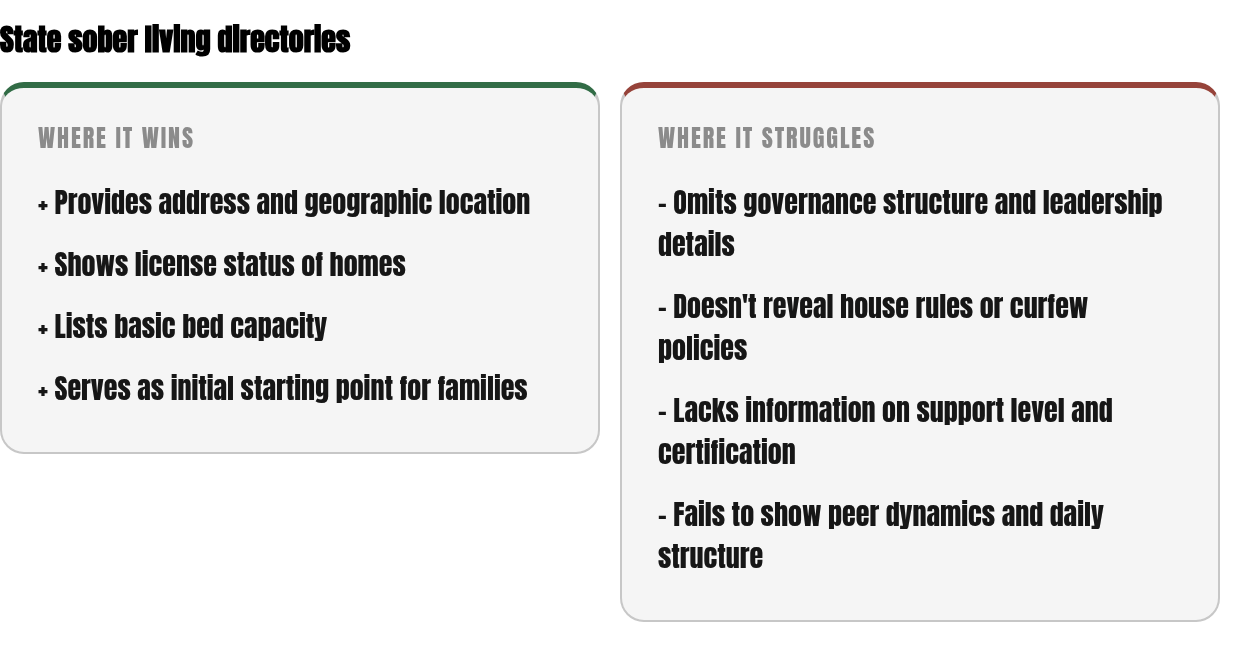
A directory may not tell you who runs the residence, how decisions get made, or what happens when a resident breaks a rule. Those gaps matter. Two homes a mile apart can look interchangeable in a listing while operating differently day to day.
Why governance gaps matter
The SAMHSA Best Practices framework emphasizes operational details such as documented expectations, accountable leadership, and recovery-centered practices. None of those are address-level fields.
NARR's support levels give you a way to separate homes that run on peer leadership from residences with more formal clinical involvement. A directory may show both with beds available. It may not show which model a resident is walking into.
| Example directory field | Evaluation category from the SAMHSA framework |
|---|---|
| Address / county | Written resident expectations |
| Bed capacity | NARR level of support |
| Contact information | Certification status |
| Gender / substance type | Recovery-centered operational practices |
Choosing a home mainly on location and cost may leave families without enough information about daily structure or accountability.
What directories don't show: house culture, peer dynamics, and rules
Curfew design is one practical signal to ask about. For example, a home might use an earlier weekday curfew and a later weekend limit. Ask what the home requires.
Common sober living expectations may include no substances on the premises, drug testing, recovery meeting attendance, and some form of financial obligation. Some homes keep rent due regardless of employment status; providers may describe that as an accountability measure. Practices vary, so ask how the specific home handles rent, work, and financial hardship. If you want a fuller picture of how these environments function, our overview on safety and structure in sober living walks through what to look for.
What well-run sober living homes actually require
Visitor policies can catch people off guard. Some homes set visiting hours and restrict overnight guests, and those restrictions may include family members. Providers may explain the rule as protecting the peer environment from outside influences. Work or school expectations may serve a similar purpose in some homes, but ask whether they are required.
| Rule category to ask about | What to clarify | May appear in state directories? |
|---|---|---|
| Substance policy | Zero-tolerance and drug testing expectations | Rarely |
| Curfews | Weekday and weekend times | Unlikely |
| Financial obligations | Rent schedule and bill expectations | Unlikely |
| Visitor policy | Hours and overnight restrictions | Unlikely |
| Work/school requirement | Employment or training expectations | Unlikely |
| Recovery meetings | Type and frequency | Sometimes |
Use this table as a starting list of questions, not as a universal set of rules. Ask directly about each row.
How to evaluate a sober-living home past the address
A directory listing gives you an address. A placement decision requires operational evidence. Before committing, look for information about the people running the home, how residents interact, and whether the provider documents its expectations in writing.
Questions that reveal how the house actually runs
Ask the house manager to describe a typical morning. That answer tells you whether residents follow a shared structure or each person improvises. Request a video walkthrough of common areas and sleeping arrangements. Look for posted expectations and signs that residents follow daily routines.
Ask about resident age ranges, lengths of sobriety, and how the home handles accountability and conflict. A house with residents at different sobriety lengths may run differently than one with longer-term peers. Peer composition may matter more than any amenity for some placements.
Request a written rule book before committing. The document should explain who enforces expectations, how concerns get raised, and what happens after a violation. If a home won't provide written policies, that's a signal.
| What a Directory May Show | What Direct Inquiry May Reveal |
|---|---|
| Address, license status | Whether staff posts and enforces rules |
| Capacity listed | Resident ages and sobriety lengths |
| Geographic area | How the home handles accountability and conflict |
| Certification listed | Actual rent and visitor policies |
Review platforms can supplement what you learn, but verify every claim directly. A five-star rating tells you little about whether the house culture fits the person moving in. For families working through what comes next after placement, MADE Recovery can help build a plan for ongoing coaching, accountability, and support through that transition.
What we'd tell you to verify about us, too
Any family comparing sober living homes or support services faces the same gap: a listing address tells you little about daily structure, written expectations, or how a provider handles accountability. That standard applies to MADE Recovery's coaching and support services as well.
We want families and prospective clients to come in with real questions. If you're supporting someone through this transition, our intervention specialists and coaches work directly with families to manage recovery decisions, from getting a loved one into treatment to figuring out what structured support looks like once they're home. The table below maps categories worth verifying before committing to any provider.
What to verify before choosing a sober living home or support service
| Verification Category | Directory Listing | Ask MADE Recovery |
|---|---|---|
| Scope of coaching and support services | Not provided | Ask what services are included |
| Written expectations and policies | Not provided | Ask for written materials before committing |
| Cost range and payment options | Not provided | Request a clear fee breakdown |
| Coach or specialist credentials | Sometimes listed | Ask how to verify current status |
| Communication and availability | Not provided | Ask how often support is provided |
| Approach to family involvement and accountability | Not provided | Ask what participation looks like |
No article closes this gap for you. Call us, ask for documentation in writing, and confirm whether our credentials are current and publicly verifiable. If we can't answer those questions clearly and promptly, treat that as useful information. We'd give you the same advice about any provider.
The bottom line on choosing a sober living home
When comparing sober living homes, we look beyond proximity and kitchen upgrades. We look for real governance. SAMHSA's Best Practices for Recovery Housing identifies a stable, safe place to live as one of the major dimensions that support a life in recovery. That framework suggests the environment doesn't just host recovery; it can shape it.
That perspective changes how you compare homes. Instead of treating accreditation, rules, and oversight as paperwork, ask whether the provider can show you how those elements work day to day. Clear documentation should come with consistent enforcement and a credible response when circumstances change.
Score every home on the same scale before you commit
One way to compare homes is to use a simple scoring framework after your walkthrough interview and written-rule request. Each category scores 1 (low), 2 (medium), or 3 (high). A strong placement may warrant mostly 2s and 3s across the board.
| Category | Low (1) | Medium (2) | High (3) |
|---|---|---|---|
| Written house rules | Verbal only or unavailable | Provided on request | Shared proactively, resident-signed |
| Financial expectations | No documented policy | Basic rent schedule only | Full payment accountability in writing |
| Daily structure | Unscheduled | Meetings required, little else | Morning-to-evening structured framework |
| Governance / oversight | No formal accountability | Some peer accountability | NARR-certified or independently reviewed |
| Relapse protocol | No documented response | General removal policy | Written referral and re-entry process |
Any category scoring a 1 warrants a direct follow-up question. Two or more 1s is a sign to keep looking. Safe housing requires more than any directory listing shows, and that gap is why this review matters.
References
[1] [PDF] Best Practices for Recovery Housing | SAMHSA Library - https://library.samhsa.gov/sites/default/files/best-practices-for-recovery-housing-pep23-10-00-002.pdf
[2] 10 Common Sober Living Rules - IKON Recovery Centers - https://www.ikonrecoverycenters.org/10-common-sober-living-rules/
Questions People Ask
1. Does a higher NARR certification level automatically mean a better sober living home?
A higher NARR level indicates a different degree of structure and support, not an automatic guarantee of fit. A peer-run home may suit someone with established sobriety, while a residence with clinical involvement may be more appropriate for a person who needs closer assistance. Compare the level with the individual's current needs rather than using the label as a universal ranking.
2. What does it actually mean when a sober living home refuses to share written policies before intake?
It means the provider has not given you a document that explains expectations and enforcement before asking for a commitment. In structured homes, providers can usually identify their rules, explain how residents acknowledge them, and describe the process for handling disputes. Ask whether the policies are current and whether residents receive a copy.
3. Can strong online ratings replace asking a home directly about its rules and structure?
Reviews reflect sentiment, not governance. A five-star rating tells you a past resident had a positive experience but says nothing about current operating practices or how the home responds to a relapse. Use reviews to develop follow-up questions, then verify the answers through a direct conversation and the provider's written materials.
4. Why don't sober living homes pause rent obligations when a resident hasn't found work yet?
Practices vary. Some sober living homes maintain fixed rent policies to keep financial expectations consistent while a resident looks for work. Ask how the provider handles hardship, missed payments, and communication about financial problems.