Proximity Is Not Enough: Screen Curfews, Drug Testing, and Peer Culture Before Moving In
November 1, 2026
Quick Summary
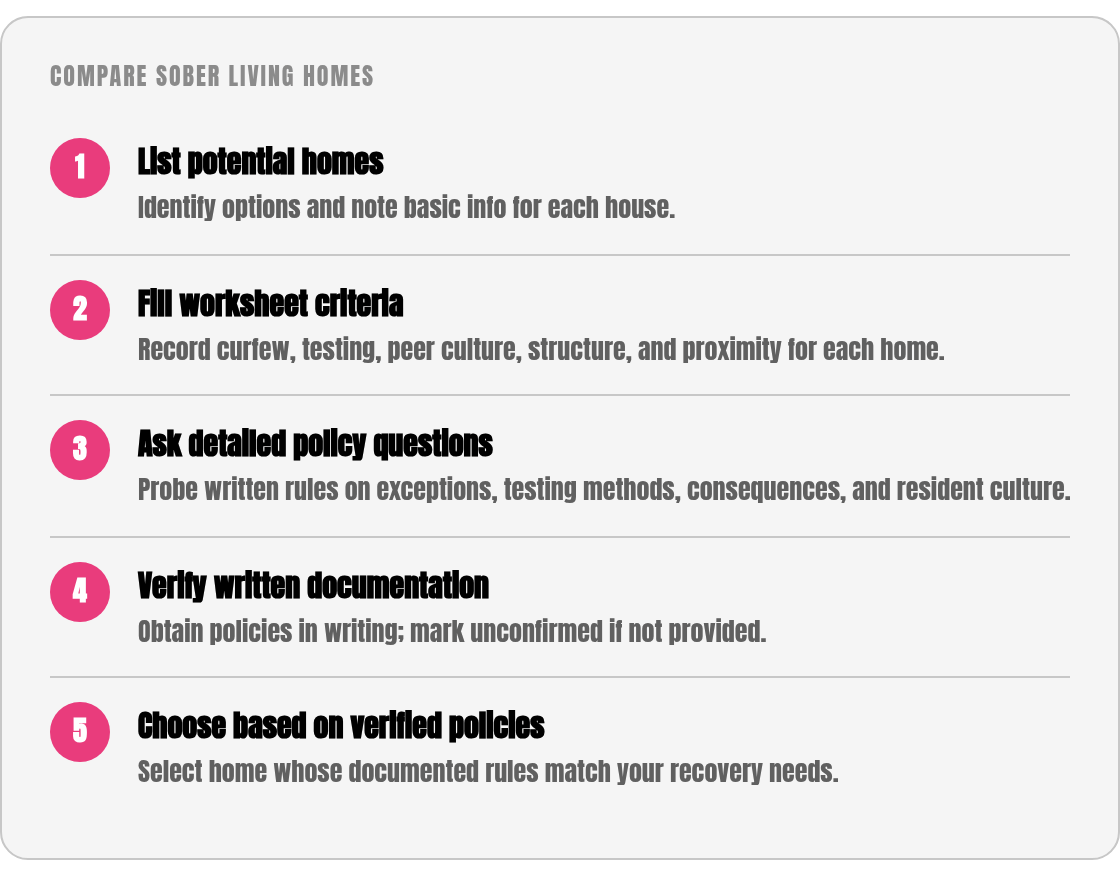
After detox, many people pick a sober living home by how close it is to family. Compare sober living homes on what they put in writing instead. A house five minutes from your parents can still run on loose rules. Use this worksheet to record what each option actually documents.
The research article cited below [1] describes many sober living houses as relying on informal monitoring, peer-led accountability, and 12-step or mutual-help structure rather than formal clinical treatment. That means "structured" can mean very different things across houses, so compare documented practices rather than claims.
| Home or Model | Curfew | Drug Testing | Peer Culture | Structure | Proximity |
|---|---|---|---|---|---|
| Independent rental | |||||
| Peer-run sober house | |||||
| Staffed structured home | |||||
| Our sober living home |
Ask each provider—including us—for current location, pricing, and availability in writing, and fill in our row the same way you fill in every other home.
- Curfew: The time residents must be home, and what happens after a missed curfew.
- Drug Testing: How often testing happens, whether it's random, and the consequence of a positive result.
- Peer Culture: Whether residents work, go to meetings, and hold each other accountable.
- Structure: Chores, house meetings, staff presence, and who enforces the rules.
- Proximity: Distance to work, family, meetings, and old using spots.
What the worksheet covers:
- Each house gets rated on five criteria: curfew, drug testing, peer culture, structure, and proximity to work, family, and meetings.
- Testing policies differ on fixed versus random scheduling, urine versus oral-fluid samples, who observes collection, and whether a missed test counts as positive.
- Written consequences for a positive test can range from a counseling referral and extra check-ins to temporary restrictions, transfer, or discharge.
- A clear curfew policy lists weeknight and weekend hours, explains how work, medical, and family exceptions get approved, and spells out escalating consequences.
- Applicant screening can include interviews, resident input, orientation, and a probationary period for new residents.
- Example scoring rule: award up to 35 points for written structure and curfew consequences, 25 for verified peer culture from current residents, 20 for documented testing policy, and 20 for proximity and practical access. Score unverified cells as 0. Compare totals only after you visit.
Curfew Policies: Ask About the Late Shift, Not the Time
Keep proximity as one scored column rather than the deciding factor. If a rule isn't written down, treat it as unverified. Visit on an ordinary weeknight and talk with current residents before you move in.
Curfew is a good place to start, because the posted time tells you very little. What tells you something is how the house handles a late shift or a family emergency. Ask each house to walk you through those situations.
Say your restaurant shift sometimes runs past curfew. Ask whether the house grants advance approval, who signs off, and what proof it wants, such as your manager's schedule. Ask the same about medical appointments and family visits. Plenty of houses decide these case by case and write nothing down. In those houses, you find out the rule the night you break it.
| Question | A clear answer includes |
|---|---|
| Hours | Weeknight and weekend times, in writing |
| Exceptions | How work, medical, and family requests get approved and documented |
| Verification | Resident check-ins, staff oversight, or access records |
| Consequences | Specific steps for a first and a repeat late arrival |
Houses verify arrivals and absences in different ways, and no single method is standard. Ask what each one actually does, not what it intends to do.
Also ask whether any state or local licensing, certification, or resident-rights rules apply to the home. Then confirm with that agency yourself.
Drug Testing: The Follow-Up Questions Matter More Than the Yes
Ask a house manager "Do you test?" and almost every one will say yes. That answer is nearly useless. The real information comes from the follow-ups.
Start with scheduling. Testing on a fixed schedule is something residents can plan around. Testing at random comes with little or no notice. Then ask who collects the sample, staff or another resident. Ask how often testing happens, what counts as a missed test, and whether a no-show gets treated as a positive.
What should a home put in writing about testing?
| Policy area | Questions to ask |
|---|---|
| Format | Urine or oral fluid (a mouth swab)? Who observes collection? |
| Results | Who sees them? Do family members or employers get results, and only with your consent? |
| Disputes | Can you request a confirmation test, and who pays for it? |
| Consequences | Which responses apply: counseling referral, more check-ins, temporary restrictions, transfer, or discharge? |
Ask every house for its written consequence and confirmation procedures, ours included. If a home can't hand you that page, treat its accountability as unverified. Be wary of any house that promises testing alone lowers relapse risk.
Peer Culture: What the House Actually Tolerates
House rules tell you what a home forbids. The residents show you what it tolerates. Those two lists don't always match. Visit each sober living home on your list in the evening and listen to how people talk about recovery.
Brochures often mention group meals, meetings, exercise, and chores. Treat each one as a question: what do residents actually do together? Ask how the house screens applicants, including interviews, resident input, orientation, and any probationary period. The cited research article [1] describes peer culture and 12-step involvement as among the main purported therapeutic factors in sober living houses, so treat those claims as things to verify rather than assume.
| Culture-fit check | Ask |
|---|---|
| Use on the premises | How did staff handle the last incident? |
| Pressure to ignore rules | Can residents report violations safely? |
| Frequent disruptive gatherings | Who approves guests? |
| Glamorizing past use | Does anyone address it? |
| Intimidation or unresolved conflict | Who settles disputes, and how? |
Hypothetical: An Evening in Two Sober Living Homes
In House A, residents cook dinner together and then leave for a meeting. A dispute over chores gets parked until the weekly house meeting. In House B, nobody mentions meetings, and one resident shrugs that the manager rarely checks in.
House B may sit closer to family. Distance won't tell you whether a house will help you keep your daily routines and accountability, so weigh the culture you come home to alongside the location.
Proximity vs. Structure: Ten Minutes From Mom Doesn't Mean Anyone Checks the Door
Location is one scored column, not a shortcut around the others. Use the example scoring rule above: give documented structure, peer culture, and testing more weight than the commute. The table below separates what proximity can give you from what still needs to be verified in writing.
| Factor | What proximity gives you | What to verify in writing |
|---|---|---|
| Commute | Shorter trips to work and meetings | Curfew exceptions for that commute |
| Family access | Easier visits | Guest rules and who approves them |
| Staffing | Nothing by itself | Who is on site, and when |
| Testing | Nothing by itself | Schedule, collection, and consequences |
Two Houses at the Same Distance Can Run Very Differently
Take two hypothetical houses, both a short drive from family. In the first, residents share recovery goals, go to meetings together, and hold each other to chores and curfew.
In the second, the rules slide. Friends drop by late, and stories about past use get laughs. From the driveway, both houses look the same. Ask the residents which one you're standing in.
MADE Recovery's Sober Living: Hold Us to the Same Worksheet
Calling a home "premium" proves nothing, including ours. Compare written policies against every other sober living home on your list, line by line.
When you contact us, ask for current documents, not a verbal summary. If a policy isn't in writing, mark that cell unconfirmed on your worksheet.
| Area | Ask us to confirm in writing |
|---|---|
| Curfew | Hours, exception approvals, how we check, consequences |
| Testing | Whether we test, fixed or random, specimen type, who sees results, response to missed or positive tests |
| Resident fit | How we evaluate applicants, set expectations, and involve current residents |
| Community | Which group activities happen, and how often |
How does coaching connect to house rules?
Ask whether sober coaching, if offered, ties into housing accountability. Find out who runs check-ins, what information reaches family with your consent, and how accountability meetings work. If coaching is described as nonmedical support, ask for that in writing, and confirm it does not replace care from outside professionals or treatment facilities. No house can promise sobriety.
What to Do Before You Sign a Sober Living Agreement
Print one copy of this checklist for each house you tour and fill it in while you're there. Oversight of sober living homes varies by state and by house, so give the oversight row as much attention as the curfew row. After your visits, add the points from the example scoring rule and compare the totals.
| Check | Write down |
|---|---|
| Curfew | Hours, exceptions, consequences |
| Testing | Method, frequency, response to positives |
| Peer culture and staffing | Who lives there, who is on site and when |
| Costs | Rent, fees, deposit, refund terms |
| Commute and family access | Travel time, visiting rules |
| Oversight | Licensing, certification, or affiliation |
On the tour, ask to see the written rules. Ask about privacy, daily routines, conflict resolution, discharge policy, and emergency procedures. The answers to the last two are the ones you'll care about most if things get hard.
How can families help without taking over?
With the resident's consent, family members can join tours, review agreements, and plan transportation. The resident makes the final choice and decides who sees personal information. Families who respect that line usually end up with more say, not less.
Check any oversight claim with your state licensing or certification body, your local housing authority, or a recognized recovery-residence organization. Then ask us for current services, availability, costs, and consultation terms in writing, and fill in our row like you did the rest.
References
[1] (PDF) A Clean and Sober Place to Live: Philosophy, Structure, and ... - https://www.researchgate.net/publication/23187624_A_Clean_and_Sober_Place_to_Live_Philosophy_Structure_and_Purported_Therapeutic_Factors_in_Sober_Living_Houses
Common Questions
What should I do if a sober living home won't put its rules in writing?
Treat any policy you only hear out loud as unconfirmed, and mark it that way on your comparison worksheet. Ask for current documents on curfew exceptions, testing consequences, and discharge. Then talk with residents on an ordinary evening to see whether daily life in the house matches what the documents say.
Does frequent drug testing mean a sober living home will keep me sober?
Drug testing does not guarantee sobriety, and no home should promise that testing alone lowers relapse risk. A test can detect prohibited use, may discourage it, and gives residents a regular accountability checkpoint. Peer culture and daily structure matter just as much. When you compare houses, ask whether tests are random, whether a missed test counts as positive, and whether you can request a confirmation test and who pays for it.
Is sober coaching at MADE Recovery a substitute for addiction treatment?
Ask MADE Recovery for a written description of any sober coaching. If a provider describes coaching as nonmedical support, confirm that in writing and ask whether it replaces care from outside professionals or treatment facilities. No house can promise sobriety. Before moving in, ask whether coaching ties into house accountability, who runs check-ins, and what information reaches family with your consent, and request those answers in writing.