Sober Living Homes vs Sober Coaches: Shelter or Real-World Sobriety?
November 1, 2026
What the research does and doesn't tell you, up front:
- Polcin and colleagues followed 245 sober living residents for 18 months. Residents improved on alcohol use, drug use, employment, psychiatric symptoms, and arrests.
- Fewer substance users in a resident's social network predicted better results on nearly every outcome in that study.
- Residents improved whether they arrived after inpatient care, during outpatient treatment, after incarceration, or with no treatment at all.
- More 12-step involvement was linked to fewer arrests and lower alcohol and drug use over the follow-up period.
- Sober coaching has little published outcome research. The evidence cited here doesn't compare coaching with sober living, and it doesn't report relapse rates for the first 90 days.
- Licensing and oversight vary by jurisdiction and by whether a service is classified as housing, clinical treatment, peer support, or coaching.
Which one fits your situation
If you need a substance-free place to live and a recovery-focused household, choose sober living. If you already have stable housing and need accountability in daily settings like work, travel, or family life, choose a sober coach after rehab. Some people use both for a stretch.
| Sober living home | Independent sober coach | Our coaching | |
|---|---|---|---|
| Setting | Shared alcohol- and drug-free house | Your home and daily life | Virtual or in person, at home, traveling, or in our sober living home |
| Structure | House rules, peer support, 12-step emphasis | Set by coach and client | One coach or a coordinated team |
| Personalization | Same rules for all residents | Varies by coach | Plan tailored after an initial consultation |
| Flexibility | Residents stayed as long as they wished in the homes studied | Fits your schedule | Support tapers as independence grows |
| Primary purpose | Stable recovery housing | Individual support in everyday life | Transition from treatment to everyday life |
| Evidence notes | Best evidence here is for sober living outcomes and recovery social networks | Limited published outcomes | Nonmedical support; we make no outcome claims |
Providers aren't overseen the same way. Ask any sober living home or coaching service, us included, how it's categorized, who supervises the work, and what standards apply.
Pick based on the next thing you have to get through. When the address itself is the risk, a shared house makes sense. When you're heading back to a job, a trip, or family life at home, coaching usually makes more sense.
Why the first months out are the real test
Treatment has structure around it. Someone else sets the schedule, everyone around you is sober, and nobody offers you a beer at 4 p.m. Then you leave detox, residential treatment, jail, or an unstable home, and every one of those decisions is yours again. Anyone who has done aftercare work for long has seen people do well in treatment, then struggle in the first few weeks back home.
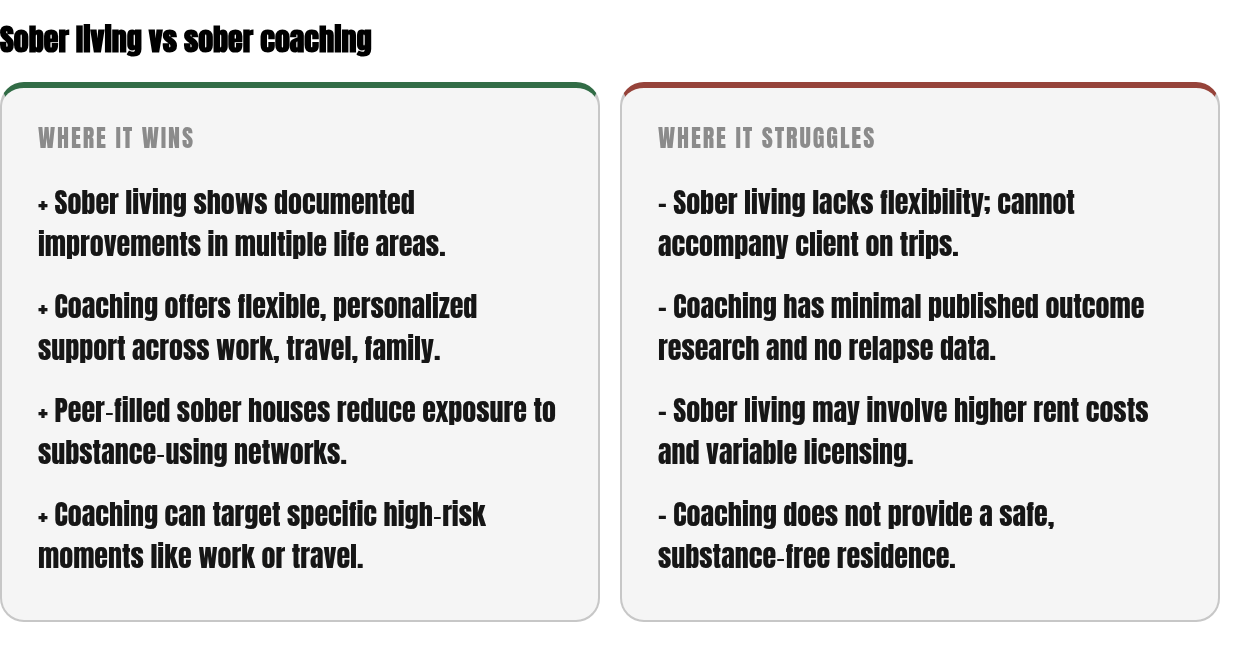
The data in this comparison comes from sober living, not coaching. The study followed new residents over time and found improvement across several parts of life, not just drinking and using. That fits what aftercare actually looks like. You aren't fixing one behavior. You're trying to get housing, work, relationships, mental health, and accountability steady at the same time.
Two findings matter most for planning: who surrounds you, and whether recovery routines are part of ordinary life. If the people around you still drink or use, a coach can help you plan around that exposure. A recovery house removes a lot of the exposure. If meetings, chores, curfews, and housemates going through the same transition help you, sober living may give you structure that coaching alone can't rebuild.
| Evidence status | What it covers |
|---|---|
| Covered | Sober living residents improved across multiple referral pathways |
| Covered | Recovery-oriented relationships and mutual-help involvement predicted outcomes |
| Not covered | Short-term relapse percentages immediately after discharge |
| Not covered | Direct head-to-head results for coaching versus sober living |
Since the research points most clearly at environment and relationships, skip the question "which service sounds more intense?" Ask which risk you're trying to solve: where you live, who you're around, or the milestones coming up.
What a normal day looks like in each
A sober living house hands you a routine before you've built your own. House rules, chore charts, and housemates heading out to meetings give each day its shape. A sober coach after rehab works the other way around. You keep your own schedule, and we help you plan for its hardest hours.
Those hours are usually social, which is why we plan around people as well as time slots. A recovery house can make evenings less lonely. It can't choose who sits next to you at work, what gets said at a family dinner, or how you get through the first stressful weekend after treatment.
| Hypothetical moment | Sober living house | Our coaching |
|---|---|---|
| First day back at work | Come home to peers who know how that day feels | Plan the commute, lunch, and after-work hours in advance |
| Family dinner | House rules give you a reason to leave early | Trigger list, exit script, and a check-in call afterward |
| Travel day | Leaving the house means leaving its structure | Coach support virtually or in person, plus logistics planning |
These are illustrations, not client stories. Neither option is more serious. The question is where your relapse pressure shows up. If home is safe and your days are already fairly steady, a house routine may add less than targeted coaching would. If your evenings are empty or the people closest to you still use, start with the house.
Cost, insurance, and how much each one bends
Price is one question. The other question is what you're buying: a bed in a recovery-focused house, or support that goes with you to work, family events, and trips. Get these answers before you compare.
| Question to ask | Sober living home | Our coaching |
|---|---|---|
| Do I need housing? | Yes, you rent a room | No, you stay home |
| What fits my budget? | Ask what rent includes | Ask what your consultation plan covers |
| Will insurance or Medicaid help? | Confirm with the house and your payer | Confirm with us and your payer |
| Where am I located? | You live at that address | Virtual or in person |
| Do I travel? | Ask about overnight rules | Support can travel with you |
| How much time can I give? | The house sets the routine | Set around your schedule |
How flexible is a sober coach after rehab?
Sober living means moving in. That's the right call when home isn't safe or your friends still use. It's a poor fit when you have stable housing, a job, and a family you aren't going to leave.
Coaching works around the life you already have. We work virtually or in person, at home, on the road, or in our sober living home. Don't assume either option is reimbursable. Get the answer in writing from the provider and from your insurer.
Flexibility has a downside too. A coach can work around a work calendar, a custody schedule, or a business trip. A house doesn't travel, and sometimes that's exactly why it helps. It gives you a protected base and a predictable routine during a period when too much freedom is a risk.
Using a house and a coach together
Nobody has tested the combination. The sober living researchers we rely on called for randomized studies to show whether the houses themselves cause the gains residents made. No one has run that kind of trial on a house plus a coach. So treat hybrid aftercare as a service design idea built from known ingredients, not a proven upgrade.
The pieces are straightforward. A house gives you a recovery-oriented residence and sober peers. A sober coach after rehab plans the moments the house never sees: your first week back at work, a flight through an airport full of bars, a holiday at your parents' place.
| Model | Where you live | Who plans milestones | Evidence status |
|---|---|---|---|
| Traditional home | Shared sober house | You and housemates | Observational outcome data |
| Coaching-only support | Your own home | You and a coach | Not studied in these sources |
| Integrated hybrid | Shared sober house | A coach, alongside house peers | Concept, untested |
A combination can help when two questions are open at once: where you'll live, and how you'll handle the real-world transitions ahead. Someone might need a substance-free residence while also preparing for work travel or hard contact with family. The house doesn't replace planning in that case, and coaching doesn't replace a safe place to sleep.
If you already have stable housing and a sober household, skip the hybrid. Coaching alone may cover your transition points. Before you combine services, check local housing rules, treatment-service licensing, coach credentials, privacy practices, and payer requirements. If housing is still unsettled, our piece Where to Live After Rehab: Sober Housing vs. Going Home covers that decision in more depth.
Before you sign a lease or book a call
Work through this list honestly. Each "yes" points toward a sober living house or a sober coach after rehab. If your answers split down the middle, that tells you something too.
| Checklist question | If yes, lean toward |
|---|---|
| Do you lack a safe, substance-free place to live? | Sober living |
| Do most people you see still drink or use? | Sober living |
| Do you want 12-step or peer involvement built into your days? | Sober living |
| Is your housing stable but your routines shaky? | Coaching |
| Are you returning to work or family soon? | Coaching |
| Do you travel often? | Coaching |
| Can you sustain rent more easily than coaching fees, or the reverse? | Whichever you can keep paying |
| Do you prefer residential or non-residential support? | Your answer decides |
Start with your address and the people around you
When your social circle or your housing is the problem, a recovery house deals with both at once. You get a different living environment, and you're surrounded by people who are also trying to stay sober. That's the setup the Polcin research measured, and it's the one with data behind it.
When housing is solid and the risk is concentrated in specific milestones, like a first day back, a business trip, or a holiday, coaching is the more targeted tool. We offer one coach or a coordinated team, virtual or in person, including travel. We'll help you build a plan. We can't promise how it turns out, and you should be wary of anyone who does.
When you answered yes on both sides, a hybrid may fit for a while. Before you commit, ask every provider, us included, what they actually deliver, how they're classified, and who's accountable for the work. Then book the consultation or tour that matches your biggest risk right now.
References
[1] Sober Living Houses for Alcohol and Drug Dependence - ResearchGate - https://www.researchgate.net/publication/42344760_Sober_Living_Houses_for_Alcohol_and_Drug_Dependence_18-Month_Outcomes
FAQ
1. Can a sober coach replace rehab or medical treatment?
No. A sober coach does not replace medical or clinical care. MADE Recovery provides nonmedical support, so we don't diagnose conditions, handle detox, or manage medications. Coaching is best understood as practical recovery support for daily life once appropriate clinical care is already in place.
2. Do I need to finish rehab before moving into a sober living home?
Not always. Some houses accept people from different starting points, while others have stricter admission requirements. Ask the specific sober living home what it requires, what level of abstinence it expects before move-in, and whether it coordinates with outside treatment providers.
3. Is there evidence that sober coaching works?
The research base for coaching is much thinner than the research base for sober living. MADE Recovery makes no outcome claims for its coaching. Judge any coach on scope, availability, credentials, communication style, boundaries, and whether the plan matches the situations you actually face.
4. Are sober coaches and sober living homes licensed?
Rules vary by location and service type. A residence, a peer-support service, a clinical program, and a coaching arrangement may fall under different standards. Ask providers how they are classified, what oversight applies, and what credentials or training the staff bring to the work.
5. Will insurance or Medicaid pay for sober living or a sober coach?
Do not rely on assumptions about coverage. Confirm payment details before you commit, and get the answer in writing from both the provider and the payer. Also ask what is included, what costs extra, and what happens if you need to change or end the arrangement.