Sober Living Homes vs. Moving Back Home: Which Protects Recovery?
August 28, 2026

Key Takeaways
- Three factors decide the housing choice after rehab: personal accountability, current relapse risk, and the strength of existing home support.
- Most relapses happen after rehab rather than during treatment, when people leave structured programs for unstructured living environments.
- A study tracking 300 sober living residents over 18 months found real gains in substance use, employment, and psychiatric symptoms.
- One program saw abstinence rates climb from just 11% at baseline to 68% within six months of structured living.
- Early recovery struggles usually stem from environment rather than lack of motivation or insufficient willpower among former patients.
- Moving back home can work when the household is genuinely stable and sober, but structure wins for high-risk individuals.
The Real Question: Sober Living or Your Old Room?
The choice between a sober living home and moving back home comes down to three things: how much accountability you can hold on your own, how high your relapse risk runs right now, and how strong the support system already is at home. Get those three right and the housing decision mostly makes itself.
Here's the honest starting point. Life after rehab is where most relapses happen, not during treatment. In our experience, the people who struggle most in early recovery aren't the ones who lacked motivation. They're the ones who walked out of a structured program straight into an unstructured house.
That's why we push clients to weigh these factors before signing a lease or booking a flight home. The research backs this up. A study of 300 sober living residents tracked over 18 months showed real gains in substance use, employment, and psychiatric symptoms.
What Should You Weigh When Choosing Where to Live After Rehab?
Three factors decide it: personal accountability, relapse risk, and home support strength. If you score low on accountability or high on relapse risk, structure wins. If home is genuinely stable and sober, moving back can work. Life after rehab rarely fails on willpower. It fails on environment.
The abstinence data makes the environment case hard to ignore. In one program, abstinence rates rose from 11% at baseline to 68% at six months, and another moved from 20% to 40%, per the same sober living research. Those numbers aren't magic. They come from removing the drug- and alcohol-free environment problem at the source.
Douglas Polcin put it plainly: "Lack of a stable, alcohol- and drug-free living environment can be a serious obstacle to sustained abstinence." Read that as a test. If your home fails that one line, a sober living house is probably the safer call.
Which Option Fits Which Situation?
Here's how we map the common cases. This isn't about which option is "better." It's about which one matches your three factors.
| Factor | Sober Living Home | Moving Back Home | Sober Coaching (MADE Recovery) |
|---|---|---|---|
| Best for | High relapse risk, weak home structure | Stable, sober, supportive household | Accountability without relocating |
| Structure | House rules, chores, 12-step attendance | Self-directed | Built around your own routine |
| Residency length | Open-ended while compliant | Permanent | No residency required |
| Cost | Resident-paid, unlicensed | Low or none | Coaching fee |
| Peer community | Built-in | Depends on family | Coach-led, one-on-one |
Sober living's open-ended stay is a real edge. Residents can stay as long as they comply with house rules, unlike fixed-term halfway houses. Average stays of 254 and 166 days in the studied programs both beat the recommended 90-day minimum.
If home is your plan but you need accountability, that's where we fit. We coach clients who move back home but still need structure, offering customized programs that help them establish daily routines and stay accountable as they reintegrate. The gap between "I'm home" and "I have support" is exactly what a sober coach fills.
Does the Neighborhood Matter More Than the Rules?
Yes, often as much. Research on 557 sober living residents found that homes near more self-help groups produced better recovery outcomes, and that community factors like alcohol outlet density mattered, per this social model recovery analysis.
Our take: choosing where to live is a geographic decision, not just a housing one. A sober living house surrounded by liquor stores can underperform a supportive home in a quiet, low-risk neighborhood. Before you rule out home, check what's within walking distance of both options. Sometimes the "safer" choice on paper sits in the riskier zip code.
What the Numbers Actually Say
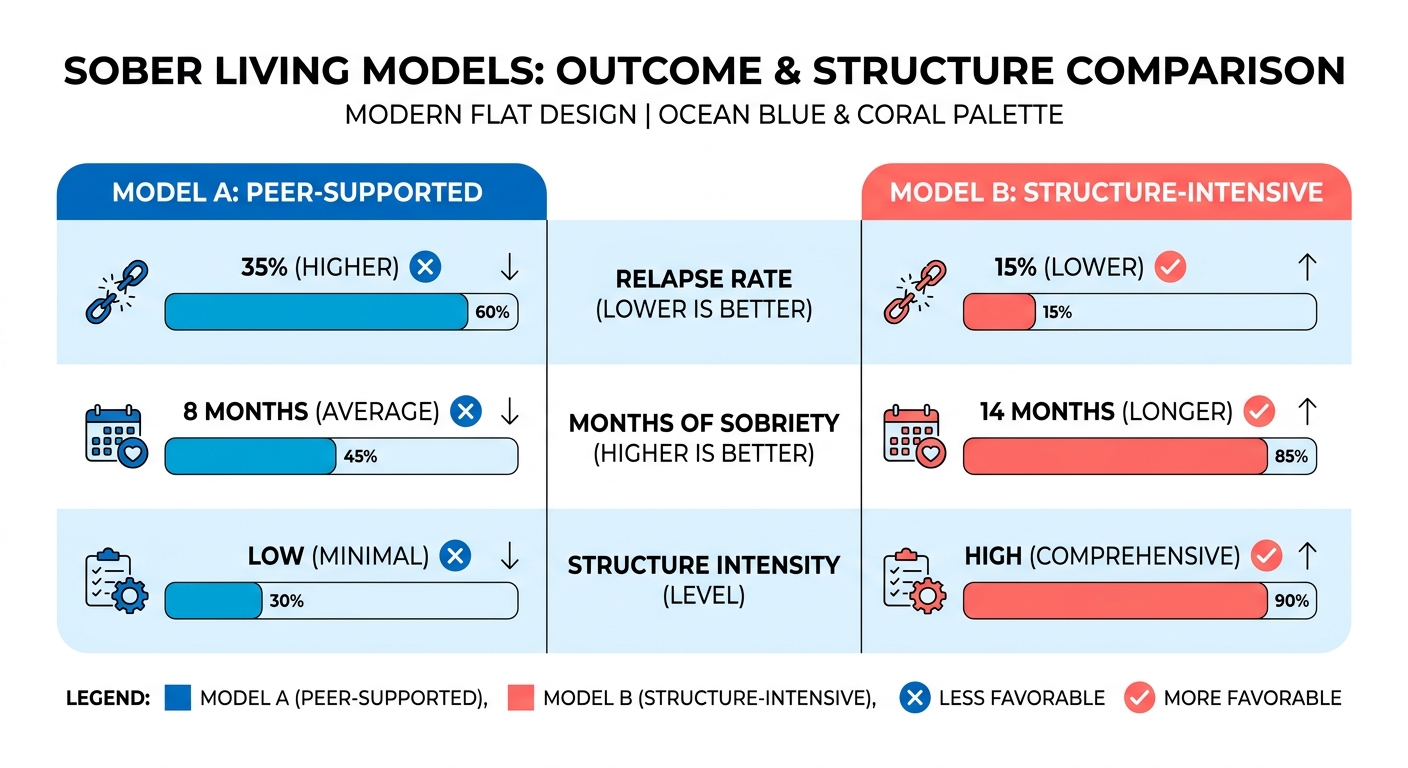
The numbers that matter most in life after rehab aren't from treatment. They're from the months after discharge. Polcin's team tracked residents across two sober living models and found that the size of the improvement depended heavily on the structure each house imposed, not on how motivated residents were walking in.
The gap between the two reflects structure, not willpower. The stronger performer required residents to stay enrolled in outpatient treatment, a built-in accountability layer the other house didn't have. In our experience, that's the consistent pattern: the environment does work that willpower alone can't sustain.
The 18-Month Data on Life After Rehab
The honest answer on long-term outcomes depends on which model you're comparing. Research on the Oxford House model, a self-governed, democratically run structure, shows 70% sobriety success at 18 months versus 30% for those who moved back home. A separate analysis of a broader SLH population puts the 18-month abstinence figure closer to 42%.
Both numbers are real. The 70% reflects what happens when residents self-select into a high-accountability model and pay their own way. The 42% is the floor across all SLH types, including lower-structure houses. Our read: if you're comparing sober living to going home, the relevant ceiling is closer to 70%, but only if the house runs on genuine peer accountability, not just a curfew.
How the Three Options Compare
| Factor | Sober Living Home | Moving Back Home | Sober Coaching |
|---|---|---|---|
| Accountability | Built-in (peers, rules, meetings) | Depends on family dynamics | Structured; coach-led |
| Trigger exposure | Low; drug/alcohol-free environment | Variable by household | Variable; client stays in own environment |
| Typical duration | Open-ended; avg. 166–254 days in research | Indefinite | Scales to client need |
| Cost | Self-funded; no state subsidy | Lowest upfront | Varies by support level |
| Best for | High relapse risk, weak home environment | Strong support, low relapse risk | Any risk level needing structured guidance |
Local community integration plays a massive role in preventing isolation. When a resident can easily walk to community centers, employment agencies, or recreational facilities, they build a new life faster. The physical ease of connecting with the local recovery community helps solidify the habits learned in treatment.
Where Sober Coaching Fits In
Sober living and going home aren't the only two options. For clients returning to a supportive household who still require an extra layer of clinical-style oversight, professional guidance bridges the gap. At MADE Recovery, our coaches work directly with clients to design daily schedules, establish clear boundaries with family members, and conduct regular drug screenings. This separates the physical housing decision from the support decision, ensuring that even a standard home environment can be reinforced with professional accountability.
The 90-day threshold is a critical benchmark for brain chemistry stabilization and habit formation. Clients who treat early recovery as a brief transition phase often underestimate the time required to build new neural pathways. Extending structured support past this initial three-month window significantly improves long-term outcomes.
The Commitment Test Most People Skip
The decision about life after rehab comes down to a single question most people skip: can you commit to structured living for the next three to eight months? That's the real test hiding underneath the sober living versus home debate. Everything else follows from your answer.
Here's why the commitment question comes first. Long-term tracking shows that the benefits of transitional housing accumulate over several months, far exceeding the standard brief stay. Leaving prematurely often interrupts the process of building independent coping mechanisms. If committing to a multi-month stay feels daunting, it is worth exploring alternative structured support systems that can adapt to your timeline.
Which Option Fits Your Situation?
Match your circumstances to the three factors we've weighed throughout: accountability, relapse risk, and support strength. Here's how they sort into a clear recommendation.
| Your situation | Best choice | Why |
|---|---|---|
| Relapse history, weak home support, ready to commit 3+ months | Sober living home | Structure and peer accountability do the work willpower can't hold alone |
| Strong sober family, low relapse risk, stable routine at home | Move back home | The support system already exists; added structure is redundant |
| Home is a trigger-heavy or using environment | Sober living home | A drug-free environment beats a destructive home setting every time |
| Can't commit to 90+ days of house rules | Home plus coaching | Below the threshold, a home works better with added accountability layers |
Does the Neighborhood Change the Answer?
Yes, and this is the factor almost nobody weighs. The local environment surrounding a residence can either reinforce recovery or constantly challenge it. Choosing a location with easy access to employment opportunities, green spaces, and positive social outlets helps replace old habits with healthy new routines.
Our take: the external environment acts as a silent partner in your recovery. A residence situated in a high-stress urban center or an area associated with past substance use can trigger cravings, regardless of how strict the house rules are. Before finalizing your living arrangements, map out the surrounding blocks to ensure they align with a calm, focused lifestyle.
The One Thing Both Paths Share
Neither option works in isolation. The strongest predictor of staying sober wasn't the address. It was social connection. As Rachael Korcha put it, "Involvement in 12-Step groups was the strongest predictor of positive outcomes in our study."
That's the honest bottom line. A sober living home wins when your home is unstable, your relapse risk runs high, and you're ready to commit the months it takes. Home wins when you already have sober people around you and a routine that holds.
Whichever you pick, don't walk out of treatment into an empty schedule. If your home environment is workable but you need accountability to hold it together, structured coaching can bridge that gap. Weighing a coach against a sober living house is often the smarter version of the same decision. The environment carries the recovery. Choose the one that carries yours.
References
[1] What Did We Learn from Our Study on Sober Living Houses ... - https://pmc.ncbi.nlm.nih.gov/articles/PMC3057870/
[2] What Is A Sober Living Home? - https://www.addictioncenter.com/treatment/sober-living-homes/
[3] What Is A Sober Living Home? - Addiction Center - CAESdQHrOzAV9wGQrx9cxY-_YPxZAAW_pte9HFMn39wCoVOaewqEeo0-vv6TkVIqGIFi28ZqqbBNqMO2HMMHgWMK5GbSt9Si5BZ3tBhN9YIkV_vbULPlLUGQ5EoRiHFvXj0ZVjgg4tjdBCyuShZXvIyV-fHS7MHWYQ
[4] Where to Live After Rehab Ends: Rehab Aftercare Options - https://americanaddictioncenters.org/rehab-guide/aftercare/where-to-live-after-rehab
[5] Moving Social Model Recovery Forward: Recent Research on ... - https://pubmed.ncbi.nlm.nih.gov/37125214/
[6] (PDF) What Did We Learn from Our Study on Sober Living ... - https://www.researchgate.net/publication/49821781_What_Did_We_Learn_from_Our_Study_on_Sober_Living_Houses_and_Where_Do_We_Go_from_Here
[7] "A lot of moving parts": Recovery home challenges linking ... - https://pubmed.ncbi.nlm.nih.gov/39106919/
[8] Moving Social Model Recovery Forward: Recent Research ... - https://www.researchgate.net/publication/366990091_Moving_Social_Model_Recovery_Forward_Recent_Research_on_Sober_Living_Houses
[9] Sober Living Houses for Alcohol and Drug Dependence - https://www.researchgate.net/publication/42344760_Sober_Living_Houses_for_Alcohol_and_Drug_Dependence_18-Month_Outcomes
[10] Oxford House: A Review of Research and Implications for ... - https://www.researchgate.net/publication/279415804_Oxford_House_A_Review_of_Research_and_Implications_for_Substance_Abuse_Recovery_and_Community_Research
Frequently Asked Questions
1. How long should I stay in a sober living home to see real benefits?
Plan for at least 90 days to allow your brain and habits to stabilize. Research indicates that extended stays yield significantly better outcomes because they allow residents to practice real-world coping skills while maintaining a safety net. Leaving too early often disrupts this critical integration phase before new routines become second nature.
2. Can moving back home ever be safer than a sober living home?
Yes, moving home can be the safer choice if your family environment is highly supportive, entirely substance-free, and aligned with your recovery goals. If your home offers a calm, low-stress atmosphere away from old triggers, it can provide a more nurturing foundation than an under-regulated or poorly located transitional facility.
3. What if my home is supportive but I still need daily accountability?
Sober coaching is designed specifically for this scenario. A professional coach can implement structured check-ins, goal-setting exercises, and regular drug screenings right in your home. This allows you to benefit from the comfort of your family environment while maintaining the rigorous personal accountability required to prevent relapse.
4. Why do most relapses happen after rehab rather than during treatment?
The transition from a highly controlled clinical setting to everyday life presents a massive psychological shift. In rehab, every hour is scheduled and triggers are entirely removed. Once discharged, individuals must navigate stress, old associations, and unstructured time on their own, making the immediate post-treatment environment the ultimate test of recovery.
5. How much does the neighborhood around a sober living home actually matter?
The surrounding neighborhood is crucial because it dictates your daily exposure to triggers and your ease of access to positive resources. A home located near public transit, employment opportunities, and active recovery communities makes it much easier to build a healthy, active lifestyle than one isolated from these essential supports.
6. What's the difference between a sober living home and a halfway house?
Sober living homes generally offer flexible, open-ended residency, allowing individuals to transition at their own pace as long as they follow house guidelines. In contrast, halfway houses are often state-funded, require active outpatient treatment enrollment, and impose strict, government-mandated limits on how long a resident can stay.
7. What single factor predicts staying sober more than housing choice?
Active participation in a supportive peer community is the strongest predictor of long-term sobriety. Building deep connections with others who share your recovery goals provides the emotional safety net and mutual accountability needed to navigate difficult moments, far outweighing the physical structure of any building.