Sober Living Homes vs Independent Coaching: Accountability or Flexibility by Recovery Stage
November 2, 2026
What You Need to Know
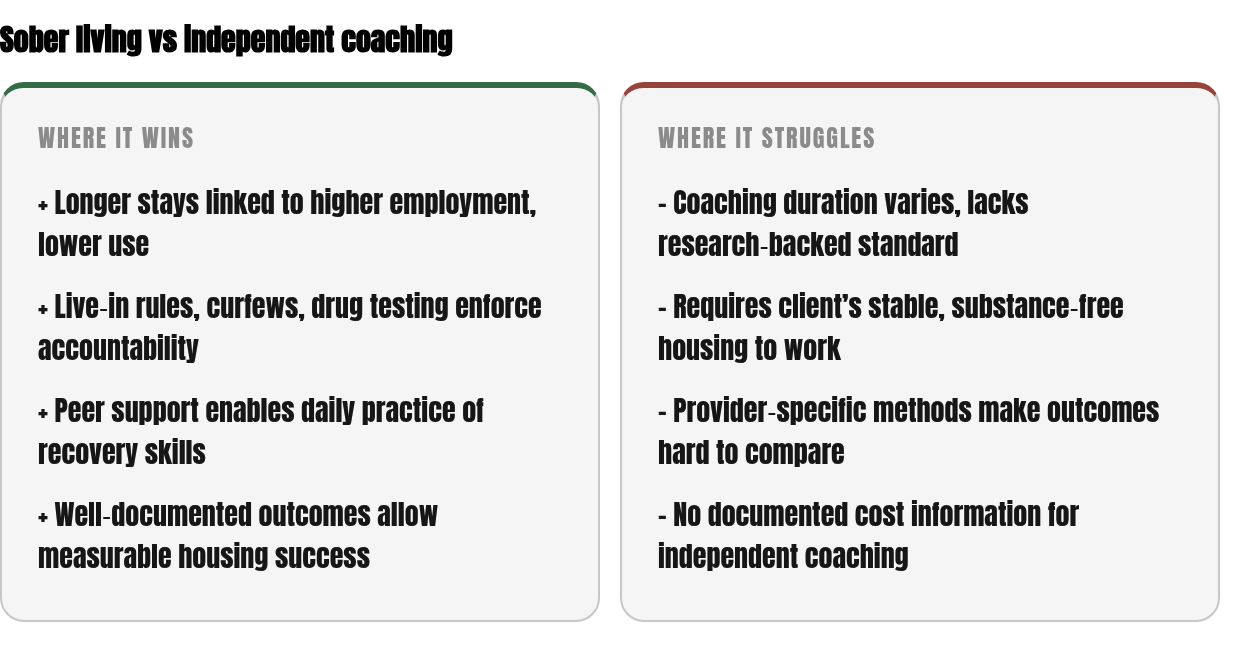
- Sober living residents who stayed longer showed higher employment rates and lower substance use than early leavers.
- Research documents sober living's structure and duration clearly, but comparable evidence for independent coaching engagement length remains provider-specific and unverified.
- Sober living homes often provide live-in accountability through house rules. Many also use curfews, drug testing, and peer support. Stays vary by house, and rules and duration differ.
- Independent coaching offers flexible scheduling and nonresidential support but requires stable housing and self-regulation to manage triggers between sessions.
- Oxford House residents stayed for about a year, with many remaining longer to maintain peer accountability and environmental supports.
- Outpatient clients using structured sober living during treatment had better discharge outcomes and longer treatment stays than those without housing support.
The Short Version
Sober living and independent coaching solve different problems. A recovery home changes the resident's daily environment. Coaching adds individualized guidance without replacing housing. The best fit depends on recovery stage, home stability, relapse exposure, and the person's ability to follow a plan when no one is physically present.
Sober Living vs. Independent Coaching: What the Evidence Shows
| Factor | Sober Living Homes | Independent Coaching | MADE Recovery (Coaching + Sober Living) |
|---|---|---|---|
| Best Fit Stage | Post-treatment transition, early recovery | Provider-specific; verify readiness requirements | Post-detox or residential treatment |
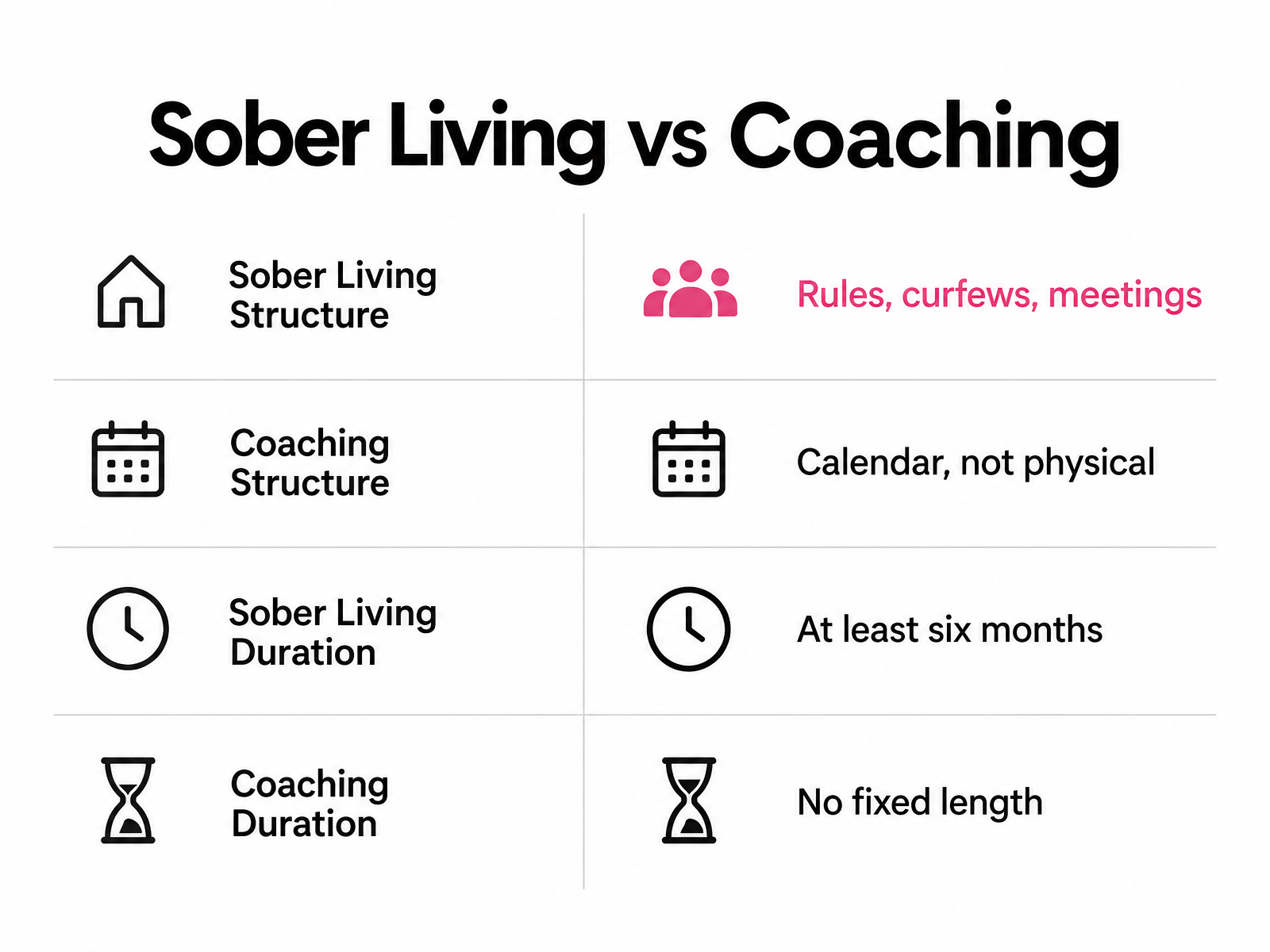
| Structure & Accountability | Live-in environment with house rules; many homes add peer support, curfews, or drug testing | Varies by provider; session frequency and accountability methods require confirmation | Team-based coaching with in-person or virtual sessions; optional sober living integration |
| Typical Engagement Length | 90 days to 12 months is common; confirm house policy | Not documented in available research; ask provider directly | Customized; tapers as independence increases |
| Cost Range | Generally lower than residential treatment; typically out-of-pocket | Provider-specific; not covered in available research | Contact for pricing |
The comparison exposes an evidence gap. Sober living outcomes are well documented, in part because researchers can define the setting, observe participation, and measure housing-related outcomes. Independent coaching is less standardized because providers differ in contact frequency, practitioner background, goal-setting methods, crisis availability, and coordination with treatment.
Two takeaways stand out: structure trades autonomy for environmental protection, and support should become less intensive only as capacity grows. A calendar date alone does not establish readiness; employment, safe relationships, consistent participation, and the ability to handle stress without returning to use are more useful markers.
When the Decision Actually Matters
When someone leaves detox or residential treatment, the key question is whether support belongs in the person's surroundings or can work through scheduled conversations.
In a recovery residence, accountability is continuous and social. Residents see how others manage cravings, conflict, work, and ordinary responsibilities. They experience immediate consequences when their choices affect the household. That setting can make recovery practices part of everyday life rather than tasks reserved for treatment appointments.
Independent coaching places responsibility elsewhere. The coach can clarify goals, prepare for difficult situations, review setbacks, and identify warning signs. The client still controls the hours between contacts. That distinction matters for someone whose home contains substances, conflict, isolation, or relationships connected to previous use.
Duration and What Drives It
Research on extended structured support suggests that recovery does not always align with a short program timetable. People need enough exposure to ordinary pressures—paychecks, family contact, boredom, workplace tension, and social invitations—to practice responding differently while support remains nearby.
Housing duration is better understood as a readiness issue, not a fixed prescription. A resident may be physically abstinent but still lack income, transportation, supportive relationships, or a workable plan for evenings and weekends. Someone with a safe home and dependable community support may be ready for more autonomy sooner.
Coaching cannot be evaluated through residence metrics because it does not control where the client lives. MADE Recovery provides virtual and in-person options that can be adjusted as needs change. When reviewing any coaching service, ask how the provider decides when to increase or reduce contact, how progress is documented, and whether support is available around predictable high-risk events.
Who Needs Housing Versus Who Needs Coaching
Housing is generally the stronger starting point when the person's surroundings actively undermine sobriety. That includes living with people who use substances, returning to relationships organized around prior use, or having no dependable place to stay. In those circumstances, even excellent planning may collapse because the client must repeatedly resist the same cues without environmental reinforcement.
The broader outcomes examined in research on sober living residents include substance use, employment, legal involvement, and psychiatric symptoms. This scope matters because recovery stability is rarely defined by abstinence alone. Housing can create room to address several connected problems without expecting one weekly conversation to carry the entire plan.
Coaching is more plausible when the environmental foundation is already in place. A client may have supportive relatives, a substance-free apartment, reliable transportation, established treatment relationships, and enough stability to recognize risk before a crisis develops. The coach can then focus on decisions and follow-through rather than trying to compensate for unsafe surroundings.
A blended plan may be appropriate when needs overlap. Someone can use recovery housing for day-to-day stability while working with a coach on career decisions, communication, or the eventual move into an apartment. Another client may begin coaching shortly before leaving a residence so that the support relationship is already established during the transition. The distinction between residential treatment and recovery housing further shows why housing, clinical care, and coaching should not be treated as interchangeable services.
The coaching evidence base remains harder to generalize because "recovery coach" can describe markedly different programs. We offer customized support through an individual coach or coordinated team, depending on need. Prospective clients should examine what the service includes rather than relying on the coaching label.
Recovery Stages and Matching Support Models
Recovery planning often divides the transition into early, middle, and extended phases. These are practical planning categories rather than validated clinical stages, and people may move through them at different rates. Relevant factors include prior relapse patterns, severity of substance use, psychiatric needs, family circumstances, and the safety of the intended home.
Many recovery residences do not impose a universal departure date. Polcin's research team notes that continued residence may remain available while the person benefits from the setting and meets program expectations.
What Each Phase Asks of You
| Phase | Planning focus | What the sober living evidence says |
|---|---|---|
| Early (first 90 days) | Establishing routines, attending meetings, and connecting with sober peers | Initial support should be long enough for residents to practice a stable daily pattern (St. Christopher's) |
| Middle (3 to 6 months) | Taking on work, school, or other real-world responsibilities | Progress can be assessed through reliability, participation, and the ability to recover from ordinary setbacks |
| Extended (6+ months) | Preparing to sustain independence outside the residence | Additional time may be useful when housing, mental health, employment, or relationship risks remain unresolved |
A stage-by-stage readiness tool can make these phases observable:
- Early: Can the person keep a daily routine, attend meetings, and stay connected to sober peers? If not, do not reduce structure.
- Middle: Is the person reliable at work or school, participating in the household, and recovering from ordinary setbacks? Repeated setbacks or missed contact are escalation triggers—increase contact before a return to use.
- Extended: Are safe housing, income, ongoing care, supportive relationships, transportation, and a strategy for predictable triggers functioning outside the residence? If any remains unresolved, delay departure rather than relying on a calendar date.
Where Coaching and Blended Support Fit
Different situations call for different combinations. A client preparing for a difficult family gathering may use coaching to set boundaries and plan an exit. Someone taking a first overnight trip can identify check-in points and nearby support before leaving. A person starting a new job may need help reconciling work demands with recovery commitments.
We can provide coaching alongside housing or as a nonresidential service. The house supplies a stable setting and shared expectations. The coach helps translate broad recovery goals into decisions tied to the client's work, family, travel, and future housing. Independence should expand as the person demonstrates the ability to use it safely.
Premium Sober Living Homes: Structure and Early-Stage Accountability
A sober living home is designed around abstinence, but it is not the same as detox, inpatient care, or residential clinical treatment. Its primary function is to maintain a recovery-supportive household where residents can resume ordinary life without immediately losing all external accountability.
Research on sober living environments suggests that the setting matters because behavior is shaped by repeated social contact. Residents are not only following policies. They are spending time with people whose routines, expectations, and relationships are organized around recovery.
The Daily Structure You'll Actually Live
Daily life usually combines personal obligations with household participation. Residents may attend peer-support meetings, complete assigned chores, respect curfews, join house discussions, and remain accountable for school, employment, or volunteer commitments. Newer residents may have less freedom until they demonstrate consistency.
This routine turns abstract goals into observable behavior. "Be responsible" becomes arriving home as agreed, communicating schedule changes, paying required expenses, maintaining shared spaces, and showing up for work or appointments. House meetings also help resolve tensions before they become reasons to leave or return to use.
Program rules vary, so applicants should ask what attendance is required, whether outside treatment is expected, how drug testing is handled, what visitors are permitted, and how privileges are earned. The word "premium" does not itself establish clinical quality, staffing standards, or a particular accountability model.
The Accountability Mechanism That Actually Works
Rules are useful only when they preserve a community in which recovery-supportive relationships can develop. A curfew creates predictability for the household. Shared responsibilities make reliability visible. Peer meetings reduce the isolation that can allow problems to remain hidden.
Communal living also brings friction. Residents must negotiate noise, privacy, chores, personalities, and differences in recovery experience. That difficulty can be productive when the house has fair expectations and a workable process for addressing conflict. It gives residents an opportunity to practice communication and emotional regulation before those same pressures arise in less protected settings.
The move from intensive care to ordinary life can otherwise be abrupt. Background information on sober living homes describes their transitional role. Residents regain practical responsibility while retaining a substance-free base. Budgeting, commuting, job searches, meal planning, and relationship repair can occur without the full restrictions of treatment or the total autonomy of living alone.
For contrast, independent coaching provides planned guidance without supervising the client's household. A coach can help prepare for a stressful week or review a poor decision, but cannot ensure that roommates, visitors, or family members respect recovery boundaries.
How to Choose What Fits
Choosing between sober living and independent coaching requires an honest assessment of what happens outside appointments. Consider motivation, access to substances, household relationships, daily responsibilities, transportation, income, and the reliability of existing support.
Start with Time Since Treatment and Current Stability
Someone leaving an intensive program should distinguish clinical discharge from readiness for unrestricted independence. Completing care confirms that a phase has ended. It does not automatically resolve housing problems, rebuild a social network, or establish a sustainable daily routine.
Structured housing can provide a transitional foundation when the next environment is uncertain. The important question is whether the person can protect recovery during unplanned moments, not merely whether they can describe a strong plan during an appointment.
Coaching may fit a client whose surroundings are already safe and whose recovery practices continue without direct supervision. Before selecting that path, examine evenings, weekends, conflict, loneliness, and access to former contacts. These are often the conditions under which the difference between scheduled and environmental accountability becomes visible.
Assess Your Need for Daily Structure and a Recovery-Supportive Environment
Ask what currently keeps the day organized. If routines depend on staff reminders, transportation assistance, or immediate peer intervention, removing all of those supports at once may be premature. A residence can preserve enough structure for the person to practice managing obligations incrementally.
A coach can support someone who already performs those tasks but wants focused assistance with planning and accountability. Because comparative research does not establish a universal coaching model, prospective clients should ask how goals are tracked, whether family or clinicians can be involved with consent, and how the coach responds when contact is missed or risk increases.
Employment, Family, Housing, and Autonomy Needs
Shared housing can simplify some parts of recovery while complicating others. House schedules may conflict with shift work, parenting, travel, or an established career. Costs, transportation, roommate compatibility, and proximity to treatment or employment also affect whether the arrangement is sustainable.
Autonomy should not be treated as an all-or-nothing choice. Programs may allow residents to earn greater freedom, while coaching can be added around specific responsibilities. The useful question is which freedoms the person can manage now and which still require guardrails.
Hybrid services deserve careful review because the same label may cover different arrangements. Determine whether coaching is integrated with the residence, whether information is shared between providers, who manages clinical concerns, and whether support continues after the client moves.
| Decision Factor | Sober Living Home Likely Fits | Independent Coaching or Blended Support May Fit |
|---|---|---|
| Time since treatment | Immediate transition with unresolved environmental risks | Established stability or dependable support already in place |
| Living environment | Housing is unsafe, uncertain, or connected to active use | Home is substance-free and relationships reinforce recovery |
| Relapse history | Repeated setbacks suggest a need for environmental guardrails | Risks are recognized early and managed with existing resources |
| Structure needs | Daily expectations and visible accountability remain necessary | The person follows routines without continual supervision |
| Employment/autonomy | Work habits and independent-living skills are still developing | Career, parenting, travel, or location make shared housing impractical |
Confirm Clinical and Provider-Specific Details Before Choosing
Research can describe recovery housing as a category, but the quality and rules of individual homes still vary. Coaching varies even more. A sound decision requires reviewing the actual service agreement rather than assuming every provider follows the same model.
Ask who delivers support, what qualifications they hold, how often contact occurs, how progress is reviewed, and which needs fall outside the program's scope. Clarify whether therapy, medication management, outpatient treatment, or peer-support participation must be arranged separately.
Relapse policies also require direct discussion. One provider's overview explains that a home may discharge a resident after renewed substance use because it is not equipped to provide acute clinical care. Applicants should learn the specific policy, whether re-entry is possible, and who coordinates a return to treatment when necessary.
For blended care, identify one person responsible for coordination. Without that role, a house manager, coach, therapist, and family member may each assume someone else is monitoring a developing problem. Written consent and clear communication boundaries can help prevent that gap.
Call us at 661-369-6255 to discuss your recovery stage, structure needs, flexibility preferences, and whether our services fit.
References
[1] What to Expect in a Sober House: Structure, Cost & Rules - https://www.vanderburghhouse.com/ultimate-sober-house-guide/
[2] How Long Should Someone Stay in a Transitional Sober Living Home? - https://recoveryfirst.org/sober-living/how-long-stay/
[3] Sober Living Homes vs Residential Treatment: Key Differences - https://lighthouserecovery.com/sober-living-homes-vs-residential-treatment-key-differences/
[4] The Role of Recovery Housing During Outpatient Substance Use Treatment - https://pmc.ncbi.nlm.nih.gov/articles/PMC8748296/
[5] How Long Does a Sober Living Home Usually Last? - https://www.addictionwellness.com/blogs/sober-living-stay-length
[6] Rules & Expectations in Sober Living Homes - Gambit Recovery - https://www.gambitrecovery.com/sober-living-rules
[7] What Did We Learn from Our Study on Sober Living Houses and Where ... - https://pmc.ncbi.nlm.nih.gov/articles/PMC3057870/
[8] What Is a Sober Living Home? Rules, Cost, and Benefits - https://carolinacenterforrecovery.com/addiction-blog/what-is-a-sober-living-home/
[9] Recovery in context: Sober living houses and the ecology of recovery - https://www.researchgate.net/publication/344303581_Recovery_in_context_Sober_living_houses_and_the_ecology_of_recovery
Frequently Asked Questions
1. Can I use independent coaching while living at home with family who doesn’t support my recovery?
You can use coaching, but it should not be mistaken for control over the household. Discuss whether you have a private place for sessions, reliable transportation, supportive contacts outside the family, and a plan for leaving situations that threaten sobriety. If those protections cannot be created, housing may need to be addressed separately before a nonresidential plan is realistic.
2. What happens if I relapse while living in a sober living home?
The result depends on the home’s written policy and available resources. Before admission, ask who is notified, whether testing is confirmed, where a resident is referred for assessment, how belongings are handled, and whether returning later is possible. A recovery residence is not a substitute for detoxification or acute treatment, so renewed use may require transfer to a clinical level of care.
3. How do I know if sober living is enough, or if I need more time?
Do not decide from elapsed time alone. Review whether you have safe housing to move into, dependable income or a realistic work plan, ongoing care, recovery-supportive relationships, transportation, and a strategy for predictable triggers. A move makes more sense when these pieces function outside the residence rather than existing only as future intentions.