Sober Coaching Sessions: Weekly Check-Ins or 24-Hour On-Call Access?
October 31, 2026

Quick Answers
- Relapse risk peaks during the first 90 days after treatment, according to Ashley Addiction Treatment, so coaching support usually concentrates in that window.
- Ashley's coaching model pairs round-the-clock availability with a scheduled block that runs from a few hours each day up to 40 hours a week.
- Futures Recovery Healthcare says the right level of support is the minimum that keeps a client stable. Its hiring checklist includes a question about emergencies.
- None of the cited sources shows that faster coach response times lead to better recovery outcomes.
- Published descriptions confirm that a 24/7 support layer exists. They leave response time and contact method undefined, which makes it hard for families to compare providers.
- Caron says many clients pay out of pocket for sober coaching, whether they choose weekly sessions or on-call access.
- A 24-hour sober coach does not live with the client. Continuous on-site presence is the job of a sober companion.
Why the choice matters most in early recovery
Leaving detox or residential treatment means trading a full daily structure for a lot of unstructured time. Ashley Addiction Treatment describes heightened relapse risk after treatment, particularly in the early months. Coaching can help bridge that move from a facility schedule back to ordinary life.
That is where the weekly-versus-on-call question gets real. A sober coach after rehab has to cover the first Friday night home, the first work trip, and the first family event where everyone else is drinking. Our coaching is nonmedical. It runs alongside therapy and medical care and replaces neither.
Let the calendar set the level of support
The sources don't agree on how much coverage is standard. Ashley Addiction Treatment describes availability outside scheduled coaching. Futures Recovery Healthcare focuses on matching support to the client's stability and progress.
Both positions hold up, because they answer different questions. Ashley is describing what a coaching package contains. Futures is describing what one person needs.
Our recommendation is to treat on-call access as something specific circumstances switch on: travel days, high-risk settings, the early weeks after treatment. When those pass, support can step back to scheduled check-ins.
Weekly check-ins give you a fixed point of accountability. 24-hour access gives you someone to call when a concern comes up. The available sources don't establish that either format produces better outcomes, so anyone telling you otherwise should show their data.
| Feature | Weekly Check-Ins | 24-Hour On-Call | MADE Recovery Hybrid | Typical Client Fit |
|---|---|---|---|---|
| Session frequency | Fixed recurring sessions | Contact as needed, often on top of scheduled hours | Unverified; ask our team | Steady routines suit fixed sessions |
| Response time | Next scheduled session | Around the clock, per Ashley and Caron | Unverified | Travelers, high-risk settings |
| Cost structure | Private-pay arrangement; confirm terms | Private-pay arrangement; confirm terms | Unverified | Families planning a budget |
| Personalization | Plan reviewed each session | Adjusted as situations come up | Unverified | Clients with shifting triggers |
| Delivery mode | Varies by provider | Varies by provider | Unverified | Depends on location |
| Best-fit label | Stable home routine | Travel and early weeks | Planned step-down | — |
The profiles below are illustrations, not clinical categories:
- Scheduled support: someone back home with a steady job and a support network already in place.
- 24-hour availability: someone traveling for work or living around frequent alcohol exposure.
- Hybrid: a family that wants on-call coverage during the early weeks or a travel stretch, followed by a planned move to weekly sessions.
What "24-hour on-call" actually gets you
Ashley Addiction Treatment describes two layers inside one coaching arrangement. Its sober coach is "available 24/7 as a source of support" and is also "usually scheduled to be present with the individual a certain number of hours per week."
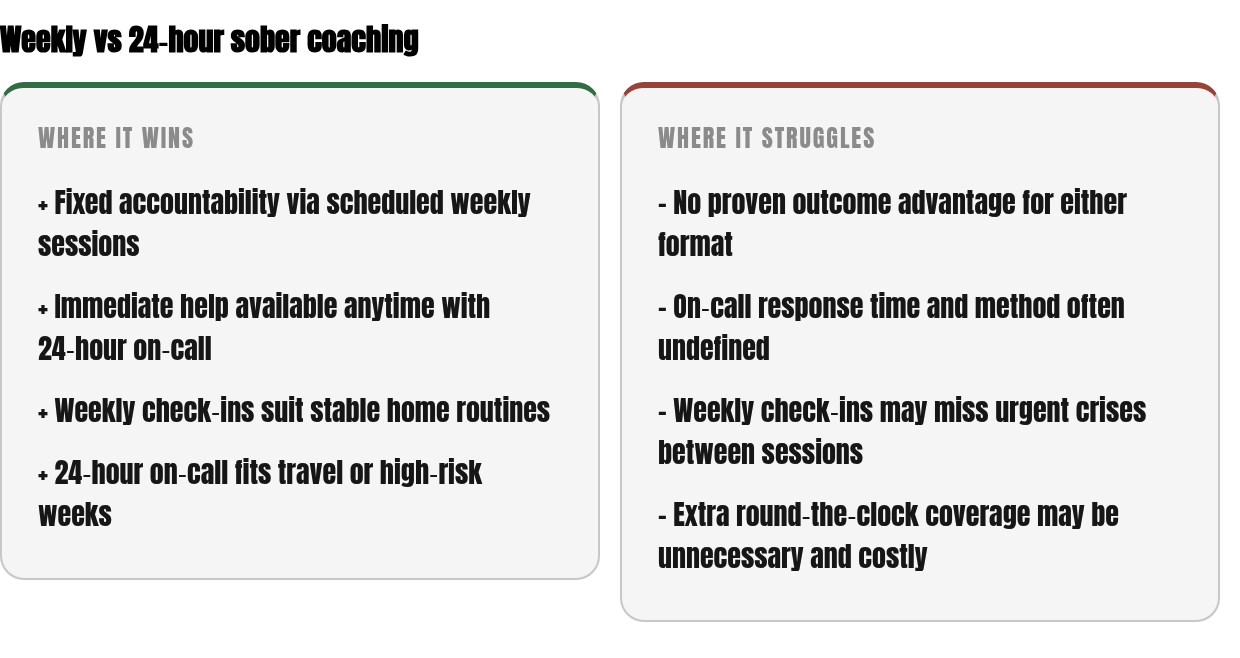
Families hear "24-hour access" and often picture someone in the house around the clock. The documented model is narrower: a set block of scheduled time, plus a standing option to reach out between those blocks.
That split matters if the person you're hiring for travels or is going back to a risky setting. The scheduled block carries the routine work. The on-call layer covers the gaps between planned contacts. We describe that in-between role in what your sober coach actually does between check-ins. Neither layer puts a coach in the home full-time.
What should families confirm before paying for on-call access?
The published descriptions don't say how quickly a coach answers or which contact method applies. Ask any provider, including us, to put both in writing.
Futures Recovery Healthcare's hiring checklist includes a question about relapse risk or emergencies. It's a good question to ask word for word. A vague answer is a warning sign.
| Element | Scheduled hours | 24/7 availability |
|---|---|---|
| What sources document | Planned coaching contact | Coach available as a source of support |
| What sources leave open | How the hours are spread across the week | Response time, contact method |
| What to get in writing | Weekly hour count, travel coverage | Emergency process, plan for scaling it back |
Is round-the-clock coverage always the safer choice?
No. Ashley presents 24/7 availability as part of standard coaching, but a package description can't tell you what a particular client needs. Someone who is stable and making progress may do well with less contact. Someone heading into a high-risk stretch may need more.
We match the intensity of support to what's on the calendar: a trip, a stretch in a high-risk environment, the first weeks back home. During stable periods, weekly check-ins that leave "some space and privacy," in Ashley's words, may fit better.
More coverage also isn't automatically better. An open-ended arrangement with no plan to scale it back deserves harder questions, the same way you'd question a treatment stay with no discharge plan.
Picking a model for the months after treatment
Caron's sober coaching guide and Ashley both treat 24/7 on-call relapse support as a standard part of coaching. Futures takes a more conditional view and reserves extra access for travel, major transitions, or early stabilization.
We side with Futures on the default. When you plan sober coaching after rehab, the client's circumstances should decide whether they need round-the-clock access. A brochure listing it is not a reason to buy it. The table below is our planning guide, not a validated risk-assessment tool.
Match the rhythm to the itinerary
| Situation | Weekly scheduled check-ins | Access outside scheduled hours |
|---|---|---|
| Stable home routine, predictable work hours | Often a good fit | Mainly for emergencies |
| Frequent travel, hotels, conferences | Hard to hold to a fixed day | Useful during trips |
| Returning to a high-risk home or job | Thin on its own | Worth having early on |
| Shift work or shifting family obligations | A fixed slot may clash | Flexible contact helps |
| Cannot safely be alone | Not enough | Coaching may not be enough either |
The last row is the one families tend to skip past. For a client who can't safely be alone, Ashley's overview points to a sober companion who lives with the client. A coach works on a schedule and isn't built for that level of presence.
For clients with variable schedules, one option to discuss is a hybrid: a weekly baseline, plus defined on-call windows around travel or high-risk weeks. No research validates this model. Treat it as a planning idea, not a standard.
Duration is another place the sources pull in different directions. Caron describes coaching relationships lasting a long time. Futures warns that clients shouldn't depend on a coach forever. Both can be true if the program is reviewed and adjusted as circumstances change. Every MADE Recovery coaching program is tailored to the client, and you should ask us, or anyone else, exactly how that adjustment will work.
Settle these questions before signing
- Can the client safely be alone overnight? If not, start with a companion conversation instead of coaching.
- Will the coming months bring travel, a risky setting, or irregular hours? If yes, ask how support can be added around those periods. If no, weekly check-ins are a reasonable place to start.
- Is "on-call" undefined in the agreement? Find out who answers, how fast, and during which hours before you choose.
Everything in this section describes sober coaching across the field, not our own terms. Before you commit, have our team confirm in writing what our coverage includes for your situation.
Where MADE Recovery fits, and what to get in writing
The question we hear most from families is simple: who picks up when something goes wrong between sessions? Our answer is a hybrid. We pair scheduled coaching, virtual or in person, with support built around the client's actual calendar. That support can range from home companionship to a sober travel companion who goes along on a trip that could test early sobriety.
The structure follows the general model any sober coach after rehab works from: planned time for routine work, plus a way to reach someone outside it. Outside research describes that model in general terms. It doesn't describe us. No independent source verifies our team structure, travel offering, tapering process, outcomes, or pricing, so confirm each item below with us directly.
| Component | General sober-coaching model | Our version | Confirm with us |
|---|---|---|---|
| Scheduled sessions | Set weekly hours | Virtual or in person, tailored to the client | Session length and frequency |
| Between-session support | On-call access | Companionship during critical moments | Hours covered and response time |
| Coach structure | One coach | One coach or a coordinated team | Who covers nights and travel |
| Travel | Varies by provider | Sober travel companions | Destinations and logistics |
| Step-down | Not specified | Support tapers as independence grows | How tapering decisions get made |
| Cost | Varies | Not published here | A written quote |
When is our hybrid model the wrong fit?
When the need is medical. Our support is nonmedical. We don't diagnose, detox, or manage medications, and our coaching runs alongside treatment from outside professionals and facilities.
Not every client needs every component, either. Depending on the level of support needed, a client works with a single coach or a coordinated team, and we intentionally reduce support as they gain independence.
When you call, ask us to put coverage hours, staffing, and price in writing before you commit. We'll help you build a plan around the months ahead, and you should hold us to the details.
References
[1] What Is Sober Coaching? - Ashley Addiction Treatment - https://www.ashleytreatment.org/rehab-blog/what-is-sober-coaching/
[2] Sober Coaching: How It Works, Key Benefits,… - Caron Treatment Centers - https://www.caron.org/addiction-101/treatment-advice/sober-coaching
[3] What Is a Sober Coach? | Benefits, Costs, and How to Choose One - https://futuresrecoveryhealthcare.com/alcoholism/what-is-a-sober-coach/
Frequently Asked Questions
Does insurance usually pay for a sober coach?
Families should ask providers how payment works and request a written quote. The estimate should list scheduled hours, on-call terms, and travel coverage. MADE Recovery doesn't publish pricing in this article, so ask our team for a quote for your situation.
Can sober coaching sessions happen online instead of in person?
Sober coaching can be delivered virtually or in person, depending on the provider. Delivery mode varies across the field, so confirm it before you sign. MADE Recovery offers scheduled sessions in either format, tailored to the client. Location often decides the fit. Someone far from a provider may rely on virtual sessions, while a trip that could test early sobriety may call for someone physically present, such as a sober travel companion.
Can I start with 24-hour access and move to weekly check-ins later?
Moving from on-call access to scheduled check-ins is a reasonable way to plan support. Heavier coverage can fit travel, high-risk settings, or the early weeks after treatment, while a less intensive arrangement may suit a settled routine. MADE Recovery reviews support as clients gain independence. Ask any provider to explain in writing how they decide when to scale back.
If I'm stable, is paying for on-call access a waste?
On-call access may add little for someone who is stable and making progress. A client with a steady job, a home routine, and a support network may do well with weekly sessions and keep between-session contact mainly for emergencies. Ask what practical problem the additional access is meant to solve before adding it to a plan.
Can a sober coach manage my medications or help me detox?
A sober coach provides nonmedical support and cannot manage medications or oversee detox. MADE Recovery does not diagnose conditions, provide detoxification, or handle medications. Our coaching and companionship run alongside therapy and medical care from outside professionals and facilities. If you need medical help, arrange it with a qualified provider and use coaching for accountability between appointments.