Sober Coaching Sessions: Phone Call, Home Visit, or Text Triage?
October 23, 2026

Why Sober Coaching Sessions Matter
The early months after discharge can carry elevated relapse risk. You leave treatment with a folder of recommendations and decent intentions, then walk into triggers, isolation, and decision fatigue without the structure that kept you upright inside. That gap—between discharge and real life—is where sober coaching after rehab can do its work.
A coach provides accountability, relapse-prevention planning, and structured contact during the weeks when routines are still fragile. Hazelden Betty Ford puts it plainly: "Establishing new patterns and healthy routines is key to building lasting recovery. It's simple, but not easy." MADE Recovery offers virtual and in-person coaching to support clients as they transition back into everyday life.
What Early Contact Looks Like
Contact frequency varies. Some clients may need more frequent contact during periods when mood, cravings, or daily structure feel unstable; others do well with less frequent sessions plus an agreed way to reach their coach when challenges arise. The difference between a scheduled home visit and being able to reach your coach during a craving is immediacy—one waits, the other responds.
Effective coaching often includes both proactive first-30-day contact and reactive availability. Proactive contact is scheduled or coach-initiated; reactive contact means you can reach out when struggling. They serve different purposes, and many plans use both.
In-Person or Virtual—Each Serves a Purpose
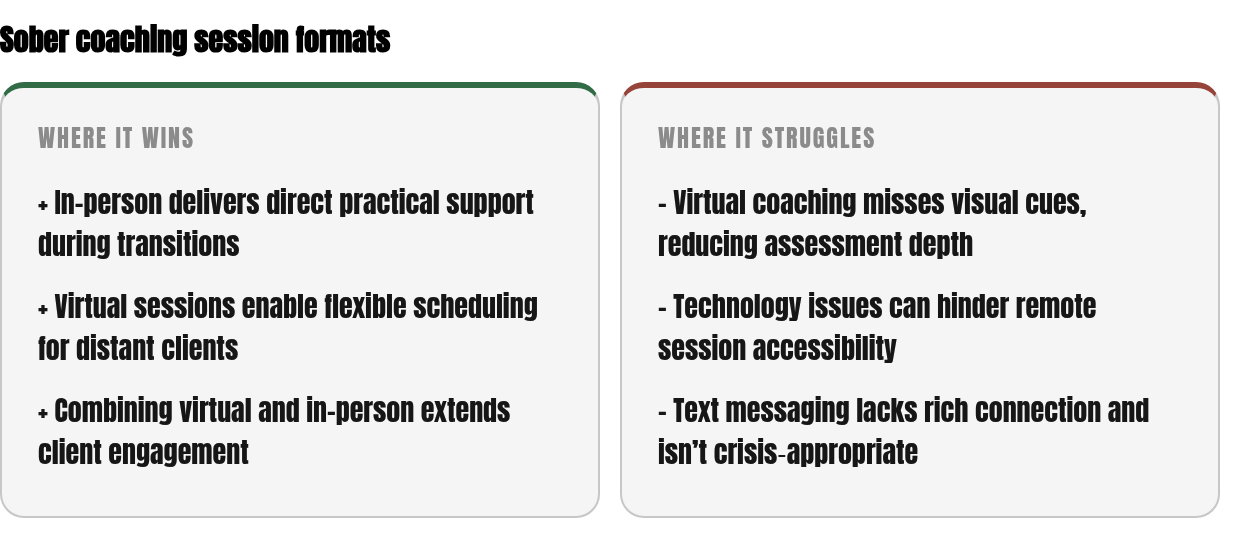
In-person sessions may allow direct, practical interaction: accompanying you to an appointment or court, helping you navigate social services, or sitting through a hard conversation in real time. We can come to you, you can come to us, or you can receive coaching while living in our sober living home alongside others in recovery.
Virtual formats—video calls—offer flexibility for clients who've relocated or have unpredictable schedules. We pair formats to your circumstances, not to a rigid protocol.
| Format | Core Strength | Common Use Case |
|---|---|---|
| In-person | May include direct practical support; physical presence during transitions | In-person meetings or appointments a client identifies as high-risk |
| Virtual (video) | Flexible scheduling; supports relocated clients | Routine check-ins when travel is difficult |
Research has not consistently identified format-specific stage recommendations. Some providers observe that clients may use virtual contact for routine check-ins and in-person meetings for major transitions. The right mix depends on the client and the situation.
Key Takeaways
- Early recovery brings substantial emotional and practical challenges. Reliable coaching contact helps.
- In one large hospital system evaluation, clients who engaged with recovery coach contact showed lower hospitalization rates during the same treatment month. That is a same-month association, not evidence of what happens in a following month.
- Text-only treatment was less preferred than video or in-person modalities in a discrete choice experiment measuring patient preferences.
- Combining remote and face-to-face support may help maintain continuity when schedules, transportation, or living arrangements change.
Phone Call Coaching Sessions
We offer virtual and in-person coaching sessions with a consistent structure: checking in on your current state, reviewing goals from your last conversation, working through immediate challenges, and updating your plan based on what came up. The conversation moves where you need it to go without feeling scripted.
Clients may begin with more frequent coaching contacts during the first month—a mix of virtual and in-person check-ins tailored to their needs. Research on early recovery contact describes this pattern as useful for building momentum without overwhelming someone just out of detox. Virtual sessions fit naturally when travel is difficult or flexibility matters most.
What Virtual Sessions Handle Well
Virtual contact removes the logistical friction of travel. That matters when you're managing early sobriety and may not have reliable transportation or a flexible schedule. Hazelden Betty Ford's coaching program describes its support as "as close as your phone," which reflects the accessibility of remote coaching for people managing work, family, or distance barriers.
Our support is designed to meet you where you are, whether that's virtual check-ins, in-person meetings, or in-person support during vulnerable moments. The flexibility helps maintain connection and accountability through changing circumstances.
Where Remote Contact Falls Short
Virtual coaching may reduce some visual cues that help a coach read how someone is doing. Nonverbal signals—fidgeting, posture, eye contact—are harder to catch through a screen or over the phone. A discrete choice experiment found that text-only treatment was significantly less preferred than any modality with video or in-person contact. That preference does not make text useless; it suggests many people value the richer connection that comes from seeing each other.
Access to technology itself can be a barrier. If internet service is spotty, or if you share a device with family and can't have a private conversation, remote coaching may not work as smoothly. Research on telephone-based treatment notes that some clients in opioid treatment with limited income found even audio-only sessions unfeasible because of device or data constraints.
Recovery coach contact correlates with better clinical outcomes during the same month. The evidence does not isolate one delivery format as the cause of those improvements, and it does not establish a following-month effect. Virtual contact remains one way to preserve continuity when travel, work, or family responsibilities interfere with an in-person appointment.
Home Visit Coaching Sessions
We offer in-person coaching sessions that bring structured support directly into your environment during early recovery. While phone and virtual check-ins provide flexible accessibility, home-based meetings may allow for individualized discussion and practical planning tied to the spaces where you'll spend time.
What In-Person Coaching Sessions Look Like After Rehab
Coaching frequency adjusts based on your needs. Some clients schedule a home visit with phone support between sessions. Others prefer more face-to-face structure. Our programs are tailored to each individual, offering support from a single dedicated coach or a coordinated team, depending on the level of care needed.
Home visits may be scheduled around periods a client identifies as high-risk. As clients find their rhythm, our support intentionally tapers to encourage independence and long-term stability.
Why Some Clients Choose In-Person Over Remote Contact
Virtual and phone-based coaching work well for many people in recovery, but in-person sessions may provide immediate environmental context that remote contact cannot match. Meeting in your living space may make it easier to notice elements of the environment that support or complicate recovery, then work with you on practical plans for those spaces rather than discussing them only in the abstract.
Text Triage Coaching Sessions
Text messaging can bridge gaps between scheduled check-ins, but it generally works best as part of a broader contact plan rather than as standalone support. Clients may use text to flag cravings, ask quick questions about a trigger they just encountered, or confirm next steps after a phone conversation. That asynchronous format keeps a line open when you need it without requiring both people to be available at the same moment.
What Text Support Looks Like in Practice
MADE Recovery offers virtual and in-person coaching, with the format tailored to each client's needs. Text messaging is not a standalone treatment service, clinical telehealth, or crisis triage. For example, a client might reach out while standing outside a bar where friends are meeting, while dealing with a family conflict, or after a rough day at work. When the situation calls for more discussion, phone or video coaching gives the client and coach room to respond in real time.
Telehealth preference research indicates that many people value the additional connection provided by audio and video. Text can still serve as a low-barrier way to initiate contact or communicate a brief update, particularly for someone who cannot speak privately at that moment. That makes text an entry point rather than automatically weaker care.
The technology varies. Some providers use WhatsApp, dedicated secure portals, or standard SMS depending on privacy requirements and client comfort. Coaching programs that prioritize simplicity often select tools that keep contact straightforward rather than introducing unfamiliar platforms. Audio gives you tone, pacing, and immediate back-and-forth. Text loses those cues.
Text is not crisis intervention. When someone communicates about active suicidal thoughts or immediate danger, the appropriate response is to move to a phone call or connect them with 911 or the 988 Suicide and Crisis Lifeline. Text doesn't replace the real-time assessment and de-escalation that voice or emergency contact provides. It is also not a substitute for clinical treatment or medical care. Clients should ask their coach in advance about response times, after-hours availability, and which concerns belong in emergency or clinical services.
For clients juggling work schedules or limited privacy at home, flexible contact offers accessibility that rigid scheduling doesn't. You can reach out during a break, connect when your coach is available, and continue the conversation without coordinating calendars. Used alongside scheduled sessions, text helps preserve continuity between more substantial conversations.
How We Combine Virtual and In-Person Support
We offer coaching through virtual sessions and in-person support, each designed to meet clients where they are as their needs shift. Someone can rely on phone or video calls when schedules are tight, then shift to in-person visits when face-to-face accountability matters most. The format adapts to the moment rather than forcing you into a single channel.
How Virtual and In-Person Sessions Work Together
Virtual coaching covers the same core planning work as home visits: reviewing recent triggers, troubleshooting challenges before they escalate, updating your recovery plan based on what's actually happening in your life. The format—phone, video, or in-person—adjusts to your schedule and access to technology.
Some clients need the face-to-face accountability of home visits when family dynamics are tense or the environment itself triggers cravings. Others live in areas where travel to a clinic isn't feasible, making virtual sessions the most consistent option. Clients can use both approaches, with remote conversations for planning and home visits when in-person support with routines or the household environment is useful.
Hazelden Betty Ford's Connection program notes that recovery coaching is available even for people who are "sober curious but having trouble not using"—you don't need to commit to abstinence upfront to start coaching. That flexibility extends to format. If you're managing early sobriety while working remotely, virtual sessions may be enough. If you're managing a chaotic household or need in-person support building new routines, home visits can become more central.
When Contact Between Sessions Matters
The space between scheduled sessions is where challenges often surface. A client may need to talk through a family conflict, confirm a plan after a difficult workday, or respond to an unexpected craving. Having an agreed-upon way to contact a coach gives that moment somewhere to go before the next appointment.
We structure ongoing contact as part of a broader plan rather than standalone care. A client may have scheduled virtual sessions along with a defined way to reach their coach when an issue cannot wait. The arrangement should be clear about appropriate uses, response expectations, and when a concern requires emergency or clinical services.
Some studies on telephone-based treatment found that audio-only telemedicine had comparable efficacy with in-person care for substance use reduction and treatment retention, despite lacking visual cues. Phone calls may maintain relational depth while preserving accessibility—a balance that can help when immediate support matters more than waiting for the next scheduled visit.
If additional practical supports are needed—such as nursing support, grocery shopping, meal prep, or day-to-day life management—ask what the program can directly provide and what falls outside the coaching relationship. As clients find their rhythm, support intentionally tapers to encourage independence. The integrated model means you're not locked into a format that worked during the first stage but no longer fits later. Your coaching evolves as your recovery does.
References
[1] Sober and Recovery Coaching and Monitoring - Hazelden Betty Ford - https://www.hazeldenbettyford.org/relapse-prevention/connection-recovery-coaching
[2] The First 30 Days with a Recovery Coach: What to Expect - https://allthewaywell.org/first-30-days-with-a-recovery-coach/
[3] FAQs | Peer to Peer Recovery Coaching Services | Reading, PA ... - https://recoverycoachingservices.com/faqs
[4] Initial evaluation of a peer recovery coach program in a large hospital ... - https://www.recoveryanswers.org/research-post/initial-evaluation-peer-recovery-coach-program-large-hospital-system/
[5] Peer Recovery Support Services and Recovery Coaching for Substance ... - https://pmc.ncbi.nlm.nih.gov/articles/PMC12811009/
[6] [PDF] A Systematic Review of Peer Recovery Support Services and R - https://www.mass.gov/doc/mgh-recovery-coach-report-submitted-to-recovery-coach-inbox/download
[7] Lived Experience in New Models of Care for Substance Use Disorder - https://www.frontiersin.org/journals/psychology/articles/10.3389/fpsyg.2019.01052/full
[8] Sober Coaching: How It Works, Key Benefits,… - Caron Treatment Centers - https://www.caron.org/addiction-101/treatment-advice/sober-coaching
[9] Telemedicine-delivered treatment for substance use disorder - PMC - NIH - https://pmc.ncbi.nlm.nih.gov/articles/PMC11444076/
[10] Determinants of preference for telehealth versus in-person ... - https://www.sciencedirect.com/science/article/abs/pii/S2949875922000091
[11] Old tech but not low tech: telephone-based treatment ... - PMC - https://pmc.ncbi.nlm.nih.gov/articles/PMC10985352/
[12] Telehealth Addiction Treatment | Hazelden Betty Ford - https://www.hazeldenbettyford.org/research-studies/addiction-research/telehealth-addiction-treatment
[13] Telehealth services have increased access to addiction care, but has ... - https://www.recoveryanswers.org/research-post/telehealth-services-increased-access-addiction-care-has-everyone-benefitted-equally/
FAQ
How often should I meet with a sober coach during the first 90 days after treatment?
There is no universal schedule. A coach may recommend more structured contact when cravings, isolation, or major changes are making daily routines difficult, then adjust the plan as stability grows. The right cadence depends on your recovery goals, available support, living situation, and the kinds of challenges appearing between conversations.
Can I switch between virtual and in-person coaching sessions as my schedule changes?
Yes. Coaching can be adjusted when work, transportation, travel, or household circumstances change. Discuss those changes with your coach so the format continues to provide the level of accountability and practical support you need.
What happens if I need support between my scheduled coaching sessions?
Ask your coach in advance how between-session contact works, including which channel to use and what response time to expect. A brief text may be appropriate for an update or request to connect, while a complicated concern may call for a phone or video conversation. Text is not crisis or clinical care. Emergencies require emergency services rather than waiting for a coach's response.