Sober Coaching After Rehab: Transferring the Safety, Removing the Scaffolding
October 31, 2026

Quick Summary
The first 30 days after residential discharge are the most vulnerable stretch in early recovery. Physical improvement after detox can create misplaced confidence before someone has enough structure to manage open time, and idle time is a major relapse risk. A sober coach after rehab can extend some of treatment's structure into that gap before gradually shifting responsibility back to the client rather than leaving them to manage it alone.
Five Pillars for the First 30 Days
These categories come from the continuing-care and recovery coaching research, not from any single program's design. Cadence is left customizable because the evidence doesn't specify exact session lengths or visit frequencies — intensity should match individual risk, not a default schedule.
| Support pillar | What it does | Effort | Cadence |
|---|---|---|---|
| Virtual recovery coaching | Phone or video check-ins for accountability and coping-skill reinforcement | Low–med | Customizable |
| Personalized coaching | One-on-one guidance tailored to individual triggers and routines | Medium | Customizable |
| Relapse-prevention planning | Identifying high-risk situations and rehearsing responses | Medium | Customizable |
| Rapid linkage to continuing care | Quick connection to outpatient therapy or medication-assisted treatment | High | Customizable |
| Peer and outpatient supports | AA/NA, peer specialists, community-based recovery activities | Low–med | Customizable |
Effort here reflects client involvement, not clinical scoring. Peer recovery support services are stronger at keeping people engaged with treatment than at directly reducing substance use. That distinction matters when you're deciding where to invest the first month's energy.
These pillars work together. Virtual coaching provides the daily thread; personalized coaching adapts it to the person in front of you. Relapse-prevention planning gives a concrete map for the worst moments, and rapid linkage keeps the structure from collapsing between discharge and that first outpatient appointment.
What the Research Shows
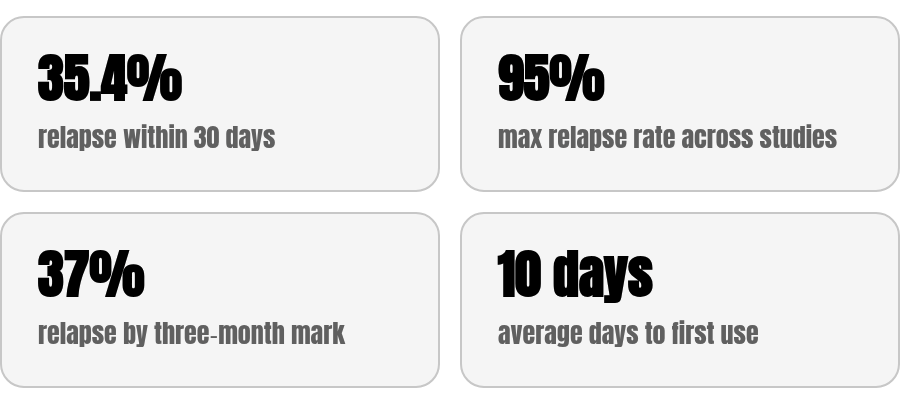
- Among residential treatment discharges, relapse within 30 days was reported, with use beginning soon after discharge.
- Across 10 studies in a systematic review, relapse rates after residential treatment ranged widely from 0% to 95%, depending on continuing support.
- A prospective cohort study found relapse by the three-month mark following residential treatment.
- Five pillars anchor the post-discharge month: virtual coaching, personalized guidance, relapse-prevention planning, rapid linkage to outpatient care, and peer support.
- A sober coach is a nonclinical support professional whose role centers on turning treatment insights into real decisions in everyday environments.
- The primary barrier for most people leaving residential care isn't knowledge of what to do — it's follow-through once they're back in the real world.
- Peer recovery support services are particularly useful for maintaining engagement with treatment; their direct effect on substance use is less certain.
The Gap Residential Treatment Leaves
A study tracking patients after residential discharge found that early return to use is a serious concern. The risk doesn't wait until someone has had time to settle back in — it can emerge before continuing care has taken hold. A sober coach can fill exactly that window by helping a client organize the first practical decisions at home.
Part of what makes discharge risky is connected to what made residential treatment work. A systematic review in Substance Abuse and Rehabilitation found wide variation in outcomes across studies, reflecting how much continuing support shapes the transition. A prospective cohort study of illicit drug users found substantial vulnerability after treatment ended. Residential treatment creates a buffer between someone and the environment where they used. When that structure ends, so does the buffer.
A Sober Coach Is Practical Support, Not Clinical Care
A sober coach is a nonclinical recovery support professional — not a therapist, not a sponsor. The role focuses on implementation: turning insights from treatment into real decisions at home, at work, and in situations where relapse risk is present. One way we frame it: a sober coach bridges the treatment program and real life.
Not everyone leaving residential care needs this layer. Many people build strong recovery through therapy, mutual-aid meetings, and outpatient care. In our experience, coaching matters most when the problem isn't knowledge — it's follow-through. That support can be in-person or virtual, with remote formats making structured relapse-prevention work accessible wherever someone is rebuilding their life.
Bringing the Safety Plan into the Real World
Residential treatment gives clients a safety-plan document when they leave. In our experience, that document is genuinely useful and genuinely hard to execute alone, because triggers look different at home, and the people on your emergency-contact list are often the same ones you have complicated history with. Working with a sober coach doesn't mean rewriting that plan — it means helping it hold in the actual environment where it has to work.
A well-built relapse-prevention plan covers the same core components regardless of who creates it: known triggers, early warning signs, practiced coping responses, safe people and environments to move toward, and a clear action sequence for high-risk moments. The harder part, as one aftercare resource frames it, is applying those components when circumstances change. Coaching helps the client test the plan against ordinary pressures, notice where it breaks down, and revise the routine without taking ownership away from them.
What the Coach Actually Does
Coaching in this context is one-on-one and nonclinical. It doesn't diagnose, treat, or prescribe. The focus is implementation: turning a discharge plan into daily decisions during the moments that carry real risk — evenings, weekends, unstructured time, the first family gathering back home. Those situations don't come up in a controlled treatment setting.
The practical value of coaching is proximity to those decisions. A coach can help a client work through what happened after a difficult evening, separate a lapse in routine from a crisis, and bring the issue back to the clinical team when professional care is needed. Coaching stays a support layer rather than a replacement for therapy, medication management, or other clinical services. It keeps the client's own plan active between formal appointments.
Building Structure Into the First 30 Days
The continuing-care research on post-residential transitions points to a consistent pattern: early engagement matters. People who connect with support services quickly after leaving treatment tend to do better than those who wait — yet even motivated clients face a gap in the first days home. Before the first therapy session, before the first peer meeting. Largely on their own. That's where a sober coach does some of the most valuable work.
Studies also show that even among people who engage early, coverage across the full month tends to be uneven. Appointments get canceled, routines falter, and the structure of treatment gives way to the unpredictability of real life. Interrupting that pattern is the job.
Why Outpatient Therapy Anchors the Month
The continuing-care literature consistently points to structured outpatient therapy as one of the more reliable anchors in early recovery. Scheduled, one-on-one sessions create a recurring commitment that's harder to skip, and that predictability matters when cravings and disruptions are highest. We're not dismissing peer support; it likely builds protective effects that short follow-up windows can't fully measure.
What the research also shows is that the clients who most need consistent support are often the ones most likely to slip out of it. Physical stabilization can create overconfidence, home environments may be unstable, and motivation can drop right when accountability matters most. That's a structure problem. Our focus in the first 30 days is building short-term goals around the commitments that anchor recovery: attending therapy, making peer meetings, and completing recovery tasks. A missed appointment soon after discharge isn't just a scheduling inconvenience; it removes a structured touchpoint during the most exposed period.
The evidence doesn't isolate nutrition or sleep schedules as causal factors in this window, so we don't frame them that way.
Stepping Back: How Coaching Phases Out
The goal of working with a sober coach after rehab isn't to build dependence on the coach. It's to gradually transfer ownership of the daily routine back to the person doing the work. We think of this as tapering: reducing contact frequency and intensity as a client demonstrates they can hold structure independently.
What guides our tapering is individual readiness, not a fixed timeline. As clients gain independence, support is intentionally reduced to encourage self-sufficiency. We watch for real progress in daily structure, then ease back.
We don't follow a preset taper schedule. We're working from accumulated experience and coaching judgment, not a sourced protocol. Each client's taper reflects their demonstrated stability, their environment, and the supports already running around them.
What Needs to Be in Place Before We Pull Back
We assess readiness for less frequent contact together with the client and coordinate with their clinical team when one exists. We look for concrete signals: consistent meeting attendance, follow-through on outpatient appointments, stable routines, and honest self-reporting when things slip. Virtual check-ins can bridge the step between frequent contact and independent management.
The supports that replace coaching contact need to be running before we step back, not after. AA/NA, peer recovery support, and clinically appropriate medication all have roles. The minimum support that keeps someone stable is the target, not maximum contact indefinitely.
Refusal-skills practice fits here as a coaching exercise: rehearsing how to manage social settings where substances are present before those situations arrive. The evidence doesn't give us sourced outcomes for this specific practice, but it bridges the gap between knowing what to do and actually executing it under real pressure.
References
[1] Sober Coaching: How It Works, Key Benefits,… - Caron Treatment Centers - https://www.caron.org/addiction-101/treatment-advice/sober-coaching
[2] What Is a Sober Coach? | Benefits, Costs, and How to Choose One - https://futuresrecoveryhealthcare.com/alcoholism/what-is-a-sober-coach/
[3] Sober and Recovery Coaching and Monitoring: Find a Coach - https://www.hazeldenbettyford.org/relapse-prevention/connection-recovery-coaching
[4] Risk of Relapse Following Discharge from Non-Hospital Residential ... - https://pmc.ncbi.nlm.nih.gov/articles/PMC12035408/
[5] Professional and community-based continuing care following ... - https://www.recoveryanswers.org/research-post/professional-community-based-continuing-care-following-residential-treatment/
[6] Long-Term Outcomes After Residential Substance Use Treatment - https://academic.oup.com/milmed/article/182/1-2/e1589/4099796
[7] Relapse after inpatient substance use treatment: A prospective cohort ... - https://www.sciencedirect.com/science/article/pii/S0306460318308542
[8] (PDF) Building a Path to Sobriety: Challenges and Strategies of ... - https://www.researchgate.net/publication/381197631_Building_a_Path_to_Sobriety_Challenges_and_Strategies_of_Rehabilitation_Workers_in_the_Aftercare_Process_of_Substance-Abuse_Individuals
[9] (PDF) Peer Recovery Support Services and Recovery Coaching ... - https://www.researchgate.net/publication/390092484_Peer_Recovery_Support_Services_and_Recovery_Coaching_for_Substance_Use_Disorder_A_Systematic_Review
FAQ
1. What should someone do if they leave residential treatment without any outpatient appointments scheduled yet?
Connecting with recovery support right away is the most important first step. A sober coach can help establish daily structure, create accountability routines, and make rapid connections to outpatient therapy while the client is still navigating the transition home. The aim is to prevent an unscheduled gap from becoming the default plan.
2. If someone is already attending AA or NA meetings regularly, do they still need a sober coach?
Regular meeting attendance and sober coaching serve genuinely different functions. Peer recovery support can help maintain engagement with recovery, while coaching focuses on what happens between meetings—especially when daily routines, family situations, or work demands remain difficult to manage. For someone with solid peer support, coaching matters most when practical follow-through is still breaking down.
3. How does a client know when they're personally ready to reduce coaching contact?
Readiness shows up in daily behavior, not just in feeling confident. Concrete signals include consistent therapy and meeting attendance, stable daily routines, follow-through on recovery tasks, and honest self-reporting when things get difficult. The supports taking coaching's place—outpatient care, peer groups, medication where appropriate—need to be running reliably before contact frequency drops, not scheduled to start afterward.