Sober Coaches Explain What They Actually Do During a 72-Hour Relapse Window
October 30, 2026

The short version
Relapse risk is highest in the first 12 weeks after intensive inpatient treatment, and the first 30 days after discharge carry the sharpest acute risk. Tolerance falls fast during abstinence, so a return to use within the first 72 hours is more dangerous than most people expect. Steven Melemis, writing in the Yale Journal of Biology and Medicine, lists six observable signs of emotional relapse, which is defined by denial rather than craving. Sober coaching schedules run from a few hours a day up to 40 hours a week, so support can scale to whatever stabilization actually requires.
Why the discharge gap is where risk concentrates
When a client leaves rehab, we prepare for the gap before structured daily life returns. That gap is where risk concentrates. A StatPearls review of relapse prevention puts the early post-discharge stretch among the most vulnerable periods in recovery, with later spikes showing up as people move further from the structure of treatment.
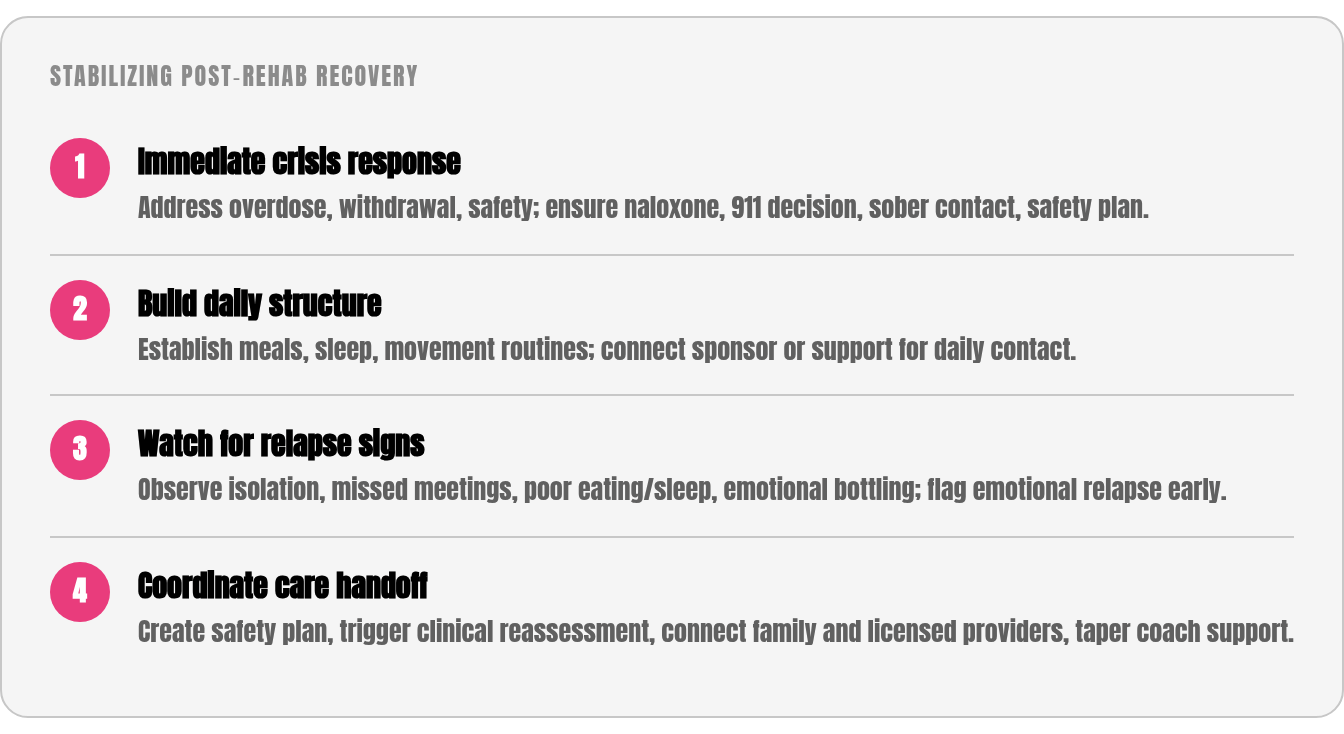
No single factor explains the first 72 hours. Tolerance drops, so any return to use hits harder and faster than the person's memory of using suggests. The clinical team is scheduled days out, not hours out. Sleep, meals, and recovery contacts become the client's job again, and isolation fills the gap.
A practical guide to the hours after a relapse breaks the response into windows. First hour: breathing, consciousness, naloxone, the 911 decision. Next several hours: don't use alone, and get harm-reduction tools like fentanyl test strips into the picture. Later that same day: a sober contact is involved and a short written safety plan exists, naming contacts, the nearest ER, allergies, and the conditions that trigger a 911 call. Clinical reassessment belongs at 24 to 48 hours.
Where the coach actually sits in that sequence
Our work is nonmedical, and that's a line, not a hedge. Overdose, active withdrawal, suicidal crisis, medical detox: clinical territory, every time. If you want the distinction laid out plainly, this comparison of sober coaches and therapists covers it.
We provide structured presence when being alone raises risk. A relapse response guide written from a faith-and-clinical perspective stresses fast outreach to existing recovery supports, timely clinical follow-up, and more frequent contact after a slip. All three are likelier to happen when someone is already in the client's corner. That is the coach's job, and it is often missing before the first outpatient appointment.
Hours 24-48: rebuilding structure, meals, and sleep
By hours 24 to 48 the acute check is behind you. What a sober coach does after rehab at this stage isn't emergency presence, it's scheduled structure. One treatment provider's overview describes coaching as flexible enough to match different stabilization needs, from light daily check-ins to a much heavier weekly presence.
The first structural job is breaking isolation and moving support into daily contact. That means a sponsor, a pastor, or a treatment-team contact moving from "I have their number" to daily contact. Isolation is one of the earliest behavioral signals that emotional relapse is already running, and the people in that state are usually the last to notice it in themselves.
What the evidence actually supports in this window
Sleep on a consistent schedule. Move daily. Eat on a routine. Those basics help early stabilization and show progress too. A coach on this schedule can see sleep slip or movement fade over several days. Something is often shifting before the client says a word.
What we push back on in this window is big decisions. No job changes, no significant relationship conversations, no large financial moves. Anything irreversible can wait until the person is on steadier ground. Decisions made at hour 30 tend to get revisited by week six.
There's also a boundary we hold without wobbling: if the relapse involved physical dependence, or if this is a pattern rather than an event, routine-building is not where we start. A medical detox assessment comes first. Our job is to help connect someone to that level of care, not to stand in for it.
Hours 48-72: reading the signs a client won't report
People in emotional relapse usually do not know they are in it. Melemis' clinical research describes the stage precisely: nobody is thinking about using, and denial rather than craving is the defining feature. That is why a sober coach after rehab watches behavior instead of waiting for a client to name a problem.
The six signs he identifies are bottling up emotions, isolating, skipping meetings, sitting in meetings without sharing, focusing on other people's problems instead of their own, and poor eating and sleeping. A client in emotional relapse is the least reliable reporter of their own risk, so our team watches those behaviors. We already coach on meals and daily routine, which means a slip in those habits shows up early. Breakfast stops, the texts get shorter, and the change is visible before it is named.
When emotional relapse tips into mental relapse
Accumulating signs shift the risk. Mental relapse is where bargaining starts: schemes to control use, thoughts of using arriving more often, scanning for opportunities. Melemis is clear that an occasional thought of using is normal and isn't a failure. The warning is a change in pattern, thoughts getting more insistent over days rather than hours.
That's when the circle around the client needs to widen. MADE Recovery provides nonmedical support, so a reassessment or a change in level of care is a call for licensed clinicians and treatment providers. What we do is care coordination, helping families find those programs and get connected.
The call should be short. One recovery action guide makes the case bluntly: the person you're calling doesn't need context, just a yes or no. Their example works as written: "I relapsed and need you to stay with me for 24 hours. Can you come now or stay on the phone?" Sponsor, family member, or treatment team, the script does not change.
The written safety plan should name who can stay with the client or stay on the phone, the nearest ER, allergies, and the specific conditions for calling 911. The same guide recommends reconnecting with a sober contact, a prescribing clinician, and a trusted family member during the first day, and avoiding being alone in the immediate aftermath. When families contact MADE Recovery, they talk to a real professional within 24 hours.
After hour 72: who owns the next stretch
By hour 72 the hand-off stops being abstract. Someone has to own the next stretch, and it isn't the person who owned the last three days. Families often expect a document by now, some signed summary of the crisis. Knowing who handles the next stretch, and how support continues, matters more than any form.
Anyone shopping for a sober coach after rehab may assume a standardized 72-hour review form exists somewhere. We looked. It doesn't. What we can offer is care coordination: sorting through options, connecting you with licensed programs and providers, and staying with you through that process.

The one firm deadline: clinical reassessment inside 48 hours
The sources we lean on disagree about contact timing. A faith-based clinical guide sets the first call to a sponsor, pastor, or treatment team within an hour of use. A separate relapse action plan puts the sober-contact alert later, in the 6 to 24 hour window.
That disagreement matters. An hour is realistic when the relationship already exists and the person picks up. Where it doesn't, the longer window is the honest floor. Which is the argument for writing the contact list before discharge rather than at 2 a.m. on a bad night.
Both sources converge on prompt clinical review, sooner where dependence or repeated relapse is in play. We help families connect with licensed providers for that step. We don't perform it. The assessment belongs to the treatment team or a medical provider, and blurring that would weaken our clearest line.
Dense contact first, then a taper that earns itself
Our support tapers. It tapers as clients find their rhythm and need us less, not by calendar. A preset weekly-then-biweekly schedule sounds organized, but the sources do not establish that cadence. What they do support is prompt recovery contact, no isolation for at least a week, and major life decisions delayed for 48 to 72 hours.
Keep the ask short when someone reaches out. The action plan's script is deliberately blunt for a reason: a long explanation is the thing that stops a call from happening.
Family is the step people often skip. Bring in one trusted family member, not the whole family. Add them to the safety plan so they know their role, the emergency threshold, and who else is involved. One informed person in the plan is better than five people guessing outside it.
References
[1] Sober Coaching: How It Works, Key Benefits,… - Caron Treatment Centers - https://www.caron.org/addiction-101/treatment-advice/sober-coaching
[2] What Is Sober Coaching? - Ashley Addiction Treatment - https://www.ashleytreatment.org/rehab-blog/what-is-sober-coaching/
[3] What to Do After a Relapse: A Recovery Action Plan - https://back2basicsrecovery.com/after-a-relapse/
[4] First 72 Hours After a Relapse: Faith and Clinical Steps for Men - https://sozorecoverycenter.com/relapse-after-rehab-christian/
[5] Relapse Prevention and the Five Rules of Recovery - PMC - NIH - https://pmc.ncbi.nlm.nih.gov/articles/PMC4553654/
[6] [PDF] Client's Handbook: Matrix Intensive Outpatient Treatment for People ... - https://library.samhsa.gov/sites/default/files/sma15-4154.pdf
[7] Addiction Relapse Prevention - StatPearls - NCBI Bookshelf - NIH - https://www.ncbi.nlm.nih.gov/books/NBK551500/
[8] Lived Experience in New Models of Care for Substance Use Disorder - https://pmc.ncbi.nlm.nih.gov/articles/PMC6585590/
Questions People Ask
Can a sober coach manage withdrawal or detox after a relapse?
No. Withdrawal and detox require medical judgment. MADE Recovery can stay involved as support and coordination, but the clinical decision-making belongs to licensed professionals.
Do thoughts of using mean someone has already relapsed?
No. A passing thought is not the same as a return to use. What matters is whether the thought starts changing behavior: secrecy, planning, bargaining, or pulling away from recovery support.
Should families expect a formal report when the 72-hour window ends?
Not necessarily. The more useful hand-off is practical: who is responsible now, which providers are involved, what the safety plan says, and how support will continue after the initial crisis window.