Sober Coach vs Sponsor: Who Shows Up When You're Alone at a Wedding
October 30, 2026

Key Takeaways
- A wedding packs social pressure, easy access to alcohol, family dynamics, and long stretches of unstructured time into a single day.
- What matters is whether your support can respond during the ceremony, dinner, speeches, and ride home, not whether you have support on paper.
- Sponsors and sober coaches can both help, but they do different jobs.
- A sponsor usually brings peer-based recovery experience. A sober coach or companion may provide structured planning and accountability built around the event.
- Settle what "on call" means before the event, especially if you need someone physically there.
Why a wedding is a real test in early sobriety
Caron describes the first weeks home after treatment as a vulnerable stretch. The structure of rehab fades and real-world challenges come back. If a wedding lands in that window and you're going alone, you're walking into a high-risk stretch of recovery at an event designed around drinking.
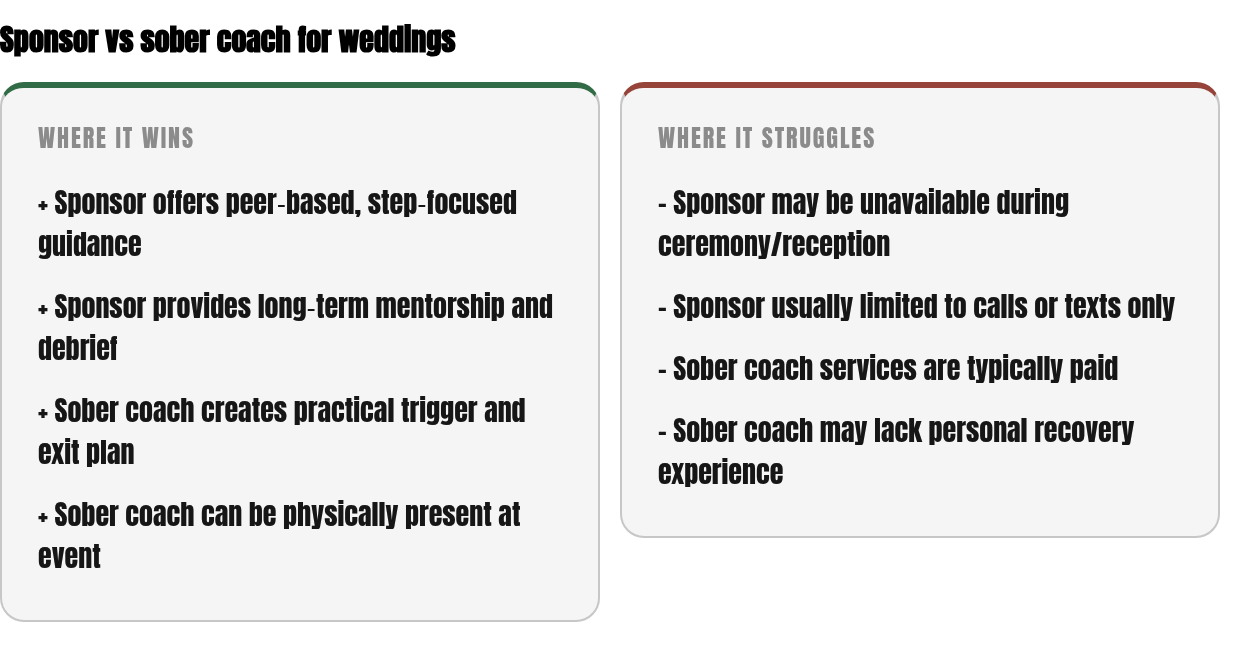
The triggers are predictable, and that is one advantage. There's an open bar. Someone hands you champagne for the toast. Relatives you've never faced sober are at your table, and a hundred people are drinking around you. The pressure to "just have one" often comes from people who mean well. Going solo also removes the friend who would notice you drifting toward the bar. Detox To Rehab points to isolation as the risk that matters most, and a single guest at a reception fits that description closely.
So our recommendation is simple. Treat the choice between a sponsor and a sober coach after rehab as a planning decision you make weeks ahead. Don't treat it as a phone call you hope someone answers.
Support has to work at 9 p.m.
At a wedding, help needs to arrive in minutes. That might be a text that gets answered, an exit strategy you've rehearsed, or a person standing next to you. Long-term mentorship builds your foundation. It won't get you through a toast at 9 p.m. Before you RSVP, confirm who you can reach during the ceremony and reception, and how.
Sponsors and coaches cover that need differently. Detox To Rehab describes a sponsor as an unpaid peer who guides you through the Steps, and a recovery coach as someone who helps with accountability, routines, and preparing for difficult situations. It also warns that neither one should be the only thing standing between you and a return to use. We agree on both counts. A coach or sober companion can cover the hours when a volunteer sponsor is at work, asleep, or at their own family event. MADE Recovery can arrange for a companion to attend a wedding with you anywhere in the U.S. That coverage works best as one part of a wider plan.
| Wedding need | Sponsor | Sober coach or companion |
|---|---|---|
| Preparation | Step-based guidance, shared experience | Trigger plan, exit strategy, check-in times |
| Contact during the reception | Depends on a volunteer's availability | Arranged and confirmed in advance |
| Someone physically present | Only if they offer it | Possible with a confirmed companion |
| Debrief afterward | Strong fit | Adjusts the plan going forward |
You can skip paid coverage if you're well past early recovery and attending with a sober friend who knows your plan. If the wedding falls in your first 90 days, we'll help you turn your discharge plan into a specific plan for the day.
What a sponsor and a sober coach each do on the day
The split usually looks like this. A sponsor helps you prepare beforehand and talk it through afterward. A sober coach or companion may be able to stay reachable, or be in the room, during the ceremony and reception. That gap is why MADE Recovery offers sober companionship for events like weddings, arranged around your needs and schedule.
Some definitions, so we're using the same terms:
Sponsor: a volunteer peer mentor in a 12-step fellowship who offers experience-based support, guidance on Step work, and recovery accountability. Sponsors generally aren't paid.
Sober coach: a structured, often paid personal guide through the transition into sober life. If you're weighing a sober coach after rehab, read how Caron describes sober coaching. Arrangements vary, especially in how available the coach actually is.
| Wedding question | Sponsor | Sober coach or companion |
|---|---|---|
| What is the relationship based on? | Shared 12-step experience | Professional recovery support |
| How do they help before the event? | Talk through risk, meetings, and recovery principles | Build a practical plan for transportation, timing, and triggers |
| What happens during the event? | Calls or texts only if agreed in advance | Phone, nearby, or in-room support if that is part of the arrangement |
| What happens afterward? | Step-based reflection and accountability | Follow-up on what worked and what needs adjusting |
| What should you clarify? | Whether they are free during the reception | Whether "available" means remote or physically present |
What to confirm before the wedding
Get availability confirmed weeks ahead, in writing if possible. With a sponsor, agree on something realistic for the day, like a text after the toasts or a call at a set hour. Don't assume your sponsor can come. Ask directly where their limits are. Most sponsors have jobs, families, and sponsees of their own, and a Saturday night is rarely open.
Before you hire a coach or companion, ask:
- Presence: Can they attend in person, or only by phone?
- Location: Where will they be during the event? At the venue, nearby, or at home?
- Check-ins: How do check-ins work, and how often?
- Exit: Will they help you leave safely, including the ride home?
When you reach out to MADE Recovery, we'll go through these questions with you and arrange companion support where it counts, whether that's a wedding, a family gathering, or a party. Our coaches also help clients build the daily routines that hold things together between events.
A coach can often be more available than peer support. For a solo guest, we often suggest layering: the sponsor keeps you grounded before and after, and the coach or companion handles the reception itself.
Sponsor, independent coach, or MADE Recovery: how they compare
Pin down availability first. Coaching providers describe on-call coverage in different ways, and "24/7" can mean a lot of things. Use round-the-clock emergency and relapse support as the standard you ask about. Before you count on any sober coach after rehab to pick up during a reception, get it confirmed in writing.
Detox To Rehab makes a useful point here: knowing the difference between the roles can help you decide whether you need a sponsor, a recovery coach, or both. We'd add that "both" is often the right answer for a wedding. A paid coach can cover hours your sponsor can't, but the coach should be one layer in a plan that also includes your sponsor, a meeting, and a ride home.
| Sponsor | Independent sober coach/companion | MADE Recovery | |
|---|---|---|---|
| Role | Volunteer 12-step peer mentor | Structured recovery guide, often paid | Nonmedical sober coaching and companionship |
| Availability to confirm | Ask directly; unpaid, so nothing is guaranteed | Depends on the contract | Ask us about your event date and in-person options |
| Intervention style | Calls, texts, agreed check-ins | Structured check-ins, if contracted | Arranged around your needs and schedule |
| Planning depth | Step-grounded prep and debrief | Goals, routines, preparing for difficult situations | Scope to confirm with us |
| Cost/commitment | Generally unpaid | Paid; terms vary by provider | Pricing to confirm with us |
| Best for | AA or NA members | Any pathway, including SMART Recovery | Early recovery, attending alone |
Do not assume a coach has lived experience. Many do, but it isn't guaranteed. Detox To Rehab notes that some coaches come from professional training without a 12-step background, and contrasts sponsors, who speak mostly from personal experience, with coaches who may be trained in coaching methods, recovery support, boundaries, and community resources. Neither background is automatically better. You just want to know which one you're getting, so ask.
Questions to settle before the invitation date
If you have stable time and a sober friend coming with you, your sponsor's prep call is probably enough. If you're early and going alone, work through these with whoever will be on call:
- Can we do a pre-event call to write my refusal script?
- Can I text during the reception, and how fast will you reply?
- Can you attend in person, or stay reachable by phone?
- What's my exit strategy if I need to leave, and who drives?
- Which venue triggers should we plan for: the toast, the bar, certain relatives?
- What are our check-in times, and who is my backup emergency contact?
We'll help you build this plan as part of sober coaching after rehab.
Where MADE Recovery fits on the wedding day
The hardest part of going to a wedding alone is the hours between the ceremony and the ride home. The bar stays open the whole time, and that's when a plan either holds or doesn't. Our team plans for that stretch. We work with people coming out of detox, rehab, or residential treatment, and a sober coach after rehab tends to be most useful when a big event lands in those early months.
We match the level of support to the person. Some clients work with one dedicated coach, online or in person. Others need a coordinated team, usually when they need more support overall. For a wedding, that choice shapes how present your support can be.
| Wedding need | Single dedicated coach | Coordinated team |
|---|---|---|
| Planning before the day | Tailored plan built with you | Tailored plan built with you |
| Format | Virtual or in-person | Virtual or in-person |
| Best fit | Steady recovery with one high-risk event | Higher care needs or a shaky stretch |
| After the event | Support tapers as you steady | Support tapers as you steady |
When you don't need a paid companion
You may not need us there if you have solid sober time, a sponsor who answers late at night, and a sober friend at the reception. A phone plan with your sponsor and your own car can cover it. We'd rather tell you that than sell you something you don't need.
We fit best when risks stack up: you're in early recovery, you're going alone, there's an open bar, and relatives you haven't faced sober will be there. We provide nonmedical support. We don't replace your sponsor, your meetings, or any medical or clinical care you get from outside professionals. We work alongside them.
Start with an initial consultation. We'll assess what you need and build a plan around the date. Call or text 661-369-6255.
References
[1] Recovery Coach vs. Sponsor: What's the Difference? - Detox To Rehab - https://detoxtorehab.com/recovery/recovery-coach-vs-sponsor-whats-the-difference
[2] Sober Coaching: How It Works, Key Benefits,… - Caron Treatment Centers - https://www.caron.org/addiction-101/treatment-advice/sober-coaching
Questions People Ask
Can I work with a sober coach if I don't follow a 12-step program?
Yes. A sober coach can support people using non-12-step recovery paths, including SMART Recovery. If you already attend AA or NA, coaching can still sit beside that structure instead of replacing it.
Does a sober coach replace medical treatment or therapy after rehab?
No. MADE Recovery coaching is nonmedical and does not diagnose conditions, provide detox, manage medications, or replace clinical treatment. The focus is practical accountability, daily structure, and preparation for high-pressure situations such as weddings.
Do all sober coaches have personal experience with addiction?
No. Some do, and some come through formal recovery-support training instead. If personal addiction history matters to you, ask directly before hiring a coach or companion.
When is a sponsor alone enough support for a wedding?
A sponsor may be enough when the event is lower risk, your recovery is steady, you have reliable transportation, and another sober person at the reception knows your plan.