What Sobriety Coaches Do That Therapists and Sponsors Don't After Treatment
October 25, 2026

The Short Version
Sobriety coaches provide structure between scheduled appointments through regular check-ins, relapse-prevention planning, practical guidance, and program-dependent crisis support. Therapists provide clinical assessment and treatment. Peer sponsors offer lived experience and encouragement. Recovery coaches add nonclinical accountability and help people work recovery goals into daily life.
During the transition out of treatment, that support may include housing, transportation, routines, family boundaries, stress management, communication, and relationships. Coaching credentials vary. Some programs use licensed or credentialed coaches, while other coaching roles are deliberately nonclinical.
A systematic review of peer recovery support found stronger evidence for improving treatment engagement and retention than for reducing substance-use outcomes. Features such as 24/7 availability and follow-up monitoring show how intensive a service may be, but they do not prove that coaching prevents relapse.
Quick Summary
A sober coach after rehab can bridge the gap between structured treatment and daily independence. The main benefit is consistent support: someone notices when a routine slips, helps adjust the plan, and stays involved through the ordinary details that make recovery difficult to maintain.
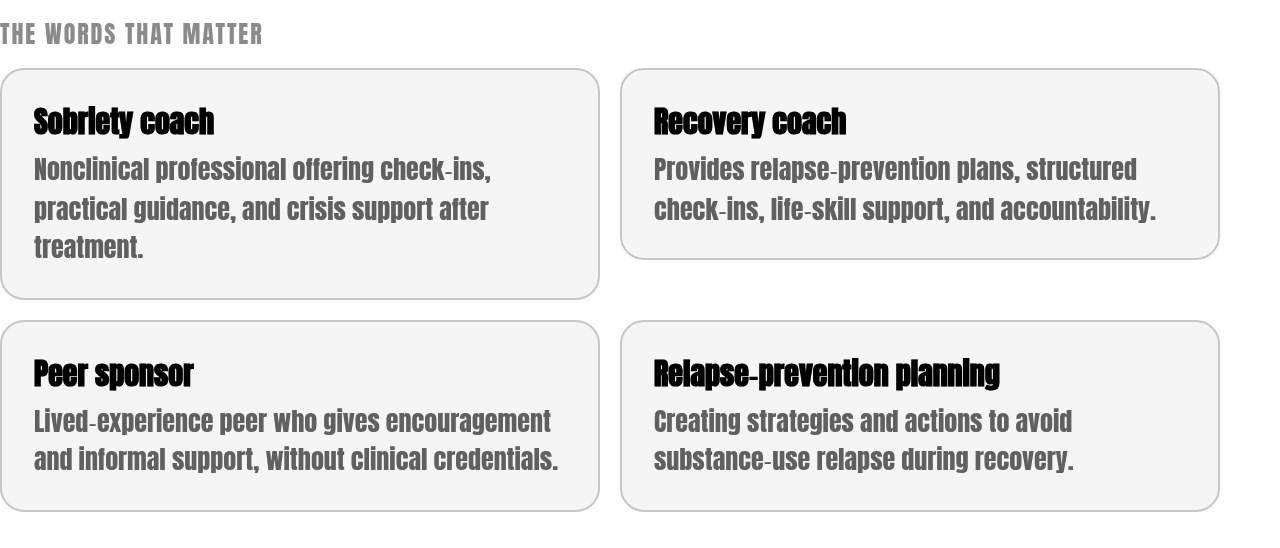
Coaching does not replace therapy, medication management, detox, or medical care. Its value lies in regular contact, practical planning, and support during transitions.
Recovery coaches add continuity between appointments
The main distinction is continuity of presence. Therapy and peer sponsorship generally rely on scheduled sessions or voluntary contact. A dedicated coach may provide regular check-ins, practical relapse-prevention planning, and on-call support, depending on the program.
| Support dimension | Recovery coach | Licensed therapist or counselor | Peer sponsor |
|---|---|---|---|
| Clinical credentials | Varies; some are licensed or credentialed | Licensed within their discipline | No clinical credentials |
| Relapse-prevention planning | High | High | Limited or informal |
| Structured recovery check-ins | High | Moderate | Low to moderate |
| Practical life-skills support | High | Moderate to high | Variable |
| 24/7 crisis availability | Program-dependent | Rare outside office hours | Rare |
| Delivery format | Phone, text, virtual, in person | Scheduled sessions | Meetings, calls, informal contact |
| Primary role | Nonclinical recovery support and accountability | Diagnosis, assessment, and clinical treatment | Lived experience and encouragement |
Coaching can be particularly useful after leaving a structured program. Appointments may become less frequent while work, transportation, family responsibilities, and social pressures return. A Caron overview of sober coaching lists 24/7 availability as one program feature. That describes the level of service, not a guarantee of better substance-use outcomes.
Credentials also vary across programs. Hazelden Betty Ford uses licensed and credentialed coaches. In William White’s role analysis, nonclinical coaches are distinguished from clinicians and peer sponsors.
Coaching is not a substitute for clinical care. Withdrawal, medication questions, diagnosis, and worsening mental health need an appropriately qualified treatment provider.
Why Sobriety Coaches Matter After Treatment
Coming home after treatment can disturb more than the treatment schedule. Routines change. Family roles shift. Housing and transportation become urgent. Small decisions that once had staff support now land on the person leaving care.
A sober coach after rehab can help turn a discharge plan into a workable week. What happens before work? Who gets called after a difficult conversation? How will transportation work? Which commitments are realistic right now?
The aim is not to make someone dependent on a coach. It is to make the recovery plan easier to practice in ordinary life.
Recovery coaching fills the gap between appointments
Coaching does not replace therapy, medication management, or medical care. It adds a layer of structured accountability while schedules, relationships, and surroundings are changing. The MISSION Recovery Coach Guidebook identifies relapse-prevention planning, stress management, communication, relationships, and life-skills work as concrete coaching functions.
| Support need | Therapist | Peer sponsor | Dedicated coach |
|---|---|---|---|
| Clinical assessment and treatment | Primary | Not provided | Not provided |
| Recovery check-ins and plan tracking | Variable | Voluntary | Structured |
| Practical life-skills support | Limited | Informal | Central |
| Crisis support | Depends on provider | Usually voluntary | Varies by program |
Hazelden Betty Ford’s Connection program combines coaching with follow-up calls and monitoring. That illustrates one way ongoing recovery support can work.
At MADE Recovery, we provide personalized coaching, companionship, and practical guidance through virtual or in-person sessions. As clients build stable routines and need less support, contact may gradually taper.
Availability does not prove outcomes
Coaching can make sense when someone needs frequent structure, practical guidance, or quick accountability during re-entry. A coaching-only approach is not enough for emergencies, withdrawal, medication changes, or other medical needs.
At MADE Recovery, we help clients build routines that work beyond treatment. We can support that process, but we do not promise a guaranteed path to sobriety or claim that coaching prevents relapse.
Defining the Roles: Coach, Therapist, Sponsor, and MADE Recovery
A recovery coach may hold clinical credentials, but that does not make every coaching role a therapy role. Some organizations staff programs with licensed professionals. Other models are intentionally nonclinical.
We see those as different service designs, not competing definitions. The important question is what each provider is trained to do and how their role fits with the rest of the care team.
What does each role actually do?
| Role | Core scope | Typical contact | Best fit |
|---|---|---|---|
| Recovery coach | Relapse-prevention planning, structured check-ins, life-skills support, accountability | Regular check-ins; some programs offer on-call support | People needing hands-on guidance after rehab |
| Licensed therapist or addiction counselor | Clinical assessment, counseling, and treatment for substance-use and mental-health concerns | Scheduled appointments | People needing diagnosis, clinical treatment, or medication management |
| Peer sponsor | Experience-sharing, encouragement, and mutual-aid support | Voluntary meetings and informal contact | People who want a peer relationship grounded in lived experience |
| MADE Recovery | Nonmedical recovery coaching, companionship, practical planning, and crisis support | Virtual and in-person coaching, ongoing companionship, or support from a coordinated team | People who need support during the transition out of treatment |
A sober coach after rehab can help translate a discharge plan into daily routines, strengthen healthy habits, and provide accountability as the client’s needs change. A sponsor offers something different: shared experience and peer encouragement, often through meetings or informal contact. A therapist provides specialized clinical care, but that care may not include everyday follow-through between sessions.
When does dedicated coaching add the most?
The need often rises during the transition home, when routines, housing, relationships, and responsibilities all shift at once. Coaching can also help when someone understands the discharge plan but struggles to apply it under pressure.
MADE Recovery offers individualized support through virtual and in-person sessions, a dedicated coach or coordinated team, practical guidance, and sober companionship as needed. The focus is continuity without promising certainty.
A coach can help identify patterns, prepare for difficult settings, and coordinate nonmedical support before a small disruption grows into a larger setback. Diagnosis, medication management, detox, and licensed clinical care remain outside this role.
Accountability & Daily Structure: What Coaches Deliver That Others Don’t
A sober coach after rehab helps turn recovery goals into specific daily actions through accountability, routine building, companionship, and guidance based on the client’s needs. Check-ins can show what is changing between conversations and what support may be needed next.
Consistency creates accountability between appointments
Therapy provides clinical care. Sponsorship provides peer support. A dedicated coach adds practical recovery guidance, regular contact, and a plan that can change when circumstances do.
| Support element | Therapist | Sponsor | Dedicated recovery coach |
|---|---|---|---|
| Primary role | Clinical assessment and treatment | Peer guidance and shared experience | Plan execution, accountability, and practical support |
| Contact pattern | Scheduled sessions | Voluntary meetings | Structured check-ins based on the client’s support needs |
| Recovery review | Clinical and symptom-focused | Variable | Goals, routines, daily functioning, and available support |
| Next steps | Clinical or emergency pathways when appropriate | Peer support and shared experience | Practical guidance, coordination with support services, and referral to qualified professionals when needed |
The difference is follow-through. Coaching can provide regular practical support while someone rebuilds daily life after treatment. The MISSION Recovery Coach Guidebook offers one framework for recovery and life-skills work, including housing, employment, stress, communication, and relapse-prevention planning.
Occasional encouragement may be enough for someone whose plan is already working. Structured coaching becomes more useful when the gaps between appointments leave room for uncertainty or missed follow-through.
MADE Recovery provides nonmedical recovery support. We do not diagnose, manage medications, provide detoxification, or replace therapy or medical care.
Accountability works best when it is specific and repeatable. A coach can define the next action, check whether it happened, and revise the plan when work, family, travel, stress, or another change affects the situation.
Practical Life‑Skill Coaching: Nutrition, Routine, and Stress Management
A sober coach after rehab can turn practical goals into repeatable actions. Caron Treatment Centers notes that coaches may adjust diet, sleep, and daily habits while checking in during the week. This is hands-on implementation, not clinical treatment.
How does coaching differ from therapy and sponsorship?
A therapist may identify lifestyle factors and recommend changes. A sponsor may share personal practices or offer encouragement. A coach can help build the plan, work through obstacles, and adjust it as circumstances change.
That might include a practical meal guide, grocery list, routine worksheet, or personal stress-relief checklist. Recovery goals become more useful when they are translated into ordinary choices rather than left as general advice.
| Support area | Therapist | Sponsor | Dedicated coach |
|---|---|---|---|
| Nutrition | May identify relevant concerns | May share personal practices | Can build and revise practical meal guides |
| Daily structure | May discuss routine benefits | May model recovery habits | Can create routines and schedule check-ins |
| Stress management | May teach clinical coping tools | May offer peer support | Can rehearse breathing, grounding, and activity plans |
| Availability | Usually appointment-based | Usually voluntary encounters | May include on-call crisis support |
Continuity matters when someone understands the plan but has trouble carrying it into meals, sleep, movement, appointments, and stressful moments. Coaching can help with implementation, but it is not a guaranteed relapse-prevention tool.
Which daily habits deserve the most attention?
We start with meals, wake and sleep times, movement, appointments, and a short stress-response practice. A useful routine should still be possible on a difficult day.
A coach can rehearse breathing or grounding exercises, schedule manageable activity, and use check-ins to adjust the plan. Medical nutrition advice, medication management, and treatment for a diagnosed condition belong with qualified medical or clinical professionals.
Our role is to support practical habits as part of the broader recovery plan, without presenting nonmedical coaching as medical care.
Choosing the Right Post‑Treatment Support: Decision Guide & Recommendation
When choosing a sober coach after rehab, judge the service by its design and fit. Do not treat advertising around relapse prevention as a promise. A systematic review is useful here because it keeps the decision grounded. Recovery support should be judged by what it provides, how it coordinates with care, and whether it meets the person’s actual need after treatment.
Which level of support do you need?
Start with the gap you need to fill. A licensed therapist is the appropriate fit for diagnosed mental-health or substance-use treatment, medication management, and clinical assessment. A sponsor offers voluntary peer support. A dedicated coach fills a different role: consistent follow-through during the transition home.
| Primary need | Best fit | What to look for |
|---|---|---|
| Clinical treatment | Licensed therapist | Diagnosis, medication, and clinical care |
| Peer connection | Sponsor | Regular meetings and shared experience |
| Daily implementation | Recovery coach | Scheduled check-ins, practical planning, rapid adjustment |
| Clinical or crisis support | Qualified treatment professional | Clear escalation process and appropriate clinical response |
Cost depends on the provider, service intensity, location, and whether sessions are virtual or in person. Ask for a written fee schedule, billing frequency, included hours, and charges for travel, recovery housing, or after-hours support. An hourly rate alone does not tell the whole story.
A lower-cost sponsor relationship may suit someone with a stable routine. It may not fit someone who needs structured accountability during a high-risk transition.
When does higher-touch coaching make sense?
MADE Recovery serves people leaving treatment who need more support than occasional appointments. We offer virtual and in-person coaching, day-to-day sober companionship at home, sober travel companionship, and a premium sober living home in Newport Beach, California. Support is built around an individualized plan, team support, and a taper-off schedule that can reduce contact as stability improves.
That model can suit a period when support needs are changing quickly. Someone may begin with frequent contact during re-entry, then step down as routines become more stable. William L. White’s role-clarity framework also supports keeping coaching distinct from clinical treatment.
A dedicated coach can be useful when discharge feels unstable and someone needs practical guidance between sessions. Paid coaching may be unnecessary if existing care already provides regular structure, planning, and reliable access to clinical or crisis support.
References
[1] Sober and Recovery Coaching and Monitoring - Hazelden Betty Ford - https://www.hazeldenbettyford.org/relapse-prevention/connection-recovery-coaching
[2] Sober Coaching: How It Works, Key Benefits,… - Caron Treatment Centers - https://www.caron.org/addiction-101/treatment-advice/sober-coaching
[3] [PDF] Recovery Coach Guidebook - Mass.gov - https://www.mass.gov/files/documents/2019/08/01/MISSION%20Navigating%20Transitions%20Program%20Recovery%20Coach%20Guide_Final%206.27.1....pdf
[4] [PDF] A Systematic Review of Peer Recovery Support Services and R - https://www.mass.gov/doc/mgh-recovery-coach-report-submitted-to-recovery-coach-inbox/download
[5] [PDF] Sponsor, Recovery Coach, Addiction Counselor: The Importance of Role ... - https://www.bumc.bu.edu/care/files/2018/12/Recovery-Coach-Article_William-White.pdf
[6] Peer Recovery Support Services and Recovery Coaching for Substance ... - https://pmc.ncbi.nlm.nih.gov/articles/PMC12811009/
[7] (PDF) Peer Recovery Support Services and Recovery Coaching ... - https://www.researchgate.net/publication/390092484_Peer_Recovery_Support_Services_and_Recovery_Coaching_for_Substance_Use_Disorder_A_Systematic_Review
[8] Recovery Coaches: An Emerging Profession - NAADAC - https://www.naadac.org/certification-column/posts/recovery-coaches-an-emerging-profession
FAQ
Can a recovery coach be my only source of support after treatment?
Sometimes, but only when your needs are nonmedical. Coaching can be the main layer for accountability, routine support, companionship, and practical adjustment after treatment. It should not be the only support if you need diagnosis, prescriptions, detoxification, or help with worsening mental health. MADE Recovery provides nonmedical coaching, companionship, sober living, and coordination while keeping clinical care in the hands of qualified providers.
How do I know whether I need a coach instead of a sponsor or therapist?
Look at what is missing from your current support system. If you need treatment for symptoms or a formal condition, choose a therapist. If you want mutual-aid connection from someone with lived experience, a sponsor may fit. If the hard part is executing the plan day by day, a coach can help organize the practical pieces and keep you accountable between appointments.
What should I ask a recovery coach before paying for services?
Ask who will provide the coaching, what credentials they hold, how often contact occurs, how quickly they respond, and whether after-hours or crisis support is included. Request a written fee schedule showing included hours, billing frequency, travel, recovery-housing, and after-hours charges. Clarify whether support can be virtual or in person and how it will coordinate with your therapist. No coach should promise guaranteed sobriety or relapse prevention.