How Coaching, Peer Groups, and Therapy Each Fill a Different Gap After Treatment
October 3, 2026

The short version up front:
- Recovery coaching, peer support groups, and professional therapy fill distinct post-treatment gaps. They do not overlap cleanly.
- Peer recovery support improves treatment engagement and retention. NIH research ties it to better self-efficacy, but direct substance-use effects are still being studied.
- Recovery coaches typically hold Peer Recovery Support Specialist certification. Requirements vary by state and program, usually including formal training and a sobriety period.
- Therapy is the most expensive and most regulated option. Peer support groups are free and credential-free.
- The first 90 days after residential treatment is when recovery coaching matters most.
- Sustained peer presence, not a one-off check-in, seems to matter during post-discharge and post-crisis gaps when clinical care is episodic.
What You're Actually Choosing Between
When you leave formal treatment, the practical question is: who's in your corner when the structure drops away? Three kinds of support have emerged over the past decade or so—recovery coaching, peer support groups, professional therapy—and the evidence shows they fill different gaps rather than overlapping roles.
How Each One Works in Practice
Recovery coaching is not clinical guidance. Coaches draw on their own lived experience with addiction plus formal training to help you stay connected to care, show up to appointments, and build daily routines. Communities for Recovery describes peer recovery coaches as distinct from sponsors, caseworkers, and clinicians—they do not follow a treatment plan or enforce a program. They meet you in real time: at a clinic, in your home, or at the edge of a relapse.
Professional therapy operates under licensure and clinical oversight. You're working through emotional processing, trauma, and co-occurring mental health conditions with a trained clinician who can diagnose and treat psychiatric symptoms. Therapy is regulated, billed through insurance or self-pay, and structured around evidence-based protocols.
Peer support groups rely on shared lived experience without formal hierarchy. Twelve-step meetings, SMART Recovery, and similar groups offer mutual aid. No one is the expert, and no one gets paid. You show up, share what's real, and hear from others who've been where you are.
What the Research Actually Shows
The evidence suggests peer recovery support services help keep people engaged and retained in treatment, even as researchers continue to study their direct effect on substance use. That matters. Peer support keeps you in the system during high-risk windows—post-discharge, post-crisis—when clinical care is episodic. NIH research points to benefits across areas like treatment engagement and self-efficacy, though peer support often has not been tested as a standalone intervention.
The value appears to come from sustained presence rather than brief contact. A one-off check-in is unlikely to move the needle on its own. That argues for triage: intensive peer support is better aimed at people showing early engagement signals—attending initial sessions, responding to outreach—than at broad, one-size-fits-all outreach.
Cost, Access, and Oversight
Therapy is the most expensive and most regulated option. Licensed therapists bill through insurance or charge out-of-pocket rates, and cost is often a real barrier to access. Recovery coaching generally costs less. Analyses of recovery coaching point to its potential economic value, though reviews of long-term peer recovery services note that upfront costs to healthcare systems can create a barrier even where the broader benefits are clear.
Peer support groups are free and require no credentials. You can walk into a meeting tonight. Recovery coaches typically hold certifications as Peer Recovery Support Specialists, though requirements vary by state and program; they usually include formal training and a period of sobriety. SAMHSA notes that peer roles now extend to supervising other peer workers, administering programs, and educating policymakers—peers are becoming organizational leaders, not just support providers.
| Dimension | Recovery Coaching | Peer Support Groups | Professional Therapy |
|---|---|---|---|
| Guidance Style | Lived experience + training; practical accountability | Shared lived experience; mutual aid | Clinical protocols; diagnosis and treatment |
| Credential/Oversight | Certification requirements vary by state/program; typically includes formal training plus sobriety period | No formal credentials required | Licensed clinician (LCSW, PsyD, MD) |
| Cost | Generally lower than therapy; often uninsured upfront | Free | Insurance or self-pay; often a barrier to access |
| Access | Varies by program; may require referral | Widely available; walk-in | Limited by provider availability and insurance |
| Primary Outcome Focus | Treatment engagement, appointment follow-through, relapse prevention | Community connection, mutual support | Emotional processing, psychiatric symptom management |
| Evidence for Substance Use Outcomes | Still being studied | Still being studied | Moderate to strong for co-occurring disorders |
When to Use Which
If you're in the first 90 days after residential treatment and need to make outpatient appointments stick, recovery coaching fills that gap. If you're processing trauma or managing diagnosed anxiety or depression, therapy is the clinical layer you need. If you want community and the stability of hearing other people's stories without paying for it, peer groups offer that connection.
One practical caveat: peer support works best when you're ready to engage with it, because coaches and peers often hold you to real expectations. That's not a flaw—it's a feature when you're ready. Most people leaving treatment benefit from layering all three: coaching for continuity, therapy for clinical depth, peer groups for community.
The Post-Treatment Gap Nobody Plans For
When you leave a treatment program, the hardest part often is not the clinical work. It is everything that happens between appointments. Who keeps you connected to care when the schedule goes quiet? That gap is where support after treatment either holds or falls apart, and it is exactly where recovery coaching earns its place alongside peer groups and therapy.
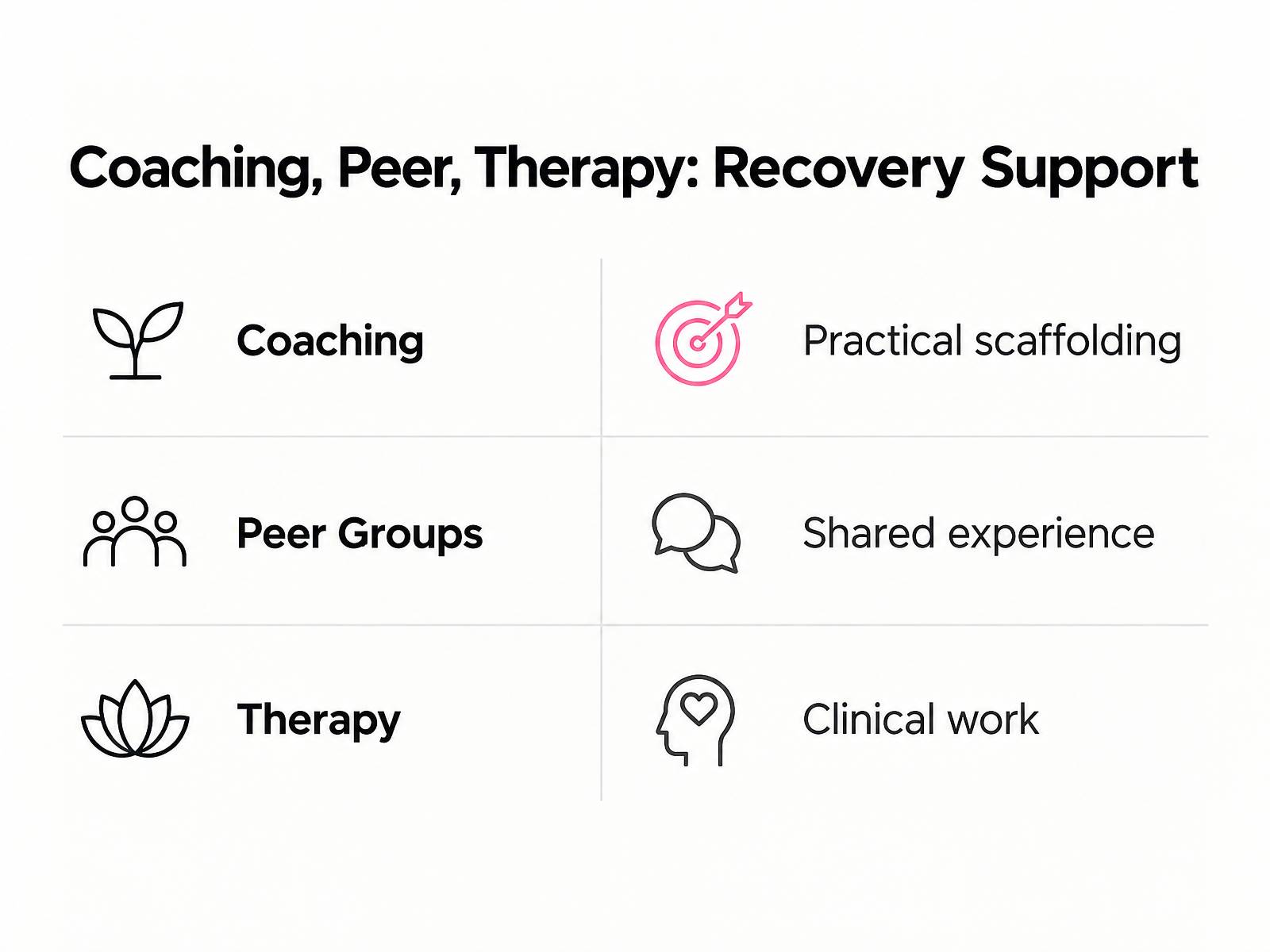
The three are not interchangeable. Therapy does the clinical and emotional work. Peer groups give you shared lived experience and belonging. Recovery coaching handles the practical scaffolding: getting you to the appointment, the meeting, the follow-up. The coaching layer gets skipped most often, and it is usually the one that determines whether the other two actually happen.
Research on peer recovery support consistently points to one clear benefit: keeping people engaged with care during the risky post-discharge window. A 2025 systematic review from the Recovery Research Institute found the strongest evidence for treatment engagement and retention, rather than direct changes in substance use.
Does a referral guarantee someone shows up?
No. A referral is not attendance, and this is the trap families fall into. Simply handing someone a meeting schedule or a therapist's number does not mean they will go. Sustained peer presence—someone checking in, coordinating logistics, showing up with you—is what makes the difference between an appointment on paper and one that actually happens. Because repeated involvement matters more than a single encounter, intensive follow-through is better directed toward people showing early follow-through signals than spread across everyone equally.
| Need after treatment | Primary layer | What it provides |
|---|---|---|
| Practical accountability, linkage | Recovery coaching | Coordination, follow-through, real-world support |
| Shared lived experience, belonging | Peer groups | Connection with others in recovery |
| Clinical, emotional processing | Therapy | Professional counseling outside coaching's scope |
Coaching works as the connective layer, not a replacement for therapy or medical care. Its role is helping you stay engaged with the full structure of support you need, from the practical day-to-day work to the clinical appointments that move recovery forward.
Coaching: Structured Accountability and Follow-Through
The most underrated part of support after treatment is not motivation; it's follow-through. Peer recovery support research—including reviews like Massachusetts General Hospital's—highlights how much of the work is staying connected to appointments and follow-up care. That gap is where MADE Recovery's sober coaching is built to help.
A coaching team treats the work as scaffolding: routine-building, appointment follow-through, and linkage to other supports. Coaching is nonmedical recovery support, not a clinical layer. Clients can work with a single dedicated coach or a coordinated team depending on the level of support needed, and the format should match the person. If someone is in acute withdrawal or needs medication management, coaching is the wrong first call.
Where the Evidence Lands
Current peer recovery support research focuses a lot of attention on connection to care, coaching relationships, and practical follow-through. That matches how coaching is built. The goal isn't to promise sobriety; it's to help you stay engaged with the appointments and supports that hold recovery together.
Some economic modeling has explored coaching as a complement to clinical care after inpatient treatment. That is not a reason to drop clinical care; it is a reason to see coaching as a practical bridge alongside the care that requires a licensed or medical team.
| What coaching is built for | What coaching is not |
|---|---|
| Routine-building and daily structure | Clinical therapy or diagnosis |
| Appointment follow-through and referral linkage | Detox or medication management |
| Connecting you to meetings and other supports | Mutual-help sponsorship |
Peer Support Groups: Mutual Aid and Belonging
Peer support groups are the shared-lived-experience layer of support after treatment, and the most accessible entry point: free, walk-in, and credential-free. They are voluntary gatherings where people in recovery give and receive nonprofessional assistance by exchanging knowledge, coping strategies, and understanding.
Peer groups build belonging and model recovery through shared stories; recovery coaching builds follow-through on appointments and meetings. The research split is consistent: peer support's strongest evidence sits in treatment engagement and attendance, not directly measurable substance use.
Showing Up Is the Unsexy Win
The published research points to a consistent pattern: peer support is most clearly linked to people showing up—attending meetings, engaging with treatment, staying connected over time. Continued attendance varies, and the benefit depends on repeated involvement rather than a single encounter.
There are limits. One peer-support intervention reported increased self-criticism, and a brief single-session peer contact changed nothing. Peer groups work when people attend repeatedly.
| Factor | Peer Support Groups | Recovery Coaching |
|---|---|---|
| Core mechanism | Mutual aid, shared experience | Individual accountability, care linkage |
| Structure | Voluntary, peer-led, drop-in | Scheduled, coach-matched, goal-focused |
| Strongest evidence | Meeting attendance, treatment engagement | Appointment follow-through, connection to care |
| Known limitations | Attendance varies; possible self-criticism | Single-session contact alone fails |
Both layers can play a role in a broader recovery plan, but they are not interchangeable.
Therapy: The Clinical Floor
Therapy is the clinical floor of support after treatment. If the work requires a diagnosis, a treatment plan, or a license to manage, it belongs to a therapist rather than a coach or a peer group. A coaching team refers up that floor on purpose. Coaching handles follow-through; therapy handles the psychological load underneath it.
SAMHSA's peer support worker page describes peers as people who help others stay engaged. A 2016 review of peer support groups says peers lack sufficient training to manage psychiatric conditions or high-risk situations. That boundary is the whole point: peers and coaches get someone to the appointment; therapy holds suicidality, severe depression, trauma, and co-occurring symptoms.
CBT, DBT, EMDR, relapse-prevention counseling, and trauma-informed therapy are clinical tools, not accountability tools. They require credentialed clinicians.
| Layer | Primary job | Licensed clinical work? | Insurance |
|---|---|---|---|
| Licensed therapy | Diagnoses and treats trauma, severe anxiety/depression, suicidality | Yes | Most likely to involve insurance reimbursement |
| Recovery coaching | Routine-building, appointment follow-through, linkage to care | No, nonmedical recovery support | Coverage varies |
| Peer support groups | Shared lived experience and mutual belonging | No, voluntary peer-to-peer | Coverage varies |
Credentials, Cost, and the Insurance Gap
Therapists carry credentials like LCSW, LMFT, LPC/LMHC, or psychologist/PsyD/PhD. Psychiatrists are MDs or DOs and can prescribe. Outpatient therapy is recurring, scheduled sessions. No exact session length applies across the board.
Cost, waitlists, transportation, stigma, and insurance limits all slow access. Integrated care happens when a therapist coordinates with a coach or peer worker under releases of information and client consent. The strongest evidence supports peer support improving mental-health appointment adherence, which is exactly the gap coaching can fill while therapy does the deeper work.
Integration: Building a Coordinated Aftercare Plan
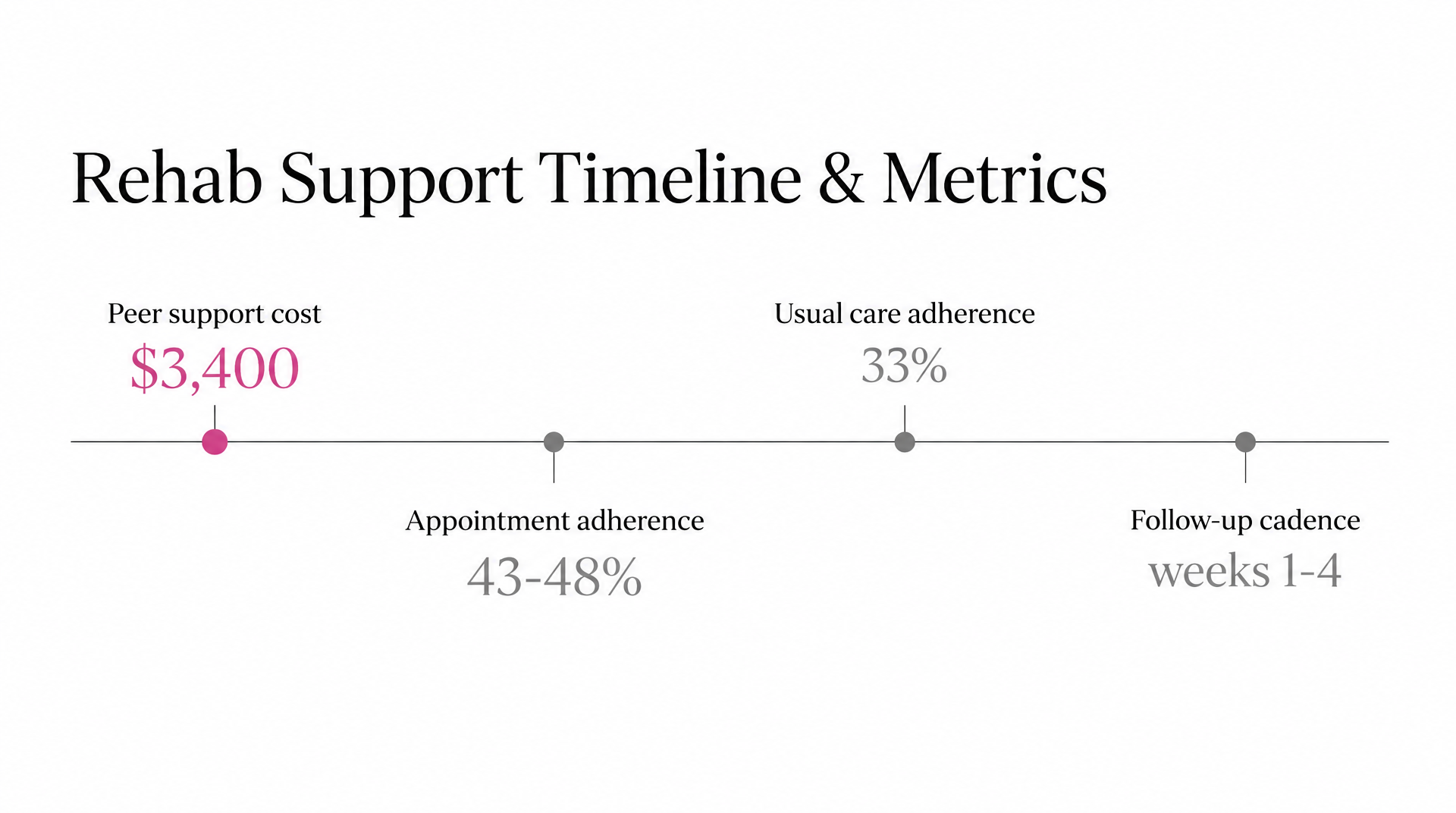
The economics of support after treatment keep producing the same split: a recent economic evaluation put peer recovery support at roughly $3,400 per good year of life added, but health systems often pay more upfront. That argues for payment and reimbursement reform, not just more clinical evidence: the problem is upstream budgeting, not lack of value.
Sequence the three layers rather than stacking them. Stabilize routine and accountability first. Then build peer connection. Escalate to therapy when clinical or emotional issues need licensed care. That order is guidance, not a proven bundle; no trial has tested all three together against single-modality support.
What Does a Coordinated Week Look Like?
| Day | Layer | Coordination job |
|---|---|---|
| Monday | Coach check-in | Medication refill, appointment reminders |
| Wednesday | Peer group | Belonging, shared coping |
| Thursday | Therapy | Clinical/emotional processing |
| Friday | Coach planning | Weekend triggers, meeting plan |
A coaching layer's evidence is specific, but the full bundle should not be claimed to lower relapse more than any single part.
How Do the Roles Communicate Without Breaking Trust?
Keep the coach on logistics, the therapist on clinical risk, and peer groups confidential. Any shared details need a release. Crisis goes to the therapist or emergency services, not the coach.
Calendars, shared care plans, telehealth portals, and recovery apps help as coordination aids, not evidence-based interventions. A sample six-month cadence: weeks 1–4 coach check-ins multiple times weekly plus peer meetings; months 2–3 weekly coach plus group and therapy as needed; month 6 reassess. That mirrors six-month follow-ups common in peer-support research and the one-year coaching model in the economic simulation.
Choosing Your Mix: A Practical Decision Guide
Choosing support after treatment starts with a blunt question: which gap is widest right now? This is not a validated clinical questionnaire. It is a practical way to think through the real-world gaps people describe after treatment: accountability, community, and clinical load.
The Three-Question Sort
| If this is your situation | Lean toward | Because |
|---|---|---|
| Appointments slip, mornings lack structure, or motivation dips between sessions | Recovery coaching | Coaches handle follow-through and linkage; Mountain View Health's piece explains they build schedules, rehearse conversations, and text before appointments |
| Isolation is the loudest problem | Peer groups | Shared stories and sober community reduce loneliness, the core of mutual support groups |
| Trauma, severe depression or anxiety, suicidal thoughts, psychosis, or medical instability | Therapy first | These need licensed clinical care, not coaching alone |
Insurance follows the same split. Therapy usually sits inside licensed clinical networks. Coaching and peer support coverage varies widely, so check your plan before assuming.
Red Flags That Move Therapy to the Front
If you have suicidality, psychosis, unresolved trauma symptoms, or risk of harm, skip coaching-only planning and contact a licensed therapist or urgent care first. The economic case matters less than access in a crisis. Still, recovery coaching cost-effectiveness modeling explores whether coaching can reduce long-term costs even when health systems face higher upfront expenses—one reason coverage discussions lag even when the support shows promise.
Next steps: book a coaching consultation, attend one peer meeting this week, ask your treatment provider for therapist referrals, and put all three on a single weekly aftercare calendar.
References
[1] Peer Recovery - CARE of Southeastern Michigan - https://www.careofsem.com/peer-recovery/
[2] Peer Recovery Support Services and Recovery Coaching for Substance ... - https://pmc.ncbi.nlm.nih.gov/articles/PMC12811009/
[3] Peer Recovery Support - https://communitiesforrecovery.org/peer-support/
[4] What Are Peer Recovery Coaches and Do They Actually Make a ... - https://mountainviewtreatment.com/what-are-peer-recovery-coaches-and-do-they-actually-make-a-difference/
[6] Peer Support Workers for Those in Recovery - SAMHSA - https://www.samhsa.gov/substance-use/recovery/peer-support-workers
[7] Benefits of peer support groups in the treatment of addiction - PMC - NIH - https://pmc.ncbi.nlm.nih.gov/articles/PMC5047716/
[8] The potential economic benefits of recovery coaching - https://www.recoveryanswers.org/research-post/potential-economic-benefits-recovery-coaching/
[9] [PDF] A Systematic Review of Peer Recovery Support Services and R - https://www.mass.gov/doc/mgh-recovery-coach-report-submitted-to-recovery-coach-inbox/download
[10] The cost-effectiveness of long-term post-treatment peer recovery ... - https://facesandvoicesofrecovery.org/resource/the-cost-effectiveness-of-long-term-post-treatment-peer-recovery-support-services-in-the-united-states/
[11] The Power of Connection: Peer Support and Mutual Support ... - https://www.mobilizerecovery.org/the_power_of_connection_peer_support_and_mutual_support_groups
Frequently Asked Questions
1. Does health insurance cover recovery coaching, and what if I can’t afford therapy?
Coverage for recovery coaching varies by plan, and peer support groups are free and require no credentials. Licensed therapy is the most regulated and expensive option, usually billed through insurance or self-pay. Because recovery coaching is nonmedical support, confirm your plan before assuming reimbursement. Coaching and peer groups can help with engagement, but neither replaces clinical care.
2. If I relapse after treatment, should I call my recovery coach or a therapist first?
Call a licensed clinician or urgent care first if you are in acute withdrawal, need medication management, or have thoughts of self-harm. Coaching is the wrong first call in a medical or psychiatric crisis. Once you are stable, a coach can help you rebuild routines and stay connected to outpatient appointments.
3. Is a recovery coach the same as a 12-step sponsor?
A recovery coach is distinct from a 12-step sponsor. Coaches draw on lived experience and formal training to help with appointment follow-through, routines, and linkage to care. Sponsors operate inside a mutual-help program. The two roles can work side by side, but a coach does not enforce a 12-step program.