Sober Coach vs Recovery Therapist: Who Shows Up When You're Triggered at Work
October 22, 2026

Before we get into it, the short version:
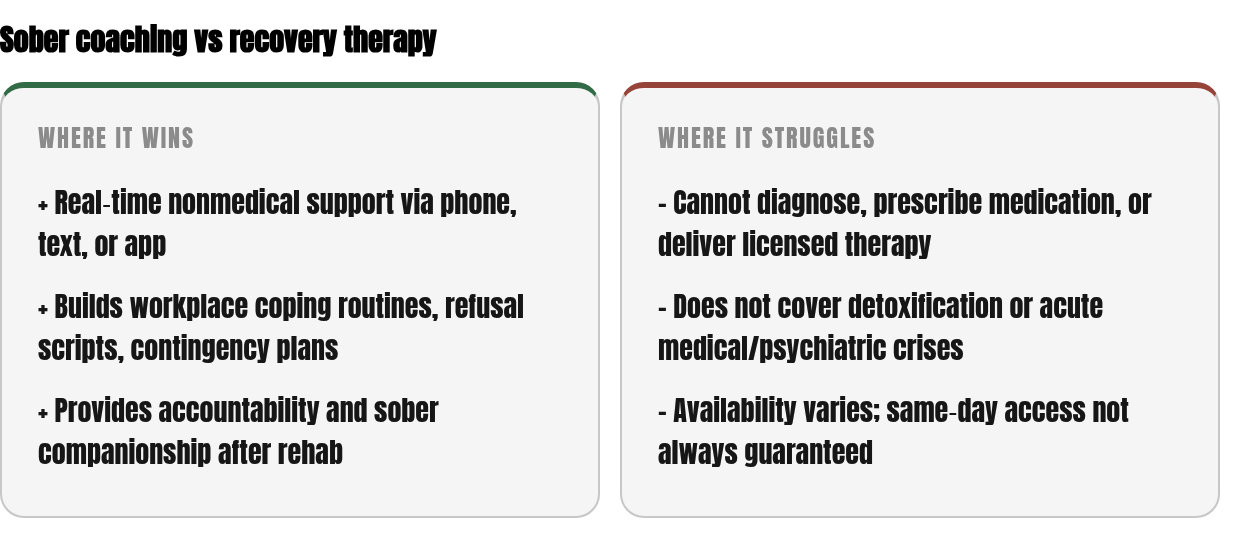
- Sober coaching offers nonmedical support for staying accountable, maintaining sober companionship, building coping routines, and planning for high-risk situations.
- Licensed recovery therapy provides clinical assessment, structured emotional processing, treatment planning, and ongoing mental-health care.
- Coaching may include phone, text, app, and virtual check-ins. Therapists generally work through scheduled appointments.
- Workplace coaching can include refusal scripts, transportation plans, after-hours boundaries, grounding routines, and contingency plans for deadlines.
- Sober coaching does not include detoxification, medication management, diagnosis, or licensed therapy; confirm any provider’s exact scope. Those services require qualified clinical care.
Why the Difference Between a Sober Coach and Recovery Therapist Matters at Work
A sober coach helps someone manage the practical demands of staying steady after rehab. A recovery therapist addresses clinical concerns through licensed treatment. Workplace triggers can happen suddenly, so support depends on whether you need everyday guidance, clinical care, or both.
Coaching for Daily Pressure, Therapy for Clinical Care
A sober coach after rehab can help someone build workplace coping routines, plan for high-risk situations, and handle some of the pressure that follows treatment. This is practical, nonmedical support.
| Workplace need | Sober coaching | Recovery therapy |
|---|---|---|
| Stressful deadlines | Build routines and contingency plans | Assess and treat related clinical concerns |
| After-hours events | Plan safer boundaries and exits | Explore emotional, cognitive, or substance-related issues |
| Social drinking culture | Build refusal scripts and accountability | Treat underlying patterns within a clinical framework |
| Immediate urge to drink | Provide nonmedical support and a next-step plan | Assess risk and provide appropriate treatment |
At MADE Recovery, we help clients apply recovery to situations that rarely feel simple, including returning to work. Our team provides sober companionship, accountability, and practical planning. We are not clinicians, and we do not diagnose or deliver medical treatment.
Someone facing a team dinner may need a script for refusing alcohol, a transportation plan, and a clear limit for the evening. A sober coach can help build that plan. Withdrawal symptoms, trauma symptoms, or another clinical concern require a qualified treatment provider.
Coaching should not be the only response when the immediate concern is medical or psychiatric. Workplace stress may call for coaching. Acute withdrawal, medication questions, or worsening mental health belong with a qualified clinical professional. We help clarify that distinction instead of blurring the lines. Our guide to what a sober coach does after rehab goes into more detail about the practical role.
Availability and Real-Time Support During a Workplace Trigger
When a workplace trigger hits, the question is not which profession is “better.” It is who can respond in the moment, and what support do you need? A sober coach can provide practical, nonmedical support. A licensed therapist handles clinical care through scheduled sessions.
Who Can Respond When a Trigger Hits?
The main differences are availability and function, not status. A therapist may require an appointment. A sober companion may be available during difficult moments, particularly when someone needs help managing pressure, confusion, or a difficult workday decision. Ask any provider about its actual response window. Advertised availability may not match what clients receive.
| Support option | Common access pattern | Best use at work | Main limitation |
|---|---|---|---|
| Sober coaching | Contact and session options vary by provider; may include phone, text, app, or virtual check-ins | Nonmedical support, planning, accountability, and companionship | Does not provide diagnosis, medication management, detox, or licensed therapy |
| Recovery therapy | Scheduled appointment, phone, video, or secure messaging | Clinical assessment, treatment planning, and ongoing mental-health care | May not provide same-day access outside scheduled sessions |
| Employer EAP | Employer-defined referral and response process | Employer-defined workplace support and referrals | Rules, response expectations, and confidentiality vary by employer |
MADE Recovery offers personalized sober companionship at home, social events, and other settings where someone may want support. Coaching is available online and in person, with each program shaped around the client’s needs. The goal is to help clients pause, identify the trigger, and make a practical next choice.
A difficult message from a supervisor at the end of the day may leave someone needing help slowing down before responding. A coach can assist with a pause-and-plan process when that service is available. Symptoms that require assessment or treatment should go to a therapist or other appropriate clinical professional.
Confirm current response windows and preferred contact methods before relying on a provider during a work crisis.
What Each Role Can Do During the First Minutes of a Trigger
A workplace trigger can arrive before there is time to think it through. A useful first-response plan is simple: pause, create distance, contact support, and follow your existing relapse-prevention plan.
Grounding, Emotional Work, and Follow-Through
A coach can help make that plan usable in the middle of a workday. Coaching may include grounding exercises, deciding whom to contact, and building habits for difficult moments.
| Need | Sober coaching | Recovery therapy |
|---|---|---|
| Acute grounding | Practice grounding, urge-surfing, and safer decision-making | Teach or refine coping skills |
| Emotional processing | Support practical application of your plan | Explore emotions and recurring patterns through structured work |
| CBT-based worksheets | Review practical assignments when applicable | Use worksheets to examine thoughts, feelings, and behaviors |
| Longer-term follow-through | Help adjust routines and accountability | Address clinical concerns through licensed care |
Grounding can give someone something concrete to focus on during the first few minutes. They might name five things they see, slow their breathing, or feel both feet on the floor. Some people use urge-surfing to observe the urge without acting on it while staying with the plan made beforehand.
A licensed therapist may use CBT-based worksheets to examine how a workplace reaction connects to a broader pattern. That level of work does not fit every situation. Routine deadline stress may not require it. Recurring thoughts, intense anxiety, or complicated relationships may benefit from more structured attention.
At MADE Recovery, we help clients turn these ideas into repeatable habits. That can include preparing for a difficult commute, choosing someone to call after a rough meeting, and reviewing what worked at the end of the day. The focus is practice and follow-through, not clinical interpretation.
How Coaching and Therapy Can Work Together After Treatment
Workplace pressure can make it tempting to treat every problem as either a coaching issue or a therapy issue. In practice, the two roles can support different parts of recovery. A coach helps turn recovery intentions into everyday work routines, while a therapist addresses clinical concerns. Neither role has to handle everything alone.
Keeping the Roles and Communication Clear
The functions should stay distinct and communication should be intentional. MADE Recovery provides nonmedical coaching, sober companionship, sober living, and intervention support. A licensed therapist or other qualified provider may separately provide diagnosis, medication management, psychotherapy, or other medical care. Those clinical services are outside our role.
| Support need | MADE Recovery | Licensed recovery therapist |
|---|---|---|
| Daily accountability | Practical coaching and accountability | Depends on the therapist’s role |
| Workday application | Help applying recovery routines to workplace situations | Explore clinical and emotional patterns |
| Clinical treatment | Outside our scope | Clinical assessment and treatment |
| Urgent clinical concern | Direct the person to appropriate treatment | Clinical care within the professional relationship |
Information sharing should follow consent, relevance, and confidentiality. A client may authorize a coach to share selected workplace goals or allow a therapist to coordinate general support. Neither arrangement requires unrelated personal details to be disclosed. Agree in advance on what each person may share, with whom, and for what purpose. A narrower release is usually preferable.
Clear schedules, goals, and communication methods can make coordination easier. A therapist may focus on a recurring emotional or behavioral pattern while a coach helps the client test a workplace coping plan. Both should know which concerns require clinical escalation. Do not assume every provider has a referral network or shared-care model. Verify any proposed coordination directly.
For example, before a difficult work situation, a client may tell a therapist that it repeatedly leads to panic and ask a coach to help prepare a specific plan. During the moment, the coach can help with a pause-and-plan check-in if available. Afterward, the coach can review what worked while the therapist addresses the broader pattern.
Which Support Fits When You’re Triggered at Work?
The right support depends on what you need. A licensed therapist or other qualified medical professional may be appropriate when someone needs diagnosis, medication management, or other clinical care.
Match the Support to the Need
| Need | Sober coaching | Recovery therapist |
|---|---|---|
| Approach | Nonmedical support built around each client’s needs and preferences | Clinical care provided within the therapist’s credentials and scope |
| Main objective | Accountability, practical guidance, healthy routines, and human connection | Assessment, symptom treatment, and structured therapy |
| Best fit | Ongoing support during the transition from treatment to everyday life | Ongoing clinical care |
| Cost | Ask the provider about rates and package terms | Ask your insurer and therapist directly |
A coach can help someone build stability, work through practical challenges, establish routines, and make decisions based on an existing recovery plan. If you are experiencing withdrawal, psychosis, severe psychiatric symptoms, or medication concerns, seek qualified medical care rather than relying on nonmedical support.
MADE Recovery does not list specific coach certifications on its website. When evaluating a sober coach, ask about lived recovery experience, relevant coaching credentials, boundaries, response times, and how the coach coordinates with therapists. A recovery therapist may hold credentials such as LCSW, LPC, or addiction-specialized psychology credentials, depending on their license and role.
Common questions:
- Can I use both? Yes. Coaching can support daily routines, while a therapist handles clinical care.
- Can a coach diagnose or medicate? No. Those services fall outside nonmedical recovery support.
References
Frequently Asked Questions
1. What should I do if a workplace trigger happens outside my therapist’s scheduled hours?
Use the support plan you established in advance. That may mean contacting a coach or another support person for practical help, depending on that person’s stated availability. If the situation involves withdrawal symptoms, medication questions, psychosis, or severe psychiatric symptoms, seek qualified medical or clinical care.
2. Can a sober coach replace an employer’s employee assistance program?
A coach should not automatically replace an employer assistance program because each serves a different function. Coaching focuses on individual accountability and recovery planning, while an EAP offers workplace support and referrals through an employer-defined process. A person may use both, but should confirm eligibility, confidentiality rules, and the limits of each service.
3. How much personal information should I share about my recovery with an employer?
Share only what is necessary and properly authorized. Recovery information is sensitive, and broad consent is not always required when providers coordinate limited support. Clients can agree in advance on what may be communicated, to whom, and for what purpose. If you are considering a workplace accommodation, ask what documentation the employer actually requires and share only that information.
4. What should I ask when choosing a sober coach after rehab?
Ask about lived recovery experience, relevant coaching credentials, boundaries, response times, communication methods, and whether the coach coordinates with therapists. These questions clarify what the service includes without assuming that every coach operates in the same way. MADE Recovery provides coaching, companionship, sober living, and intervention support; clinical treatment remains the responsibility of appropriately qualified providers.