6 Jobs a Sober Coach Does That Your Discharge Packet Skips
September 25, 2026

What You Need to Know
- Inpatient peer linkage work improved engagement in recovery services at 30 days.
- Across studies on coaching and substance use, the results were mixed.
- Sober coaches work as nonmedical support. They don't diagnose, detox, or manage medications the way clinical care does.
- Brief peer contact in detox settings has been associated with more aftercare initiation.
- First-time rehab graduates and people leaving detox tend to gain the most from early coaching, since routine and support fall away at the same moment.
- Discharge packets center on clinical instructions, so they skip the daily-living handoff: routines, travel, and unstructured hours.
- A single coach builds continuity by learning your triggers and schedule. A coordinated team spreads coverage across time zones and crises.
Where coaching earns its keep
The distance between a discharge packet and real life is wider than most people expect. Your packet lists appointments, medications to raise with a prescriber, maybe a relapse-prevention worksheet. What it rarely covers is the Tuesday morning when you're alone in your kitchen, off routine, with four unstructured hours ahead and no plan for any of them. That's the space sober coaching after rehab is built for.
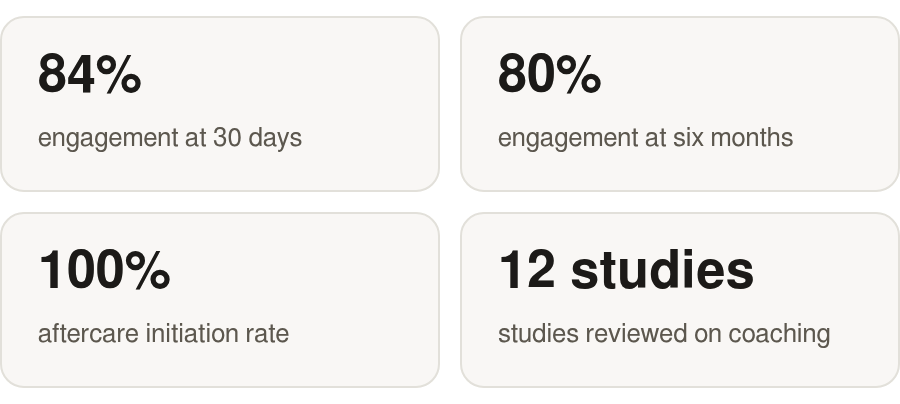

The strongest evidence for coaching lands in one place: transitions and connection, not clinical cure. A systematic review of peer recovery services found that inpatient linkage work improved engagement in recovery services after discharge, and that the effect held up months later. Coaches are good at getting you connected and keeping you there. That's the lane where this kind of support consistently delivers.
Why don't discharge packets cover daily living?
Discharge packets are organized around clinical instructions, so the daily-living handoff falls through the cracks. They tell you what to do medically. They rarely show you how to rebuild a morning routine, get through a first sober trip, or sit at a family dinner where everyone else is drinking.
- Confirm someone is helping you structure the early weeks at home, when routine collapses and formal programming no longer shapes the day.
- Ask who covers the practical gaps your packet leaves blank: home routines, travel, grocery runs, and the empty stretches of time.
We'll hold this boundary plainly: we're a nonmedical recovery support team. Our work sits in the day-to-day space between appointments, where plans either become habits or stay on paper.
Does the research actually prove coaching reduces relapse?
Not cleanly, and we won't pretend otherwise. The evidence that coaching directly reduces substance use is still mixed. Studies point in different directions rather than giving a tidy yes or no.
So we don't promise coaching prevents relapse. What holds up across the broader evidence base is linkage, retention, and aftercare initiation. In detox settings especially, brief peer contact has been associated with more people taking the next step into care. That's the real return: staying connected long enough for recovery to take hold.
- Judge a coach on connection and follow-through, not on guarantees no one can honestly make.
Who benefits most from a coach in the first weeks?
First-time rehab graduates and people leaving detox get the most from early coaching, because the handoff from structured care to ordinary life can be abrupt. Timing beats total hours. A small amount of support at the right moment can matter more than a large plan that starts after the riskiest stretch has already passed.
- If you're leaving detox or residential care for the first time, prioritize coaching in week one, not month three.
If you want to see what those early check-ins might look like for your situation, reach out and we'll help you build a plan that fits the first weeks home.
Matching the coaching model to your week
Picking a coaching model comes down to matching support to the parts of your day that fall apart first. The discharge packet tells you what to do clinically. It says nothing about who helps you rebuild a morning routine, get through a wedding, or keep your footing on a work trip. Let that practical gap drive the choice.
Start with a clear read on what the evidence supports. Coaching shows its most consistent results in transitions and connection, not in curing anything clinical. One source frames the coach's role as narrow, describing them as not substance abuse experts with limited reach. A broader review of peer recovery work shows peers doing real transition-of-care work: better retention, fewer readmissions, faster treatment initiation. Both can be true at once. Coaches are strong at daily-living navigation and system linkage, weaker at clinical treatment. The boundary is where the value sits.
One coach or a coordinated team?
A single coach gives you continuity. The same person learns your triggers, your kitchen, your schedule, and that history compounds over the weeks. The tradeoff is coverage. One person can't be on call overnight, cover a travel disruption, and still show up fresh for every routine check-in.
A team spreads the load and keeps someone available across time zones and crises, but you repeat your story more often and continuity can thin out. We build around six jobs: habit and routine work, companionship, travel, and crisis backup often call for different strengths.
- Ask how the coach or team handles continuity when your main contact is off or traveling, especially in the earliest post-discharge window.
- Confirm who covers habit and routine coaching versus who handles a live crisis, so no job falls through the cracks.
Virtual or in-person support?
The research doesn't cleanly rank formats, so match delivery to the job. Habit-building, nutrition planning, and daily check-ins can work remotely when the task is mostly planning, accountability, and reflection. Virtual support also helps when your schedule or location shifts week to week.
Companionship at a triggering event or on a business trip is where in-person earns its cost. That's the hands-on part a packet can't script. Someone physically in the room can read it, help you leave early, or interrupt a risky pattern before it picks up speed.
- Decide which jobs genuinely need someone present versus a scheduled call.
- Ask for travel and social-event protocols before you book, not after a trip is on the calendar.
What red flags should you watch for?
Coaching is nonmedical support. Anyone promising to prevent relapse or manage your medications is selling something they can't deliver. Training and supervision vary, too. Most peer workers receive formal training that clarifies their roles and boundaries, so ask how a given coach was trained and who oversees their work.
Be honest about the limits. Peer support isn't uniformly positive. Some findings show that more peer contact can coincide with more care utilization rather than a clean drop in crises. Good coaching knows when to hand you off to clinical treatment.
- Walk away from anyone guaranteeing sobriety or offering to adjust medications.
- Ask about training, supervision, and how they escalate a medical emergency.
Action Checklist: Building Your Post‑Discharge Support Plan
A good post-discharge plan isn't a binder you file away. It's a working document that turns each of the six jobs into something you actually do this week. Below is a checklist you can print and mark up. It's built around the daily-living gaps coaching is meant to fill, not the clinical items your discharge packet already covers.
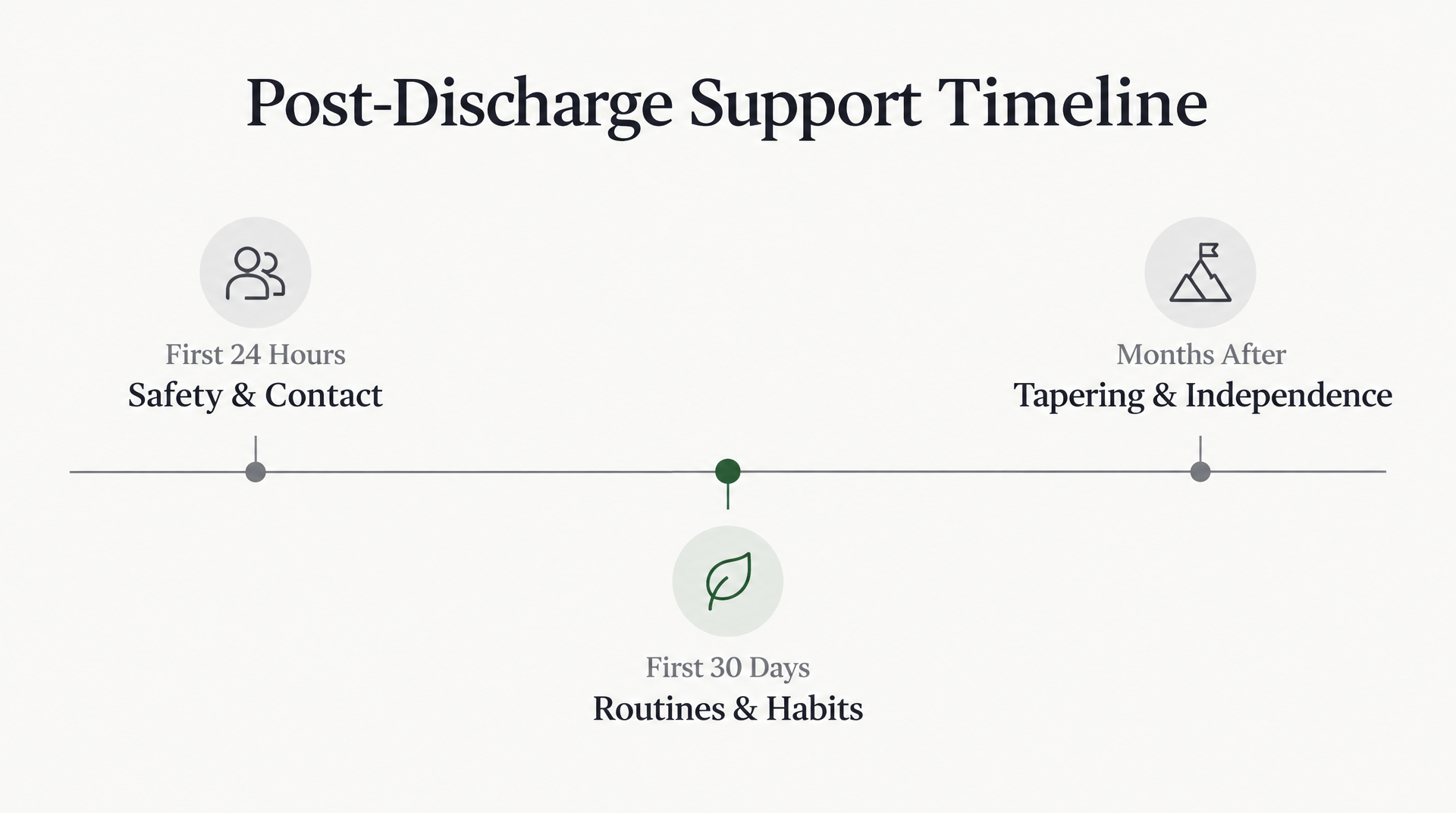
Work through it in three passes: the first day, the early month, and the stretch when support starts to step down. Use a real template if you have one. If you don't, this structure works as a starting draft.
What Goes in the First 24 Hours?
The first day is about safety and contact, not ambition. Get the scaffolding up before the quiet hours arrive.
- Schedule your first coaching session and put it on a shared calendar, so the appointment exists outside your own memory.
- Build an emergency contact list with your coach, one family member, and your prescriber, and keep it somewhere you'll actually reach for it.
- Walk your home and name the high-risk rooms and hours out loud, so triggers get flagged instead of ambushing you.
What Are the First 30-Day Milestones?
Month one is where routines either take root or fall apart. These items track whether daily life is holding.
- Track a fixed wake, meal, and sleep schedule for at least two weeks, since a steady rhythm blunts the empty time that feeds cravings.
- Set two or three habits you can measure, like a morning walk or a hydration log, and check them off daily.
- Plan one low-stakes travel or social test run with your coach on call, so you learn how you handle being off routine before the stakes are high.
When Should You Taper Coaching?
Tapering is a sign of progress, not a cutoff. You step down as independence grows, not on a fixed date.
- Review what held and what slipped at set check-ins, then decide together whether to reduce contact frequency.
- Keep an on-call path open even as sessions space out, so a hard week doesn't mean starting over.
Ready to put a plan like this in place? Reach out to MADE Recovery for an initial consultation, and we'll help you build one around your actual days.
References
[1] What Are Recovery Coaches, and Do They Work? - National Rehab Hotline - https://nationalrehabhotline.org/resources/recovery-coaches/
[2] Peer Recovery Support Services and Recovery Coaching for Substance ... - https://pmc.ncbi.nlm.nih.gov/articles/PMC12811009/
[3] Lived Experience in New Models of Care for Substance Use Disorder - https://pmc.ncbi.nlm.nih.gov/articles/PMC6585590/
Quick Questions, Straight Answers
1. What's the difference between a sober coach and clinical treatment like therapy or detox?
Therapy, detox, and medication management belong to licensed clinical providers. A sober coach works on the other side of that handoff: turning recovery goals into daily structure, helping you prepare for risky situations, and keeping communication open with the support system you already have.
2. Can a sober coach come with me to a wedding or a business trip?
Yes, if that is part of the coaching plan. For events and travel, ask in advance what the coach will and will not do, how they handle exits from high-risk settings, and what happens if plans change mid-trip.
3. Is virtual coaching as effective as in-person support?
It depends on the task. Remote coaching is usually best for planning, accountability, and routine review. In-person support is better when the main risk comes from the environment itself, such as a social event, airport, hotel bar, or family gathering.
4. How do I know if a sober coach is qualified and trustworthy?
Ask direct questions about training, supervision, scope of practice, and emergency procedures. A trustworthy coach will explain their limits clearly and will not blur the line between recovery support and medical care.
5. What happens if my main coach isn't available during a late-night crisis?
This should be spelled out before coaching begins. Ask whether there is a backup coach, an on-call number, or a team protocol, and make sure you know which situations go straight to emergency or clinical support.
6. Will I need a sober coach forever, or can I step down?
Most people use coaching as a bridge, not a permanent dependency. As routines stabilize, sessions can become less frequent while still preserving a way to reconnect quickly if stress, travel, or a major transition puts recovery under strain.