One Coach or a Whole Team: Which Builds Firm Foundations at 2 A.M.
August 27, 2026

Key Takeaways
- The whole solo-versus-team question comes down to one thing: who picks up when a craving hits at 2 a.m.
- A solo coach gives you deep rapport and a single strong bond. But they work limited hours, and when they're off, you're on your own.
- Team-based coaching spreads your case across several coaches. That builds in backup when one person is unavailable.
- A team brings different strengths, nutrition, daily routine, crisis planning, instead of leaning on one person's skill set.
- Solo coaching suits people with stable housing and strong follow-through. Teams serve people at high relapse risk better.
- Coordinated coverage matters most in the fragile first weeks home, when detox or residential ends and old habits come back loud.
- Sober coaching pricing scales with how much of your day the support covers, not a flat rate.
The Fast Version
One coach or a full team? It comes down to a single question: who answers when a craving hits at 2 a.m.
A solo coach builds a strong personal bond. But they sleep. A coordinated team covers the gaps, so more support is reachable when the house goes quiet and old habits get loud. That coverage is what holds the line in the first fragile weeks home.
Here's how the two models stack up on the things that actually matter after detox or residential treatment.
One Coach or a Team: The Real Difference
A solo coach is one dedicated person. Deep rapport, but limited hours and no backup. Team-based coaching puts several coaches on your case, which means broader reach, someone covering when one person is off, and different strengths for nutrition, routine, and the crisis moments. The trade-off is intimacy versus availability.
| Factor | Solo Sober Coach | Team-Based Coaching |
|---|---|---|
| Late-night crisis reach | Limited to one person's hours | Shared across several coaches |
| Relationship depth | Very high, single bond | High, spread across a few coaches |
| Backup if unavailable | None | Built in |
| Skill range | One person's strengths | Nutrition, routine, crisis planning covered |
| Best for | Stable housing, strong follow-through | High relapse risk, first weeks out |
What Does This Cost?
Sober coaching pricing scales with how much of your day it covers, not with quality. Hourly work runs $75 to $400. Live-in support runs $1,000 to $4,000+ per day, according to our own breakdown of sober coach costs. The daily rate buys full coverage during the highest-risk window. Hourly check-ins hold accountability once you stabilize.
| Support tier | Typical cost | Best for |
|---|---|---|
| Live-in companion | $1,000–$4,000+/day | First weeks, high relapse risk |
| Intensive coaching | $200–$400/hr | Early transition, frequent check-ins |
| Maintenance coaching | $75–$200/hr | Building independence |
We taper on purpose. A coordinated team brings the support you need up front, then steps down to lighter check-ins as your rhythm returns, so you never pay for supervision you've outgrown. Skip the daily tier entirely if your housing is stable and your follow-through is solid. Pay for the team model when 2 a.m. genuinely feels unsafe.
Why Even Weigh These Two
Choosing between a solo coach and a team is really about matching support to your actual risk level. If your vulnerabilities peak late at night, or you live alone, a coordinated team wins on coverage. If your triggers cluster in daylight and you value one deep relationship, a solo coach can build a solid base just fine. Most people coming out of inpatient fall somewhere in between.
Coordinated coverage tends to matter most during the initial transition. That's the window when clinical supervision ends, structure disappears, and a single sleeping mentor leaves a gap right when you need a voice. After that, we step down the intensity. At MADE, the program is built to reduce touchpoints as you show self-reliance, so the goal is long-term stability, not a standing appointment forever.
Which Model Fits Your Situation?
A solo coach works best when your schedule is stable, your triggers are predictable, and one trusted relationship keeps you honest. Team-based coaching works best when your vulnerable moments are unpredictable, especially off-hours, and you need someone reachable around the clock.
| Your Situation | Solo Coach | Coordinated Team |
|---|---|---|
| Late-night cravings | Gaps when they sleep | Someone always on call |
| Deep single rapport | Strong | Shared across coaches |
| Backup if coach is off | None | Built in |
| Varied needs (nutrition, sleep, work) | One skill set | Multiple strengths |
| Cost | Lower | Higher |
What Should Drive Your Choice?
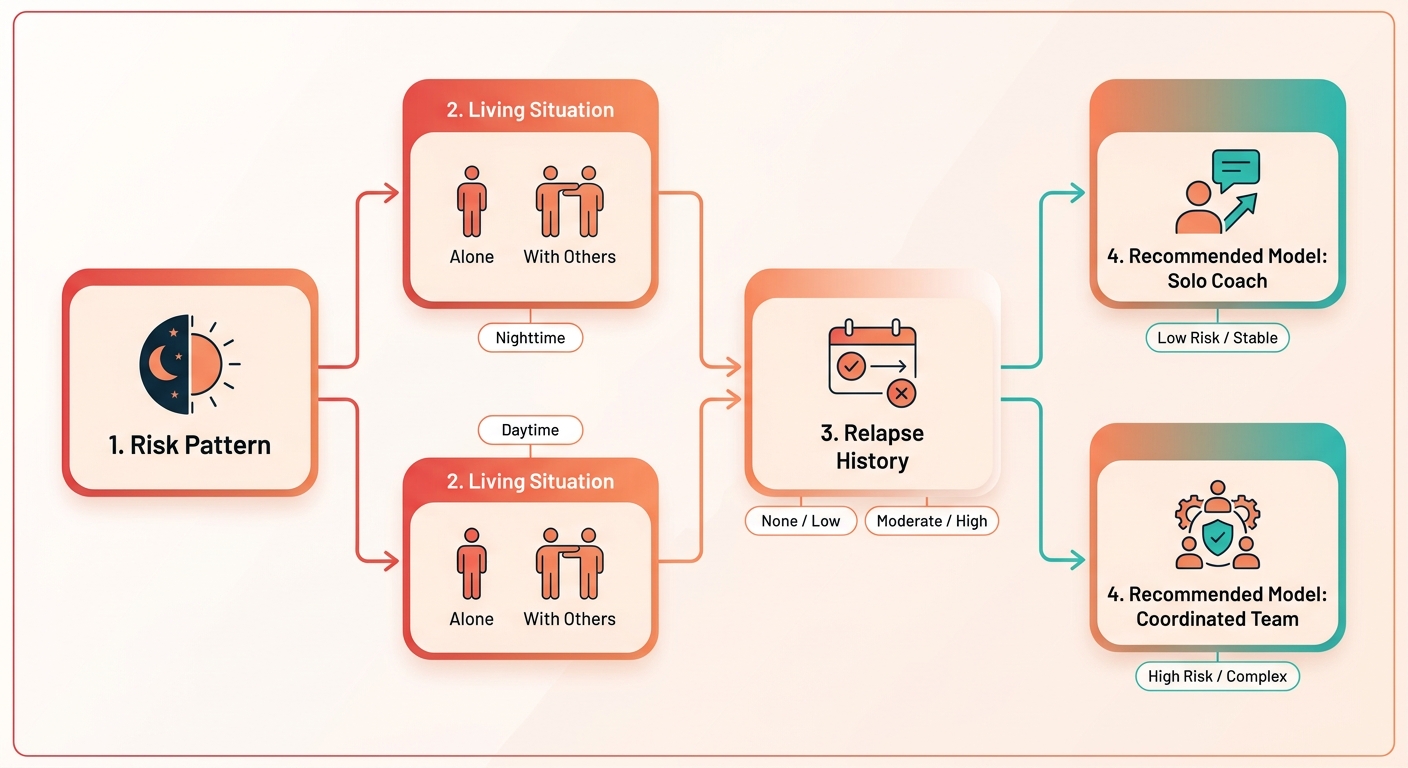
Three factors matter most: when your cravings hit, whether you live with support, and how many life areas need attention at once. Answer those honestly and the right model usually becomes obvious.
Ask yourself when the urge to use actually shows up. If it's the middle of the night and you're alone, coverage beats rapport. If your family is present and your risky hours are few, a single coach may be enough.
If you already have a strong local network and predictable triggers, a full team might be overkill. But in the first 30 days, when one voice can't be everywhere, a coordinated team is what keeps late-night gaps from swallowing your progress. Our coaching can include coordination with clinical providers, nutritional planning, physical wellness, and day-to-day life management as you rebuild those routines.
Feature Comparison
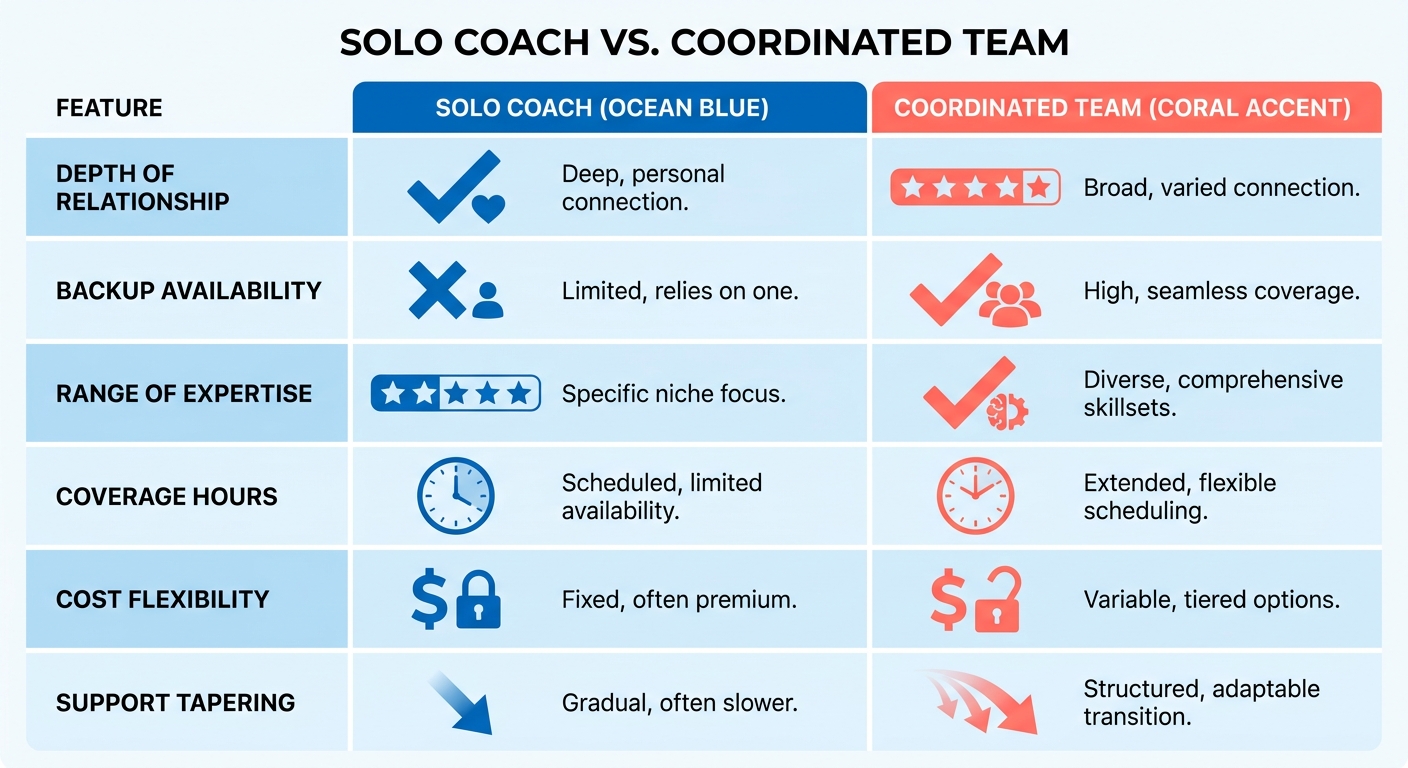
What separates a solo coach from a team is how the support is structured: depth of relationship, backup when your coach is unavailable, and range of expertise. A solo coach gives you one deep relationship. A coordinated team gives you added reach and redundancy. Both can build lasting stability. They just do it through different mechanics.
Here's what each model actually delivers as you re-enter daily life.
| Feature | Solo Coach | Coordinated Team (our model) |
|---|---|---|
| Backup when your coach is off | None | Another coach steps in |
| Range of expertise | One person's strengths | Nutrition, routine building, family dynamics |
| Depth of single relationship | Very strong | Shared across the team |
| Coordination with support services | Depends on the coach | Built into our model |
| Support that tapers over time | Depends on the coach | Built into our protocol |
Which Model Fits Your Level of Care?
Redundancy is the feature that decides a lot of cases. With a team, if your coach is off, another steps in, and clients can draw on the group depending on the level of care they need. A solo coach offers one steady presence. The right choice depends on how much support your transition actually calls for.
The tradeoff is worth naming plainly: individual coaching tends to build deeper one-on-one relationships, while a team-based approach adds range and coordination. Neither is strictly better. They solve different problems.
Where a Solo Coach Still Wins
Go with the single-coach model if you want one steady voice and a tightly held relationship. Sensitive issues that call for a close, consistent connection often fit individual work well, since fewer people hold your story. One relationship, deeply built, has real staying power.
Our team model lets any coach step in when the level of care calls for coordinated support. That's a strength for coverage. And we'll be honest with you about which model fits.
Performance Comparison
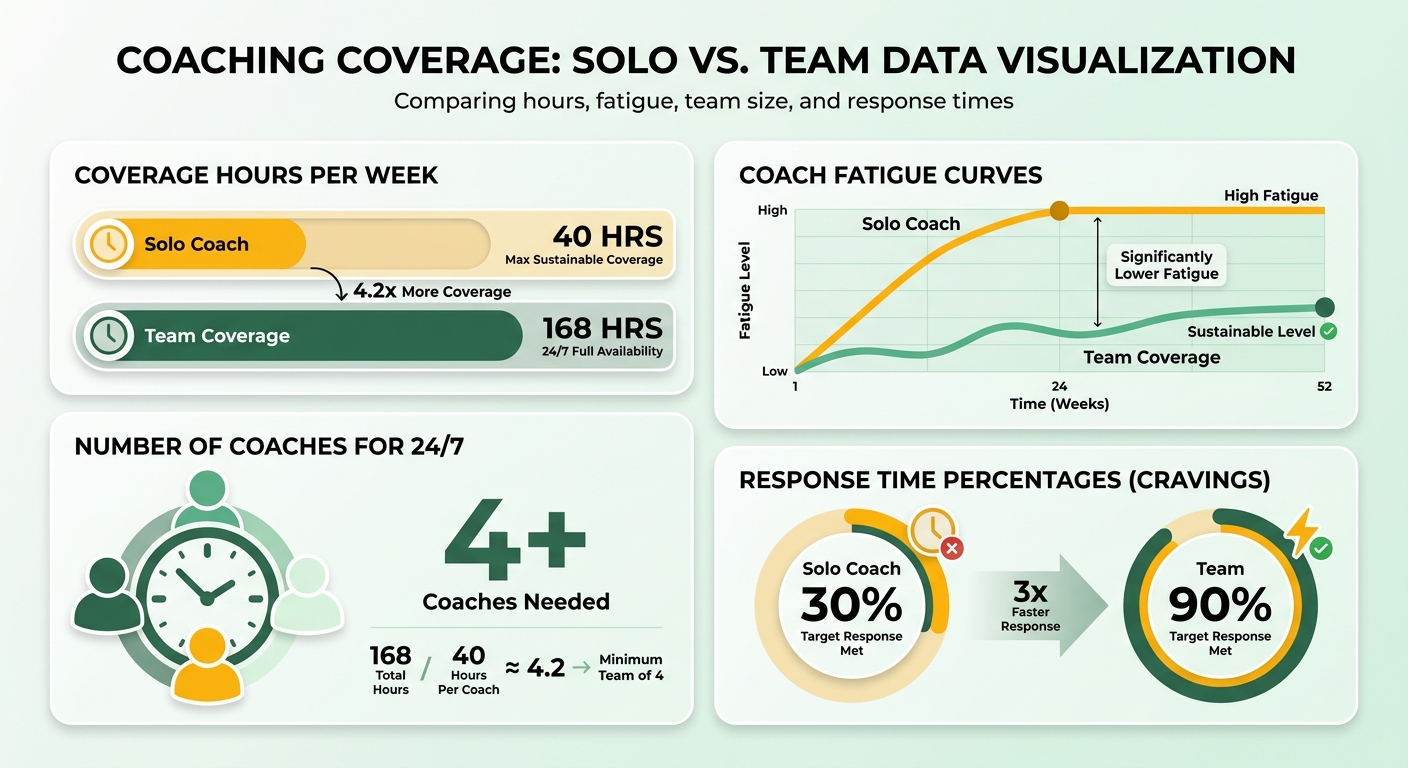
Speed is where a coordinated team wins outright. A solo coach answers when they're awake. A team means more coaches can share the load. That difference in coverage is the whole game during post-rehab re-entry. It's what turns white-knuckle nights alone into a recovery base built on accountability and consistent care.
Call it coverage math. One person can hold only so much before fatigue sets in. A coordinated team spreads that load across coaches. When after-hours vulnerability peaks and daily structure is gone, the question isn't how good your coach is. It's whether the support model can stay steady without burning anyone out.
How Do the Two Models Compare?
A team distributes coverage because support is shared across coaches rather than resting on one person. A solo coach carries every call alone. A team routes demand to whoever is covering, depending on the level of care needed. For post-detox clients managing a high-risk transition, that shared capacity keeps support consistent.
Here's how the two scale under real load.
| Factor | Solo Coach | Coordinated Team (our model) |
|---|---|---|
| Off-hours response speed | Delayed until awake | Shared across the team |
| Handling multiple crises at once | One at a time | Shared across coaches |
| Resource strain on the coach | High, burnout risk | Distributed, sustainable |
| Coverage during illness or vacation | Gap | Another coach fills in |
Does a Team Actually Scale Better?
Yes, on both crisis volume and coach sustainability. A single mentor hits a ceiling. When two clients need help the same night, someone waits. A team absorbs overlapping demand without leaving anyone on hold.
The resource cost matters too. Solo coaching burns one person out over time. Late-night calls, no relief, no backup. That fatigue eventually degrades the quality of support right when clients need it steady.
Spreading the load keeps each coach fresh. Nobody carries the overnight shift alone, so the person who answers is actually present, not running on empty. That's part of why we can hand you back your own routine smoothly as your daily habits solidify.
If your risk profile is minimal and you prefer a single point of contact, the solo route stays highly effective. But for coordinated support through the toughest stretch, a team wins on the metrics that count.
Pros and Cons
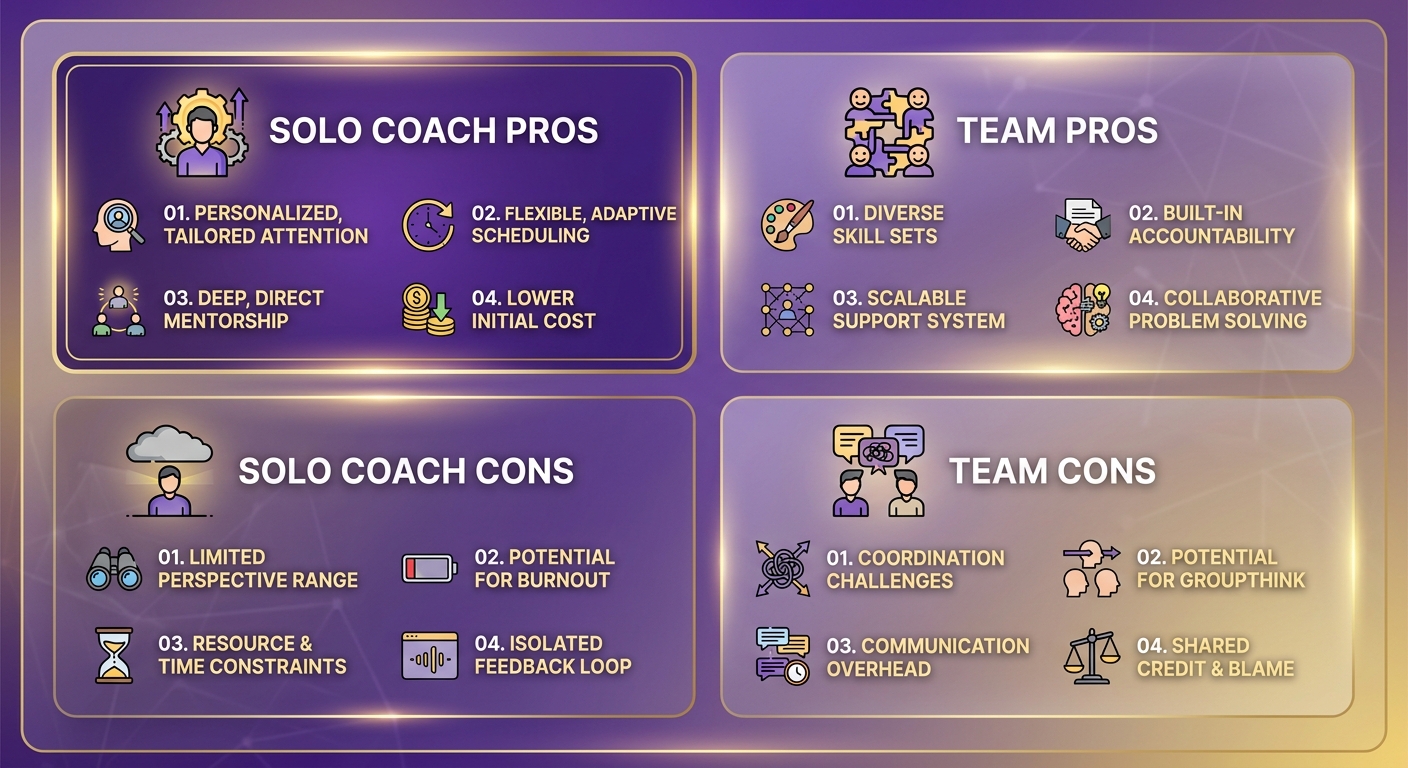
Every support model has a downside, and the honest answer is that neither one is perfect. A solo coach gives you one deep bond. A coordinated team gives you coverage. Which one builds stable groundwork depends on when your hardest hours actually hit.
Here's the trade-off in plain terms, then a table to scan fast.
The Real Strengths and Weaknesses
Solo coach: deep rapport, full confidentiality, one voice that knows your whole story. That closeness is real. Working with a single dedicated coach means the relationship can go deeper, and sensitive issues stay contained in one trusted connection. The weakness is obvious. One person sleeps, gets sick, takes vacations. When they're off, you're on your own.
Coordinated team: broader reach, backup when one coach is out, and a mix of strengths across lifestyle design, sleep hygiene, and family integration. The cost is that your story gets shared across several people, so no single relationship runs quite as deep. Some people feel that dilution. Most feel the coverage more.
| Trade-off | Solo Coach | Coordinated Team (our model) |
|---|---|---|
| Depth of one bond | Deepest | Shared, still strong |
| Coverage when one coach is off | Gaps when unavailable | Backup across the team |
| Privacy | Fully contained | Shared across coaches |
| Breadth of skills | One person's range | Several specialties |
When Should You Skip the Team?
Skip a team model if your triggers cluster in daylight and you'd trade coverage for one confidential, deep relationship. That's a fair call, especially for people who guard their privacy hard and don't want their story passed around. A solo coach fits that person better.
Our take: during the high-risk post-discharge window, when late-night vulnerability is high, coverage wins. We build our approach around a coordinated team, with our involvement fading as your own recovery routines take hold. The bond still matters. It just shouldn't be the only thing standing between you and a relapse when you're alone.
Use Cases and Ideal Users
The right model depends on when your hardest hours hit and how much backup you need. A coordinated team fits people whose risk spikes at night, who live alone, or who have relapsed before. A solo coach fits those with daytime triggers and a strong preference for one deep bond. Both can build a strong base during early transition.
Most people re-entering daily life need more coverage than they expect in those first days. That's when a shared roster of coaches earns its keep. The tradeoff is the same either way: individual work builds a deeper, more contained relationship, while a coordinated team adds reach and redundancy. We watch both play out every night.
Who Benefits Most From a Coordinated Team?
Several coaches sharing one case means someone is reachable when cravings peak overnight. That suits high-risk transitions where a single sleeping mentor leaves a dangerous gap.
If you live alone, work night shifts, or have a history of late-night relapse, the team model wins. Redundancy matters when one person can't be everywhere. It also helps if your needs span physical wellness, daily scheduling, and family integration, since different coaches bring different strengths. Our routine-building work leans on that shared expertise.
When Does a Solo Coach Make More Sense?
One dedicated person who knows your whole story. Best for daytime triggers, deep rapport, and sensitive issues you'd rather keep in one trusted connection.
Skip the team model if confidentiality is your top concern and your risk clusters in daylight. A single coach keeps everything contained. That closeness is real, and for some people it's the whole point.
| Scenario | Best Fit |
|---|---|
| Late-night cravings, living alone | Coordinated team (our model) |
| Daytime triggers, wants one deep bond | Solo coach |
| Prior late-night relapse | Coordinated team |
| Confidentiality is top priority | Solo coach |
| Needs varied expertise | Coordinated team |
Most clients land in between. That's why the program is built to step down in intensity as your self-reliance grows.
What I'd Actually Recommend
The choice between one coach and a team comes down to timing. If your hardest hours hit after midnight, a coordinated team builds a stronger base, because more people can share the support. If your risk clusters in daylight and you want one deep bond, a solo coach does the job well.
Most people coming out of inpatient don't know their own risk pattern yet. That alone is the case for coverage in the early transition. A team gives you support through the vulnerable overnight hours, then steps back as your self-reliance grows.
Which Model Should You Pick?
Quick decision guide, matched to real scenarios.
| Your situation | Better fit |
|---|---|
| Cravings spike after midnight | Coordinated team |
| You live alone | Coordinated team |
| You've relapsed before | Coordinated team |
| Triggers cluster in daylight | Solo coach |
| You value one contained relationship | Solo coach |
| You're several months stable | Either, tapering down |
Our model at MADE is built around that first column. We offer a single dedicated coach or a coordinated team, depending on the level of care you need, then gradually pull back as you establish your own daily habits. That handoff matters. The goal was never permanent dependence on us. It's your own routine carrying the weight as independence grows.
When to Skip Team Coaching
Skip the team model if your recovery is already stable and your triggers are predictable and daytime-bound. Paying for coverage you won't use is wasted money. A solo coach, or even a structured sober living arrangement, fits better then. A conversation with us can help you weigh that call.
The honest summary: coverage wins in the fragile weeks, depth wins later. Match the support to when your hard hours actually land, not to what sounds impressive on paper.
If you're still weeks out from stable and the late-night quiet scares you, start with a team. Build the routine, then let the scaffolding come down as your footing gets solid.
References
[1] Group vs Individual Coaching - Co-Active Coach - https://coactive.com/blog/group-coaching-vs-individual-coaching/
[2] (PDF) The Sacred Cow of Transferability: Why Training in ... - https://www.researchgate.net/publication/398047370_The_Sacred_Cow_of_Transferability_Why_Training_in_One-on-One_Coaching_is_Not_Sufficient_for_the_Team_Setting
Frequently Asked Questions
1. Can I switch from a solo coach to a team later, or the other way around?
Our involvement can gradually decrease, moving from intensive coverage to lighter check-ins as your routines strengthen. The MADE model starts with the level of care your risk calls for, then systematically scales back. Shifting between models is possible when your risk pattern and independence change.
2. Does sharing my case across a team compromise my privacy?
A coordinated team means your story gets shared across several coaches, so no single relationship stays fully contained. If confidentiality is your top priority, a solo coach keeps everything in one trusted connection. That trade-off is real, though most people feel the added coverage outweighs the reduced privacy.
3. Why does the article emphasize 2 a.m. specifically?
The 2 a.m. reference represents the fragile late-night window when structure disappears, the house goes quiet, and old habits get loud. A solo coach sleeps, leaving a gap exactly when cravings peak. This timing question drives the whole choice: coverage matters most when you're alone and vulnerable after midnight.
4. Will a team-based model burn out coaches less than solo coaching?
A team distributes the load across several coaches, keeping each one fresh rather than carrying every late-night call alone. Solo coaching risks burnout over time, which degrades support quality. Spreading demand means the coach who answers is actually present, not running on empty, making support more sustainable.
5. How much should I expect to pay if I only need occasional check-ins?
Maintenance coaching is billed at a lower hourly rate and suits people building independence with stable footing. Intensive coaching costs more per hour due to the frequency of early-transition check-ins. Pricing scales with how much of your day support covers, so lighter needs mean lower hourly rates.
6. What if I'm several months into stable recovery already?
What if I'm several months into stable recovery already? Either model works when you're stable, and support can scale down accordingly. Investing in round-the-clock backup is unnecessary if your triggers are predictable and daytime-bound. A solo coach or a structured sober living arrangement often fits better once you're past the early relapse window.
7. Does a team handle more than just cravings and crisis calls?
A coordinated team brings varied strengths across lifestyle design, daily scheduling, and family integration rather than one person's skill set. MADE's coaching can include coordination with clinical providers, physical wellness, and day-to-day life management. This range helps when your needs span multiple life areas at once.