How to Turn Treatment Tools into a Daily Routine That Survives Real Life
October 22, 2026

Quick Answers
- A workable recovery routine depends on consistency and flexibility, not rigid clock times or a demanding daily schedule.
- Give every coping tool a full, shortened, and emergency version for ordinary, busy, and crisis days.
- Most recovery routines protect 7–9 hours of sleep and 30–60 minutes of exercise, while keeping waking times reasonably stable.
- Start with one or two manageable practices. Adding tools gradually makes them easier to integrate than trying to follow a full schedule right away.
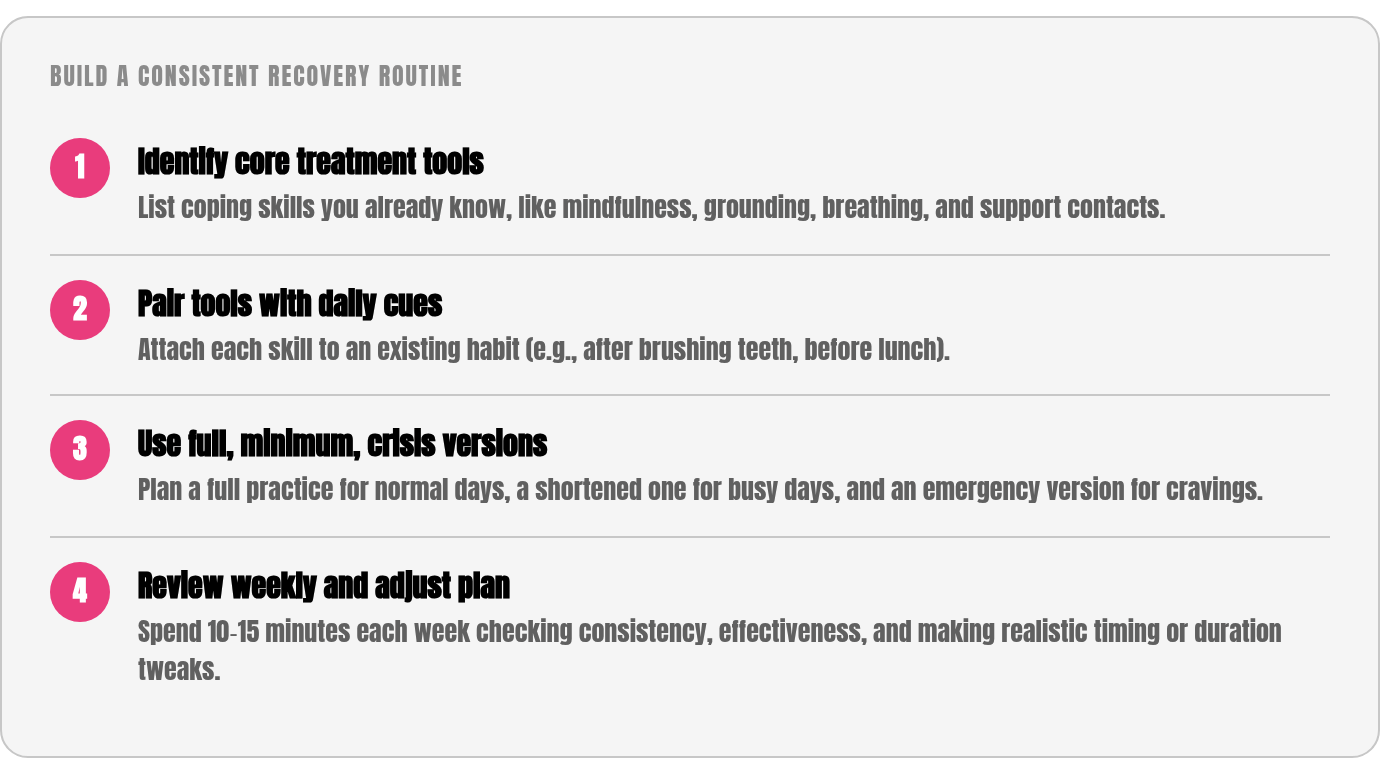
- Existing routines can anchor recovery habits: mindfulness after brushing your teeth, movement after lunch, and support before an unstructured evening.
Related Video
Watch: Maximize Productivity, Physical & Mental Health With Daily Tools | Huberman Lab Essentials by Andrew Huberman
Quick Summary
A sober coach after rehab can help turn treatment tools into habits that fit an ordinary day. Start with one or two positive practices, such as a short walk or five-minute meditation, instead of trying to follow a rigid schedule immediately. A published recovery routine guide recommends aiming for 7–9 hours of sleep and 30–60 minutes of exercise on most days.
The goal is consistency with flexibility. Protect the purpose of each habit instead of obsessing over a particular time. Use the full version on ordinary days, a shorter version when things get busy, and an emergency version when a craving or crisis interrupts the plan.
How Do You Fit Recovery Tools Into a Realistic Day?
The following table offers a practical starting point. This sample schedule begins with waking, meditation, and water at 7:00 a.m., with support meetings or reflection around early afternoon, based on this daily routine framework.
| Tool | Daily Time Needed | Ideal Time-of-Day Slot | Difficulty (1–5) | Support Touchpoint | Quick Tip |
|---|---|---|---|---|---|
| Mindfulness | 5–10 minutes | Morning | 2 | Coach or peer | Pair with waking and water. |
| Grounding and deep breathing | 3–5 minutes | As needed | 1 | Emergency contact | Use grounding to return to the present. |
| Self-care | 20–30 minutes | Evening | 3 | Supportive friend | Try a shower, meal, or grooming routine. |
| Support group | 45–60 minutes | Fixed daytime slot | 3 | Sponsor or peer | Schedule it before free time opens up. |
| Emergency contacts | quick setup; 1 call when needed | Phone and wallet | 2 | Trusted person | Include one person you can call immediately. |
| Sleep routine | a calming wind-down; 7–9 hours overnight | Night | 3 | Coach or housemate | Keep waking time consistent. |
| Exercise | 30–60 minutes | Morning or late afternoon | 4 | Coach or exercise partner | Start with a walk; skip gym perfection. |
Relapse-prevention skills should be part of everyday life, not reserved for the moment a craving appears. The relapse-prevention skill guide explains why practicing before craving intensity builds can be useful. Attach each tool to an existing cue: meditation after brushing your teeth, movement after lunch, and a support call before an unstructured evening. Missing one session means the routine needs a restart, not that recovery has failed.
Why Turning Treatment Tools into a Daily Routine Matters
Many people leave treatment knowing how to breathe deeply, check in, and ground themselves, but they struggle to use those skills once work, family responsibilities, and other demands return. Treatment sometimes introduces these tools as crisis interventions. Relapse-prevention research also supports practicing them before cravings become intense.
Sober coaching after rehab can bridge that gap. Instead of treating recovery work as homework, a coach can help place each skill where it is likely to be used: after waking, before a difficult meeting, or during an evening that would otherwise be unstructured.
Routine is useful because it creates regular chances to notice what is happening. Clinical findings indicate that occasional brief thoughts of using are normal in early recovery and do not, by themselves, mean a person has relapsed. A daily pattern can also reveal when self-care is slipping. If a morning walk disappears, meals become irregular, or sleep quality declines, those are useful signs that the plan may need more support.
A useful routine also leaves room for meaningful activity. Too much passive leisure and too little purposeful engagement can weaken recovery and quality of life. Reading, education, work, creative projects, and sober social time can help rebuild an identity that is not centered on substance use. Put these activities on the calendar as commitments rather than leaving them as vague intentions for later.
Identify Your Core Treatment Tools
A practical relapse-prevention plan should not wait for a craving to appear. As a sober coach after rehab, MADE Recovery helps clients place tools into ordinary routines, beginning with one or two manageable practices. A useful checklist includes mindfulness, trigger awareness, grounding, breathing, support groups, emergency contacts, and knowing how to get help.
Which Tools Should You Put on Your Checklist?
Start with tools you already understand and can use without special equipment. If you practiced grounding before, use it for ordinary overwhelm as well as acute cravings. Add a brief hunger, anger, loneliness, and tiredness check, along with a short list of people and resources you can contact.
Pair coping skills with practical supports: therapy appointments, peer-support meetings, medication appointments, scheduled work or education, and activities that reduce idle time. A daily structure guide also includes regular meals, water, sleep, and exercise. Treat these as routine supports, not universal nutrition rules. Detailed nutrient tracking is unnecessary unless nutrition is an identified goal or your care team recommends it.
How Do Fixed Blocks Fit Real Life?
Use anchors, not an inflexible timetable. One recovery schedule example places therapy, group meetings, or reflection around midday. You can assign the same purpose to a different part of your day, as this routine-building overview explains.
For each anchor, decide on a full version, a minimum version, and a reset plan. A full meal block might include balanced food and water. The minimum version could be a simple meal and a glass of water. If the routine slips, resume at the next anchor rather than treating the rest of the day as lost.
Too much structure can create pressure. No structure at all can leave room for rumination and idle time. Keep the purpose and adjust the format.
Design a Real‑World Routine Framework
Most adults benefit from a consistent sleep schedule, but strict clock-watching is less useful than noticing how rested you feel. Northwestern Medicine notes that adults ages 18 to 64 should generally aim for seven to nine hours of sleep each night. Feeling rested after waking can help you judge whether your current pattern is working.
As a sober coach after rehab, MADE Recovery helps clients turn treatment skills into scheduled practices. The routine should be able to absorb late work, changing family needs, and low motivation without losing its recovery purpose.
A Fill-In Template for Your Week
Start by placing one tool beside an existing cue:
- Morning: After brushing your teeth, drink water and do five minutes of breathing work.
- Workday: Before lunch, take a ten-minute walk or complete a brief check-in.
- Evening: After dinner, write down triggers, cravings, and the tool that helped.
- Weekend: Add a longer walk, support meeting, or quiet review while keeping the baseline habits.
A client might pair medication with a short walk and call a peer every Tuesday evening. The timing should match personal obligations and energy levels. There is no reliable universal “best time” for exercise, meditation, or meals in early recovery, so attach practices to events that already happen rather than continually optimizing the clock.
Preserve the Purpose, Not the Schedule
The five recovery rules emphasize consistency, while healthy routine guidance recommends scaling habits down instead of abandoning them. Use three versions: full, minimum, and crisis.
If you miss the planned walk, take a five-minute walk after your next meal. If meeting a friend is not possible, send a short check-in. If craving intensity rises despite these practices, contact your support person promptly. This routine framework can help restore continuity after an interruption.
Integrate Coaching & Accountability
Recovery challenges often build gradually instead of arriving as one dramatic event. That makes ordinary check-ins useful places to identify changes early. As a sober coach after rehab, MADE Recovery helps clients connect warning signs with practical support before maintaining a routine becomes difficult.
Accountability should follow real life
Attach check-ins to commitments already in your week, such as a support meeting, work shift, morning walk, or evening reflection. If one is missed, ask what changed instead of demanding a perfect report. The five rules of recovery emphasize honesty, self-care, and asking for help, which gives a missed check-in a clear purpose.
After a difficult shift, review mood, craving level, whether a coping tool was used, and who should be contacted next. These questions offer useful accountability without turning recovery into a constant scorecard. A person with a stable routine may need less frequent monitoring. This recovery routine guide also cautions that excessive structure can become stressful.
Build a clear escalation path
An emergency contact list should connect specific warning signs with specific people. Record who can offer practical support, who can provide transportation, and who can help contact treatment or emergency services when risk is immediate. The relapse-prevention skill checklist includes emergency contacts and getting help as standing practices.
Review the list before a trigger-heavy period, then use it when early signs of trouble begin. A brief thought about using does not automatically mean relapse. Worsening self-care, isolation, or dishonesty deserves an early conversation. Accountability works best when it leads to a defined next action.
Adapt & Troubleshoot When Life Gets Messy
A routine can fail quietly. A missed walk becomes a skipped check-in, and a demanding workweek turns recovery into something postponed repeatedly. That does not necessarily reflect a lack of effort. It may mean the plan cannot yet absorb disruption.
Working with a sober coach after rehab can help you plan for interruptions in advance. At MADE Recovery, consistency means preserving the purpose of a practice, not obeying a fixed timetable. A recovery routine guide emphasizes flexibility, while another recovery resource warns that excessive structure can become stressful. MADE Recovery uses flexible, individualized coaching to help clients build routines and work toward greater independence.

How Do We Adjust Without Abandoning Recovery?
A practical response to disruption has three parts:
- Acknowledge what changed without judgment. Identify the issue, such as overtime, illness, family needs, travel, or a stronger craving.
- Choose one realistic action. Make a call, use grounding, take several slow breaths, or complete a brief mindfulness practice.
- Continue with the smallest useful version. Return to the full routine when circumstances settle and use the shorter version while they do not. Virtual and in-person coaching options can help clients adjust support as needs change.
Daily-routine guidance supports restoring familiar structure after an interruption. For travel or holidays, keep sleep and wake times close when possible, pack grounding cues, protect meals and hydration, and arrange access to an emergency contact. For cravings, use trigger awareness, deep breathing, grounding, and getting help rather than trying to recreate an ideal day.
Skip elaborate planning for ordinary hiccups. One missed habit is not failed recovery. The useful response is to identify the next action that keeps support available.
Review, Refine, and Celebrate Progress
A useful recovery routine includes a regular review point. We recommend a brief weekly check-in because a plan can become too demanding, too rigid, or disconnected from daily life without being obvious at first. Working with a sober coach after rehab can provide an outside perspective on what is working and where support may need to increase.
How Do You Review Your Recovery Routine?
Set aside a short weekly check-in to review five areas: routine consistency, coping-tool use, warning signs, self-care, and support. Ask whether tools were used before stress escalated, whether warning signs appeared without a response, or whether a previously helpful practice simply disappeared. The three-stage relapse framework offers a useful sequence: notice emotional strain, changing thoughts, and behavior that may follow.
Do not judge the week by perfection. Recovery guidance treats occasional deviations as part of maintaining a routine, not evidence of failure. If a practice repeatedly feels unsustainable, change its timing, duration, or location while preserving its purpose.
What Changes Should You Make?
Some sources emphasize consistency, while others warn that excessive structure can become stressful. Protect function over clock time: keep the full version when possible, use a shorter version on busy days, and restore the fuller practice when circumstances improve. This approach also reflects the Ministry of Health’s routine guidance, which recommends flexibility, balance, and realistic adjustments.
Add one meaningful, low-risk activity each week: reading, journaling, creative work, outdoor movement, hobbies, or sober social time. These activities should support recovery, not become another rigid checklist. If warning signs increase, coping tools feel ineffective, or more structure is needed, strengthen the support plan promptly. A sober coach can help make those adjustments. MADE Recovery provides nonmedical recovery coaching, which is distinct from medical care, detoxification, medication management, and other treatment provided by licensed professionals.
References
[2] Daily Routine: Tools for Creating Balance and Mental Well-Being - https://me.health.gov.il/en/mental-health/learn-more/wellness/daily-routine/
[3] How Building a Daily Routine Adds Much-Needed Structure in ... - https://www.spectrumhealthsystems.org/how-building-a-daily-routine-adds-much-needed-structure-in-addiction-recovery/
[4] Relapse Prevention and the Five Rules of Recovery - PMC - NIH - https://pmc.ncbi.nlm.nih.gov/articles/PMC4553654/
[5] The Top 10 Relapse Prevention Skills - Addiction Center - https://www.addictioncenter.com/community/top-10-relapse-prevention-skills/
[6] Structure and Daily Routines: The Foundation for Lasting Recovery ... - https://www.addicted.org/after-treatment/structure-and-daily-routines/
[7] Relapse Prevention Plan: Strategies and Techniques for Addiction - https://americanaddictioncenters.org/rehab-guide/aftercare/relapse-prevention
[8] Maximize Productivity, Physical & Mental Health With Daily Tools | Huberman Lab Essentials by Andrew Huberman - https://www.youtube.com/watch?v=Pmd6knanPKw
Questions People Ask
Is a rigid recovery schedule better than a flexible one?
A flexible structure is usually more sustainable because real life includes illness, overtime, family needs, and changing motivation. Keep essential recovery functions in place—such as sleep, meals, movement, coping tools, and support—but adjust their timing and length. Flexibility helps prevent an interruption from becoming an all-or-nothing judgment about the entire routine.
What should I do if I fall behind on my recovery routine for several days?
Treat the missed days as information rather than failure. Identify what changed, choose one manageable next step, and restart at the next available anchor. A brief grounding exercise, slow breathing, check-in, or support call can reestablish contact with the plan. If warning signs increase or coping tools feel ineffective, reach out for additional support promptly.
How can I tell whether my recovery routine is becoming unsustainable?
Review the routine for signs that it is too demanding, rigid, or disconnected from your life. Repeatedly skipped practices, declining self-care, worsening sleep, increasing cravings, and isolation all deserve attention. Adjust the timing, duration, or location of a habit while preserving its purpose. MADE Recovery offers nonmedical coaching and accountability to help make those practical changes without replacing medical care or clinical treatment.