How to Script Real-Life Triggers With a Sober Coach After Rehab
October 29, 2026

Key Takeaways
- Caron points to research showing 65 to 70 percent of patients relapse within 90 days of leaving sober living.
- The MISSION recovery coach guidebook lists major life changes as stressful transitions, alongside losses and funerals.
- A first business trip inside that 90-day window stacks a new role, travel, and solitary hotel evenings into a single high-risk week.
- The six-step scripting process is a manageable early-recovery project, not a one-session fix.
- Rehearsal works best in short, frequent practice; debrief with a coach while the event details are still fresh.
- Calendar mapping flags weddings, holidays, dinners, and trips before they arrive, as part of a brief weekly review.
- Social triggers fall along four angles: environment, people, timing, and emotional state. Excitement can prompt a slip just as easily as loneliness.
Why You Need to Script Triggers Before They Happen
Scripting a trigger means picking your answer before the moment arrives. It gives a sober coach something concrete to work with instead of a vague instruction to stay strong. Caron's overview of sober coaching emphasizes the vulnerable stretch after sober living, when improvising your way through a wedding toast or a work dinner leaves too much to chance.
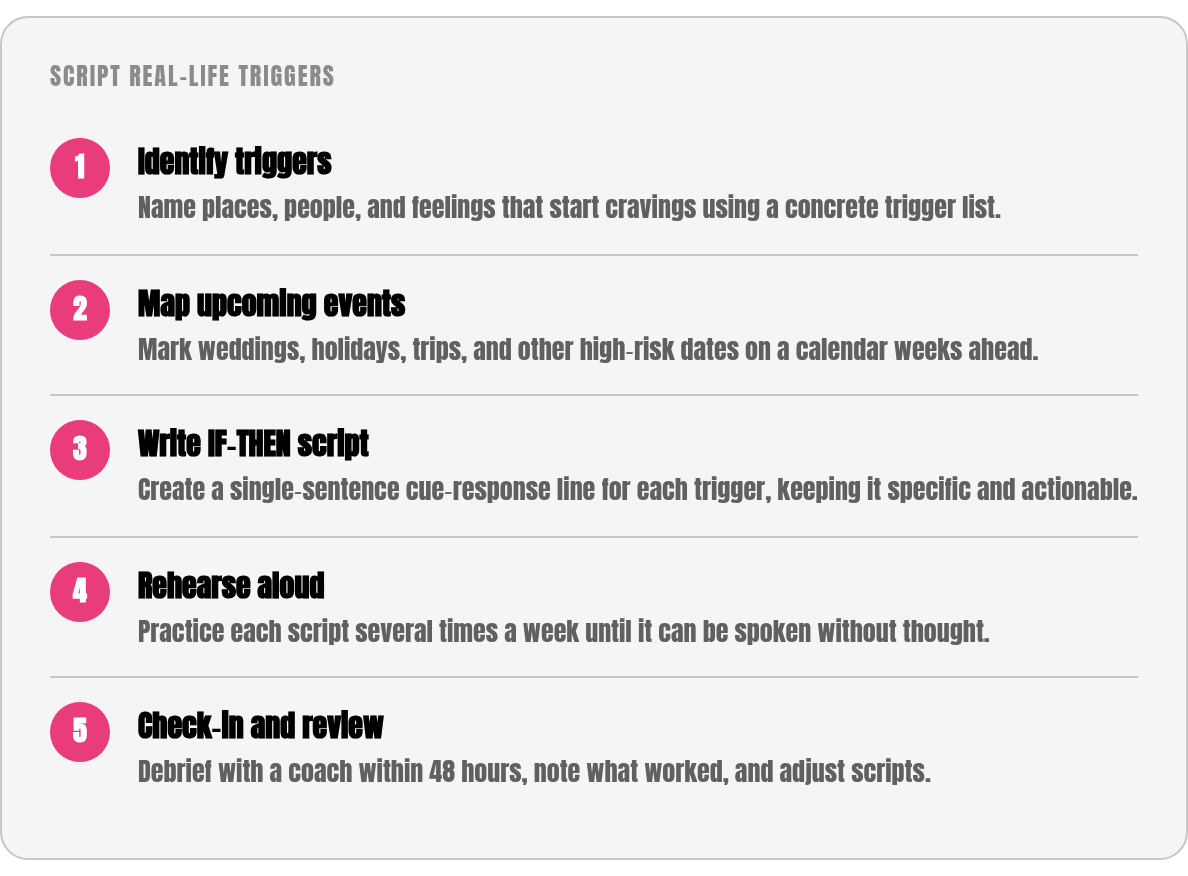
The pressure rarely shows up as craving. It shows up as a cousin handing you a beer, a boss ordering a round, or a holiday table where everyone else has a glass. We plan for those scenes by name, not by mood.
A Promotion Is a Trigger Too
Positive change carries risk alongside the obvious traps. The MISSION recovery coach guidebook treats major achievements and life upgrades as transition points that deserve the same planning attention as grief, conflict, or loss.
That matters because a celebration can lower your guard. A new position might mean unfamiliar colleagues, later dinners, travel expectations, and pressure to appear relaxed in front of people you want to impress. We tell clients to list the change itself as a trigger, right next to the bar, the toast, and the after-hours invitation.
Why a Written IF-THEN Line Beats Willpower
An IF-THEN line names the cue and the response in one sentence: "If someone puts a drink in my hand, then I set it on the bar and order a soda." The decision happens in advance, when you're calm and thinking clearly.
MISSION's relapse prevention session builds a written plan. Written lines survive a noisy room. Mental ones do not.
One caution on coaches. Not every coach works the same way, so ask whether yours uses structured tools like the recovery status checklist MISSION runs at each session. Caron describes a sober coach as someone who checks in regularly throughout the week, while the individual stays responsible for staying sober.
| Step | Goal | Typical Time Investment | Coach Involvement | Difficulty Rating |
|---|---|---|---|---|
| 1. List your triggers | Name the places, people, and feelings that start a craving | A short focused session | Reviews the list with you, virtual or in person | Low |
| 2. Map the calendar | Mark upcoming weddings, holidays, dinners, and trips before they arrive | A brief weekly review | Builds the calendar with you | Low |
| 3. Write the IF-THEN line | One sentence per trigger | A focused drafting block | Drafts and edits alongside you, virtual or in person | Moderate |
| 4. Rehearse out loud | Say the line until it needs no thought | Short practice several times a week | Runs rehearsal calls, virtual | Moderate |
| 5. Set the check-in rhythm | Daily text during high-risk weeks, weekly call otherwise | Quick contact as agreed | Schedules and holds the check-ins, virtual or in person | Low |
| 6. Review after the event | Keep what worked, rewrite what did not | A short debrief soon after | Reviews the event while details are fresh, virtual or in person | Moderate |
| Key takeaway | One rehearsed line answers the moment before it starts | A manageable early-recovery project | Holds the structure between sessions | Worth it |
You don't need special software. A phone notes app, a few calendar reminders, or printed cue cards kept in a wallet cover all six steps.
Naming the Nights That Catch You Off Guard
Most people leave treatment able to name their drug. Far fewer can name the night, the person, and the feeling that show up right before it. That gap is a practical place to start. Before writing a single script with a sober coach, it helps to get clear on what your triggers actually look like.
Keep it concrete. "Social stuff" gives you nothing to rehearse. "Sunday dinner at Mom's when my brother brings a six-pack" gives you a scene, a person, and a moment to plan around.
Four Angles for Mapping Triggers
Look at each trigger from a few angles. Most real situations touch more than one, and the overlaps show where to focus first.
- Environment: Where does it happen? Family dinners, a work happy hour, a friend's birthday at a bar, the reception hall when the toasts start.
- People: Who is there, and who will notice your glass? A parent who still pours for you, a coworker who keeps tabs, an old using friend who texts out of nowhere.
- Timing: When does pressure peak? Friday at 5 p.m., the opening minutes of a surprise celebration, the drive home after a hard family visit.
- Emotional state: What are you feeling going in? Anxiety, guilt, excitement, loneliness, or the plain pressure to fit in.
That emotional layer is the one people under-plan for. A party can feel dangerous because you're happy and visible, not only because you're upset. A quiet night can feel risky because no one is watching, not only because you're alone.
Next, rank each entry by urgency and intensity. A celebration next weekend belongs ahead of a distant holiday. Don't chase a complete inventory right away; five honest entries beat thirty guesses. Those top items can shape the scripts, check-ins, and routines you work on with your coach next. Our guide to relapse traps a sober coach defuses covers several of them in more depth.
Writing an IF-THEN Script That Actually Works
An IF-THEN script is one sentence you agree on before the moment arrives: if X happens, then I will Y. After rehab, it's a simple way to turn the plan you left treatment with into something you can use when a trigger shows up in everyday life. A line you've practiced out loud is easier to reach for than one you've only thought about.
Keep each script short, specific, polite, and actionable. If you can't say it in one breath, cut it down.
- Name the cue. Pick one scene from your trigger map, such as "If a coworker orders me a drink at the team dinner." One cue per script keeps it usable.
- Choose the response. A useful script has four parts: a polite decline, an alternative action, a grounding cue, and an exit or support plan. Missing any one leaves you improvising.
- Rehearse the words. Your coach plays the coworker and pushes back a little. Notice where you hesitate or over-explain, then trim those spots. Practice makes the response feel familiar, which helps it come out more steadily under pressure.
- Set the check-in. Decide how you'll signal your coach afterward: a text, a quick call, or a scheduled debrief. How often you check in can shift as you build independence, and support gradually tapers.
A Sample Script You Can Adapt
This is sample language, not a client quote. Treat it as a starting draft and rewrite it in your own words with your coach, because a script only works if it sounds like you.
Sample: "If someone hands me a drink, then I'll say, 'No thanks, I'm good with this,' order a soda, take one slow breath in for four and out for six, and step outside to text my coach if the pressure keeps coming."
After the event, run through four questions: what happened, what worked, what felt difficult, and what you'll adjust next time.
Keeping Scripts Alive in Your Daily Routine
A script only helps if you can reach it when someone offers you a drink. That means it has to live inside your day, not in a folder from your last session. The simplest way to keep a script within reach is to tie it to something you already do, so reviewing it takes no extra willpower.
Habit stacking works well here. Read your scripts right after your morning journal. Adjust one during your evening reflection, while the day's close calls are still fresh. Keep copies where your hands already go: a pinned phone note, a calendar reminder before a known event, a printed card in your wallet, or the back page of your recovery journal.
If a script already comes out without thinking, stop reviewing it daily. Move it into a lighter rotation and spend that attention on the scripts that still feel shaky.
How Often Should You Check In With Your Coach?
The cadence is something you and your coach agree on together. More frequent contact often makes sense early on, especially when your calendar includes events you haven't yet handled sober. Later, the rhythm may loosen as your routines become more reliable. Caron's overview of sober coaching describes coaches meeting with clients regularly throughout the week while the client keeps responsibility for staying sober. That split matters: the coach helps hold structure, but the choice in the room is still yours.
To cover the gaps between conversations, borrow the idea of a brief self-review from the MISSION Recovery Coach Guidebook. Track the essentials: whether you used, whether cravings showed up, what your mood was doing, and how motivated you felt to follow your plan. Then you and your coach can start the next check-in with concrete details instead of trying to reconstruct the week from memory.
When a Script Needs Rewriting
Bring a script back to your coach if you notice any of these:
- You hesitate every time you start the line.
- A wave of anger, shame, or panic hits before you can say it.
- You avoid the event so you won't have to use the script.
- The same trigger keeps coming back in a new form, like a different friend or a different room.
Look past the alcohol cues, too. Mood, stress, sleep, conflict, and motivation can all shape cravings. A plan that only scripts the bar and leaves out the emotional build-up before you get there has a gap in it, so it's worth scripting for the mood as well. If depression or other mental health symptoms are part of the picture, bring in a licensed professional alongside your coaching. As your scripts and routines start to hold on their own, coaching support can taper, giving you room to rely on the structure you've built.
References
[1] Sober Coaching: How It Works, Key Benefits,… - https://www.caron.org/addiction-101/treatment-advice/sober-coaching
[2] Recovery Coach Guidebook - https://www.mass.gov/files/documents/2019/08/01/MISSION%20Navigating%20Transitions%20Program%20Recovery%20Coach%20Guide_Final%206.27.1....pdf
Frequently Asked Questions
1. Do I need a therapist in addition to a sober coach if I have depression or anxiety?
Yes, if symptoms are present or persistent. A sober coach can help you practice accountability, routines, and real-world trigger scripts, but clinical conditions belong with a licensed professional. MADE Recovery offers nonmedical coaching support, not clinical treatment.
2. How can I tell whether my sober coach uses structured tools or just casual check-ins?
Ask what happens during a typical session. A strong answer should include more than encouragement; it should explain how the coach tracks cravings, events, progress, and follow-through. You can also ask how notes from one check-in shape the next plan.
3. Do I really need to script for good events like a promotion or graduation?
Yes. Good news can still bring pressure, visibility, and unexpected invitations. Script the celebration, the people likely to push, and your exit plan before the event, so excitement does not become an excuse to decide in the moment.