Does Your Discharge Plan Include Crisis Numbers or Someone Who Answers at 2 a.m.?
October 21, 2026

Quick Summary
A strong discharge plan does more than provide referrals. When someone is considering a sober coach after rehab, confirm that crisis contacts, scheduled follow-up, and a named human support contact are in place before the person leaves treatment.
Crisis Contacts Must Be Usable
A list of resources matters only if the person knows when to use it. Save local emergency, hospital, and round-the-clock crisis contacts in the phone, and keep a paper copy somewhere it will not get buried in a discharge packet.
- Record 988, local emergency services, the nearest emergency department, and relevant substance-use or addiction recovery resources
- List warning signs that indicate escalating distress, relapse risk, withdrawal concerns, or a mental health crisis
- Name at least one person who can be called at 2 a.m., plus backup contacts
In the United States, call or text 988 for crisis support and 911 for immediate danger, as explained in this hospital discharge guide. For a suspected overdose, call 911. When an identified risk requires a detailed suicide-prevention protocol, that protocol should be developed with appropriate medical or mental health professionals. Basic crisis routing still belongs in every transition plan.
Follow-Up Must Be Confirmed Before Discharge
Appointments should not exist as loose referrals. Confirm the first doctor, counselor, and recovery-support visits before discharge so the person returns home with a defined schedule.
- Record appointment dates, provider details, and preparation instructions
- Arrange transportation and designate someone to verify attendance
- Complete a written safety plan covering coping steps, personal contacts, professional services, and safe access to medications or other potentially dangerous items
- Establish the first coaching or sober-support check-in before the person arrives home
These steps work only when they are active handoffs, not paperwork. Direct provider communication, practical preparation, and clearly assigned responsibilities create a more coordinated transition. MADE Recovery can contribute sober coaching, accountability, companionship, practical guidance, and coordination with other support services. We provide nonmedical recovery support and do not replace care from doctors, treatment programs, or other licensed professionals.
Key Takeaways
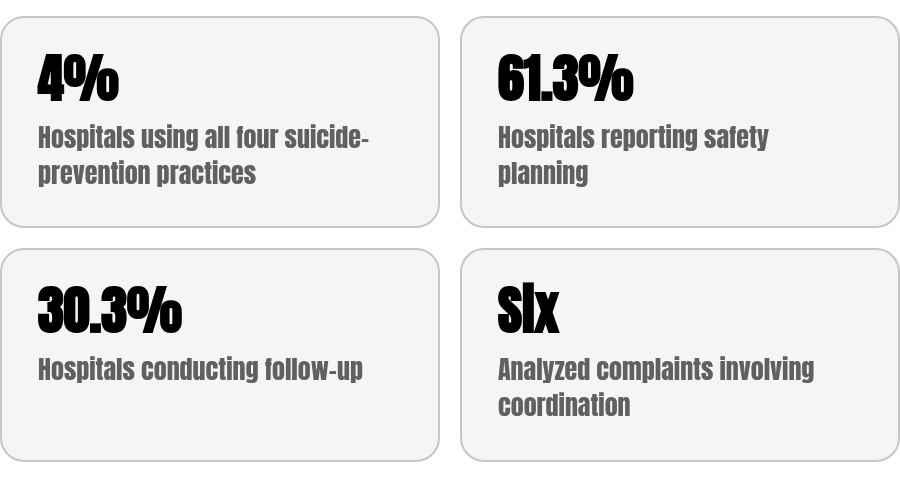
- A national survey found that only 4% of hospitals used all four recommended suicide-prevention practices after patient discharge.
- Safety planning was reported by 61.3% of surveyed hospitals, compared with 37% making warm handoffs and 30.3% conducting follow-up.
- Common discharge failures include missing information, inadequate assessment, excluded families, incomplete records, and unclear responsibility for continuing care.
- Six analyzed complaints involved coordination, decision-making, communication, capacity assessment, and emergency readmissions.
- A usable plan identifies urgent resources and the person responsible for helping with routine post-treatment steps.
Why a Discharge Plan Matters
The national discharge-prevention survey shows that comprehensive post-discharge procedures are not universal. A resource list does not establish whether help will be available when ordinary support systems are unavailable.
Does a Sober Coach After Rehab Close the Transition Gap?
A sober coach after rehab provides practical recovery assistance outside the scope of clinical treatment. The coach helps translate discharge instructions into daily routines, organizes nonmedical supports, and identifies who owns each next step.
Preparing a document is not the same as completing a connection. An appointment may remain unattended if no one resolves scheduling problems, confirms transportation, or notices that the provider never received the referral. A coach can help surface these gaps and communicate them to the appropriate people without taking on a clinician’s role.
- Identify which tasks belong to the client, family, coach, and treatment providers
- Review the first several days at home for predictable gaps in structure
- Check that the person understands any discharge instructions affecting daily routines
- Decide how missed calls, canceled visits, or unavailable services will be handled
What Do Discharge Failures Reveal?
The Parliamentary and Health Service Ombudsman’s report describes families being excluded or left without updates, incorrect self-help information, requested discharges without adequate assessment, incomplete records, a missed Mental Capacity Act assessment, and fragmented coordination that led to repeated transfers.
These cases do not show that one omitted phone number caused a particular outcome. They show how transitions break down when information, authority, and responsibility become separated. Families should ask which decisions they will be included in, what information may be shared, and where concerns should be directed. The person leaving care should receive a complete copy of the agreed plan before the final day.
1. Verify Crisis-Line Numbers Are Clearly Listed
A number buried in a discharge packet is not accessible during a crisis. Each contact should appear where the person can find it under stress, with simple instructions about when to use it. For anyone working with a sober coach after rehab, review accessibility before the transition occurs.
Can the Person Reach Help Immediately?
Check that the plan includes a national suicide and crisis option. If speaking by phone is not a good fit, online chat is available through 988lifeline.org.
- Add the primary crisis contact to the phone’s favorites or emergency-access screen
- Verify that texting HOME to 741741 reaches the Crisis Text Line, which provides continuous text support (this resource guide)
- Label each contact clearly so the person does not have to remember an organization’s name
- Make sure essential information remains available if the phone is lost, uncharged, or inaccessible
A paper copy still matters when technology fails. Keep it in a visible location and give a copy to a trusted support person rather than leaving the only version inside a larger packet.
Does the List Match the Person’s Plan?
National resources do not replace location-specific preparation. Each entry should identify who is expected to answer, the service’s hours, and the situations it handles. A sober coach can organize this information and help distinguish recovery support from professional or emergency services.
- Confirm that each organization serves the person’s current area
- Note eligibility limits, intake procedures, or instructions supplied by the service
- Mark contacts that require an established patient relationship
- Remove outdated entries and duplicate numbers that could create confusion
The Parliamentary and Health Service Ombudsman frames discharge as a transition toward recovery rather than an administrative event. A contact list supports that transition only when its entries connect to services the person can realistically access.
2. Ensure a 24/7 Human Backup Is Assigned
A continuously available service and a named personal contact serve different purposes. One offers immediate routing when a situation becomes urgent; the other understands the person’s circumstances and may help coordinate what happens next. When working with someone considering a sober coach after rehab, make those roles explicit.
A Named Contact Must Have a Defined Role
Ask the treatment team who will remain involved after discharge, what that person has agreed to do, and whether any limits apply outside normal hours. Do not infer availability from a job title or from a telephone number in the paperwork.
- Record the primary contact’s name, preferred communication method, and agreed hours
- Ask, “Who answers if I need help tonight?” and document the response
- Clarify whether the person can provide transportation, stay on the line, contact a provider, or offer another defined form of assistance
- Request an introduction before discharge so both parties can confirm expectations
- Establish what happens when a message goes unanswered or the designated person is unavailable
The hospital discharge survey addresses coordinated handoffs at an organizational level. It does not determine whether an individual sober companion will be available, but it shows why ownership matters. A name on a form does not prove acceptance of the role.
Not every transition requires a complex personal-response system. Someone with stable housing, dependable family involvement, and established care may need a simpler arrangement. Recent suicidal thoughts, escalating substance-use concerns, or an unreliable home environment call for greater clarity. The aftercare discharge guidance supports establishing follow-up care and emergency contacts rather than assuming general availability.
3. Document Emergency Action Steps
Contacts identify where help may be found. Action steps explain what to do first. The instructions should be short enough to follow when concentration and decision-making are impaired.
What Should the Written Crisis Plan Contain?
A useful plan gives the person and family a clear sequence for responding to worsening distress.
- Describe observable warning signs. Note changes in behavior, thinking, isolation, substance-use urges, or ability to remain safe.
- Match each warning sign to a response. State whether the next step is a coping strategy, a personal contact, professional assistance, or urgent intervention.
- Include transportation instructions. Explain who can drive, what alternative is available, and where to go if directed to seek in-person help.
- Address the immediate environment. Follow the treatment team’s guidance concerning access to medications or other potentially dangerous items.
- Use plain language. Avoid clinical shorthand the client or family may misunderstand.
The sequence should not require complicated decisions during acute distress. Providers can define thresholds in advance so supporters do not have to debate whether a situation is serious enough to act.
Who Needs to Know the Plan Before Discharge?
The person leaving treatment should not be the sole holder of critical information. The Service Ombudsman emphasizes clear communication with patients and carers during transitions. MADE Recovery’s coaching can support that principle through accountability and organized communication.
- Provide copies to agreed participants. Respect applicable privacy requirements while ensuring authorized supporters understand their responsibilities.
- Review the sequence together. Each participant should know where their role begins and when responsibility passes to professional services.
- Check for conflicting instructions. Resolve differences between facility paperwork, outpatient guidance, and family assumptions before departure.
- Note who may authorize decisions. Where capacity, consent, or legal authority matters, obtain guidance from treating professionals.
- Set a review point. Update the document when housing, providers, contact availability, or clinical recommendations change.
If clinicians determine that emergency care or an emergency hold is necessary, families should follow the process and instructions provided by the treating facility. Coaching does not direct those clinical or legal decisions.
4. Conduct a Post-Discharge Confirmation Call
First doctor and counselor appointments are usually scheduled within seven days of discharge, according to post-treatment support guidance. A timely confirmation call can identify problems before the initial visit, when there may still be time to correct them.
Does the Client Know What Happens Next?
The conversation should test whether the handoff works in practice, not merely confirm that a packet was received. Make the exchange active and personal, especially for someone seeking a sober coach after rehab.
- Ask the client to describe the next scheduled event without reading from the paperwork
- Record the location, arrival instructions, required documents, and provider information
- Verify that transportation, work obligations, mobility needs, and caregiving duties have been addressed
- Determine whether prescriptions, identification, insurance information, or intake forms create practical barriers
- Assign a specific follow-up task when any detail remains unresolved
The call may also reveal misunderstandings. If the client believes an appointment is confirmed but the provider has no record of it, the issue can be escalated to the responsible treatment or outpatient team.
Can They Reach Help During a Crisis?
Include a practical access check rather than another recital of resource names. Ask the client to retrieve the plan while on the call and locate the relevant entries without prompting.
- Check that the phone is charged, operational, and able to place calls or send messages
- Confirm that paper instructions are visible and available to authorized supporters
- Ask whether language, hearing, vision, literacy, or technology needs make a contact method difficult
- Verify that recent changes in housing or travel have not made local information obsolete
- Record failed numbers, unclear instructions, or unavailable services for prompt correction
End the call with a short summary of unresolved tasks and the person responsible for each one. Routine coaching contact should support the plan, not substitute for medical or crisis services.
References
[1] Supporting Someone After Inpatient Mental Health Treatment - https://healthy.kaiserpermanente.org/health-wellness/health-encyclopedia/he.supporting-someone-after-inpatient-mental-health-treatment.acm1542
[2] [PDF] Discharge from mental health care: making it safe and patient-centred - https://www.ombudsman.org.uk/sites/default/files/Discharge%20from%20mental%20health%20care%20making%20it%20safe%20and%20patient-centred_10.pdf
[3] My loved one is being discharged from inpatient hospitalization. What ... - https://helplinefaqs.nami.org/article/528-my-loved-one-is-being-discharged-from-inpatient-hospitalization-what-do-i-need-to-know
[4] 4 Strategies for Patient Suicide Prevention After Hospital Discharge - https://respiratory-therapy.com/department-management/clinical/4-strategies-patient-suicide-prevention-after-hospital-discharge/
[6] Planning for Discharge - Resnick Neuropsychiatric Hospital - https://www.uclahealth.org/hospitals/resnick/resources/planning-discharge
[7] Continuity of care after hospital discharge for suicide prevention - https://www.facebook.com/behavioralhealthandcounselingcenters/posts/discharge-is-not-the-end-of-suicide-prevention-the-days-immediately-following-a-/1414951627395539/
[8] Relapse Prevention Hotlines & Texting Resources - Rehabs.com - https://rehabs.com/rehab-hotline/relapse-prevention/
[9] (PDF) Bridging the gap: a qualitative study of providers' perceptions of a ... - https://www.researchgate.net/publication/375717583_Bridging_the_gap_a_qualitative_study_of_providers'_perceptions_of_a_partnered_crisis_follow-up_program_for_suicidal_patients_post-emergency_department_discharge
[10] Suicidal Risk Following Hospital Discharge: A Review | Request PDF - https://www.researchgate.net/publication/334277689_Suicidal_Risk_Following_Hospital_Discharge_A_Review
Quick Questions, Straight Answers
What if someone is discharged in a different state or country than before?
Treat the move as a material change to the discharge plan, not merely an address update. Ask the treatment team to verify whether existing providers can continue serving the person, whether prescriptions or records can transfer, and which services require new intake procedures. Do this before travel whenever possible so jurisdictional or access problems do not emerge after arrival.
Can a sober coach be the person someone calls at 2 a.m.?
Possibly, but only when after-hours availability is part of the coach’s explicit agreement. Ask about response times, communication boundaries, days off, and what happens when the coach is already assisting another client. Never present a coach as continuously reachable unless that commitment has actually been made.
How does sober coaching differ from a counselor or medical follow-up?
Sober coaching focuses on day-to-day implementation: routines, accountability, companionship, appointment preparation, and recovery-oriented problem-solving. Clinical professionals assess and treat health conditions. The distinction helps clients direct questions to the person qualified and authorized to answer them.
What should happen when a follow-up appointment is only a referral, not a confirmed visit?
Contact the receiving office and determine whether it accepted the referral, has the required records, and can offer an appropriate visit. If the referral cannot be completed, notify the discharging team and request an alternative rather than leaving the client to restart the search alone.