Creating Consistent Routines to Stay Sober Long Term
October 23, 2026

The Short Version
- Relapse often develops gradually, with emotional, mental, or physical changes showing up weeks or months before substance use begins.
- Scheduled coaching check-ins and companionship can make changes in mood, behavior, or daily functioning easier to notice before they become harder to manage.
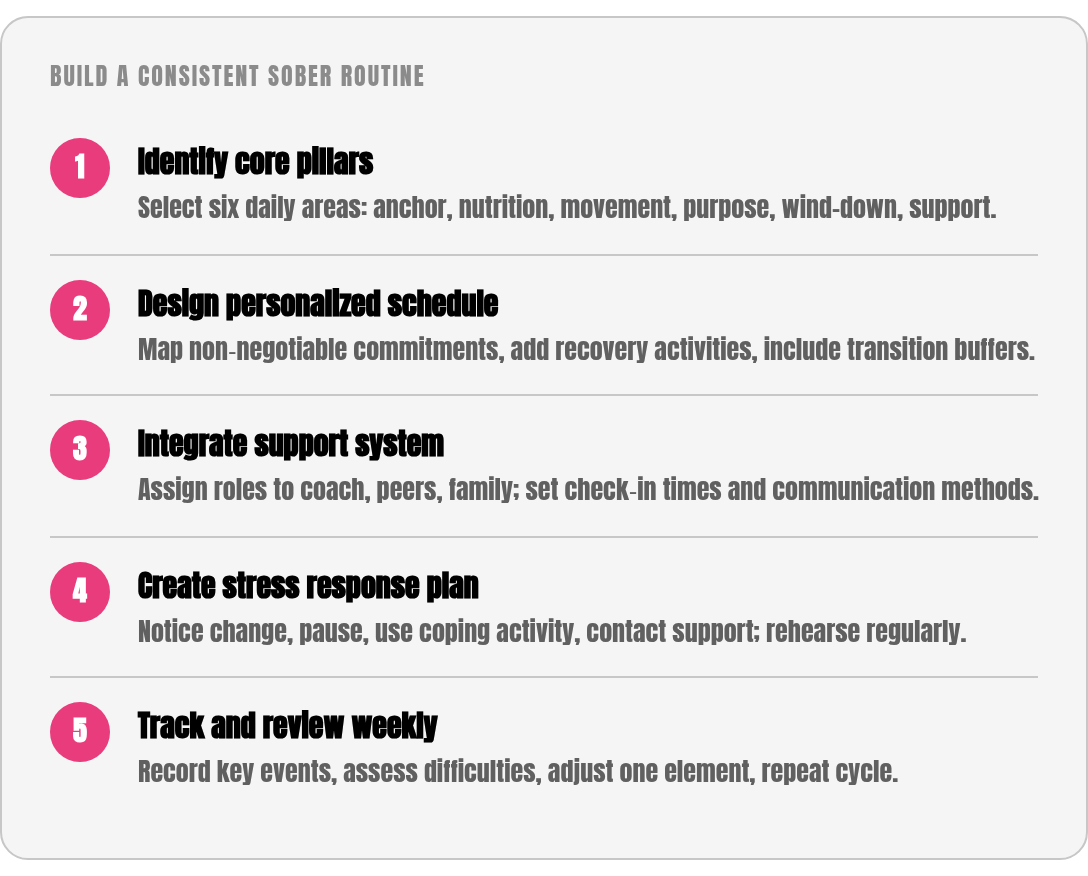
- A practical daily framework can include six pillars: a morning anchor, nutrition, movement, purposeful activity, an evening wind-down, and scheduled support check-ins.
- Suggested anchors may start with a brief period of meditation, prayer, or breathing, while movement can build gradually as appropriate.
- Regular meals, hydration, an evening wind-down, and enough sleep can reinforce physical and emotional stability.
- Research in early recovery found that unused time, more than busyness itself, often marked difficult periods, which supports the value of maintaining a manageable number of anchors.
Why Creating Consistent Routines Matters
The first months after treatment can involve a difficult shift from a highly structured environment to ordinary responsibilities. Without a plan for mornings, evenings, appointments, and social contact, every day requires repeated decisions while confidence may still be fragile.
Steven Melemis’s clinical analysis of recovery describes recovery as an ongoing process in which prevention begins well before a crisis. A routine gives clients and their support network a baseline. When normal patterns change, there is something concrete to discuss instead of relying only on a vague feeling that something is off.
Structure the transition home
We help clients establish daily patterns that support stability, confidence, and independence. Coaching can address practical needs such as planning food, coordinating appointments, reconnecting with interests, and organizing responsibilities at home.
Someone returning home may also need to fit recovery commitments around shift work, childcare, caregiving, or household demands. A common mistake is building the first plan around an ideal day rather than the one the client actually has. It should identify the parts of the day that require the most preparation and decide what will happen during them—not account for every minute. That is enough to make the transition more manageable without turning recovery into an inflexible checklist.
Families can be involved without taking over every decision. We provide guidance for families navigating recovery pathways and helping clients reintegrate into everyday life. The client’s preferences should determine what relatives know, when they become involved, and which responsibilities remain private. Relatives should not be asked to diagnose conditions, manage medication, or decide whether detoxification is needed.
Treat routines as an early-warning system
A routine establishes a recognizable pattern for ordinary days. Repeatedly canceling commitments, withdrawing from others, or neglecting responsibilities can then prompt a closer look at what has changed.
An exploratory study of habits during early recovery examined how people organized their time and what they did during this period. The findings support looking beyond the number of tasks completed. How a person experiences and organizes the day matters too.
That is why we tailor routine-building to each client rather than prescribing one calendar for everyone. A coach might reorganize an inconvenient appointment sequence, arrange companionship around a demanding event, or help prepare for a change in household responsibilities. The structure should adapt as life changes while still giving the client and support team a dependable reference point. We tend to intensify support around demanding events, travel, or changes in household responsibilities, and taper when the relevant parts of the plan hold without prompting.
Identify Core Pillars of a Sober Routine
A dependable sober routine works best when several practical areas reinforce one another. For someone working with a sober coach after rehab, these pillars organize the day without expecting one activity to carry the entire recovery plan.
The approach is collaborative. Each coaching program reflects the client’s needs, preferences, existing care, and responsibilities. Support may come from a dedicated coach or a coordinated team, depending on the situation.
A Practical Six-Pillar Daily Framework
| Pillar | Practical Example | Purpose | Support Options |
|---|---|---|---|
| Morning anchor | Wake at a planned time, drink water, and begin with a brief reflective practice. | Creates a deliberate start before competing demands take over. | Self-guided: use a calendar reminder. Peer-supported: pair the practice with a peer. Coach-assisted: discuss what makes the anchor realistic. |
| Nutrition | Plan food and drinks around treatment, employment, or family commitments. | Prevents meals from becoming an afterthought on complicated days. | Self-guided: prepare simple options. Peer-supported: exchange meal ideas. Coach-assisted: organize practical meal planning. |
| Movement | Choose an accessible form of activity and increase it only when appropriate. | Provides a constructive activity that can fit into different parts of the day. | Self-guided: walk or stretch. Peer-supported: exercise together. Coach-assisted: find a manageable place in the schedule. |
| Purposeful activity | Include employment, education, volunteering, caregiving, or a personally meaningful hobby. | Builds a life organized around responsibilities and interests beyond substance use. | Self-guided: use a weekly planner. Peer-supported: exchange opportunities. Coach-assisted: identify obstacles and next steps. |
| Evening wind-down | Reduce stimulation, prepare for the next morning, and follow a repeatable bedtime sequence. | Marks the end of active responsibilities and makes the following morning easier. | Self-guided: set a bedtime cue. Peer-supported: exchange a brief good-night message. Coach-assisted: examine changes in the evening pattern. |
| Support check-in | Contact a coach, peer, family member, or recovery group at an agreed time. | Makes support available by design rather than only after a problem appears. | Self-guided: record that contact occurred. Peer-supported: arrange recurring calls. Coach-assisted: review the plan and current concerns. |
These are categories, not rules about what recovery must look like. Movement can happen alongside social contact, and purposeful activity can be tied to caregiving. Reflection may work better later in the day if mornings are crowded. The important part is that each element has a clear role.
Relapse-prevention guidance includes self-care and connection in ongoing recovery, while SAMHSA’s recovery framework emphasizes health, purpose, home, and community. Together, these perspectives point toward a routine that addresses everyday life, not just substance avoidance.
Our sober coaching helps clients turn those broad areas into practical actions. A coach can look at which pillar is difficult to maintain, whether the obstacle is logistical or emotional, and what kind of assistance would be useful.

Design a Daily Schedule That Works for You
A schedule becomes useful when it reflects how life actually unfolds. Many plans account for major commitments but overlook the transitions around them: getting ready, traveling, waiting, coming home, or deciding what to do after an appointment.
Those intervals deserve attention because they often lack the structure attached to work, treatment, or family duties. Planning for them does not mean filling every minute. It means deciding which periods can remain open and which would benefit from a destination, task, or available contact.
How do we build a workable 24-hour schedule?
Working with a sober coach after rehab can turn broad intentions into a visible sequence. We start with the client’s nonnegotiable commitments, then place recovery activities where they are most realistic.
These blocks provide a starting point:
- Morning: Allow enough time to get ready without starting the day in a rush.
- Midday: Coordinate practical responsibilities, appointments, food, and constructive activity.
- Evening: Decide how to move from daytime demands into a calmer end-of-day pattern.
- Overnight: Protect a dependable rest period. A 7-to-9-hour sleep target may be a useful reference, although it is not an individually prescribed amount.
Short transition buffers can ease the pressure created by back-to-back commitments. They also allow time to travel, decompress, or contact someone before moving into the next part of the day.
A written schedule should distinguish firm obligations from flexible options. That distinction makes it easier to revise the plan without treating every change as a failure—a common mistake when one difficult day is read as proof the routine failed.
How do we adjust the plan when life changes?
Review the schedule across several days rather than judging it by one especially smooth or difficult day. Look for practical friction: activities that are repeatedly skipped, commitments placed too close together, or times when the plan demands more energy than the client usually has.
A peer, family member, or companion may notice complications the client has grown accustomed to. Digital calendars and habit trackers can help, but one simple tool is often easier to maintain than several overlapping systems; overlapping trackers are a common routine-building mistake.
When circumstances change, revise the smallest relevant part of the plan. If work runs late, keep the basic evening sequence and shorten a nonessential activity. If an appointment is draining, do not schedule another demanding commitment immediately afterward. If travel disrupts the usual pattern, decide in advance which elements can move and which need an alternative.
The best schedule is not the most detailed. It is the one that remains understandable and usable when the day does not go as planned.
Integrate Support Systems & Accountability
Accountability works best when everyone involved has a defined role. Without that clarity, clients may receive several reminders about the same issue while other needs go unaddressed. A coordinated plan can distribute responsibility among professional, peer, and family supports without making the person in recovery feel watched all the time.
How do we build support without adding pressure?
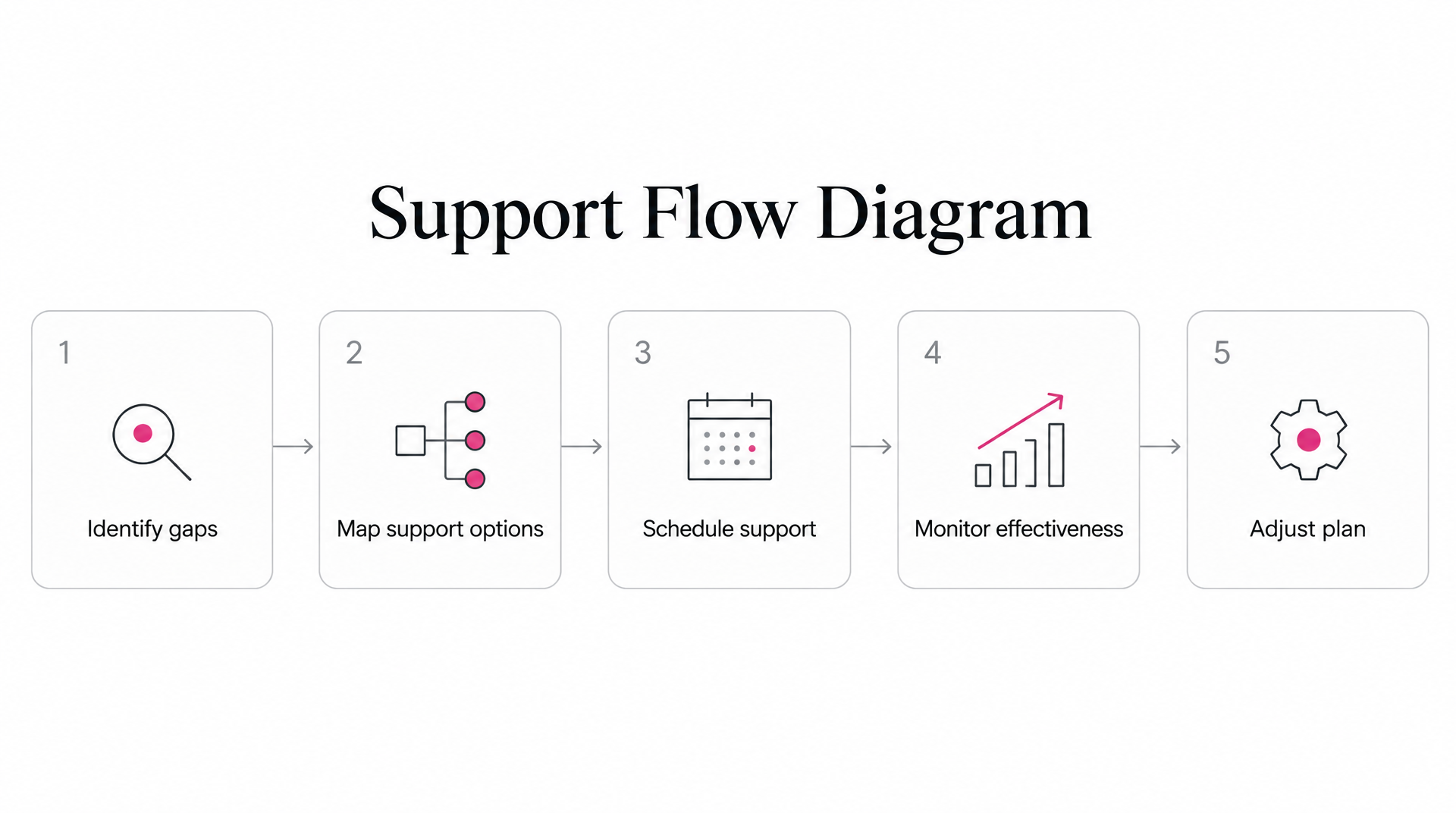
Start by asking the client what kind of help feels useful. A coach may organize planning conversations and help address barriers. A peer may be better suited to informal companionship or shared activities. A relative might offer transportation, help with household logistics, or attend a family guidance session.
The client can also decide what information is shared. One person may receive scheduling updates, while another is contacted only if an agreed concern arises. That keeps support from becoming an unrestricted flow of personal information.
Coordination matters when several people are involved. Rather than asking identical questions, the group can decide who handles each area and how observations are communicated. Family members and nonclinical coaches should never be responsible for diagnosis, medication management, or detoxification decisions; those remain with qualified professionals. Accountability remains purposeful, and the client keeps control over their own life.
When should virtual and in-person contact happen?
Remote contact suits brief, focused needs: a short call before a demanding obligation, a lunchtime message, or an exchange after a difficult interaction can provide continuity without taking up much of the day.
In-person contact may be more useful when practical presence matters, including travel, an important appointment, the first days in a new environment, or a major change in responsibilities. The format should match the help needed rather than an assumption that one option is always better.
We offer virtual and in-person coaching, so the format can change with the client’s circumstances. A support plan can identify whom to contact, which situations justify extra help, and how concerns should be communicated. For example, a coach may handle planning, a companion may provide presence during a demanding event, a peer may offer informal contact, and a relative may cover transportation only if the client agrees. Daily observation should happen only when the client agrees to it and the plan has a defined purpose.
Asking for help is presented as a recovery principle in this relapse-prevention analysis. Coaching and companionship can make that principle more practical. Health-related judgments, however, remain the responsibility of qualified medical and clinical professionals.
Manage Stress, Cravings, and Unexpected Disruptions
Even a good routine will be interrupted by conflict, overtime, travel, fatigue, or canceled plans. Planning for disruption allows the response to begin with a familiar sequence instead of an improvised decision under pressure.
A clinical analysis of relapse distinguishes between stages and describes changes in thinking and behavior that may need attention. Our coaching can help clients translate personally relevant warning signs into an action plan.
How Do You Build a Response Plan for Stress?
A sober coach after rehab can help turn warning signs into a short sequence that is easy to remember and rehearse:
-
Notice the change. Identify what is different without judging it immediately. This might involve tension, rigid thinking, withdrawal symptoms, or a growing preoccupation with substances.
-
Pause and leave if possible. Step away, postpone a conversation, or move to a safer environment. The goal is to create room for the next decision.
-
Use a coping activity. Choose an activity already included in the personal plan, such as walking, writing, breathing, or going to an agreed location. Grounding exercises are optional tools, not universal protocols.
-
Contact support. Reach a coach, trusted peer, clinician, or family member identified in advance. The plan should name people who are realistically available during likely disruptions.
Rehearse the sequence when the client is calm; practice can expose outdated phone numbers, unavailable contacts, or difficult locations.
What Should Your Craving Kit Contain?
A craving kit is a portable collection of reminders and practical items selected by the client, such as water, gum, a written list of activities, meeting information, support contacts, or a safe location. It should reflect the situations the person actually encounters. A coach or companion can work through what happens if the first option is unavailable, and the plan should distinguish ordinary support from situations requiring professional or emergency assistance.
Track, Review, and Evolve Your Routine
Tracking should make the routine easier to understand, not turn recovery into a performance score. A short record can show whether the plan is realistic and which activities tend to get displaced when circumstances become demanding.
Our sober coaching can help clients choose a tracking method and decide which observations are worth discussing with a coach, relative, peer, or treatment professional. Each entry should support a practical decision, such as changing the timing of something, arranging help, or preparing for an upcoming responsibility.
A small tracker reveals what needs attention
Use a paper notebook, calendar, or phone note to record only a few useful details: whether a planned commitment occurred, which part of the day felt difficult, changes that affected the usual schedule, and contact with a coach, peer, family member, or treatment professional. Avoid elaborate ratings unless they have a clear purpose. Neutral wording helps; “appointment moved” provides better planning information than labeling the entire day unsuccessful.
Weekly review should guide specific adjustments
We suggest a weekly review as a practical planning rhythm, not a rule. Clients should choose a frequency that produces useful observations without creating unnecessary work.
During the review, identify one part of the plan that worked and one part that needs modification. A targeted change, such as moving an appointment, replacing an impractical activity, or clarifying who will help, is easier to evaluate than rebuilding the entire schedule.
Share significant concerns with an appropriate person. Searching for opportunities to use substances, planning use, dishonesty about relevant behavior, or increasing romanticization of past use warrants prompt attention. A passing thought is not proof that recovery has failed, but a sustained shift toward preparation should not be brushed aside.
We adjust the type or intensity of coaching and companion support as a client’s circumstances evolve. In practice, we intensify support during travel, the first days in a new environment, or a major change in responsibilities, and taper when the client maintains the relevant parts of the plan without prompting. There is no single deadline for those changes; they should reflect the person’s progress, preferences, and current need for assistance.
References
[1] Relapse Prevention and the Five Rules of Recovery - PMC - NIH - https://pmc.ncbi.nlm.nih.gov/articles/PMC4553654/
[2] The Top 10 Relapse Prevention Skills - Addiction Center - https://www.addictioncenter.com/community/top-10-relapse-prevention-skills/
[3] Chapter 4—Counseling Approaches for Sustaining Recovery and ... - NCBI - https://www.ncbi.nlm.nih.gov/books/NBK601481/
[4] Habits and Routines of Adults in Early Recovery From Substance Use ... - https://pmc.ncbi.nlm.nih.gov/articles/PMC9926005/
[5] Addiction Relapse Prevention - StatPearls - NCBI Bookshelf - https://www.ncbi.nlm.nih.gov/books/NBK551500/
[6] Why Structure and Routine Are Important in Alcohol Recovery - https://clevelandhouse.org/why-structure-and-routine-are-important-in-alcohol-recovery/
[7] Why Routine Matters in Addiction Recovery - https://www.ikonrecoverycenters.org/why-routine-matters-in-addiction-recovery/
[8] (PDF) Habits and Routines of Adults in Early Recovery From Substance ... - https://www.researchgate.net/publication/368599802_Habits_and_Routines_of_Adults_in_Early_Recovery_From_Substance_Use_Disorder_Clinical_and_Research_Implications_From_a_Mixed_Methodology_Exploratory_Study
[9] Step-by-Step Sober Routine Guide for Lasting Recovery - https://reprievehouse.com/blog/step-by-step-guide-to-a-sober-routine/
[10] How to Build a Daily Routine in Recovery - https://www.ikonrecoverycenters.org/how-to-build-a-daily-routine-in-recovery/
[11] A Case Study of Haven Recovery Centre, Eldoret, Kenya - https://repository.anu.ac.ke/handle/123456789/1161
Common Questions
1. What if my work schedule, childcare, or treatment appointments make a fixed routine impossible?
Separate commitments into three categories: fixed, movable, and optional. Place fixed obligations first, identify more than one possible time for movable activities, and treat optional activities as alternatives rather than requirements. This approach lets the routine survive a shift change, delayed appointment, or family demand without requiring the entire day to be rebuilt.
2. Is an overly busy schedule better than having unstructured time during recovery?
No. A crowded schedule can hide whether activities are meaningful, sustainable, or chosen by the client. Deliberate rest should still have a clear purpose rather than becoming directionless time.
3. How do I know whether my routine is revealing warning signs of relapse?
Compare current behavior with the client’s normal baseline. A repeated pattern, growing secrecy, or movement from thoughts toward preparation deserves more attention than a single canceled activity. When the significance of a change is unclear, document it and discuss it with the appropriate support or treatment professional.
4. Should my family monitor every part of my recovery routine?
No. Families should agree in advance about what information the client consents to share, which circumstances justify contact, and who should respond. Written expectations can prevent care from becoming unrestricted supervision.
5. Can a sober coach replace my doctor or therapist during recovery?
No. We provide nonmedical sober coaching, companionship, sober living, and intervention services. We do not diagnose conditions, manage medication, provide detoxification, or deliver clinical treatment. Coaches can assist with day-to-day implementation and communication; licensed professionals handle medical and therapeutic care.