Choosing the Right Sober Living Home for Your Recovery
November 2, 2026
Quick Summary
Not every sober living home serves the same purpose. Price alone tells you almost nothing about fit. What matters: staffing level, accountability structure, peer support certification, and whether add-on services—coaching, companionship, travel support—are actually included or cost extra.
| Criterion | Level I – Peer-run | Level II – Monitored | Level III – Supervised | Level IV – Clinical |
|---|---|---|---|---|
| Staffing | No paid staff; resident-governed | House manager (peer in recovery) | Trained and certified paid staff | Credentialed clinical staff on-site |
| Accountability | Peer rules, mutual accountability | Random testing, curfews, house meetings | Daily schedule, life-skills support, clinical coordination | Integrated clinical services |
The NARR classification system sorts homes by staffing intensity, not a fixed staff-to-resident ratio. Higher levels mean more oversight, not necessarily more staff per bed.
Optional services—nutrition coaching, fitness programs, sober companionship, travel support—may not be part of the monthly rent. Request an itemized breakdown before signing.
Match the Level to Where You Are in Recovery
The right level depends on how much structure you need now. Someone with an established routine values independence and community. Someone still building daily stability needs closer supervision and coordination. Match current needs, not prestige or amenities.
Key Takeaways
- A Level III classification means trained and certified paid staff are part of the support model, but families still need to verify daily operations.
- A recent systematic review found limited evidence overall, so daily operations matter more than classification.
- A home's classification describes its general support model. Families must still investigate how that model operates day to day.
- Evaluate how easily a resident can reach outpatient care, work, and mutual-help meetings; distance from an inpatient facility should not be the deciding factor.
Why Choosing the Right Sober Living Home Matters
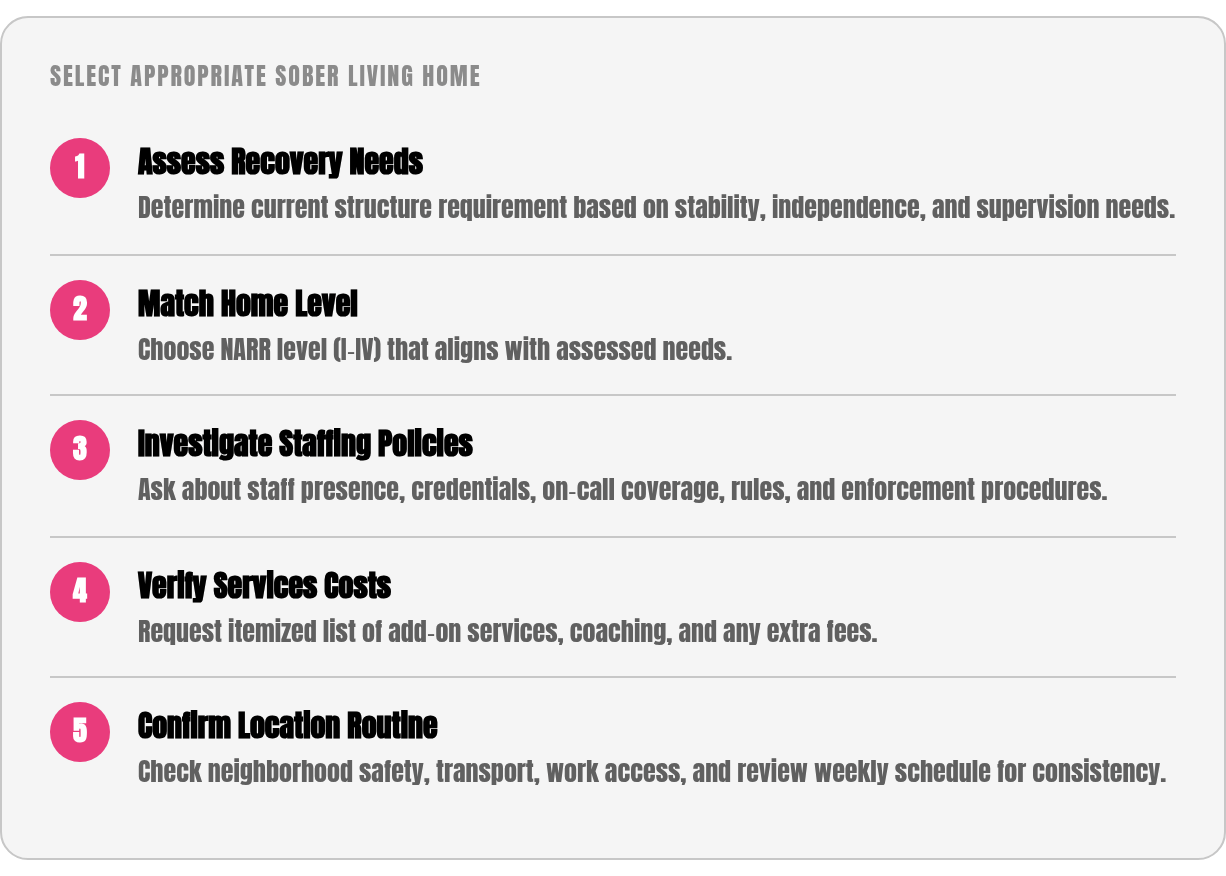
Finding the right sober living home after treatment is not about the nicest facility or cheapest option. It is about matching the residence's support model to your recovery needs. Families often struggle to determine whether clinical coordination is necessary or whether a community-based setting will provide sufficient accountability. Recovery housing research published in 2025 reviews a limited evidence base, so families should judge each home by its daily operations rather than by broad research claims.
That alignment has practical consequences. A resident transitioning from a highly organized treatment environment may struggle if the next setting provides too much unstructured time. Someone who has developed reliable habits, outside support, and employment responsibilities may find intensive supervision unnecessarily restrictive. The key question is not "Is this a good home?" but "Is this the right environment for this resident now?"
Accountability can range from informal peer expectations to formal schedules, testing requirements, and staff-led reviews. Ask how the home turns its stated philosophy into daily practice. A residence may advertise independence while still enforcing clear expectations around attendance, conduct, and substance use. Another may use the language of flexibility because its policies are poorly defined. Distinguish intentional autonomy from a lack of management.
What the Evidence Actually Shows About Outcomes
The comparative research base is thinner than many marketing materials suggest. A recent systematic review found limited evidence overall. Outcomes may include alcohol abstinence, reduced substance use, and higher income or employment rates, but they vary according to resident characteristics and the suitability of the living environment.
This uncertainty does not mean sober living is ineffective. Broad labels cannot predict an individual's experience. The surrounding community may also affect treatment connections, meeting attendance, work, and independence. The practical test is whether residents can reliably reach treatment, meetings, work, and ordinary errands.
Before signing a lease, determine whether residents must participate in 12-step or other mutual aid groups, how screening is handled, and how the home encourages peer helping. Social-model research suggests that giving and receiving support can contribute to better outcomes, particularly for alcohol use. This reciprocal role matters: residents are not merely sharing an address but participating in a community where behavior affects everyone else.
Marketing should also match operations. Ask to meet the person responsible for the house, review the rules, and speak with current residents when appropriate. A professional website cannot substitute for clear answers about staff availability, daily expectations, conflict resolution, and emergency procedures.
Core Criteria to Evaluate
A useful evaluation begins with operational questions rather than a comparison of amenities. Determine who is responsible for the residence, how expectations are communicated, what happens when problems arise, and whether the environment is compatible with the resident's obligations outside the home.
The answers should be concrete. Terms like "supportive," "structured," and "community-focused" have little value unless the provider can explain what residents actually experience throughout a normal week.
Staffing and Peer Support
Ask each home to explain its staffing model in detail without relying only on its recovery-residence classification. Find out who is physically present, who is on call, how new residents are oriented, and who has authority to respond to rule violations. Also ask whether the person managing the house lives on-site and what coverage exists during evenings, weekends, and staff absences.
Explore the staff's experience as well as their credentials. How long have team members worked at the residence? What training do they receive? How does the home handle turnover? Frequent changes in leadership can make expectations inconsistent, even when written policies appear strong.
Residents should also have recurring opportunities to connect and contribute. House meetings, shared meals, peer-led activities, and practical household responsibilities can create meaningful contact rather than passive coexistence. Ask the provider to describe how disagreements are addressed and how residents are supported when they begin withdrawing from the community. Vague answers may signal that peer culture is left to chance.
House Policies and Accountability
Review written policies on curfews, visitors, prohibited substances, overnight absences, and consequences. The residence agreement should explain fees, privacy, searches, screening procedures, medication management, discharge conditions, refunds, grievances, and responsibility for personal property.
Pay attention to how rules are enforced, not merely whether they exist. Ask whether residents receive warnings, whether consequences escalate, and whether immediate discharge is possible. A well-managed home should be able to explain how it balances community safety with a fair response to setbacks.
Medication policies deserve close attention because practices differ. Determine how prescriptions are stored, whether residents self-administer them, and what documentation the home requires. Also ask how confidential information is protected and under what circumstances staff may contact relatives, clinicians, or emergency services.
An emergency contact process should be documented before move-in. Residents and families need to know whom to call after hours, how urgent situations are assessed, and what circumstances require transfer to a higher level of care. If these procedures are improvised during a crisis, the home is not adequately prepared.
Location and Neighborhood Access
Evaluate access to work, school, transportation, outpatient care, and mutual-help meetings. A residence may offer an appealing interior but still create practical barriers if residents cannot reliably reach their obligations. Evaluate travel time, public-transit options, neighborhood walkability, and whether transportation remains available during evenings or weekends.
The immediate environment also matters. Visit at different times of day if possible and note whether the area feels safe and manageable. Ask residents how they reach appointments, buy groceries, and attend community activities. The goal is not to find an isolated property but a location that supports increasing independence without creating unnecessary exposure to destabilizing situations.
Capacity can affect the household experience as well. Ask how many people share bedrooms and bathrooms, whether quiet space is available, and how the home handles new admissions. These details help reveal whether the physical environment can support sleep, privacy, and routine.
Daily Life Blueprint
Daily routines vary considerably among sober living homes. The most useful way to assess them is to examine how a normal week is organized. Wake-up expectations, meals, employment or education, meetings, chores, curfew, and personal time shape the resident's actual experience more than polished descriptions of the property.
Ask for both weekday and weekend schedules. A home may run a highly organized Monday-through-Friday program while offering little guidance during weekends, when residents have more free time. Clarify whether attendance at house activities is mandatory, how scheduling conflicts are handled, and what accommodations exist for work shifts or school commitments.
Look for consistency between the written schedule and what residents describe. If the provider says meetings are required, ask how attendance is recorded. If chores are part of the program, determine how they are assigned and what happens when someone does not complete them. These operational details reveal whether expectations are actively managed or merely listed in a handbook.
Ask how later curfews, overnight passes, or added independence are earned and documented.
Meal Planning and Nutrition Guidance
Ask who plans meals, whether residents cook independently or together, and how groceries are purchased. Some homes use communal preparation to build life skills, while others expect each person to manage food individually. The distinction can be important for residents who have limited experience budgeting, shopping, or preparing regular meals after inpatient care.
If nutrition counseling is advertised, verify whether it is delivered by a qualified professional or offered informally by staff. Research supports recovery housing and social-model peer helping, but it has not isolated predictable meal schedules or nutrition counseling as independent predictors of abstinence. Treat these services as practical support, not proof of better outcomes.
Check-ins require similar scrutiny. Ask about their frequency, format, provider, and availability outside standard hours. They may be individual or group-based, in person or remote, and led by peers, managers, or credentialed professionals. The format affects how quickly concerns are noticed and whether residents receive immediate assistance or delayed follow-up.
A sample calendar can clarify the balance between obligations and personal responsibility. Residents need enough structure to support stability without a schedule so rigid that it prevents employment, education, family contact, or outside treatment.
Staff, Coaching & Added Value
Staff credentials provide useful information, but they do not fully explain the quality of support. Examine how team members communicate, whether responsibilities are clearly divided, and how the residence coordinates with outside professionals. A credential is most valuable when it is paired with reliable availability and a defined role.
Clinical coordination also differs from clinical treatment. A residence may communicate with therapists, physicians, or outpatient programs without delivering those services itself. Ask which activities occur in the home, which are provided elsewhere, and whether the resident must sign releases before information can be shared.
Recovery coaching should be evaluated as a distinct service. Informal peer interaction is part of many sober living environments, while coaching generally implies planned one-on-one work involving goals, follow-up, and a defined process for responding to difficulties. Providers should state which model they offer rather than using the terms interchangeably.
Verifying Provider-Specific Services
Request a written description of every added service. For coaching, ask who is assigned to the resident, how sessions are scheduled, what records are maintained, and whether communication with outside clinicians is available when authorized. Determine what happens after a missed appointment or when a resident reports cravings, conflict, or difficulty meeting goals.
Other possible offerings include sober travel companions, one-to-one support for high-risk situations, fitness programming, and specialized meal guidance. Establish whether each service is included, available for an additional charge, or delivered by a third party. Also understand its limitations; companionship, for instance, should not be presented as medical or mental-health care.
For any provider, request names, qualifications, service frequency, cancellation terms, and emergency boundaries in writing. If a program claims that a proprietary coaching approach produces superior results, ask for evidence supporting that comparison. The supplied research does not establish that a dedicated coach achieves better outcomes than peer support alone.
References
[1] What Is A Sober Living Home? - Addiction Center - https://www.addictioncenter.com/treatment/sober-living-homes/
[2] What is Sober Living - Things to Know - Hazelden Betty Ford Foundation - https://www.hazeldenbettyford.org/articles/what-is-sober-living
[3] 13 Best Sober Living in Nashville (With Pricing) - Recovery.com - https://recovery.com/nashville/sober-living/
[4] Sober living house - Wikipedia - https://en.wikipedia.org/wiki/Sober_living_house
[5] Sober Living Homes and Halfway Houses Near Me | Rehabs.com - https://rehabs.com/treatment/outpatient/sober-living/
[6] Recovery housing for substance use disorder: a systematic review - https://pubmed.ncbi.nlm.nih.gov/40115346/
[7] Moving Social Model Recovery Forward: Recent Research on ... - https://pubmed.ncbi.nlm.nih.gov/37125214/
[8] Amy MERICLE | Public Health Institute, Banja Luka | Research profile - https://www.researchgate.net/profile/Amy-Mericle
[9] Douglas Polcin Ed.D. Alcohol Research Group - ResearchGate - https://www.researchgate.net/profile/Douglas-Polcin
[10] Do neighborhood characteristics of sober living houses impact recovery ... - https://www.researchgate.net/publication/366441696_Do_neighborhood_characteristics_of_sober_living_houses_impact_recovery_outcomes_A_multilevel_analysis_of_observational_data_from_Los_Angeles_County
[11] [PDF] Recovery homes provide inexpensive and ... - ResearchGate - https://www.researchgate.net/profile/Ronald-Harvey/publication/352674793_Recovery_homes_provide_inexpensive_and_accessible_community-based_support/links/62ef6b7b505511283e98fe01/Recovery-homes-provide-inexpensive-and-accessible-community-based-support.pdf
Common Questions
Can someone fresh out of detox move directly into a peer-run Level I sober living home?
Admission may be possible, but suitability should be assessed individually. Ask the detox or treatment team to identify current risks, required follow-up care, medication needs, and the resident's ability to manage unstructured time. The prospective home should explain how it would address each of those needs before accepting the placement.
How do I verify whether a sober living home actually provides the coaching or nutrition services they advertise?
Request a sample service calendar, the provider's written scope of work, and an itemized fee schedule. Confirm that the named professional currently works with residents rather than appearing only in promotional materials, and ask whether the service is guaranteed or subject to availability.
What should I look for in a residence agreement before signing a lease?
Look for specific, understandable language rather than broad statements that give the operator unlimited discretion. Ask for clarification of any provision that conflicts with verbal promises, and make sure all agreed services and charges appear in the final document before signing.
Does living closer to an inpatient treatment facility improve recovery outcomes?
Distance from an inpatient facility should not be the deciding factor. Evaluate whether the resident can maintain the forms of continuing care and community participation they will use regularly, along with ordinary responsibilities such as work, shopping, and education.
If a Level III home employs certified peer recovery support staff, does that mean they provide clinical treatment?
No. Ask the residence to identify any licensed services separately and explain whether they are delivered on-site or through outside providers. Families should also confirm who is responsible for diagnosis, therapy, medication decisions, and treatment planning rather than assuming those functions are part of housing.