5 Readiness Signs That Tell You Whether You Need Intensive Coaching After Treatment
October 3, 2026

Key Takeaways
- Substance use disorders often relapse without structured aftercare. That makes the first weeks after treatment especially important.
- Intensive outpatient care increases weekly contact across multiple days. Standard outpatient therapy usually offers one or two hours.
- Emotional relapse builds quietly through poor self-care, restlessness, and isolation.
- Partial hospitalization provides weekly structure before clients step down to less intensive care.
- A discharge plan is not the same as continuing-care uptake. Daily or near-daily coaching can catch warning signs weekly therapy may miss.
Why Intensive Coaching After Treatment Matters
The most dangerous gap is not the absence of a discharge plan. It is the gap between the plan and actual support.
Leaving treatment means stepping into a vulnerable transition. The move from residential care into ordinary life exposes gaps that didn't show up when every day was structured. Weekly therapy helps, but one appointment often isn't enough when cravings, conflict, work stress, sleep disruption, or family pressure show up between sessions.
This is where intensive coaching fills a real need. Structured continuing care—regular check-ins, accountability, consistent support—bridges the gap between treatment discharge and independent living. The transition is structural, not just emotional. Many people are referred to continuing care, but referral is not the same as uptake. Clinically, the people who would benefit most from frequent contact are often the same people who have the hardest time showing up for a weekly appointment without active outreach. That is why active aftercare uses daily or near-daily support during the weeks when people are rebuilding routines and testing new coping skills in real-world situations.
Intensive coaching addresses that vulnerability by meeting clients where they are. It provides support that matches the intensity of the transition they're managing.
How Intensive Coaching Differs From Weekly Therapy
The difference is frequency and observation, not the basic methods.
Weekly therapy works well for stable symptoms and steady progress. It gives you space to reflect, process patterns, and build insight. But when symptoms intensify between sessions, or when coping strategies don't translate from understanding to action, frequency becomes the issue rather than the therapist's approach.
Intensive outpatient care increases contact, repetition, and accountability across the week. That rhythm reinforces skills through practice rather than reflection alone. Cognitive behavioral therapy approaches and DBT skills training become more useful when clients repeatedly apply them in real situations. Group therapy adds peer accountability that individual sessions can't replicate. Daily coaching observations can function as an early-warning system because they catch missed routines, sleep shifts, or changes in language in real time, not after a week has passed.
PHP sits one level higher in structure, closer to hospital-level care without overnight stays. Many clients use it as a short-term bridge before stepping down to IOP. Timing depends on symptom stability, engagement, and whether daily routines are holding outside the treatment setting.
Signs You Might Benefit From Intensive Support After Treatment
Five clinical markers help decide whether to maintain structured aftercare.
Physical and practical stability: You're managing basic routines—sleeping, eating, showing up on time—without daily help. You're not crisis-stable yet. You're functionally stable. That distinction matters because intensive coaching works best when you can practice skills in real-world contexts while support is still frequent.
Emotional regulation capacity: You're starting to pause before reacting. Anger, sadness, or anxiety still shows up, but you're using tools more often than avoiding them. If emotional cues escalate before you notice them, a higher-contact support plan may catch the shift earlier than standard outpatient care.
Coping and self-care consistency: You understand what you're supposed to do differently, but can you apply it when stress hits? Many people grasp coping strategies intellectually but struggle to access them during distress. Intensive coaching adds the repetition that turns insight into habit.
Support network and accountability strength: Recovery rarely happens alone. Peer support offers empathy and accountability that you can't manufacture on your own. If your network is fragile or nonexistent, structured support becomes more important.
Need for treatment-level intensity: This is about matching care to current risk. If symptoms remain severe or unpredictable despite consistent therapy, maintaining intensive support isn't failure. It is appropriate escalation.
Gauging Where You Stand
Think of readiness as a spectrum, not a threshold.
Low readiness might mean daily functioning still requires significant help, emotional regulation feels unpredictable, or you're isolating from support systems. Moderate readiness suggests you're managing routines with some consistency but still experience frequent setbacks or cravings between sessions. High readiness indicates you're applying skills reliably in real-world situations and maintaining accountability with less prompting.
The goal is to shift from external structure to internalized stability, not to hit a calendar milestone.
Physical & Practical Readiness Indicators
The most practical readiness question is whether your body and schedule can handle the day-to-day demands of continuing care.
You might be emotionally ready to leave treatment, but if basic self-care routines have started to slip or the logistics of intensive programming don't fit your current life, the plan may need adjustment before you step down.
When Self-Care Routines Signal Trouble
Poor self-care is often the first behavioral sign that recovery routines are weakening, not a moral failure.
This is easy to overlook. Research on relapse stages shows that when daily care patterns deteriorate, agitation and dissatisfaction can follow. That combination can make it harder to interrupt cravings, excuses, or old problem-solving habits once they appear.
If you're missing basic meals, letting your living space become unmanageable, or swinging between very little sleep and long crash periods, intensive coaching gives you the structure to rebuild those routines before they destabilize everything else. Weekly therapy can't always observe these changes as they happen. A sober companion or structured program sees them in real time and steps in before they compound.
Matching Your Schedule to Program Demands
Logistics can make an otherwise appropriate plan fail.
Intensive outpatient and partial hospitalization programs require meaningful weekly time commitments spread across multiple days. If you're working full-time, caring for kids, or managing health appointments, those hours may not fit without major reshuffling.
Being scared when your clinical team says you're ready for step-down care is normal. Willingness matters more than confidence. But if the logistics genuinely don't work—your job won't flex, childcare isn't available during program hours, or transportation is unreliable—forcing it sets you up to miss sessions and lose momentum. The more useful plan is to design support that fits your actual life rather than drop out halfway through.
- Track your self-care basics for a week: sleep, meals, hygiene, living space upkeep. If two or more slip consistently, you likely need more structure than weekly check-ins provide.
- Map your weekly schedule against program hours: include work, caregiving, medical appointments, and commute time. If recurring conflicts would make attendance unreliable, the plan needs adjustment before you commit.
Emotional & Behavioral Readiness Indicators
Relapse is a process, not an event. It usually unfolds gradually, which means the timing and frequency of support can be matched to warning signs.
After treatment, relapse risk rarely appears as a single dramatic moment. The early warning signs often show up long before someone uses a substance again. Relapse is a process, not a sudden event, typically unfolding over weeks. This means support after rehab can be tailored to where someone is in that process, and when structured coaching or active continuing care is most useful.
When emotional patterns signal the need for structured support
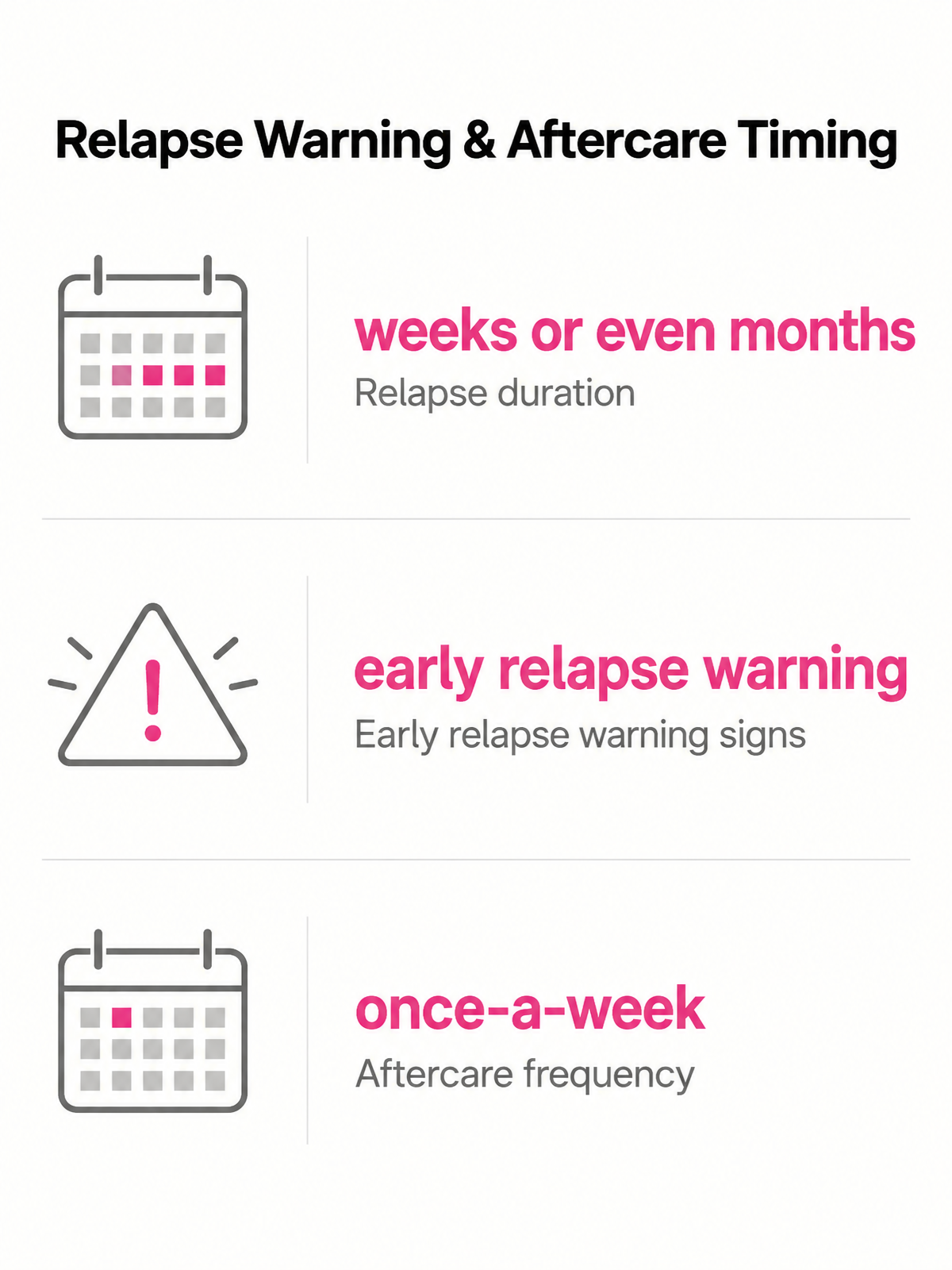
The first warning phase often looks quiet from the outside. People may not be planning to use, but their emotional regulation begins to thin out and their daily structure becomes less reliable. Neglected routines are not proof that someone is careless; they are early relapse warning signs that stability may be eroding. Research on relapse stages connects prolonged deterioration in self-care with a greater chance that internal bargaining and cravings will gain traction.
- Check for consistent self-care routines. If ordinary recovery habits have been slipping beyond an isolated bad day, treat that as useful information. Routine support can catch this before it progresses.
- Monitor mood stability. Anger, anxiety, or emotional flatness that lasts beyond a single bad day suggests someone may need more structure than weekly therapy provides.
- Track social connection patterns. Pulling away from supportive people can be a behavioral marker that intensive aftercare should address before risk escalates.
Coping consistency and trigger response
The next stage is internal conflict: part of someone wants to stay sober, but thoughts about using begin to surface.
Many people understand their coping strategies but can't apply them in the moment. That gap between insight and action is where structured aftercare becomes critical. The practice needs repetition and real-world application, not just understanding.
- Assess whether coping skills are accessible under stress. Knowing a grounding technique is not the same as using it when triggered. If skills aren't translating to real-world moments, frequent check-ins provide the practice needed to make them easier to reach.
- Identify high-risk situations that weekly therapy can't cover. Clinical experience shows that people often struggle to identify their high-risk situations or believe avoiding them signals weakness. Intensive coaching can walk through these scenarios in real time, not just in retrospect.
- Watch for romanticizing past use. When someone starts recalling the relief a substance once provided while downplaying the consequences, mental relapse is progressing. Accountability and frequent contact interrupt this pattern before it leads to physical relapse.
Supported continuing-care techniques that work
The evidence-based continuing-care techniques referenced in the literature share an active core.
Evidence-based aftercare approaches include telephone monitoring and counseling, assertive continuing care that reaches out proactively, contracting with clear expectations, prompts to reinforce routines, and active engagement rather than waiting for someone to show up. Structured coaching applies these techniques through consistent check-ins, accountability, and practical support as clients build routines and manage daily life.
When deciding whether intensive coaching is needed, the question isn't whether someone has failed. It's whether the level of support matches the stability markers and relapse-warning cues they're showing right now. If emotional regulation is fragile, daily routines are inconsistent, or triggers in everyday life feel overwhelming between therapy appointments, structured aftercare offers the frequency and accountability that bridge the gap when standard outpatient contact isn't enough.
Social & Support‑Network Readiness Indicators
The hardest truth about support after rehab is that most people around you may not know what to look for.
Relapse touches many people in recovery, and one major reason is the gap between intensive treatment and daily life. When structured accountability ends and no one steps in to bridge that transition, people are left managing triggers and cravings on their own during the most vulnerable months.
That's why support network deserves close attention before deciding how much structure you need. Relapse starts long before anyone uses, as thinking shifts and support quietly falls away. If no one around you is positioned to notice that drift, weekly therapy alone won't catch it.
Do You Have Enough External Accountability?
Informal support matters, but it is not always enough. The linked continuing-care strategies emphasize active outreach rather than passive referrals.
- A support system that reaches out, not just waits. Proactive outreach beats hoping you'll show up on your own. Someone who initiates check-ins instead of waiting for you to call when things get hard.
- Someone tracking your between-session cues. Regular contact that picks up on early warning signs, mood shifts, or changes in routine before they turn into full relapse patterns.
- Clear structure around your commitments. Accountability built into your week through contracting, prompts, and follow-through, not vague promises you make to yourself.
If your circle can't supply these, that's a signal for more structured support, not a character flaw. Structured support can help build that scaffolding, and you can read more in this take on signs you're ready for coaching.
Deciding on Intensive Coaching: A Practical Checklist & Next Steps
Use five areas to decide with a professional: daily routine stability, emotional regulation between check-ins, support network strength, cravings and high-risk thinking, and structure in your home or work environment.
This isn't a diagnostic tool or a validated clinical instrument. It's a practical guide that translates the warning signs covered above into a decision framework you can work through with a professional.
When You Need More Than Weekly Therapy But Not Full PHP
PHP provides weekly structure; IOP provides more frequent contact; weekly therapy provides one or two hours. Some people need more accountability than weekly therapy or IOP, but cannot leave work or family life for PHP. Life-embedded coaching can fit because it adds frequent contact inside your actual daily routines—grocery shopping when you're dysregulated, responding to work emails without catastrophizing, sitting through family dinners—without requiring the same block of program hours.
This does not replace PHP when PHP is clinically indicated. It addresses the space between IOP-level support and the structured step-down setting that PHP provides.
-
You can recognize emotional or behavioral relapse warning signs when they appear. Changes in sleep, food, personal care, or agitation between therapy sessions may signal that relapse risk is increasing before substance use feels imminent. Difficulty: Medium.
-
Your support network includes at least one person who can notice when you're isolating or romanticizing past use. Relapse rarely happens in a vacuum; it builds as thinking shifts and support quietly falls away. If no one around you is positioned to catch those changes, intensive coaching fills that accountability gap. Difficulty: Hard if your history includes burned bridges.
-
You're motivated to reintegrate into work, school, or family responsibilities, even if the thought feels overwhelming. Readiness doesn't mean you feel confident. It means you're willing to try. That willingness, combined with structured support, is what lets you test recovery in real-world environments without collapsing under the pressure. Difficulty: Easy to Medium.
What Families Can Do Without Replacing Clinical Decisions
Families have real but limited roles: coordinate logistics, support accountability, reduce barriers, not replace clinical judgment.
You can encourage professional assessment by helping coordinate intake appointments or transportation, support accountability by asking how meetings went without interrogating, and reduce logistical barriers by covering childcare or adjusting schedules during the first few weeks. What you cannot do is replace the clinical team's judgment on whether someone is ready for step-down care, diagnose relapse risk from behavior you observe at home, or pressure someone into a level of care their treatment provider hasn't recommended.
The clinical team looks for patterns you can't see from inside the family system—medication stability, how someone responds under stress during group therapy, whether they're applying DBT skills when no one is prompting them.
Your next step is straightforward: discuss what you've noticed with a qualified treatment professional, either the discharge planner from your most recent program or an intake coordinator at a provider that offers active continuing care. Bring this checklist if it helps frame the conversation. Most programs will conduct their own assessment, but having a clear sense of where you are across these five readiness areas makes that intake conversation faster and more focused on what you actually need.
References
[1] When to Consider Intensive Mental Health Treatment Programs - https://damorementalhealth.com/5-signs-its-time-for-mental-health-treatment/
[2] How to Know When You're Ready for a Higher Level of Mental Health Care - https://lucentrecovery.com/how-to-know-when-you-are-ready-for-higher-level-care/
[3] Preparing for IOP | Signs You're Ready for Healing - Bold Health - https://boldhealthinc.com/preparing-for-iop/
[4] Recognizing When Substance Use Requires Intensive Outpatient Care - https://thebrookhospitals.com/blog/recognizing-when-substance-use-requires-intensive-outpatient-care/
[5] PHP to IOP: How to Know You're Ready for Next Step in Recovery - https://lionheartbehavioralhealth.com/blog/signs-youre-ready-to-transition-from-php-to-iop/
[6] Are You Ready for IOP? Signs It's Time to Step Down from Inpatient ... - https://archwaybehavioralhealth.com/blog/how-to-know-when-youre-ready-to-step-down-to-an-intensive-outpatient-program/
[7] Signs It's Time to Step Up from Weekly Therapy to IOP - https://massbaybehavioralhealth.com/blog/signs-its-time-to-step-up-from-weekly-therapy-to-iop/
[8] Warning Signs of Relapse: Depression, Stress, and Other ... - https://americanaddictioncenters.org/adult-addiction-treatment-programs/signs-of-relapse
[9] Relapse Prevention and the Five Rules of Recovery - PMC - NIH - https://pmc.ncbi.nlm.nih.gov/articles/PMC4553654/
[10] Relapse Warning Signs After Treatment - https://presentmomentsrecovery.com/programs/aftercare/relapse-warning-signs/
[11] 6 Relapse Warning Signs To Know | Ashley Addiction Treatment - https://www.ashleytreatment.org/rehab-blog/early-relapse-warning-signs/
[12] Continuing Care After Rehab: Proven Strategies for You - https://themindfullemon.com/continuing-care-after-rehab/
Common Questions
1. How long does an Intensive Outpatient Program typically last compared to Partial Hospitalization?
IOP usually lasts longer than PHP because it functions as a step-down level of care rather than a short-term stabilizing structure. PHP provides more concentrated support first. IOP then gives clients time to practice recovery routines while returning to more of their ordinary responsibilities. Duration depends on individual progress and symptom stability rather than fixed timelines.
2. Can I work full-time while attending an Intensive Outpatient Program?
Many people balance full-time work with IOP because sessions are usually scheduled across the week rather than delivered as continuous care. The challenge comes when your job won't flex for session times or when program hours conflict with caregiving responsibilities. If attendance would become inconsistent, the plan needs adjustment before you commit.
3. What happens if I miss early warning signs of emotional relapse between therapy sessions?
If warning signs go unnoticed, risk can increase before the next appointment gives you a chance to talk it through. Intensive coaching creates more frequent opportunities to spot changes in routine, mood, connection, and thinking while they are still correctable. That added contact can help interrupt the progression before cravings or old behavior patterns take over.
4. Should family members raise concerns about relapse risk even when treatment providers say someone is ready for step-down care?
Family members should share specific observations with the clinical team but cannot replace their assessment of readiness for less intensive care. Treatment providers evaluate patterns families can't see from inside the home, like medication stability and stress responses during group therapy. Your role is coordinating logistics, supporting accountability without interrogation, and helping identify changes in routine that clinical staff should know about.