3 Signs You're Ready for Tapered Coaching After Rehab
September 3, 2026
Key Takeaways
- Somewhere between 40 and 60% of people relapse in their first year of recovery when structured aftercare is missing.
- Tapered coaching matches support to where a client actually is on the recovery curve, instead of removing help all at once.
- Lean on intensive coaching too long, and you risk learned helplessness, where every decision defaults to the coach.
- Good post-rehab coaching is built to work itself out of a job, moving from reactive presence to proactive strategy over time.
- Graduated exposure builds self-efficacy the same way exposure therapy does: you face triggers with a little less scaffolding each time.
- Long-term recovery tends to follow the same arc, from leaning on support toward genuine self-determination.
- The three readiness signs are observable checkpoints, not vague feelings. They mark a real developmental stage.
Why Tapered Coaching After Rehab Matters
Tapering sober coaching after rehab isn't about pulling support away. It's about matching support to where you actually are on the recovery curve. Done right, it builds the self-reliance that keeps you sober for years, not weeks.
The transition back to daily life is fragile. A large share of people slip within their first year of discharge when there's no structured aftercare holding them up. But over-support has its own cost. Lean on intensive coaching too long and self-trust starts to erode. You end up deferring every choice to your coach instead of sharpening your own judgment.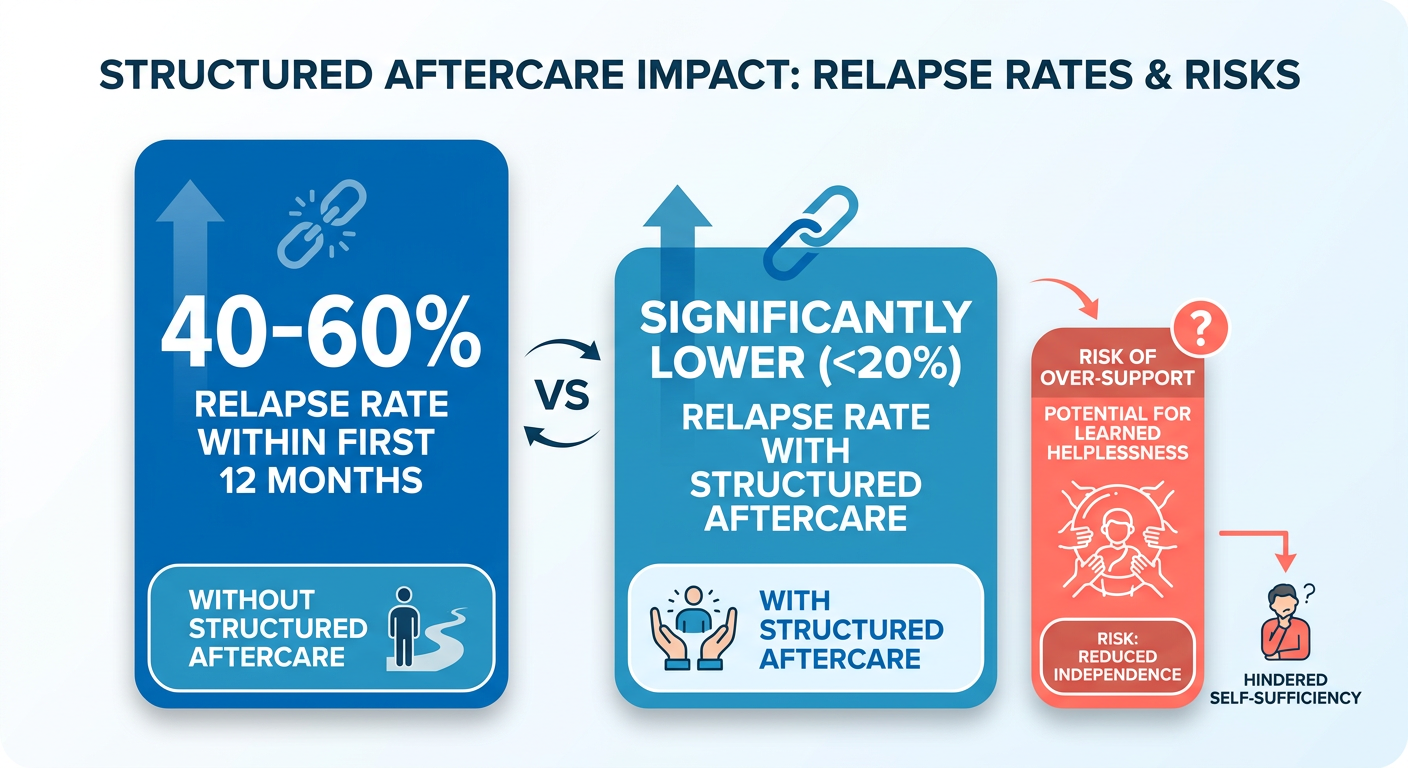
Sustainable coaching after rehab aims at long-term independence. Our approach is a structured step-down that tracks a client's growing stability, moving the focus from crisis management to lifestyle design. Early on, the job is safety. Later, the job is handing you the wheel.
Why tapering beats staying at peak support
Systematic step-downs build resilience. As sessions get less frequent, you're prompted to handle real-world stress with less oversight. Your nervous system gets a little more used to anxiety-inducing triggers each time, and your coping skills get reinforced through direct experience.
That's the shift from external accountability to internal motivation. We don't wait on a client's subjective sense of "readiness." We look for concrete behavioral milestones that show you're ready for the next phase. When those markers show up, we adjust session frequency to match. The safety net stays. The dependence doesn't.
There's a real economic case too. Fewer intensive-care hours and fewer readmissions mean lower hospitalization costs, and structured support often helps prevent long-term hospitalization. But the bigger payoff is psychological. Autonomy is the outcome. Dependence is the side effect worth avoiding.
Who actually benefits from tapering
Tapering works best for three groups: high-functioning professionals, clients with strong family or team support, and those transitioning to independent living. If your recovery capital is already stacking up (employment, housing, a social network), you're the person ready to shift from one coach to a broader team.
- You have 90 days of continuous sobriety. Usually takes 3 to 4 months, and it signals your baseline routine holds under normal stress. Difficulty: Medium.
- You self-monitor daily without prompting. A relapse-trigger log you keep on your own beats one your coach reminds you to fill in. Difficulty: Easy to Medium.
- You have a support network beyond your coach. Build the new system before you reduce the old one. Difficulty: Hard if your history includes isolation.
Skip tapering if you're in the first weeks post-detox, or if your support network is still just your coach. Cutting contact then is escape, not expansion.
Our framework uses a systematic reduction: intensive daily touchpoints move to weekly check-ins as behavioral markers are hit. For anyone still establishing a baseline, we focus on cementing the daily habits that stabilize the nervous system and manage stress first. Foundation before reduction.
One sign sits above the other three. When you can raise the transition conversation yourself, you're ready. Leaving a coach should feel like expansion, not escape.
Sign 3 – Confidence Managing Triggers and Making Your Own Recovery Calls
The clearest sign you're ready to taper sober coaching after rehab is confidence managing triggers on your own. Not white-knuckling. Actual self-efficacy: you hit a high-risk moment, run your own play, and come out sober. When decisions stop routing through your coach by default, the coaching has done its job.
Self-efficacy shows up in real life, not on paper. It's the difference between hoping you'll hold steady and knowing you can. When you're consistently handling social, emotional, and physical triggers on your own, your internal coping is working, and less frequent contact makes sense.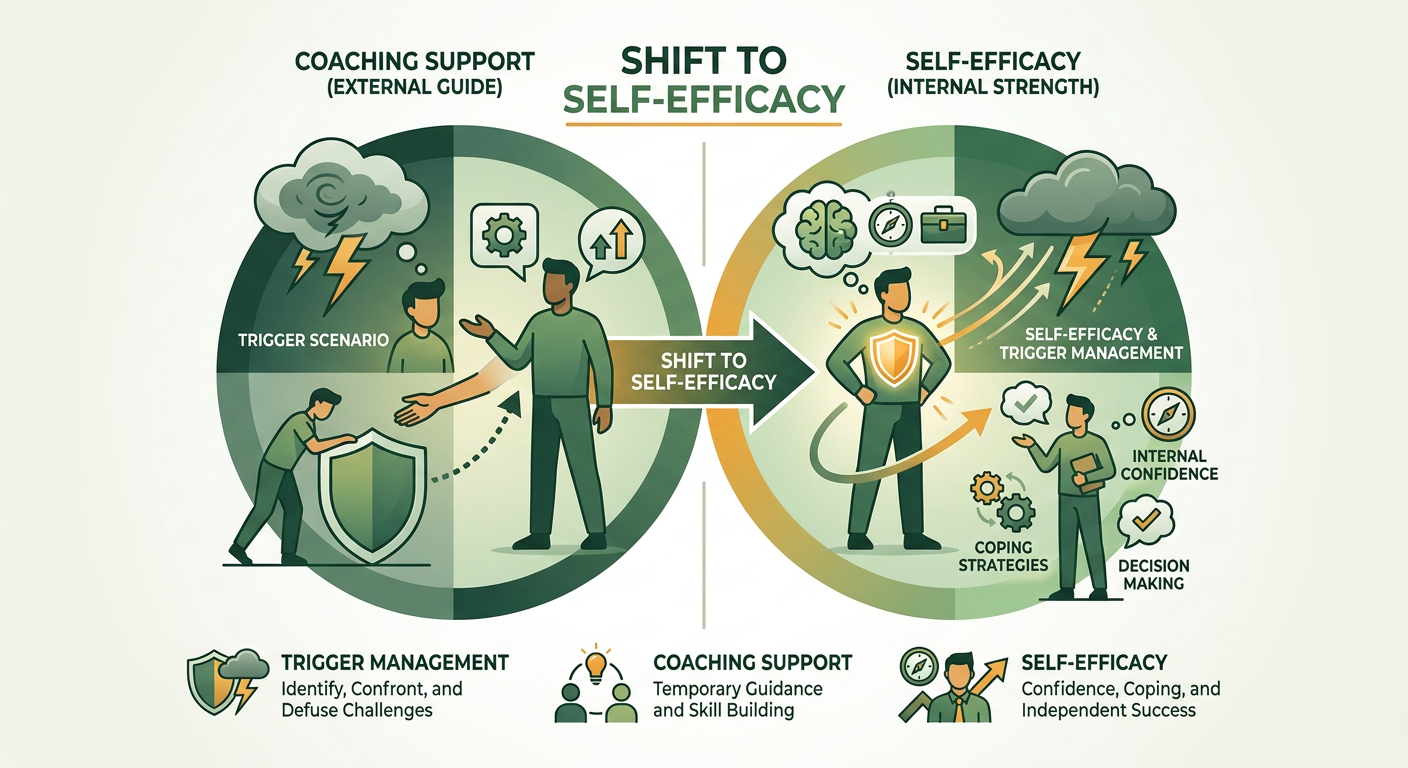
How do you know your trigger management is solid?
You know it's solid when you can name your personal triggers, not just the textbook ones, and point to a coping strategy that actually worked in the real world. Hands-on coaching tends to produce smoother transitions from residential treatment back into regular life, and this tested confidence is a big part of why. That's the gap between knowing the theory and living it.
Start with a trigger inventory. Common triggers hit everyone: parties, payday, conflict. Personal triggers are yours alone: a specific song, a certain drive home, a family member's tone. Sort them, then log which coping strategy defused each one.
- Categorize your risk factors, separating broad social pressure from the highly specific personal cues, so nothing hides.
- Rate your confidence situation by situation, then flag any category that still feels shaky for more taper prep.
- Pass one real-world test, like a social event with alcohol present, staying sober without a rescue call.
We build this readiness through physiological stabilization and stress management. Our coaches provide real-time support in the high-stakes moments, then step back as you show you can hold your own boundaries. The goal is for real-world challenges to feel manageable because you've already practiced the response.
For any high-risk situation, run this three-step plan:
- Pause before reacting, buying the ten seconds that break autopilot.
- Assess the trigger and your options honestly, naming what you're actually feeling.
- Act on your plan, then tell someone on your support team what happened.
As you take over these steps yourself, self-regulation becomes an automatic habit instead of something that needs external prompting.
Preparing for the Transition to Tapered Coaching
Preparing to taper sober coaching after rehab starts with a written plan, not a gut feeling. In our experience, the clients who map out the taper before they touch it adjust far more smoothly than the ones who wing it. We treat that written plan as an anchor, so each step-down is deliberate and transparent instead of abrupt.
Transitioning out should be a planned process, not an abrupt exit. That lines up with what this piece on outgrowing a recovery coach argues, and it's why we treat the taper as a project with milestones, not a countdown to zero contact.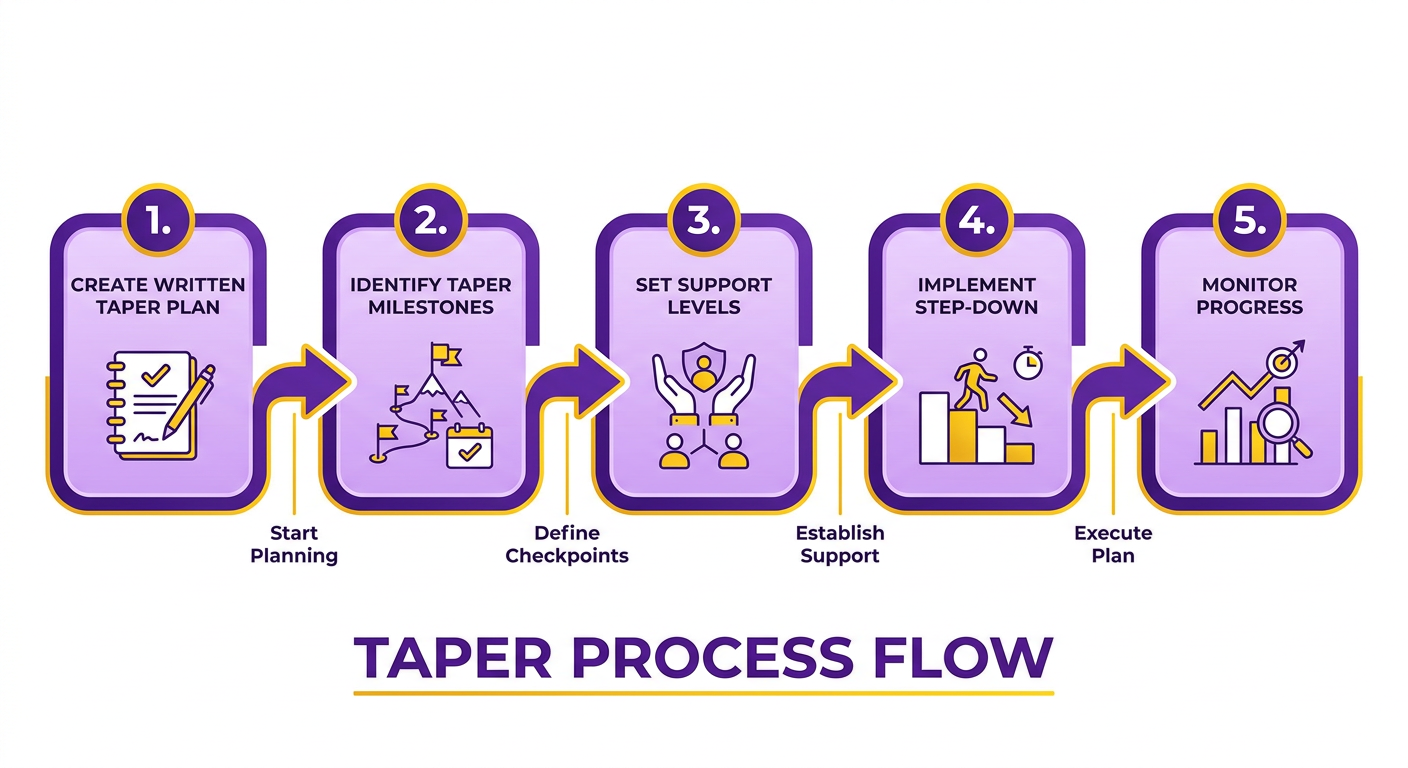
What a realistic taper timeline looks like
A typical taper runs 4 to 6 weeks of gradual reduction, moving from three sessions a week down to one. You don't drop from daily contact to nothing. You step down in stages so each new level gets tested before you cut further.
Build a Transition Plan Document to anchor it. One-page working file, revisited at every check-in.
- Set your step-down schedule with concrete dates (e.g., 3×/week for two weeks, then 2×/week, then 1×/week) so the reduction is visible, not vague.
- List measurable milestones tied to behavior, not mood, so you can see the growth from reliance to self-determination that a BMC Psychology study found in long-term recovery.
- Write fallback options in advance, so a hard week has a pre-agreed response instead of a scramble.
How to negotiate the taper with your coach
Raise it directly. A good coach welcomes this conversation, because independence is the whole point. Try a simple script: "I've handled my last three high-risk moments on my own. I'd like to step down to twice a week and review in two weeks."
Starting that conversation is proactive self-advocacy. As the same source notes, moving away from intensive coaching should feel like a natural stage of growth, not a sudden loss of safety.
- Confirm in-person vs. virtual logistics so tech, environment, and privacy don't derail a session mid-step-down.
- Agree on a post-taper satisfaction target of ≥8/10, giving you and your coach a shared read on whether the taper actually worked.
Your contingency and support plan
Cravings can spike mid-taper. That's not failure. It means you need quick-access resources ready before you need them, plus a daily routine that holds you steady.
Nutrition is part of that stability. We help clients rebuild healthy eating habits that support physical healing, emotional balance, and daily energy, and steady energy makes cravings easier to ride out. For more on building that structure, see our guide on the 90-day routine that stops relapse.
- Lock your daily routine: 7-9 hrs sleep, balanced meals, 30 min exercise, plus recovery activities like meditation or therapy.
- Save quick-access contacts for craving spikes, so support is one tap away when it counts.
- Build your support network: at least 2 sober contacts and 1 non-sober ally who knows your recovery plan, so the taper doesn't leave a gap.
Maintaining Accountability After Tapering
Fewer coaching hours doesn't mean less accountability. It means a leaner set of tools carrying the same weight. The best structure for sober coaching after rehab at this stage is low-intensity but consistent: one reliable touchpoint, a peer community, and a way to catch trouble early.
Here's the number that should shape your setup. Clients who keep at least one monthly accountability touchpoint show a 30% lower relapse risk. That single monthly anchor does more work than a dozen scattered check-ins you never keep.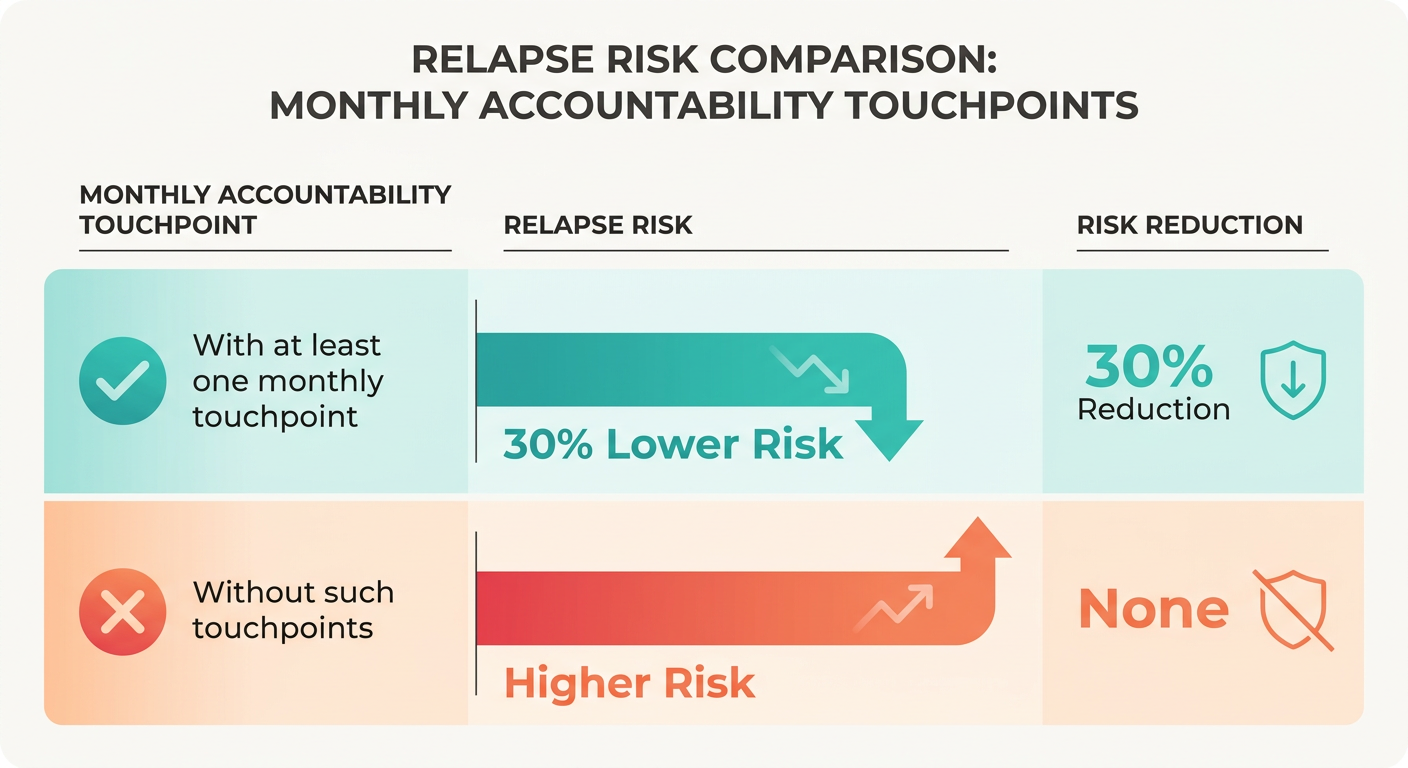
What replaces weekly coaching?
Once contact tapers, you swap high-frequency coaching for a small stack of self-directed tools. Each one keeps you honest without routing every decision through a coach. That shift is the point. A minimal, structured framework beats trying to run recovery in complete isolation.
- Monthly "Pulse Check" call (15-20 mins): A short, structured call to review wins, name any wobbles, and reset goals for the month. Keep it tight. This is a temperature read, not a full session.
- A peer-support group you actually attend: A recovery community gives you the social capital your coach used to hold. Pick one format and commit; consistency beats variety here.
- A habit-tracker app with push notifications: Daily nudges make your routine visible. When you can see a streak, you protect it.
Where peer support fits for a tapered client
Peer support becomes your main social scaffold as coaching winds down. The dynamic shifts from professional oversight to mutual accountability. A community of shared experience fills the gap left by fewer coaching hours without building a new dependency in its place.
Our take: a regular group meeting plus a monthly professional check-in is the balance that works. You get peer-level community and a structured professional touchpoint, which keeps you anchored without over-supporting.
- Ongoing community connection: Staying plugged in after formal coaching ends is one of the strongest moves you can make. Our programs lean on mentorship and community precisely because they sustain recovery once intensive support winds down.
- Quarterly self-review worksheet: Every three months, write down your goals, current triggers, and routine health (sleep, food, movement). Reflection you can reread beats memory you can't.
When to re-engage intensive coaching
Re-engage when your red flags cluster, not when you have a single bad day. One rough week doesn't call for a full return to intensive coaching. That's normal. Watch for patterns instead: skipped meetings, isolating, romanticizing use, sleep falling apart, or dodging your Pulse Check.
Building this self-monitoring into your post-taper life matters as much as the foundational habits in our guide on the 90-day routine that prevents relapse. Catching behavioral drift early keeps any step-up in support brief and targeted.
- Name 3-4 personal red flags in writing: Vague warning signs get ignored. Specific ones ("missed two meetings," "hiding my calendar") trigger action.
- Agree a re-engagement trigger in advance: Decide now what pattern brings your coach back. A pre-set rule removes the debate when you're least able to have it.
Real‑World Example: MADE Recovery’s Tapered Coaching in Action
Here's what tapered sober coaching after rehab looks like when the readiness signs line up. At MADE Recovery, we start clients coming out of detox or residential treatment with more intensive support, because the early window is where most people lose ground.
The taper is individualized. We step back gradually based on objective behavioral milestones, not arbitrary timelines. That's the pattern we build around: match the step-down to real progress, not a calendar.
How the three signs show up in practice
Each readiness sign reflects real stability before we touch session frequency.
- Sign 1. A consistent early streak. The first three months post-treatment are the most vulnerable window. A solid, uninterrupted stretch of sobriety here proves your baseline routines can hold under real-world stress, outside a controlled clinical setting.
- Sign 2. A stable daily structure. We focus on cementing the daily habits that support physical and emotional regulation, with family members getting regular accountability updates. That structure has to run on its own before we consider cutting coaching hours.
- Sign 3. Proven trigger management. Our coaches show up in a client's actual environment, the job site, the family dinner, the airport bar, and step in before a craving becomes a relapse. Once clients hold steady through social and emotional triggers on their own, that's the signal.
What the taper actually looks like
Our step-down protocol moves clients into self-directed recovery while keeping a reliable safety net.
- Communicate the plan early. We write the taper down before starting it, so no step-down feels abrupt.
- Keep a flexible fallback. If cravings spike, we can add support back. That safety valve is why clients trust the taper enough to actually follow it.
By putting self-efficacy first, we help clients build lasting confidence. The philosophy stays simple: align support with real progress, keep communication open, and always have a structured fallback in place.
References
[1] What Happens When You Outgrow Your Recovery Coach - https://allthewaywell.org/what-happens-when-you-outgrow-your-recovery-coach/
Frequently Asked Questions
1. Can I taper coaching if I relapsed once during my first 90 days?
A single relapse does not mean failure, but it does mean your baseline routines are not yet fully self-sustaining. Reset your timeline and focus on the specific breakdown in your coping strategies. Tapering should resume only after you have re-established a consistent, uninterrupted period of sobriety and shown that your daily habits can withstand stress without external intervention.
2. What's the difference between white-knuckling sobriety and genuine readiness to taper?
White-knuckling is marked by high anxiety, hyper-vigilance, and relying only on sheer willpower to avoid relapse. Genuine readiness is marked by calm, proactive use of your coping strategies. You are ready to taper when a high-risk situation no longer triggers panic, but instead prompts you to apply your relapse prevention plan with confidence.
3. How is tapered coaching different from just quitting coaching abruptly?
Tapering is a controlled, milestone-based reduction of support that lets you test self-reliance in manageable increments. Quitting abruptly, on the other hand, removes your safety net overnight. Ending coaching too soon, especially before you have a robust external support network, often comes from avoidance rather than readiness and raises the risk of a setback.
4. What if my cravings spike in the middle of the taper?
An increase in craving intensity during a transition is a common physiological response to reduced oversight, not a sign of failure. If this happens, use your pre-planned coping resources right away and focus on stabilizing your daily physical self-care. If the cravings stay intense, use your agreed-upon fallback plan to temporarily increase coaching contact until you regain your footing.
5. Do I still need accountability after I finish tapering?
Yes. Transitioning to independent living does not mean eliminating accountability; it means shifting to self-directed maintenance. Research indicates that maintaining even a minimal, consistent professional touchpoint significantly reduces the likelihood of relapse. A brief monthly check-in and active participation in a peer community help you stay anchored without becoming dependent on intensive coaching.
6. How do I know when to re-engage intensive coaching after tapering?
Look for a cumulative pattern of behavioral changes rather than one difficult day. Warning signs include withdrawing from your support network, neglecting your daily routines, or avoiding scheduled check-ins. A pre-written list of specific warning signs helps you identify when it's time to temporarily step up your level of professional support.
7. Is tapered coaching right for someone with a history of isolation?
It can be highly effective, but the transition requires extra care. If you tend to isolate, your primary focus must be building a diverse external support system before any reduction in coaching begins. That means establishing active connections with peer groups and trusted personal allies. Tapering should be paused if your coach remains your sole source of accountability and connection.