How a Sober Coach Builds the 90-Day Routine That Prevents Relapse
August 12, 2026

Key Takeaways
- Roughly 65 to 70 percent of people relapse within the first 90 days after leaving sober-living programs, per Caron's coaching data.
- The 90-day routine uses daily anchors adjusted weekly, not a pass-fail checklist.
- The support crew increases difficulty as clients steady out.
- Sleep and accountability check-ins are low-effort anchors, rated difficulty 2 of 5.
- Structured activity is the hardest piece, rated difficulty 4.
- Structured activity fills four to six unstructured hours each day.
- That idle time is where early recovery triggers do the most damage.
- The team-based model rebuilds treatment's external structure.
- It then turns those patterns into habits the client owns.
- Meals and hydration steady blood sugar and blunt impulsive cravings.
- That means three meals and two liters of water a day.
- Coaches start with high-impact, low-difficulty tasks.
- They add harder pieces only when a client is ready.
Quick Summary
A good 90-day routine is not a rigid checklist. It is a set of daily anchors. A sober coach and support crew bend them to fit your week. The table below shows how we explain it to clients and families. It shows where support is needed most. It also shows how heavy each piece feels early in recovery.
The first weeks matter because leaving a structured setting opens many doors at once. Not all of them lead somewhere good. Our team-based model targets that window. We rebuild the structure treatment gave you. Then we hand it back as habits you own. Low-difficulty, high-impact anchors come first. Harder tasks wait until you're ready.
What a 90-day routine actually involves
Each piece carries a different weight. Sleep and check-ins are easy wins. Structured activity is the hard one, and we treat it that way.
| Routine Element | Typical Time / Day | Difficulty (1-5) | Key Metric | Benefit Highlight | Coach's Role |
|---|---|---|---|---|---|
| Sleep (7-8 h) | 7-8 h | 2 | Improves mood & decisions | Cuts mental strain, a top relapse driver | Sets wake/sleep anchors |
| Meals & Hydration | 3 meals + 2 L water | 3 | Stabilizes blood sugar | Curbs impulsive cravings | Meal prep, grocery runs |
| Structured Activity | 4-6 h | 4 | Fills unstructured hours | Prevents idle-time triggers | Paces the ramp-up |
| Accountability Check-ins | 15-30 min | 2 | Real-time support | Reinforces human connection | Daily contact & guidance |
| Flexible Rest Slot | 30-45 min | 1 | Builds stress resilience | Adapts without breaking routine | Adjusts on hard days |
The order is deliberate. Physical basics come first. A body that has slept and eaten can handle harder work. Dr. KJ Foster puts it this way: "The more that you can get your body and brain into a consistent routine, the better you're going to be relative to post-acute withdrawals."
How long it takes to lock the routine in
Habit-formation research puts the automatic mark at around 66 days. That shifts the payoff into the back half of the 90-day window. The first two weeks feel effortful. That is normal, not a warning sign.
Do not rush the difficulty-4 items. Recovery experts warn against jumping back into work, school, or heavy social plans too soon. Loading a job search onto week one is a reliable way to burn out and relapse. We keep structured activity light until sleep and meals are steady.
What success looks like
By the three-month mark, people commonly report better physical health, sharper emotional awareness, and stronger relationships. One person in recovery described the shift as finding purpose in planning a day. A client in structured continuing care reported fewer cravings and steadier moods over the same span.
But 90 days is a launchpad, not a finish line. The odds of staying sober climb past the mark. Continuing-care research is clear that longer support arcs produce better outcomes. We treat this routine as Phase 1. Then we taper our involvement as your independence grows.
Assessing Individual Recovery Needs
Assessment starts before we build a single daily anchor. The first job of sober coaching is finding which relapse risks are active for you right now. We do not focus on the ones a generic program assumes. That means mapping your triggers, your support gaps, and where you sit on the recovery curve.
This comes first because relapse prevention therapy, the clinical framework behind most structured aftercare, begins with an assessment of your interpersonal, intrapersonal, environmental, and physiological risks. Skip it, and the routine is just a guess. A good coach treats the first two weeks as data collection, not correction.
The tools we use to read your risk
Assessment starts with an initial consultation and keeps going through real-time coach observation as your program takes shape. Instead of using a one-size-fits-all checklist, we build the program around where your risk is high and your confidence is low. Support lands there first.
The coach side catches what a questionnaire misses. Melemis's work on relapse stages notes that relapse begins weeks or months before actual use, moving through emotional, then mental, then physical stages. A coach in weekly contact can spot emotional relapse, the isolation and skipped self-care, long before it turns into a craving.
That is where the team model earns its keep. A questionnaire scores you once. A coach and a coordinated crew track you continuously and adjust.
Making 90-day objectives measurable
We build objectives around your progress and the routines that steady it. Then we adjust as your needs change. A static routine misses the client who looks stable on paper but is quietly relapsing emotionally. With a coordinated team, different people watch different signs and flag the coach when something shifts.
Objectives have to be countable. Not "attend meetings," but "five meetings this week plus one sponsor call." Not "sleep better," but "in bed by 11, tracked nightly." This matters because post-acute withdrawal can last up to two years. A consistent routine is what steadies the brain through it. Countable targets let us catch drift early.
Peer coach or clinician: which assesses better?
Both, and that is the point. Sober coaches bring lived experience of long-term sobriety rather than a therapy license. That closes the gap between what treatment taught and what your Tuesday actually demands. Clinical RPT brings the diagnostic rigor and the instruments.
The honest carve-out: a coach is not a substitute for therapy. Deeper psychiatric issues still need a licensed clinician. Our answer is to coordinate the two. Peer accountability and clinical care then point at the same person.
A solid assessment also catches co-occurring conditions early. SAMHSA data shows nearly half of people in recovery are managing a mental health condition alongside a substance use disorder. Catching depression or anxiety in that first assessment week means the 90-day plan can account for therapy appointments, medication check-ins, and realistic energy levels from day one.
Building a Daily Routine
We build the routine to fit the individual and let it evolve as you progress. The clients who make it past 90 days treat the routine as a scaffold they can adjust, not a test they can fail. That distinction matters because neurological stabilization takes a long time. A rigid schedule you cannot keep becomes one more failure while your brain is already struggling to adapt.
Start with the non-negotiables
Week one is survival mode, not optimization. We lock in three anchors before anything else: wake time, first meal, and your daily check-in with your coach. These are not arbitrary. They target the neurological reset window. The brain's reward pathways need significant time without substances to restore normal chemical signaling, and consistent sleep-wake cycles speed that up. Wake time stays within a 30-minute window seven days a week. First meal lands within an hour of waking, even if it is just protein and fruit. The coach check-in keeps you connected by text, call, or in person, so support holds steady through the earliest, hardest weeks.
The sequence has a reason. Clients moving from structured treatment to unstructured home life lose the daily scaffolding exactly when their prefrontal cortex is still rebuilding impulse control. The check-in recreates the accountability treatment provided. It also keeps a coach close during the moments that matter most. Regular contact means your coach can catch it when self-care slips or isolation creeps in. That support can come before the mental stage of relapse starts.
Layer in movement and connection
Week two adds physical movement and peer support to the scaffold. Movement does not mean a gym membership or a training plan. It means building activity you will actually do into your day: a walk, a bike ride, bodyweight circuits, whatever fits. People who hold 90 days of abstinence show a 15 to 20 percent improvement in sleep architecture, and morning exercise is the fastest lever for sleep quality while your circadian rhythm is still recalibrating.
Peer connection goes on the calendar too, not in the "when I feel like it" pile. Communities like 12-step, SMART Recovery, or secular recovery groups give you a place to sit with people going through the same thing. One client pointed to the value of that shared experience, the relief of connecting with peers who understand the daily grind of early sobriety. Your coach helps you stay engaged, because pulling away from social connection is the clearest signal of behavioral isolation.
Map your high-risk situations
By week three we map your high-risk situations and plan responses. Relapse prevention research points to negative emotional states and social pressure as the two most common triggers, but your map is specific to you. We work with you to name the three to five situations that are live threats in your current life. For one client it is driving past the old dealer's block on the commute home. For another it is Sunday afternoons when the house is empty and boredom sets in.
For each one, we plan the response ahead of time: who to call, where to go, what to do next, whether that is leaving the location, starting a specific task, or riding out the urge. The plan is not theoretical. We talk it through in your sessions. Relapse prevention therapy treats a lapse as a learning opportunity rather than a failure. Afterward, the focus stays on what worked and what to adjust. You are not memorizing coping skills in the abstract. You are rehearsing the exact sequence you'll reach for when your prefrontal cortex is offline and instinct takes over.
Adjust to what's actually happening
The routine is not static. We review and adjust weekly for the first month, then biweekly through day 90. If 90 days feels hard, that does not mean recovery is not working. It usually means recovery is asking you to build skills you did not need in active use. The team-based model means your progress has a coordinated crew watching it, not one set of eyes. When something shifts, when you're steady in one area but struggling in another, the crew alerts your coach before the gap is even on your radar.
Clients with co-occurring PTSD, for instance, carry a 60 percent higher relapse risk at the 90-day mark than those with a single diagnosis. If symptoms flare or life gets harder, we can add support: more frequent contact, more coordination. Our packages are built to flex. When you stabilize, we scale back. The scaffold adapts to what you're living through, not what a generic template assumes.
Tracking Progress and Adapting
We track two things at once: the behaviors you committed to, and the emotional or social drift that tells us you're off course before a lapse happens. Clients who hit every check-in but stop sleeping or start skipping meals are showing early warning signs. They just do not know it yet. That kind of behavioral drift often runs ahead of the conscious desire to use, which makes it one of the best signals that a routine needs adjusting.
The first month, we stay in close contact. Your coach helps you build awareness of your daily patterns: when you're waking, whether you're eating regularly, how you're handling the hard moments. We're not grading you. We're watching for pattern breaks. If your wake time drifts two hours later three days running, that's data. If you skip two meals and then pull back from support, that's a chain we can interrupt before it reaches the mental-relapse stage.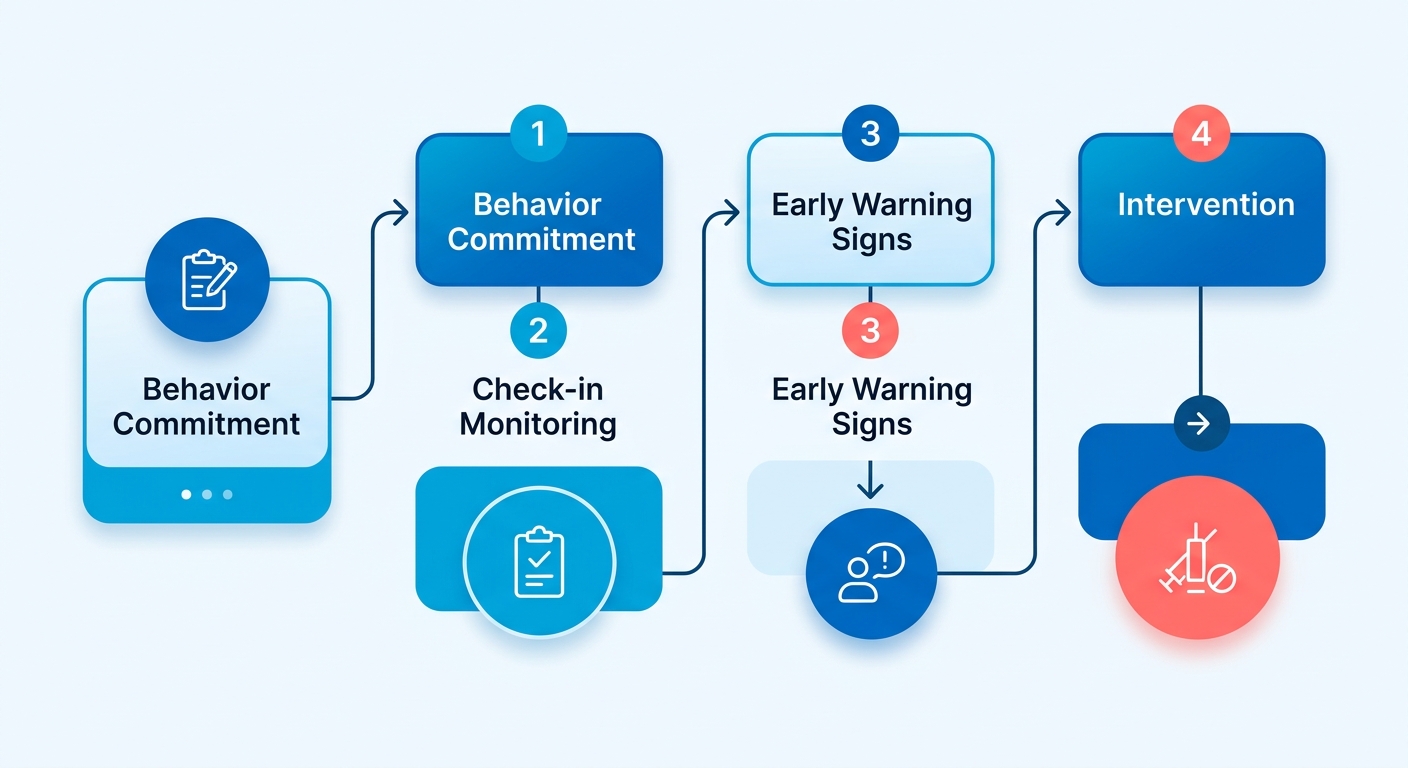
What gets measured and why
Your emotional baseline matters because mood shifts often surface before behavior does. Coaches track how you describe your days: irritability creeping in, motivation dropping, small resentments stacking up. Those signals tend to show up before a routine starts breaking down. Feeling off is not failing. It flags a need for adjustment, whether that is a conversation, a change in structure, or a check-in with your medical team.
Check-in consistency is the second anchor. We watch whether you're showing up and keeping contact, not grading what you say. A client who goes quiet for a few days is telling us they're in the mental stage, bargaining with themselves, isolating, and rationalizing why the routine does not apply this week. Keeping that line of communication open heads off the isolation that lets old habits back in.
Trigger exposure is something we help you spot and manage as it happens. Coaches stay close during the moments that matter, so you can learn what actually trips you up versus what you assumed would. External stressors and social settings are common catalysts, but your personal list might include boredom, success, or being alone in your car. The point of steady contact is to build coping skills right where you need them.
How we adapt your support level
As you move through early recovery, we adjust the level of support to match what is working and what is not. By the third or fourth week, post-acute withdrawal symptoms have usually peaked, and you've had enough hard moments to know which strategies you'll actually use versus which ones only sound good. If an approach is not helping, we find a different one with you. Mind-body relaxation works for long-term prevention, but only if you'll actually practice it when your brain is screaming at you.
We taper support when you're stable and add it back when you're drifting. As you show consistent patterns, regular sleep, steady meals, difficult situations handled, we gradually check in less often. That's not graduation. It's a test of whether the structure has gone internal. If your patterns break when contact drops, we go back to more frequent support. The early months do not guarantee long-term sobriety. They get you into the stretch where stability becomes more likely, if you keep doing the work.
What happens during a crisis
When you reach out in a crisis or after a lapse, you get immediate support. Coaches help you get to a safe place and work through it using the strategies you've been building together. We focus on safety and stabilization, not shame. You do not lose your progress. You gain insight into what needs adjustment.
In the day or two after a lapse, we help you understand what broke: Did you skip sleep two nights before? Did a new stressor show up that we had not prepared for? Did a coping approach fail under real-world pressure? That reflection tells us how to adjust your support, whether that's more frequent check-ins, coordination with other professionals, or a change in daily structure. Clients at higher risk benefit more from intensified continuing care, and a lapse is the clearest signal that your current support needs to match your current risk.
We do not pull support when you stumble. We adjust it, so what comes next builds on what you learned.
Sustaining Sobriety and Transitioning to Self-Reliance
The 90-day mark is not the finish line. It is the entry point into a longer stabilization process. Because our support tapers gradually rather than ending on a fixed date, we treat the weeks after day 90 as continued care, not a graduation. Continuing-care research shows interventions lasting at least 12 months produce better outcomes than shorter programs, but the first quarter stays the highest-risk window. Our team-based model leans in hard during those first 90 days, then hands responsibility back to you as your neurological and emotional systems steady.
When your coach steps back, and when they don't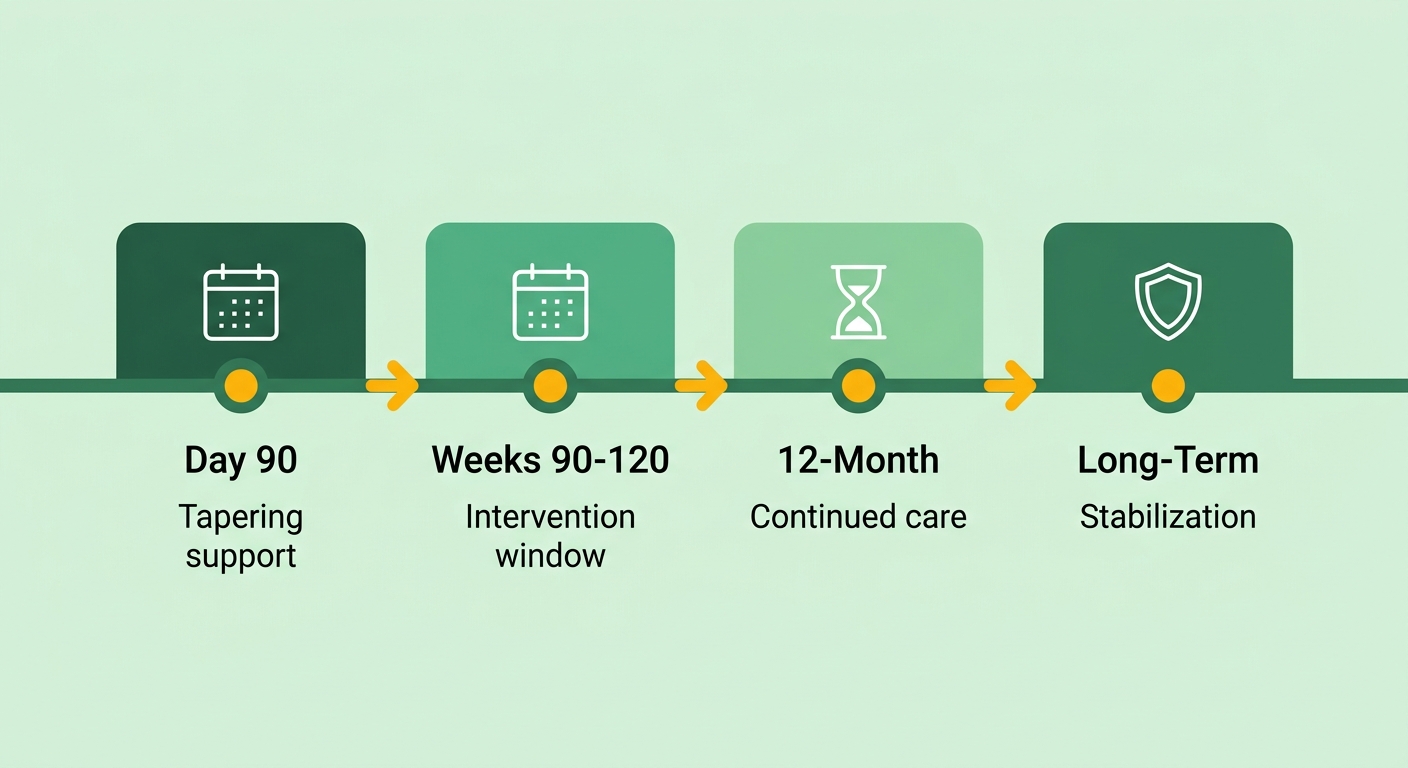
As you gain independence, support tapers rather than ending abruptly. By that point your brain chemistry has begun to stabilize and your prefrontal cortex shows measurable metabolic normalization. You're sleeping better, your decisions are sharper, and a high-risk situation does not hijack your whole day the way it did in month one. That is when we start easing back, shifting from constant accountability toward the level of support that matches your growing self-sufficiency.
Complex mental health conditions shift that timeline. Research shows people dealing with anxiety disorders in early recovery often stabilize later, with acute symptoms persisting four to six months past initial sobriety. In those cases our packages evolve to keep a dedicated coach or coordinated team closely involved for longer, adjusting the level of care as needs change. The coach handles real-time crises and coordinates with any other services you're working with, so the day-to-day pressures do not pile onto each other.
The transition is not about withdrawing support. It is about converting external accountability into internal habit. Your coach stops reminding you to eat breakfast because you've built the routine yourself. They stop scripting your responses to social pressure because you've rehearsed enough scenarios to trust your instincts. What stays is real-world support when it counts: if you're in a high-risk moment or catch early relapse signs like sleep drift, skipped meals, or isolation, your coach is there. That steady presence is meant to make sure you do not face the hardest stretches alone.
Catching a relapse before you use
Spotting the early signs means you can act while the fix is still simple. Behavioral changes come before physical relapse, which gives you a window to change course before cravings take the wheel. We help clients catch these shifts early. The first phase looks like poor self-care: attending meetings but not sharing, eating on no schedule, pulling away from your support network. You're not thinking about using yet, but you're building the conditions that make it feel inevitable.
The next phase is when the bargaining starts. You think about people you used with, places you used to go, situations where "just one" might be fine. You start minimizing the consequences or glamorizing the high. Breaking isolation is what matters here. Saying these thoughts out loud to someone who gets it is what stops the momentum. You call your coach, you show up to a meeting, you text your accountability partner. You name the thoughts instead of letting them compound in private.
Physical relapse is when you're about to use or already have. Most people picture this stage when they hear "relapse," but by the time you're here you've already cycled through weeks of emotional and mental drift. Our approach is simple: reach out to your coach for real human connection, then look together at what part of the routine needs reinforcement. We analyze the breakdown without the shame. What triggered the emotional drift? Which coping skill failed? What needs rebuilding?
Building infrastructure that outlasts your coach
The routines you build in the first 90 days are training wheels. By month four you're keeping them up without constant supervision, and you're also starting to notice when they need adjusting. Your job changes, your living situation shifts, a family crisis hits. Any of these can destabilize a routine that felt bulletproof at day 90. Clinical experience shows people who keep up ongoing self-care and stay connected to peer support have better long-term outcomes than those who lean only on early-recovery structure.
We help clients build lasting community and mentorship, because those relationships are meant to hold you up long after our coaching ends. Peer support groups are one common source of that connection. As our support tapers to encourage independence, the network you've built stays put. One person who made the transition well noted how much it helped to keep marking milestones while shifting to a self-directed structure. You're still planning your day, tracking your triggers, checking in with accountability partners, but you're doing it because the habits are yours now, not because someone told you to.
The milestone you're aiming for is not "I don't need help anymore." It's "I know how to ask for help before I'm in crisis." That's what lasting recovery looks like. You've built the daily anchors, learned your warning signs, and surrounded yourself with people who notice when you start to drift. The 90-day routine gave you the scaffolding. The next nine months teach you how to repair it when it breaks.
References
[1] Sober Coaching: How It Works, Key Benefits,… - https://www.caron.org/addiction-101/treatment-advice/sober-coaching
[2] The First 90 Days of Recovery - https://archangelcenters.com/recovery/first-90-days/
[3] Relapse Prevention and the Five Rules of Recovery - PMC - NIH - https://pmc.ncbi.nlm.nih.gov/articles/PMC4553654/
[4] Ways to Avoid Relapse - https://recoveryfirst.org/sober-living/how-to-avoid-relapse/
[5] 3 Stages of Relapse + How To Protect Your Sobriety - https://hellosomedaycoaching.com/3-stages-of-relapse-and-how-to-protect-your-sobriety/
[6] What to Expect in the First 90 Days of Sobriety - https://www.theblanchardinstitute.com/what-to-expect-in-the-first-90-days-of-sobriety-a-compassionate-guide/
[7] Sober Coaching: Learn How to Support Long-Term Recovery - https://recoverycarepartner.com/how-sober-coaching-supports-long-term-recovery/
[8] The first 90 days of recovery: Building a routine that lasts - https://www.rosecrance.org/blog/summer-of-recovery-celebrating-three-months-sober/
[9] Early Recovery Advice | Tips for the First 90 Days of ... - https://www.youtube.com/watch?v=sRPtU9jTEC8
[10] 90 Days of Sobriety: Your Guide to Lasting Recovery - https://sayarc.com/learning-center/90-days-of-sobriety/
[11] Clinical Guidelines for Implementing Relapse Prevention ... - https://www.researchgate.net/publication/235326763_Clinical_Guidelines_for_Implementing_Relapse_Prevention_Therapy_A_Guideline_Developed_for_the_Behavioral_Health_Recovery_Management_Project
[12] Impact of Continuing Care on Recovery From Substance ... - https://www.researchgate.net/publication/348845588_Impact_of_Continuing_Care_on_Recovery_From_Substance_Use_Disorder
Frequently Asked Questions
1. What happens if I can't maintain the routine during a particularly stressful week?
The routine adapts rather than breaks. Coaches adjust weekly based on real conditions. They scale difficulty down when stress spikes and back up when you stabilize. Flexible rest slots and adjusted check-in frequency keep the scaffold intact without demanding perfection during hard weeks.
2. How does a sober coach differ from a therapist in preventing relapse?
Sober coaches bring lived sobriety experience and handle daily accountability. Therapists provide clinical diagnosis and treat co-occurring mental health conditions. The team model coordinates both, so peer support and licensed care reinforce each other rather than operating separately.
3. Why does structured activity rank as the hardest routine element?
Structured activity requires significant mental effort because it replaces the empty hours that often lead to boredom and cravings. Coaches recommend keeping these commitments light during the initial weeks, allowing basic physiological habits like sleep and nutrition to stabilize first. Rushing into demanding obligations like a job search too early can lead to exhaustion and increase vulnerability to relapse.
4. What specific signs indicate I'm entering emotional relapse before cravings start?
Early indicators include subtle behavioral shifts such as withdrawing from social contact, neglecting personal hygiene, or ignoring daily schedules. When a client begins avoiding check-ins or showing inconsistent daily patterns, it suggests a drift in focus. Identifying these changes early allows a coach to help adjust the daily structure before the individual begins actively bargaining with the idea of using.
5. Does the program end abruptly after 90 days or continue longer?
The program transitions into a gradual step-down phase rather than stopping suddenly at the three-month mark. Because long-term recovery benefits from extended support, coaches slowly reduce the frequency of check-ins as daily habits become self-sustaining. If challenges arise, the level of contact can be temporarily increased to provide stability during transitions.
6. How do meal timing and hydration actually reduce cravings?
Regular nutrition and hydration prevent physical fluctuations that the brain can misinterpret as stress or cravings. When blood sugar drops, it triggers a physiological stress response that impairs decision-making and increases impulsivity. Establishing consistent eating patterns helps maintain physical equilibrium, making it easier to manage emotional triggers during the early months of recovery.