Can You Self-Manage Recovery? Check Stressors, Isolation, and Nutrition First
August 13, 2026

Key Takeaways
- Self-managed recovery depends on three live risk factors: stress, isolation, nutrition.
- Overdose deaths climbed during the pandemic as isolation and boredom increased.
- Leaving detox or residential care is its own stage.
- Self-care does real clinical work. It builds self-worth and agency.
- A durable routine shifts with your environment, not a fixed checklist.
Why Self-Managed Recovery Matters
Holding onto progress after structured treatment takes a plan that fits the day. The hard part usually is not knowing what to do. It is catching warning signs before they stack up. A rigid list of rules does not do that. A responsive framework, one that adjusts to daily pressure and changing surroundings, does.
What Self-Management Asks of You That Treatment Didn't
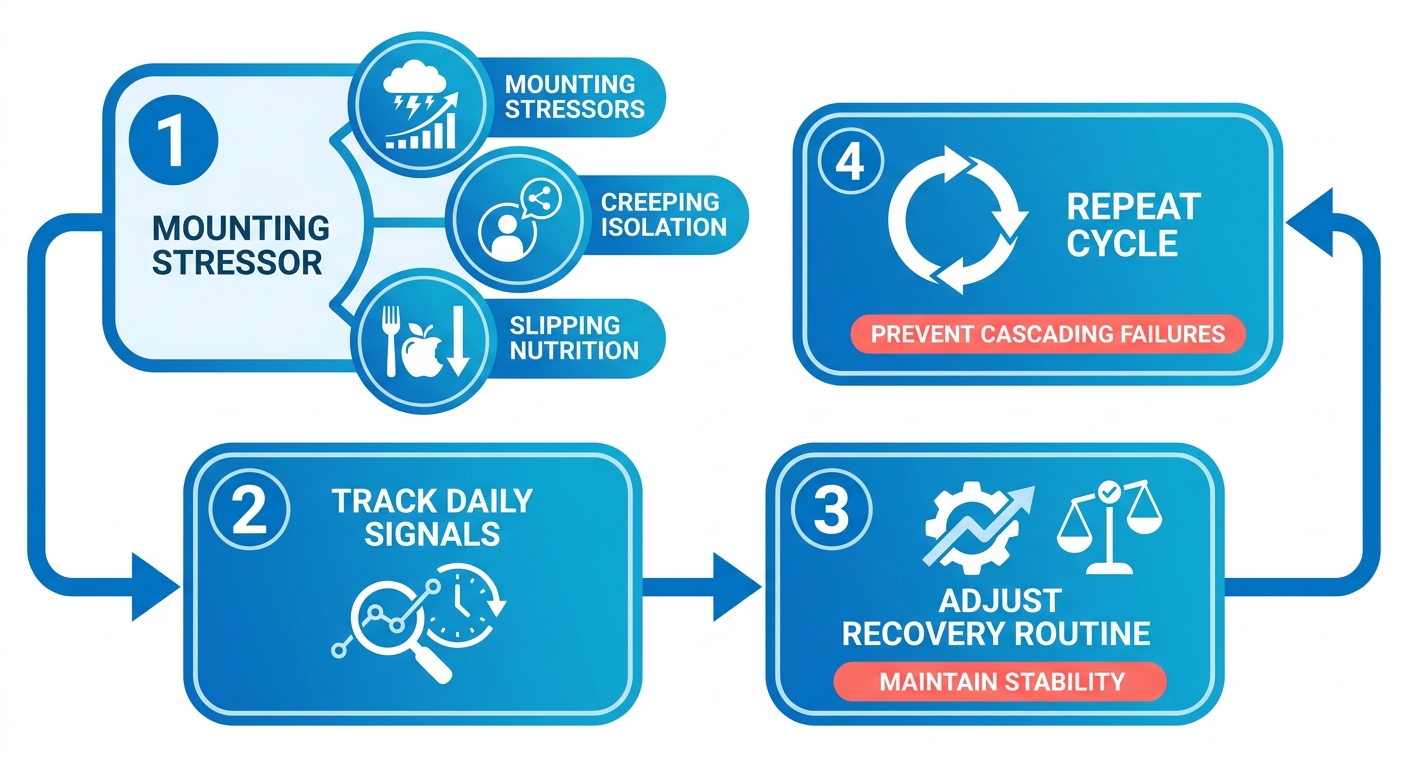
Most people assume treatment ends and self-management starts there. We see it differently. The post-residential phase asks you to apply skills actively, not just follow a schedule someone else set. Dr. Brian Barnett at Cleveland Clinic noted that isolation and boredom tend to hit at the same time in early recovery, especially during stretches of social distancing. That pairing is exactly why a structured daily plan matters. It bridges the gap between clinical supervision and living on your own.
Self-care gets framed as a soft add-on to the "real" clinical work. The evidence says otherwise. Dr. Deena Manion notes that self-care builds agency, reinforces self-worth, and supports long-term wellness. Treat daily habits as active recovery variables rather than lifestyle suggestions, and people spot trouble earlier and correct faster.
Why the Three Signals Only Make Sense Together
Relapse triggers do not line up politely one at a time. Isolation drags nutrition down, and both raise stress. Recent research shows that perceived social isolation rewires how the brain processes food cues, nudging people toward sugary, reward-driven eating and worse diet quality overall. So when Cleveland Clinic flagged isolation as a relapse trigger, they were describing half of it. The isolation is quietly degrading the nutritional base that other programs treat as separate.
Good recovery support covers all three because single-domain self-care leaves blind spots. Manage stress through exercise while isolation climbs, and the exercise will not replace the social accountability you are losing. Eat well while chronic stress wrecks your sleep, and the nutrition gains erode anyway. Adults need 7 or more hours a night for better mental health. David Marlon puts it plainly: "Self-care strategies are key in ensuring that we maintain balance and well-being during recovery." Balance means seeing across domains, not stacking isolated habits.
Who This Actually Fits
This works best for people leaving detox or residential treatment who want structured accountability without checking back into inpatient care. Finish a 30- or 60-day program and you have the clinical foundation. What you do not have is a system that catches early drift: missed meals, skipped check-ins, three days with no real human contact.
We also see strong results with clients who bounced off traditional aftercare because it felt too generic. Group meetings help plenty of people. They just do not flag when your personal stress load is rising or when your eating is sliding. If you need someone to see the pattern before you do, ongoing coaching closes that gap.
Skip this if you are still in active crisis or acute withdrawal. Self-management assumes you are medically stable with baseline coping skills already in place. Still detoxing, or dealing with severe psychiatric symptoms? Inpatient or intensive outpatient comes first. MADE Recovery coaching usually starts in the first 90 days after treatment, when structure is still fresh but outside support is dropping off fast.
What This Costs You in Time and Effort
A monitored routine takes 15 to 30 minutes a day for check-ins, meal logging, and quick stress read-outs. Add aerobic exercise 3 to 5 times a week for 30 to 60 minutes, strength training 2 to 3 times a week for 20 to 30 minutes, and daily flexibility work at 10 to 15 minutes. Call it 60 to 90 minutes a day total, most of it folded into things you would do anyway: eating, moving, staying in touch.
The difficulty is not the tasks. It is staying consistent during high-stress weeks. Once a routine gets familiar, the early motivation fades and consistency gets harder to hold. That is where coaching earns its keep, spotting early drift and adjusting support as you go.
One practical move clinicians push: get rid of the stockpiles. Dr. Barnett recommends removing substances from your environment rather than leaning on willpower. That is proactive disposal, not a test of grit. Same logic runs through nutrition. If the kitchen is loaded with high-reward, low-nutrient food, isolation will steer you straight to it. Stock what you want to eat when stress is high, not what you think you should eat when you are calm.
The Role of Isolation in Recovery
Isolation rarely shows up alone. It travels with stress and nutrition trouble, dragging both down with it. That is why a solid recovery plan treats loneliness as a signal to monitor, not a mood to wait out. Left alone, it quietly reshapes the same habits you built to stay sober.
And here is the catch: scoring your own isolation is hard. The person feeling disconnected is often the last to notice the drift. A second set of eyes earns its place right here.
How Isolation Actually Raises Relapse Risk
Isolation is an emotional state, but it changes how your brain handles both cravings and food. A 2024 JAMA study on social isolation found that people high in perceived isolation showed nearly double the reward-based eating of low-isolation peers (1.26 versus 0.65), higher anxiety scores (9.40 versus 6.90), and poorer diet quality.
Researchers used fMRI to watch the brain light up differently to sweet-food cues in isolated participants, describing a "lonely brain" with altered reward and executive-control circuitry. In their words, isolation is "associated with altered brain processing of food cues within specific brain regions responsible for processing internal appetite-related states."
Our read: the isolation trigger clinics warn about is quietly driving the nutritional slide we tend to file as a separate problem. Pair the neurological shift with the emotional weight of loneliness and it stops looking like two issues. Teach someone what to eat while leaving isolation untouched, and you are fighting biology with information. That is a losing trade.
How to Rebuild Connection After Treatment
Start with structured contact, not willpower. Support groups, peer meetings, and online recovery forums give you scheduled human contact that boredom and drift cannot easily chew through. Volunteering and shared activities do the same work, swapping passive alone time for a reason to show up.
Technology covers the gaps. Cleveland Clinic's recovery center moved to virtual check-ins to keep patients connected through isolation, and tools like the CaredFor app noted by Willingway give you a channel for support between meetings. Protect your sleep too. Fatigue makes loneliness and stress much harder to sit with.
Where Consistent Support Fills the Gap
Self-scoring tools have a real ceiling. The same source that points to stress screeners also notes the National Library of Medicine calls stress hard to measure, since it is multifaceted. Isolation is the same kind of moving target.
That is the argument for consistent, team-based support. Our coaching provides ongoing companionship and coordination through hard moments, so when your contact with people thins out, coaches can catch the pattern and adjust before things compound. If you are layering this onto early daily habits, it pairs well with a structured sober routine.
Nutrition and Recovery, Minus the Snake Oil
Most people in early recovery do fine on a basic multivitamin, vitamin D if bloodwork shows a deficiency, and omega-3s if fish is not a regular part of meals. A scoping review on self-care in addiction recovery found that tailored programs combining nutrition, physical activity, and mindfulness cut relapse rates more than any single approach on its own.
Skip the pricey proprietary blends sold for "detox support" or "brain recovery." The evidence is not there, and the money does more as actual food. If insomnia or mood swings stick around despite decent nutrition, that is a conversation for a prescribing clinician, not the supplement aisle.
Hydration is not optional. Dehydration worsens brain fog, irritability, and physical cravings, all of which make any routine harder to hold. Keep a marked water bottle in sight through the day. Passive sipping beats trying to chug a liter at bedtime.
How We Watch Nutrition Without Micromanaging
We fold nutrition into ongoing coaching conversations and treat it as part of your overall stability, not a separate chore. If your eating has been solid but isolation is creeping up, the biology starts pushing cravings toward reward-driven choices even when you are intellectually committed to balanced meals. Catching that shift early is the whole point.
We watch the reverse too. Clients who suddenly report flawless meal prep and perfect gym attendance while dodging questions about sleep or social contact. Orthorexic control over food can be a stress response of its own, and it often masks avoidance of the harder emotional work. A sustainable plan has slack built in. One takeout meal or one skipped workout does not sink recovery when the rest of the system is monitored and adjusted.
For clients rebuilding after treatment, we tie nutrition to other anchors like morning structure and an evening wind-down. A protein-rich breakfast within an hour of waking steadies blood sugar through the morning, which cuts the afternoon cravings that wreck most post-work evenings. Pair that with a daily check-in and it stops being one more forgotten item on a list.
Creating a Self-Managed Recovery Plan
A self-managed recovery plan is a written system with three moving parts: goals you can measure, signals you check daily, and a crisis plan built before the crisis lands. The best plan is not the one with the most rules. It is the one that tells you when something is slipping and what to do next.
A useful plan watches the risk factors that tend to make or break the post-detox transition. Set a goal around each one, track them honestly, and give a second person access to the numbers. That last part matters more than most people expect, and we will get to why.
How to Set Recovery Goals That Actually Hold
Good recovery goals are specific, tied to a signal you can check, and small enough to hit on a bad day. "Eat better" fails. "Two protein-based meals and a consistent bedtime" works because you can score it. Tracking sleep duration and consistency gives you a clean daily number to anchor to.
Movement deserves its own target. Regular activity that balances cardio, strength, and flexibility helps steady mood and take the edge off stress. Write those as numbers, not intentions. A vision board or a written "why" helps, but the measurable target is what keeps you honest when motivation dips.
One point we lean into: self-care here is not a soft add-on. Tailored daily practices do clinically active work, which matters given the global scale of substance use disorders and how little formal long-term treatment is actually available. The plan you build yourself is a real tool for staying well. Treat it that way.
What to Track, and Who Watches With You
Track your key signals every day, but do not trust self-scoring on its own. A Mental Health America stress screener or a check-in app gives you data points. Since stress shows up physically, mentally, and socially all at once, self-reporting still misses early overload more often than people want to admit.
Our take: a screener confirms what you already suspect, but a moving, subjective target hides drift from the person living inside it. That is the case for team-based monitoring. A coach or accountability partner reading your logs in real time catches the downward slide before you would. This is where outside oversight earns its place, and it is why we build routines around daily anchors instead of willpower.
How to Build a Crisis Plan Before You Need It
A crisis plan is a set of written if-then responses you decide on while you are calm. Cravings spike, you call a named person. Skip two meals, that is a flag, not a footnote. Designing your environment ahead of time, so your immediate surroundings do not hold triggers or substances, means a bad night does not meet easy access.
Pair that with self-compassion. Self-care builds resilience and protects your autonomy. Celebrate the small milestones. A logged win reinforces the system that produced it.
References
[1] Effective Stress Management Techniques for Recovery - https://safeharborrecovery.com/blog/11-healthy-ways-cope-stress-recovery/
[2] Unwind and Recharge: Healthy Ways to De-Stress in ... - https://hopecenterrecovery.com/unwind-and-recharge-healthy-ways-to-de-stress-in-recovery/
[3] Self‐Care in Addiction Recovery: A Scoping Review - PMC - https://pmc.ncbi.nlm.nih.gov/articles/PMC12409770/
[4] Managing Addiction Recovery During Self-Isolation - https://health.clevelandclinic.org/managing-addiction-recovery-during-self-isolation
[5] The Importance of Self-Care in Recovery - https://westwindrecovery.com/self-care-in-recovery/
[6] Essential Self-Care Strategies For Mental Health - https://vegasstronger.org/news/mental-health-services/self-care-strategies-for-managing-mental-health-in-recovery/
[7] Managing Stress | Mental Health - https://www.cdc.gov/mental-health/living-with/index.html
[8] Recognizing Stressors in Recovery - https://willingway.com/recognizing-stressors-in-recovery/
[9] Lifestyle to Support Mental Health - https://www.psychiatry.org/patients-families/lifestyle-to-support-mental-health
[10] The Role of Nutrition in Addiction Recovery | Request PDF - https://www.researchgate.net/publication/330060363_The_Role_of_Nutrition_in_Addiction_Recovery
[11] (PDF) Social Isolation, Brain Food Cue Processing, Eating ... - https://www.researchgate.net/publication/379572431_Social_Isolation_Brain_Food_Cue_Processing_Eating_Behaviors_and_Mental_Health_Symptoms
Frequently Asked Questions
1. When is self-managed recovery not the right choice?
Self-management is inappropriate during acute withdrawal or psychiatric crises. It requires medical stability and baseline coping skills. If you are still detoxing or experiencing severe symptoms, inpatient or intensive outpatient care must come first. Once stabilized, a self-managed plan can support the transition back to daily life.
2. Do I need special supplements or "detox support" blends in early recovery?
Avoid expensive marketing claims for specialized recovery supplements. Focus instead on nutrient-dense whole foods and proper hydration to address physical depletion. If blood tests reveal specific deficiencies, target those under medical supervision rather than relying on over-the-counter blends.
3. Why aren't group meetings enough for post-treatment accountability?
While group meetings offer valuable community, they lack the personalized tracking needed to catch individual behavioral drift. They cannot monitor daily habits like sleep quality, meal consistency, or subtle changes in stress levels. Personalized coaching provides the specific, daily oversight required to catch these patterns early.
4. How can I catch isolation creeping up if I'm the last to notice it?
Loneliness often distorts self-perception, making it difficult to recognize when you are withdrawing. Having an external partner review your daily activity logs provides an objective perspective. They can notice when your social contact drops off and help you reconnect before it affects your overall well-being.
5. Can obsessive healthy eating actually be a warning sign?
Hyper-focusing on diet and exercise can sometimes serve as a distraction from underlying emotional challenges. When control over food becomes rigid or is used to avoid addressing other areas of life, it may signal elevated stress. A healthy routine should remain flexible and balanced.
6. Does poor sleep really affect recovery, or is it secondary?
Sleep is foundational to emotional regulation and cognitive function. Inadequate rest reduces your ability to cope with daily stressors and increases vulnerability to cravings. Tracking sleep quality helps identify when your resilience is compromised, serving as an early warning sign for other recovery challenges.
7. What makes a recovery goal actually stick on a hard day?
Goals stick when they are binary, either you did them or you did not. Instead of vague intentions, define clear, actionable behaviors that require minimal effort to complete. This ensures you can maintain consistency even on days when your energy and motivation are low.