Alumni Groups vs Sober Coach After Rehab: Crisis Response vs Peer Support
October 26, 2026

TL;DR
- Alumni groups give you scheduled meetings and peer community, not crisis intervention.
- Sober coaches work one-on-one and adjust support as triggers, routines, and goals shift.
- Research on peer support is clearest for keeping people engaged in treatment; evidence on substance-use outcomes is weaker.
- The transition home after rehab often runs into problems with work, transportation, childcare, housing, or insurance.
- Peer groups and coaching solve different problems. Some people need both.
Why the Choice Between Alumni Groups and a Sober Coach Matters
Most families coming out of rehab don't realize that recovery doesn't move in a straight line from detox to stability. It plays out in regular environments where structure vanishes, old patterns return, and isolation can close in fast.
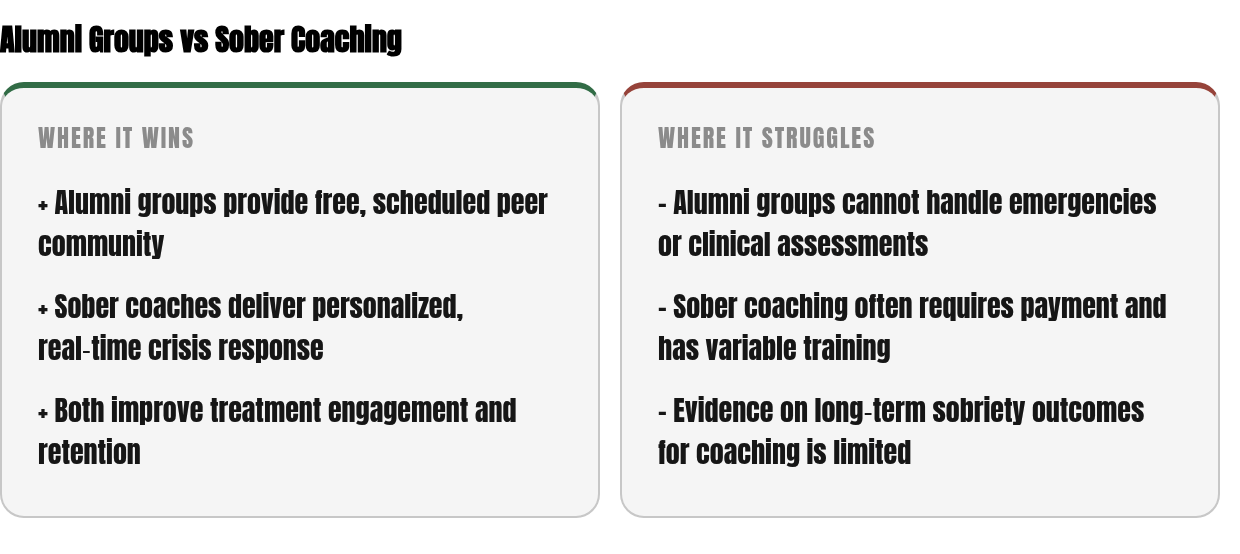
The space between residential care and daily life creates risk not because treatment didn't work, but because recovery shifts from a controlled setting into real life with competing demands. Work schedules, transportation, childcare, and insurance limits often block the outpatient care clinicians recommend. When clinical follow-through breaks down, families have to decide between peer support, one-on-one accountability, or some combination.
What Peer Connection and Individual Coaching Each Do
Alumni groups offer scheduled peer community—regular gatherings, check-ins, and resource help when formal treatment is hard to access. A sober coach after rehab gives you individualized accountability through one-on-one sessions that respond to what's happening now. The difference is design, not quality.
Research on peer recovery support shows the clearest evidence for treatment engagement and retention. Evidence on substance-use outcomes is less settled. Peer groups create belonging and mutual recognition. Coaching creates a plan for handling situations that don't fit a group discussion.
| Support Model | Primary Function | Best For |
|---|---|---|
| Alumni Groups | Scheduled peer community, shared experience, belonging | Isolation, loss of treatment structure |
| Sober Coach | Individualized accountability, crisis response, real-time support | Environmental triggers, schedule gaps, relapse risk |
We see alumni engagement fill gaps when outpatient care is unavailable because of practical barriers. Peer support doesn't replace clinical care—it helps maintain connection while someone figures out the next step. Taylor Rocheleau describes this stage plainly: "Recovery is at infancy; it needs to be sheltered and protected."
One-on-one coaching addresses a different vulnerability—returning to the same apartment, job stress, or social circle that normalized substance use. A group offers reliable community. Coaching focuses on the particular decision in front of one person.
Families often see this as either-or. The chronic nature of recovery suggests otherwise. The better question is which gaps exist now and whether community, individualized planning, or both will address them.
Alumni Groups: Peer Connection and Community Support
We organize online meetings where alumni at all stages of recovery share stories and support each other. Sessions rotate between open discussions and themed speakers, with space for alumni-led conversation about recovery topics. Members can join from anywhere via video call, which helps when distance or work makes in-person participation difficult.
Alumni check in about the challenges in front of them—work stress, family tension, or moments when old habits felt close. These exchanges make recovery visible as an ongoing process rather than a private test of willpower.
Beyond scheduled meetings, members stay connected between sessions. One staff member at a residential facility described a resident who refused clinical engagement until peers "just got me up, so I did"—peer motivation can operate differently from professional instruction.
When Alumni Groups Can't Respond to Crisis
Weekly meetings and peer connection work for routine recovery maintenance, but their limits become clearer when circumstances require immediate action. An alumni network generally can't provide clinical assessment, arrange emergency transportation, or supervise someone whose safety has deteriorated.
Members may offer emotional support during a family emergency or facility transfer, but they typically can't manage insurance requirements or coordinate professional services. The model also depends on participants having enough stability to attend, respond, and use the advice they receive.
Programs that recognize these boundaries direct members facing relapse or urgent safety concerns toward professional triage. That handoff isn't a failure of peer support. It marks the point where shared experience must give way to clinical or emergency coordination.
Sober Coaching After Rehab: Personalized Crisis Response and Daily Structure
A sober coach works one-on-one with people who need targeted help managing high-risk situations or rebuilding daily structure outside a residential setting, whether or not they're also connected to a group program. A systematic review of 28 studies involving 12,601 participants found stronger evidence for treatment engagement and retention than for substance-use outcomes. Questions about lasting substance-use effects remain.
Recovery Coaching as Personalized Accountability
A sober coach after rehab works with you to map immediate risks and goals: identifying triggers tied to specific people, places, or routines, then building alternative responses before those moments arrive. An integrative review of nine quantitative studies found that peer recovery coaches primarily served as liaisons between treatment and community resources, assisted with stress management and coping skills, provided counseling and case management, and delivered recovery and relapse prevention education. This individualized planning is the main contrast with a group's shared discussion format.
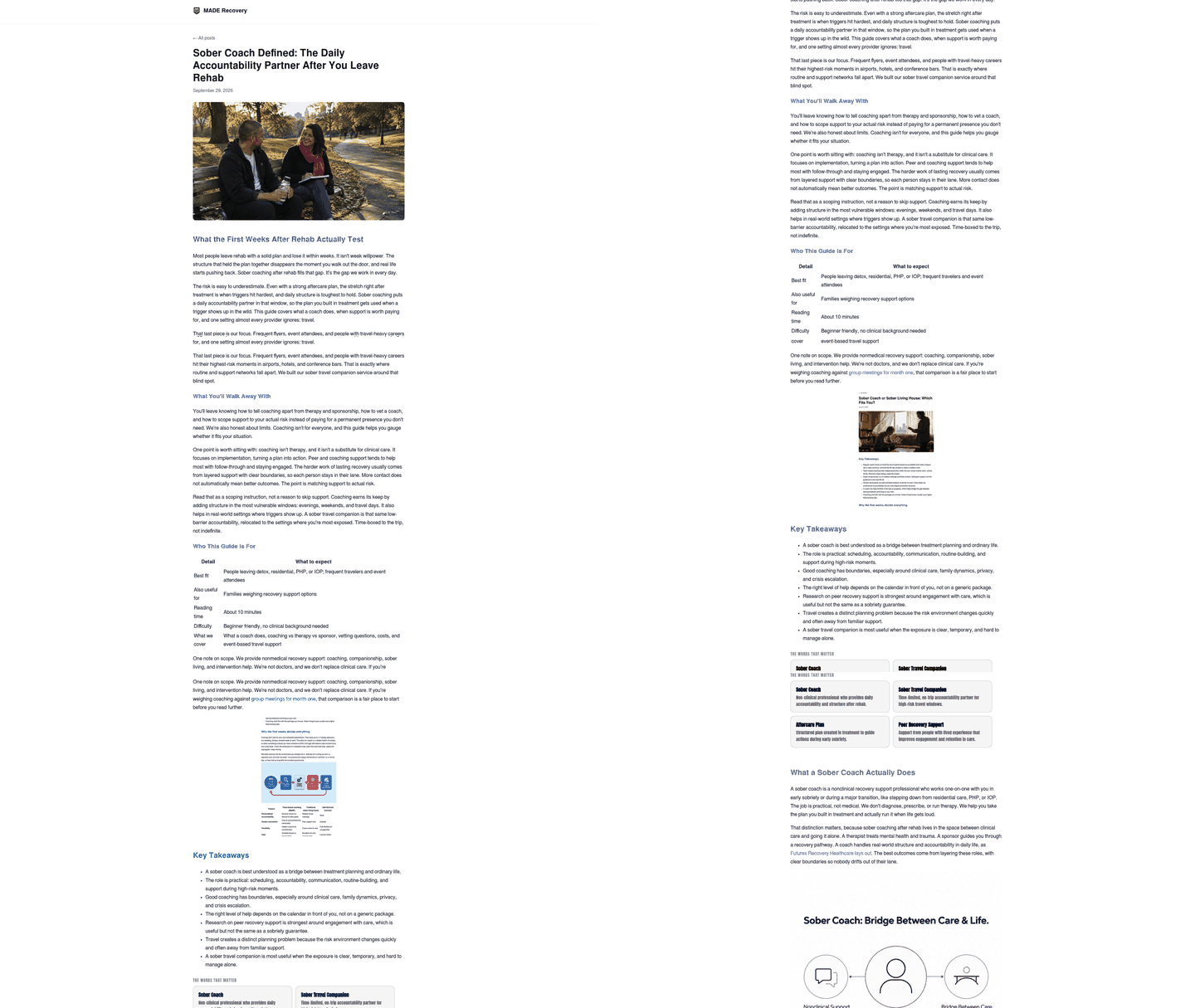
At MADE, check-ins happen by phone, video, or in person depending on your needs. You set the agenda: how to decline an invitation to an old drinking spot, how to tell a family member you're in recovery, or how to manage stress at work without reaching for substances. Your coach helps you rehearse these conversations and solve barriers as they arise. As you find your footing, support tapers intentionally to encourage independence.
When One-on-One Support Closes the Gap
Recovery coaching can preserve continuity when work, transportation, childcare, or insurance constraints make regular therapy difficult. A coach may help a client organize the day, prepare for a difficult interaction, or follow through on a referral rather than allowing a missed appointment to become complete disengagement. Research on recovery management models reports that many people entering addiction treatment in the U.S. already have prior treatment episodes. That history makes continuity between formal episodes especially important.
This arrangement also exposes a systemic concern: peer support can become a substitute for inaccessible clinical care rather than a complement to it. If you have access to both a licensed therapist and a recovery coach, the coach can reinforce clinical work. Without that access, coaching may become the primary accountability structure—useful, but not equivalent to the full recovery-management model.
| Support Type | Alumni Groups | Recovery Coaching |
|---|---|---|
| Format | Scheduled group meetings | Flexible one-to-one check-ins |
| Focus | Peer connection, shared stories, community | Individualized planning, crisis response, accountability |
| Best For | Long-term maintenance, reducing isolation | Managing high-risk situations, rebuilding structure |
| Evidence Base | Strong for engagement and retention | Moderate for engagement and retention; preliminary for substance use outcomes |
| Access Barriers | Requires consistent attendance at set times | Flexible scheduling, can meet where you are |
The professionalization of peer support creates a paradox: training and clinical deployment may improve standardization and reimbursement potential, but they can also reproduce the institutional dependence that peer models sought to counter. Historical analysis of nonclinical recovery support explains that peer-based services emerged partly in response to the over-professionalization and commercialization of addiction treatment. Hybrid models need enough structure for safety without losing the credibility of lived experience.
Side-by-Side: Alumni Groups, Sober Coaching, and MADE Recovery
Recovery First's alumni program is free, open to anyone who finished its inpatient or outpatient track, and meets Thursdays at 7 p.m. ET over Zoom. Alumni who speak to current patients need six months sober first, as its alumni page lays out. The arrangement minimizes financial barriers and asks participants mainly to show up consistently.
A sober coach after rehab inverts that model: one person, scheduled contact, and a paid service. Both can be useful, but they fail in different places.
| Criterion | Alumni group | Independent coach | Our team-based coaching |
|---|---|---|---|
| Crisis response | Relapse email or hotline | One person's availability | Coordinated team or single coach depending on care level |
| Accountability | Weekly meeting | Scheduled one-to-one | Ongoing check-ins with flexible support |
| Cost | Free | Paid, varies widely | Paid, ask for terms in writing |
| Flexibility | Mostly virtual | Phone or video | Virtual and in person |
| Training | Peer-led, lived experience | Undefined standard | Peer-style support plus companion services |
Peer Support Proves Engagement, Not Sobriety
Research on peer recovery support shows stronger evidence for engagement and treatment retention than for substance-use outcomes alone. Recovery involves several simultaneous influences, so it's difficult to attribute sobriety to one support service. Engagement is a defensible benefit. A provider shouldn't promise that coaching alone prevents relapse.
That distinction helps with selection. Alumni groups offer low-cost belonging and a shared identity. Independent coaches offer concentrated attention. Our blended model at MADE Recovery pairs peer-style check-ins with crisis planning and sober companionship, recognizing that someone's hardest moment may occur outside a meeting schedule.
Coach roles still lack a standard definition, research on coach interventions notes. Ask any provider—us included—who will answer urgent calls, what training that person holds, and where coaching ends and clinical or emergency care begins.
Combining Peer Groups with Coaching
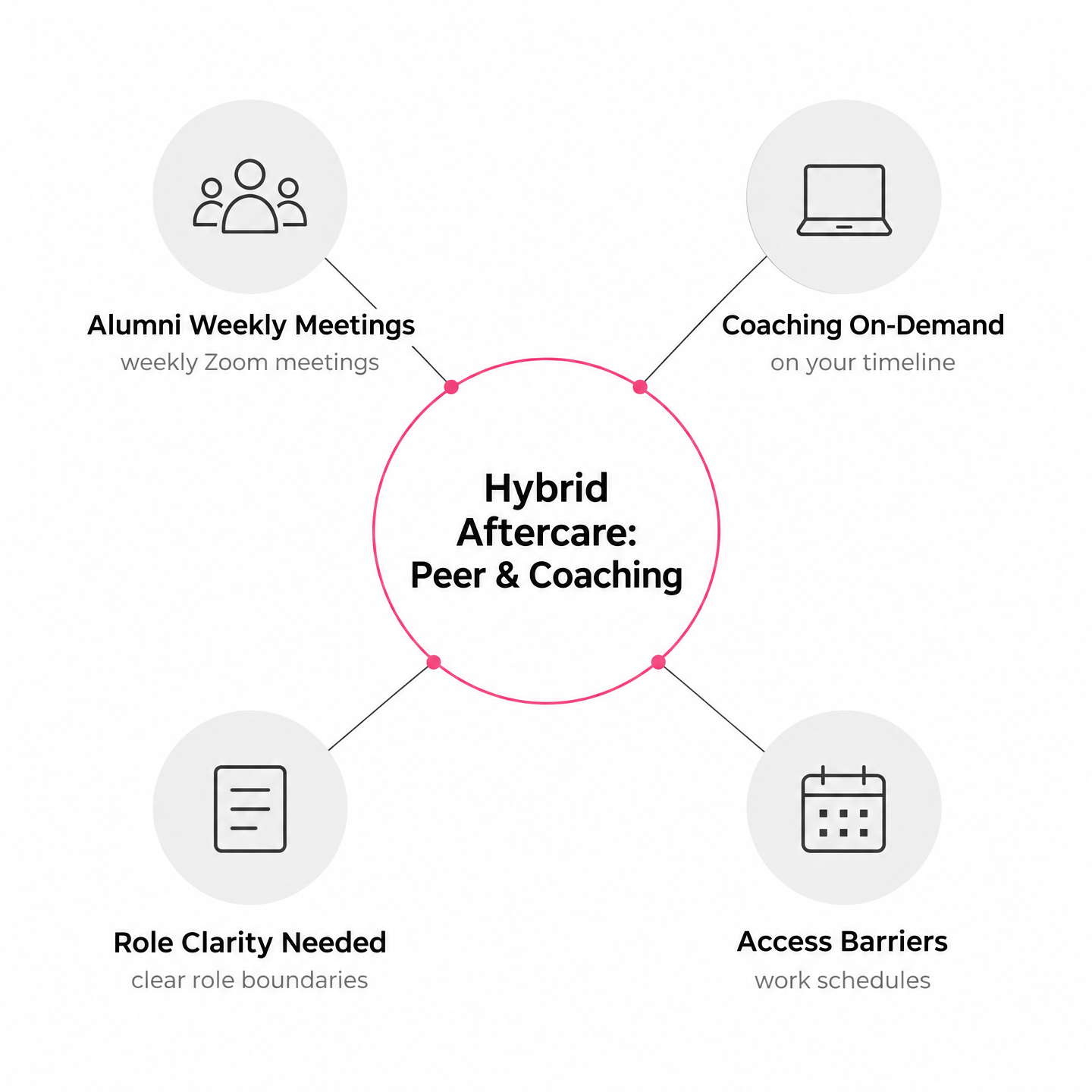
The combination of alumni meetings and one-on-one coaching addresses two distinct needs: community belonging through shared experience and personalized accountability during high-risk situations.
Programs that formally pair these models remain rare, but the logic is straightforward. Alumni groups run on predictable rhythms. A coach operates on the client's timeline, helping when isolation, conflict, or an unexpected decision disrupts the plan.
Coordinating Two Support Layers Without Duplication
The practical question families face is how to manage two support schedules without creating confusion or dependence on either.
Set clear role boundaries up front. A coach handles immediate problem-solving—managing a job interview while disclosing recovery history, scripting a conversation with an enabling family member, or building a daily routine when structure collapses. The alumni group provides validation that these problems are common and that other people have worked through them.
Communication protocols matter. Some families ask the coach and alumni coordinator to sync monthly, sharing themes without violating confidentiality. Others keep the supports separate, treating the group as peer community and the coach as individualized accountability. Recovery First requires six months of sobriety before alumni can speak to current patients, establishing one example of a defined progression into peer leadership.
Goal-tracking should flow through one system. If a coach is building a relapse-prevention plan, reference it during alumni check-ins rather than starting from scratch. If the group introduces a recovery milestone tracker, share relevant progress with the coach so adjustments reflect real-world feedback.
What Hybrid Models Reveal About Access Gaps
The evidence suggests that peer support is sometimes used in place of outpatient care that people can't reach. Taylor Rocheleau notes that work schedules, transportation, childcare responsibilities, and insurance limits can block recommended step-down services. Families may then choose between an unpaid peer group and paid coaching without receiving the full continuum clinicians intended.
Studies often examine retention and engagement rather than the effect of pairing alumni groups with nonclinical coaching. Families should therefore evaluate a hybrid plan by its defined responsibilities, access to clinical care, and ability to respond when needs exceed peer or coaching expertise.
Hybrid models work best when the supports complement rather than compete. Meeting schedules, transportation, and childcare should be discussed early, and the transition into peer-led community should be planned instead of left to chance. The goal is a path toward sustainable community connection, not permanent reliance on professional support.
What Makes Sense for Your Situation
When someone leaves residential treatment, the question isn't whether they need support—it's which kind fits the moment they're in. Alumni groups offer scheduled peer connection at no cost, while a sober coach after rehab delivers individualized accountability, often for a fee. The choice depends on urgency, available structure, and the person's ability to use support between contacts.
Questions That Shape the Decision
Start with urgency. If cravings are severe, housing is unstable, or suicidal thoughts are present, peer-only support may not be enough. Weekly meetings assume someone can remain safe between sessions. A coach may offer more responsive accountability, but urgent safety concerns still require appropriate professional or emergency services.
Next, consider whether daily routines collapsed. Alumni groups suit people who have enough stability to attend and participate while seeking connection. Coaching makes more sense when someone is relearning how to fill the day, manage social events, or navigate household responsibilities without substances. Research shows coaching improves treatment retention and engagement, but providers should describe its limits honestly.
Ask about treatment history. Someone completing a first program may benefit from meeting peers with similar milestones. Someone returning after repeated admissions may need a more structured plan for identifying what failed previously and what will change this time.
Format matters too. Virtual alumni meetings can remove travel barriers but require reliable internet and comfort with video calls. In-person coaching or companionship may be more suitable when someone needs support during a specific event or vulnerable stretch at home.
If you're unsure where to start, call us at 661-369-6255 to talk through what makes sense for your situation. We'll help you map the right mix of community and one-on-one support without overpromising what any single option can guarantee.
References
[1] Addiction Recovery: The Role of Peer and Alumni Support - https://behavioralhealthnews.org/addiction-recovery-the-role-of-peer-and-alumni-support/
[2] Peer Recovery Support Services and Recovery Coaching for Substance ... - https://pmc.ncbi.nlm.nih.gov/articles/PMC12811009/
[3] Recovery First Rehab Alumni Program (CARE) - https://recoveryfirst.org/alumni/
[4] (PDF) Peer Recovery Support Services and Recovery Coaching ... - https://www.researchgate.net/publication/390092484_Peer_Recovery_Support_Services_and_Recovery_Coaching_for_Substance_Use_Disorder_A_Systematic_Review
[5] Roles and Effects of Peer Recovery Coach Intervention in the ... - PubMed - https://pubmed.ncbi.nlm.nih.gov/36243312/
[6] Peer Recovery Support for Individuals With Substance Use Disorders - https://www.researchgate.net/publication/262421034_Peer_Recovery_Support_for_Individuals_With_Substance_Use_Disorders_Assessing_the_Evidence
[7] (PDF) Nonclinical Addiction Recovery Support Services - ResearchGate - https://www.researchgate.net/publication/232997964_Nonclinical_Addiction_Recovery_Support_Services_History_Rationale_Models_Potentials_and_Pitfalls
[8] What If We Really Believed That Addiction Was a Chronic Disorder? - https://www.researchgate.net/publication/227126486_Recovery_Management_What_If_We_Really_Believed_That_Addiction_Was_a_Chronic_Disorder
Questions People Ask
1. Can I participate in an alumni group if I completed treatment at a different facility?
Most alumni programs restrict membership to graduates of their own residential or outpatient track, as Recovery First does with its CARE program. If you completed treatment elsewhere, look for open recovery meetings in your area or ask a provider about peer-style check-ins that do not require prior program affiliation.
2. How do I know if weekly alumni meetings are enough, or if I need daily coaching check-ins?
Consider how well you function between meetings. If you can use a stable routine and reach out when needed, a group may provide the connection you are looking for. If triggers are tied to particular people, places, or responsibilities and require frequent planning, individualized coaching may be a better fit.
3. What happens during a coaching session that's different from what I'd hear in an alumni group meeting?
Coaching sessions focus on your immediate situation—rehearsing how to decline an invitation to a drinking spot, scripting a conversation about your recovery, or mapping alternatives before a high-risk event arrives. Alumni meetings center on shared stories and validation. They can reduce isolation, but they are not built around one person's individualized plan.